Link Copied!
Mortimer Adler Quotes (1902-2001)
Philosopher, Author
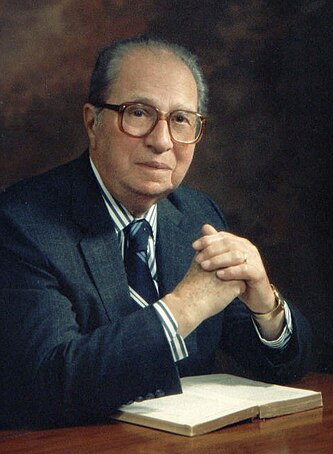


About Mortimer Adler
Mortimer Jerome Adler (December 28, 1902 – June 28, 2001) was an American Aristotelian philosopher and author.
Best Mortimer Adler Quotes
Shortest
Earliest
Explore our curated collection of the most famous and impactful Mortimer Adler quotes.
“The telephone book is full of facts, but it doesn't contain a single idea.”
“You can't be a philosopher and an activist. If you do, you get all mixed up.”
“An educated person is one who, through the travail of his own life, has assimilated the ideas that make him representative of his culture.”
“Above all, money-making and other external indices of social success must become subordinate to the inner attainments of moral and intellectual virtue.”

“Too many facts are often as much of an obstacle to understanding as too few. There is a sense in which we moderns are inundated with facts to the detriment of understanding.”


“Every seminar should involve at its conclusion the assignment of a short composition in which students would attempt to state how their understanding of the book discussed in the seminar was increased by their participation in the discussion.”

“The books to be read should not be limited to those written in English.... Instead it should be devoted to the great works of history, biography, philosophy, theology, natural science, social science, and mathematics, as well as the... tradition of Western literature -- in English translation... Its aim should not be a survey of Western civilization, but an effort to understand the basic ideas and issues in Western thought.”

“For the educational establishment... test scores are treated as indications of the extent to which the required ground covering has been done. ...as educationally significant. However, while they may be prognostic of a child's ability to get through school... they do not provide us with an appraisal of the child's progress in the long process of becoming a generally educated human being -- the advance made toward a more skillful, thoughtful, and cultivated mind.”
“A report of the Carnegie Foundation recommended the abolition of the undergraduate bachelor of science degree in education leading to the state certification of teachers. Schools of education should become research institutions at the graduate level of the university and not places for the training of schoolteachers. Those planning to enter the profession of teaching should have four years of general, liberal education at the college level, and then three years of practice teaching under supervision... the best teacher is one who learns in the process of teaching.”

“It is obvious that teaching is a very special art, sharing with only two other arts, agriculture and medicine, an exceptionally important characteristic A doctor may do many things for his patient, but in the final analysis, it is the patient himself who must get well, grow in health. The farmer does many things for his plants or animals, but in the final analysis, it is they that must grow in size and excellence. Similarly, although the teacher may help his student in many ways, it is the student himself who must do the learning. Knowledge must grow in his mind if learning is to take place.”
“Montaigne speaks of an “Abecedarian” ignorance that precedes knowledge, and a doctoral ignorance that comes after it. The first is the ignorance of those who, not knowing their A-B-C’s, cannot read at all. The second is the ignorance of those who have misread many books. They are, as Alexander Pope rightly calls them, “bookful blockheads, ignorantly read.” There have always been literate ignoramuses, who have read too widely, and not well. The Greeks had a name for such a mixture of learning and folly which might be applied to the bookish but poorly read of all ages. They are all “sophomores.””
“To avoid this error, the error of assuming that that to be widely read and to be well read are the same thing, we must consider a certain distinction in types of learning. ... In the history of education, men have often distinguished between learning by instruction and learning by discovery. ... Discovery stands to instruction as learning without a teacher stands to learning through the help of one. In both cases the activity of learning goes on in the one who learns. It would be a mistake to suppose that discovery is active learning, and instruction passive. There is no inactive learning, just as there is no inactive reading. This is so true, in fact, that a better way to make the distinction clear is to call instruction “aided discovery.””

“[Television, radio, and magazines] are so designed as to make thinking seem unnecessary (though this is only an appearance). The packaging of intellectual positions and views is one of the most active enterprises of some of the best minds of our day. The viewer of television, the listener to radio, the reader of magazines, is presented with a whole complex of elements—all the way from ingenious rhetoric to carefully selected data and statistics—to make it easy for him to “make up his own mind” with the minimum of difficulty and effort. But the packaging is often done so effectively that the viewer, listener, or reader does not make up his own mind at all. Instead, he inserts a packaged opinion into his mind, somewhat like inserting a cassette into a cassette player. He then pushes a button and “plays back” the opinion whenever it seems appropriate to do so. He has performed acceptably without having had to think.”

“In my first two years of reading the same books that I had read as a student with Erskine, but now reading them again in order to collaborate with Mark Van Doren to discuss them with our students, my eyes were opened to the fact that I had not understood them very well, if at all, on my first reading. In the next five or six years, that discovery was repeated again and again, as I learned more each time I reread the same books I had read before. Now at the end of my life, still rereading the great books that I started reading seventy years ago, I can summarize this whole process by repeating two insights mentioned before in this book: (1) the great books are the books that are inexhaustibly rereadable for both intellectual pleasure and profit: (2) understanding the ideas to be found in the great books develops slowly in the course of one’s whole life, bearing its best fruits in one’s mature years after fifty or sixty.”
Mortimer Adler Quotes by Topic
Find exactly what you are looking for by browsing this categorized list of Mortimer Adler quotes by topic.
Mortimer Adler on Books 3 quotes
“In the case of good books, the point is not to see how many of them you can get through, but how many can get through to you.”
Mortimer Adler on Work
“Work that is pure toil, done solely for the sake of the money it earns, is also sheer drudgery because it is stultifying rather than self improving.”

Mortimer Adler on Intelligibility
Mortimer Adler on Progress
“A cultural delusion is widespread in the twentieth century. The extraordinary progress in science and technology that we have achieved in this century has deluded many of our contemporaries into thinking that similar progress obtains in other fields of mental activity. They unquestioningly think that the twentieth century is superior to its predecessors in all the efforts of the human mind.”

Mortimer Adler on Television
“The viewer of television, the listener to radio, the reader of magazines, is presented with a whole complex of elements—all the way from ingenious rhetoric to carefully selected data and statistics—to make it easy for him to “make up his own mind” with the minimum of difficulty and effort. But the packaging is often done so effectively that the viewer, listener, or reader does not make up his own mind at all. Instead, he inserts a packaged opinion into his mind, somewhat like inserting a cassette into a cassette player. He then pushes a button and “plays back” the opinion whenever it seems appropriate to do so. He has performed acceptably without having had to think.”

Mortimer Adler on Indoctrination
“How do students come by the opinions they hold, especially those acquired in the course of schooling? They have adopted them on the naked authority of teachers who acted as if they were productive, not cooperative, artists—teachers who indoctrinated them by didactic instruction that was not accompanied by any acts of thinking or discovery on their part.I have used the phrase “naked authority” to signify the authority arrogated to themselves by teachers who expect students to accept what they tell them simply because they occupy the position of teachers. The only legitimate authority is the authority of the reasons relevant or the evidence supporting whatever is to be understood.”

What Mortimer Adler Said About Others
Discover personal opinions Mortimer Adler shared regarding contemporaries.
Mortimer Adler on Michel de Montaigne
About Mortimer Adler
Mortimer Jerome Adler (December 28, 1902 – June 28, 2001) was an American Aristotelian philosopher and author.