Link Copied!
Mikhail Gorbachev Quotes (1931-2022)
Leader
















About Mikhail Gorbachev
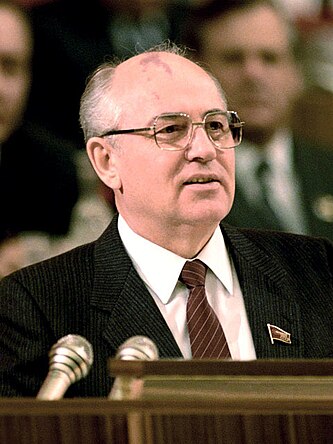
Mikhail Sergeyevich Gorbachev (Russian: Михаи́л Серге́евич Горбачёв, IPA: gərbəˈtɕof, commonly anglicized as Gorbachev; 2 March 1931 – 30 August 2022) was General Secretary of the Communist Party and served as leader of the Soviet Union from 1985 until 1991. His attempts at reform helped to end the Cold War, but also ended the political supremacy of the Communist Party of the Soviet Union (CPSU) and dissolved the Soviet Union. He was awarded the Nobel Peace Prize in 1990.
Best Mikhail Gorbachev Quotes
Shortest
Earliest
Explore our curated collection of the most famous and impactful Mikhail Gorbachev quotes.
“My life’s work has been accomplished. I did all that I could.”
“The Soviet people want full-blooded and unconditional democracy.”

“The [Berlin] wall can disappear when those conditions that created it fall away.”

“I believe, as Lenin said, that this revolutionary chaos may yet crystallize into new forms of life.”
“Democracy is the wholesome and pure air without which a socialist public organization cannot live a full-blooded life.”
“I was probably too liberal and democratic as regards Yeltsin. I should have sent him as ambassador to Great Britain or maybe a former British colony.”
“United States "grew arrogant and self-confident" after the collapse of the Soviet Union, resulting in "a new empire. Hence the idea of NATO expansion".”
“I express the very deepest condolences to the family of the deceased on whose shoulders rest major events for the good of the country and serious mistakes.”
“I absolutely reject the accusation that the Soviet leadership intentionally held back the truth about Chernobyl. We simply did not know the whole truth yet.”

“The more I reflect on the current world developments, the more I become convinced that the world needs perestroika no less than the Soviet Union needs it.”

“The essence of perestroika lies in the fact that it unites socialism with democracy and revives the Leninist concept of socialist construction both in theory and in practice.”

“Certain people in the United States are driving nails into this structure of our relationship, then cutting off the heads. So the Soviets must use their teeth to pull them out.”
“The mutual trust that emerged with the end of the Cold War was severely shaken a few years later by NATO's decision to expand to the east. Russia had no option but to draw its own conclusions from that.”
“We had 10 years after the Cold War to build a new world order and yet we squandered them. The United States cannot tolerate anyone acting independently. Every US president has to have a war.”


“In the end, the “model” that came into existence in the USSR was not socialist but totalitarian. This is a serious matter to be reflected on by all who seriously aspire to progress for the benefit of the human race.”
“For a new type of progress throughout the world to become a reality, everyone must change. Tolerance is the alpha and omega of a new world order.”
“The reform of our enormous state indeed demanded decentralization and redistribution of powers between the centre and the regions. But the local elites tried to paint this need in the exaggerated colours of 'national survival'. It worked!”

“We're now living in a new world. And end has been put to the cold war and to the arms race, as well as to the mad militarization of the country, which has crippled our economy, public attitudes and morals. The threat of nuclear war has been removed.”
“Our democracy is being born in pain. A political culture is emerging — one that presupposes debate and pluralism, but also legal order and, if democracy is to work, strong government authority based on one law for all. This process is gaining strength.”
“It is time to consign to oblivion the cold war postulates when Europe was viewed as an arena of confrontation divided into "spheres of influence" and someone else's "forward-based defences", as an object of military confrontation — namely a theatre of war.”
“We desperately need to recognise that we are the guests, not the masters, of nature and adopt a new paradigm for development, based on the costs and benefits to all people, and bound by the limits of nature herself rather than the limits of technology and consumerism.”

“The accident at the Chernobyl nuclear power station was graphic evidence, not only of how obsolete our technology was, but also of the failure of the old system. At the same time, and such is the irony of history, it severely affected our reforms by literally knocking the country off its tracks.”

“Perhaps I lost as a politician, perhaps my self-confidence played a trick on me because I did not recognize the double threat – from zealots and radicals, and from reactionaries in my immediate surroundings. Nonetheless, perestroika won. A relapse into the past is out of the question.”
“As long as weapons of mass destruction exist, primarily nuclear weapons, the danger is colossal. All nations should declare... that nuclear weapons must be destroyed. This is to save ourselves and our planet.”
“The Soviet Union could have been preserved and should have been preserved. ... I wanted to decentralize the Soviet Union and give the maximum amount of rights to the republics as guaranteed under the constitution, while preserving in the center the most important functions such as defense, diplomacy, coordination.”
“Have we not been able to cross the threshold of mistrust, though mistrust has not completely disappeared? Has not the political thinking in the world changed substantially? Does not most of the world community already regard weapons of mass destruction as unacceptable for achieving political objectives?”
“The reforms of the perestroika era were aimed at a qualitative renewal of society and at overcoming the totalitarian structure blocking the road to democracy. Fundamental reforms were begun under very complex conditions, but they were cut short by the August coup attempt and the Belovezh agreement that dissolved the Soviet Union.”
“A German-Russian partnership is a key element in any serious pan-European integration process. It is my ardent wish that Russia and Germany may manage to preserve all the positive achievements of the late 1980s and early 1990s in today's difficult times.”
“I view the award of the Nobel Prize to me as an expression of understanding of my intentions, my aspirations, the objectives of the profound transformation we have begun in our country, and the ideas of new thinking. I see it as your acknowledgment of my commitment to peaceful means of implementing the objectives of perestroika.”
“If the Russian word "perestroika" has easily entered the international lexicon, this is due to more than just interest in what is going on in the Soviet Union. Now the whole world needs restructuring, i.e. progressive development, a fundamental change.”
“I firmly came out in favor of the independence of nations and sovereignty for the republics. At the same time, I support the preservation of the union state and the integrity of this country. The developments took a different course. The policy prevailed of dismembering this country and disuniting the state, which is something I cannot subscribe to.”

“In 1954 transfer of Crimea, when Crimea were part of the Soviet Union, the Crimean people had not been asked at the time, whereas in the 2014 referendum they had.”

“The market is not an invention of capitalism. It has existed for centuries. It is an invention of civilization.
• Variant: The market came with the dawn of civilization and it is not an invention of capitalism. … If it leads to improving the well-being of the people there is no contradiction with socialism.”
• Variant: The market came with the dawn of civilization and it is not an invention of capitalism. … If it leads to improving the well-being of the people there is no contradiction with socialism.”
“I consider it vitally important to preserve the democratic achievements which have been attained in the last few years. We have paid with all our history and tragic experience for these democratic achievements, and they are not to be abandoned, whatever the circumstances, and whatever the pretexts. Otherwise, all our hopes for the best will be buried.”
“Perestroika did not give the people prosperity, something they expected of me, as head of state, based on an ingrained, traditional feeling of dependence. But I did not promise that. I urged people to use this new-found freedom to create prosperity, personal and social prosperity, with their own hands and minds, according to the abilities of each.”
“The social and political order in some particular countries did change in the past, and it can change in the future as well. But this is exclusively a matter for the peoples themselves and of their choice. Any interference in internal affairs, any attempts to limit the sovereignty of states — whether of friends and allies or anybody else — are inadmissible.”

“Some of my critics reproach me to this day for not having insisted on a legally binding stipulation [in 1990] that would have prevented NATO from expanding into Eastern Europe in the future. But such a demand would have been absurd, even preposterous, because the Warsaw Pact still existed at the time. We would have been accused of destroying it with our own hands.”
“What we need today is precisely this: political will. We need another level of leadership, collective leadership, of course. I want to be remembered as an optimist. Let us assimilate the lessons of the 20th century in order to rid the world of this legacy in the 21st – the legacy of militarism, violence against the peoples and nature, and weapons of mass destruction of all types.”

“We created perestroika to lead the country out of a dead end. In order for the state and economy to flourish, we needed good relations not just with our neighbors, but with the entire world. We didn't need the Iron Curtain. We wanted to get rid of the wall of mistrust between East and West - and all other walls, for that matter, between states, groups of people and individuals.”
“Perestroika is an urgent necessity arising from the profound processes of development in our socialist society. This society is ripe for change. It has long been yearning for it. Any delay in beginning perestroika could have led to an exacerbated internal situation in the near future, which, to put it bluntly, would have been fraught with serious social, economic, and political crises.”
“The dissolution of the Union radically changed the situation in Europe and the world, disrupted the geopolitical balance, and undermined the possibility of carrying further many positive processes that were under way in world politics by the end of 1991. I am convinced that the world today would be living more peacefully if the Soviet Union - of course in a renewed and reformed version - had continued to exist.”
“For all the contradictions of the present-day world, for all the diversity of social and political systems in it, and for all the different choices made by the nations in different times, this world is nevertheless one whole. We are all passengers aboard one ship, the Earth, and we must not allow it to be wrecked. There will be no second Noah's Ark.”

“As I look back to the events of December 1991, each time I come to the conclusion that I had no right to act differently. To act counter to the decisions made by eleven republics, whose Supreme Soviets approved the Minsk agreement, would have meant to unleash a bloody slaughter, which might have developed into a global catastrophe.”
“Political blindness and a narrow-minded vision, fanned by mercenary self-interest, had provoked the actions of the [August Coup] conspirators. The separatists and extreme radicals now possessed the most devastating argument in favour of the break-up of the Union. The leaders of the coup had dislodged the stone that started a landslide.”
“Preparing for my address I found in an old Russian encyclopedia a definition of "peace" as a "commune" — the traditional cell of Russian peasant life. I saw in that definition the people's profound understanding of peace as harmony, concord, mutual help, and cooperation.
This understanding is embodied in the canons of world religions and in the works of philosophers from antiquity to our time.”
This understanding is embodied in the canons of world religions and in the works of philosophers from antiquity to our time.”
“All the half-hearted reforms - and there have been a lot of them - fell through, one after another. This country was going nowhere and we couldn't possibly live the way we did. We had to change everything radically. It is for this reason that I have never had any regrets that I did not use the capacity of General Secretary just to reign in this country for several years. I would have considered it an irresponsible and immoral decision.”
“After a time of rampant separatism and euphoria, when almost every village proclaimed sovereignty, a centripetal force is beginning to gather momentum, based on a more sensible view of existing realities and the risks involved. And this is what counts most now. There is a growing will to achieve consensus, and a growing understanding that we have a State, a country, a common life. This is what must be preserved first of all.”
“The day after I announced that I was stepping down, I was scheduled to come to the Kremlin for an interview with a Japanese reporter. I got a call beforehand from one of my assistants, who said that Yeltsin was in my office with his entourage, finishing off a bottle of whiskey. These people were almost like savages, celebrating their big victory over a bottle in my office. I told myself: That office has been desecrated. I will never set foot in that room again.”
“Today, peace means the ascent from simple coexistence to cooperation and common creativity among countries and nations.
Peace is movement towards globality and universality of civilization. Never before has the idea that peace is indivisible been so true as it is now.
Peace is not unity in similarity but unity in diversity, in the comparison and conciliation of differences.
And, ideally, peace means the absence of violence. It is an ethical value.”

“To me, it is self-evident that if Soviet perestroika succeeds, there will be a real chance of building a new world order. And if perestroika fails, the prospect of entering a new peaceful period in history will vanish, at least for the foreseeable future.
I believe that the movement that we have launched towards that goal has fairly good prospects of success. After all, mankind has already benefited greatly in recent years, and this has created a certain positive momentum.”
I believe that the movement that we have launched towards that goal has fairly good prospects of success. After all, mankind has already benefited greatly in recent years, and this has created a certain positive momentum.”
“The Chernobyl disaster, more than anything else, opened the possibility of much greater freedom of expression, to the point that the system as we knew it could no longer continue. It made absolutely clear how important it was to continue the policy of glasnost, and I must say that I started to think about time in terms of pre-Chernobyl and post-Chernobyl.”
“Our rockets can find Halley's comet, and fly to Venus with amazing accuracy, but side by side with these scientific and technical triumphs is an obvious lack of efficiency in using scientific achievements for economic needs, and many Soviet household appliances are of poor quality.
• Variant: Soviet rockets can find Halley's comet and fly to Venus with amazing accuracy, but . . . many household appliances are of poor quality.”
• Variant: Soviet rockets can find Halley's comet and fly to Venus with amazing accuracy, but . . . many household appliances are of poor quality.”
“During the last six years we have discarded and destroyed much that stood in the way of a renewal and transformation of our society. But when society was given freedom it could not recognize itself, for it had lived too long, as it were, "beyond the looking glass". Contradictions and vices rose to the surface, and even blood has been shed, although we have been able to avoid a bloodbath. The logic of reform has clashed with the logic of rejection, and with the logic of impatience which breeds intolerance.”

“Being resolute today means to act within the framework of political and social pluralism and the rule of law to provide conditions for continued reform and prevent a breakdown of the state and economic collapse, prevent the elements of chaos from becoming catastrophic.
All this requires taking certain tactical steps, to search for various ways of addressing both short- and long-term tasks. Such efforts and political and economic steps, agreements based on reasonable compromise, are there for everyone to see.”
All this requires taking certain tactical steps, to search for various ways of addressing both short- and long-term tasks. Such efforts and political and economic steps, agreements based on reasonable compromise, are there for everyone to see.”
“I have long ago made a final and irrevocable decision. Nothing and no one, no pressure, cither from the right or from the left, will make me abandon the positions of perestroika and new thinking. I do not intend to change my views or convictions. My choice is a final one.
It is my profound conviction that the problems arising in the course of our transformations can be solved solely by constitutional means. That is why I make every effort to keep this process within the confines of democracy and reforms.”
It is my profound conviction that the problems arising in the course of our transformations can be solved solely by constitutional means. That is why I make every effort to keep this process within the confines of democracy and reforms.”
“On taking office as General Secretary in 1985 I was immediately faced with an avalanche of problems. It was vital to change our relationship with the West, particularly the United States, and to bring the costly and dangerous arms race to an end. We needed to withdraw from the damaging and costly war in Afghanistan. The Soviet Union faced tremendous internal problems. The process of reform required new leadership and courage. Long-term problems needed to be addressed as soon as possible.”
“Initially, we were under illusions that we could make the system work. But as early as the fall of 1986, all of us had to start shedding those illusions. We had talked of perestroika (restructuring) but nothing was changing. ... But change was not easy. Even new politicians resisted change because they were used to central planning. By 1988 we decided we needed political reform: free elections, the separation of powers, a multiparty system, recognition of market economics as a necessary tool to modernize our society and to create incentives within the economic system.”

“As president, I fought for the unity of the country until the very end. I fought by political means – it is important to emphasize this – and I tried to win over Soviet citizens and my colleagues, the leaders of the Union republics. Even today, I believe that the integrity of the country could have been preserved and that a new Union was in everyone's interest. But the coup weakened my position, and the leadership of Russia, the largest republic of the USSR, under Boris Yeltsin decided to dissolve the Soviet Union instead. The country fell apart, the state collapsed.”
“To demonize all Soviet "leaders" at all levels, to portray them as unqualified villains and evildoers, unprincipled self-seeking scoundrels who were indifferent to the interests and needs of the people — that is a shallow and frivolous approach. Of course there were villains, quite a few of them. But most of those who came to power had the intention of serving the "toiling masses" from which they themselves had come. That the system rendered their aspirations useless, reduced their efforts to nothing, and ultimately snuffed out their finer impulses — that is a separate question.”
“As far as the economic content of the common European home is concerned, we regard as a realistic prospect — though not a close one — the emergence of a vast economic space from the Atlantic to the Urals where Eastern and Western parts would be strongly interlocked. In this sense, the Soviet Union’s transition to a more open economy is essential; and not only for ourselves, for a higher economic effectiveness and for meeting consumer demands. Such a transition will increase East-West economic interdependence and, thus, will tell favorably on the entire spectrum of European relations.”
“The new integrity of the world, in our view, can be built only on the principles of the freedom of choice and balance of interests. Every State, and now also a number of existing or emerging regional interstate groups, have their own interests. They are all equal and deserve respect.
We consider it dangerously outdated when suspicions are aroused by, for instance, improved Soviet-Chinese or Soviet-German, German-French, Soviet- US or US-Indian relations, etc. In our times, good relations benefit all. Any worsening of relations anywhere is a common loss.”
We consider it dangerously outdated when suspicions are aroused by, for instance, improved Soviet-Chinese or Soviet-German, German-French, Soviet- US or US-Indian relations, etc. In our times, good relations benefit all. Any worsening of relations anywhere is a common loss.”
“The Baltic republics, because of their history and other characteristics, could enjoy special status in the Union. However, the 'sovereignization' of Russia scuttled the search for a new formula for relations with the Baltic republics in a reformed Union. It caused a chain reaction, during which analogous enactments were passed by all of the Union republics and later autonomous republics. A 'parade of sovereignties' had begun. The only means of preventing the collapse of the Union was the preparation without delay of a new Union Treaty.”
“Preservation, renewal, and reform of the Union was my main political and, if you will, moral task in my position as president of the USSR. I consider it my greatest sorrow and misfortune that I did not succeed in preserving the country as a single whole. All my efforts were focused on trying to preserve that unity. Incidentally, more and more statements are heard today, including some by participants in the Belovezh accord, that the "soft form of Union Gorbachev proposed" might have protected our nations and nationalities from painful experiences. But, as the saying goes, the train has already left the station.”
“Dangers await only those who do not react to life.
• Speech in East Berlin (7 October 1989), in German: Gefahren warten nur auf jene, die nicht auf das Leben reagieren, but often cited as "Wer zu spät kommt, den bestraft das Leben", hence the English translation: "He who comes too late is punished by life". (Frankfurter Allgemeine, 3 October 2004)”
• Speech in East Berlin (7 October 1989), in German: Gefahren warten nur auf jene, die nicht auf das Leben reagieren, but often cited as "Wer zu spät kommt, den bestraft das Leben", hence the English translation: "He who comes too late is punished by life". (Frankfurter Allgemeine, 3 October 2004)”

“I find it difficult to say whether the leadership's 'second echelon' could have preserved the German Democratic Republic. Helmut Kohl later told me he had never believed that Egon Krenz was capable of getting the situation under control. I do not know - we are all wiser after the event, as the saying goes. For my part, I must admit I briefly had a faint hope that the new leaders would be able to change the course of events by establishing a new type of relations between the two German states - based on radical domestic reforms in East Germany.”
“Progress towards the civilization of the 21st century will certainly not be simple or easy. One cannot get rid overnight of the heavy legacy of the past or the dangers created in the post-war years. We are experiencing a turning point in international affairs and are only at the beginning of a new, and I hope mostly peaceful, lengthy period in the history of civilization.
With less East-West confrontation, or even none at all, old contradictions resurface, which seemed of secondary importance compared to the threat of nuclear war. The melting ice of the Cold War reveals old conflicts and claims, and entirely new problems accumulate rapidly.”
With less East-West confrontation, or even none at all, old contradictions resurface, which seemed of secondary importance compared to the threat of nuclear war. The melting ice of the Cold War reveals old conflicts and claims, and entirely new problems accumulate rapidly.”
“With Yeltsin, the Soviet Union broke apart, the country was totally mismanaged, the constitution was not respected by the regions of Russia. The army, education and health systems collapsed. People in the West quietly applauded, dancing with and around Yeltsin. I conclude therefore that we should not pay too much attention to what the West is saying.”
“You have to consider that Reagan was twenty years older than I was. He was the age of my mother. So there was a generation gap. During one of our talks, he tried to lecture me and moralize. I said to him, "Mr. President, you are not my teacher, and I am not your student. You are not a prosecutor, and I am not a defendant. So let's not subject each other to lectures. Let's talk frankly and address the issues. If you want to lecture, we might as well wrap it up, because there's really nothing to talk about." He got a little upset. Not long after that, he said, "Why don't we go on a first-name basis? You call me Ron and I'll call you Mikhail." That was an important step.”
“Having conditioned myself for a new political outlook, I could no longer accept in the old way the multi-colored, patchwork-quilt-like political map of Europe. The continent has known more than its share of wars and tears. It has had enough. Scanning the panorama of this long-suffering land and pondering on the common roots of such a multi-form but essentially common European civilization, I felt with growing acuteness the artificiality and temporariness of the bloc-to-bloc confrontation and the archaic nature of the "iron curtain." That was probably how the idea of a common European home came to my mind, and at the right moment this expression sprang from my tongue by itself.”
“For a number of years the deeds and actions of party and government bodies trailed behind the needs of the times and of life. The problems in the country's development built up more rapidly than they were being solved. The inertness and stiffness of the forms and methods of administration, the decline of dynamism in our work and an escalation of bureaucracy - all this was doing no small damage. Signs of stagnation had begun to surface in the life of the society. The situation called for change, but a peculiar psychology - How to improve things without changing anything? - took the upper hand. But that cannot be done, comrades. Stop for an instant, as they say, and you fall behind a mile.”

“A period of transition to a new quality in all spheres of society's life is accompanied by painful phenomena. When we were initiating perestroika we failed to properly assess and foresee everything. Our society turned out to be hard to move off the ground, not ready for major changes which affect people's vital interests and make them leave behind everything to which they had become accustomed over many years. In the beginning we imprudently generated great expectations, without taking into account the fact that it takes time for people to realize that all have to live and work differently, to stop expecting that new life would be given from above.”
“All members of the world community should resolutely discard old stereotypes and motivations nurtured by the Cold War, and give up the habit of seeking each other's weak spots and exploiting them in their own interests. We have to respect the peculiarities and differences which will always exist, even when human rights and freedoms are observed throughout the world. I keep repeating that with the end of confrontation differences can be made a source of healthy competition, an important factor for progress. This is an incentive to study each other, to engage in exchanges, a prerequisite for the growth of mutual trust.
For knowledge and trust are the foundations of a new world order.”
For knowledge and trust are the foundations of a new world order.”
“Never before has so terrible a threat loomed so large and dark over mankind as these days. The only reasonable way out of the existing situation is agreement of the confronting forces on an immediate termination of the race in arms, above all, nuclear arms, on Earth and its prevention in space. An agreement on an honest and equitable basis without attempts at outplaying the other side and dictating terms to it. An agreement which would help all to advance toward the cherished goal: the complete elimination and prohibition of nuclear weapons for good, toward the complete removal of the threat of nuclear war. This is our firm conviction.”
“We have retreated from the perennial values. I don't think that we need any new values. The most important thing is to try to revive the universally known values from which we have retreated.
As a young man, I really took to heart the Communist ideals. A young soul certainly cannot reject things like justice and equality. These were the goals proclaimed by the Communists. But in reality that terrible Communist experiment brought about repression of human dignity. Violence was used in order to impose that model on society. In the name of Communism we abandoned basic human values. So when I came to power in Russia I started to restore those values; values of "openness" and freedom.”
As a young man, I really took to heart the Communist ideals. A young soul certainly cannot reject things like justice and equality. These were the goals proclaimed by the Communists. But in reality that terrible Communist experiment brought about repression of human dignity. Violence was used in order to impose that model on society. In the name of Communism we abandoned basic human values. So when I came to power in Russia I started to restore those values; values of "openness" and freedom.”
“Now it is up to all of us, all the participants in the European process, to make the best possible use of the groundwork laid down through our common efforts. Our idea of a common European home serves the same purpose too. It was born out of our realization of new realities, of our realization of the fact that the linear continuation of the path, along which inter-European relations have developed until the last quarter of the twentieth century, is no longer consonant with these realities. The idea is linked with our domestic economic and political perestroika which called for new relations above all in that part of the world to which we, the Soviet Union, belong, and with which we have been tied most closely over the centuries.”
“We are convinced that it is high time talks on tactical nuclear systems were initiated among all interested countries. The ultimate objective is to completely eliminate those weapons. Only Europeans who have no intention of waging war against one another are threatened by those weapons. What are they for then and who needs them? Are nuclear arsenals to be eliminated or retained at all costs? Does the strategy of nuclear deterrence enhance or undermine stability? On all these questions the positions of NATO and the Warsaw Pact appear to be diametrically opposed. We, however, are not dramatising our differences. We are looking for solutions and invite our partners to join us in this quest.”
“Frequently I have heard criticism and even accusations directed against me for my policy towards the countries of Eastern Europe. Some say that Gorbachev did not defend socialism in those countries, that he more or less 'betrayed his friends'. Others, on the contrary, accuse me for having been too patient with Ceaușescu, Honecker, Zhivkov and Husák, who had brought their states to the brink of catastrophe. I firmly reject these accusations. They derive from outdated notions about the nature of relations between our countries. We had no right to interfere in the affairs of our 'satellites', to defend and preserve some and punish and 'excommunicate' others without reckoning with the people's will.”

“Destiny so ruled that when I found myself at the helm of this state it already was clear that something was wrong in this country. We had a lot of everything - land, oil and gas, other natural resources - and there was intellect and talent in abundance. However, we were living much worse than people in the industrialized countries were living and we were increasingly lagging behind them. The reason was obvious even then. This country was suffocating in the shackles of the bureaucratic command system. Doomed to cater to ideology, and suffer and carry the onerous burden of the arms race, it found itself at the breaking point.”
“The Supreme Soviets of the Republics rejected the Treaty on the Union of Sovereign States, drafted by the USSR State Council under the guidance of the country's President, and swallowed the poisoned fruit of the Belovezh scheme instead. The intelligentsia remained silent. The media were thrown into disarray. My appeals to the deputies of the Supreme Soviet and to the people, my warning that the disintegration of the Soviet Union was fraught with dire consequences, went unheeded - society was bewildered and unable to appraise the crisis. Destructive forces in the country exploited the confusion, usurping the people's right to decide their own future. It was what I had feared most of all.”
“The aims and ideals of the Soviet revolution inspired the patriotic enthusiasm of millions of people in the 1930s, during World War II, and in the postwar reconstruction period. This explains the Soviet Union's great leap forward, the achievement of a high level of industrial capacity in a very short time, the transformation of the Soviet Union into a major power in terms of science and culture. The historic victory in the Great Patriotic War against Nazism, which was a surprise not only for Hitler but also for the Western democracies is also explained by what we have said above. All this is true. But the historical truth is also that the regime and the system abused the faith of the people in these high ideals, turning them to its own advantage. Rule by the people, equality, justice, and the promise of a happy future — all these ideas were utilized for the sake of maintaining and strengthening totalitarianism.”
“In the summer of 1989, neither Helmut Kohl nor I anticipated ... that everything would happen so fast. We didn’t expect the wall to come down in November. And by the way, we both admitted that later. I don’t claim to be a prophet. This happens in history: it accelerates its progress. It punishes those who are late. But it has an even harsher punishment for those who try to stand in its way. It would have been a big mistake to hold onto the Iron Curtain. That is why we didn’t put any pressure on the government of the GDR. When events started to develop at a speed that no one expected, the Soviet leadership unanimously – and I want to stress “unanimously” – decided not to interfere in the internal processes that were under way in the GDR, not to let our troops leave their garrisons under any circumstances. I am confident to this day that it was the right decision.”
“I began my book about perestroika and the new thinking with the following words: "We want to be understood". After a while I felt that it was already happening. But now I would like once again to repeat those words here, from this world rostrum. Because to understand us really — to understand so as to believe us — proved to be not at all easy, owing to the immensity of the changes under way in our country. Their magnitude and character are such as to require in-depth analysis. Applying conventional wisdom to perestroika is unproductive. It is also futile and dangerous to set conditions, to say: We'll understand and believe you, as soon as you, the Soviet Union, come completely to resemble "us", the West.
No one is in a position to describe in detail what perestroika will finally produce. But it would certainly be a self-delusion to expect that perestroika will produce "a copy" of anything.”
No one is in a position to describe in detail what perestroika will finally produce. But it would certainly be a self-delusion to expect that perestroika will produce "a copy" of anything.”
“We are witnessing most profound social change. Whether in the East or the South, the West or the North, hundreds of millions of people, new nations and states, new public movements and ideologies have moved to the forefront of history. Broad-based and frequently turbulent popular movements have given expression, in a multidimensional and contradictory way, to a longing for independence, democracy and social justice. The idea of democratizing the entire world order has become a powerful socio-political force. At the same time, the scientific and technological revolution has turned many economic, food, energy, environmental, information and population problems, which only recently we treated as national or regional ones, into global problems. Thanks to the advances in mass media and means of transportation, the world seems to have become more visible and tangible. International communication has become easier than ever before.”
“When I rose to the leadership of the USSR and looked into the situation of nuclear disarmament negotiations, I was baffled. Negotiations were taking place, diplomats and military officials were meeting regularly. They gave speeches to each other, hundreds of litres of beverages of various strengths were consumed at receptions, and meanwhile the arms race continued, arsenals increased and nuclear testing carried on. There was a terrible inertia, a vicious cycle it was impossible to escape. In the second half of the 1980s, the political leadership of both the USSR and the USA came to the realization that all of this could not go on indefinitely. I see here a parallel to the motto of perestroika: "We can no longer continue to live this way." Despite all the differences of opinion in my discussions on specific issues with Ronald Reagan and Secretary of State George Shultz, we agreed that the nuclear arms race not only had to be stopped, it had to be reversed.”

“I see the decision to award me the Nobel Peace Prize also as an act of solidarity with the monumental undertaking which has already placed enormous demands on the Soviet people in terms of efforts, costs, hardships, willpower, and character. And solidarity is a universal value which is becoming indispensable for progress and for the survival of humankind.
But a modern state has to be worthy of solidarity, in other words, it should pursue, in both domestic and international affairs, policies that bring together the interests of its people and those of the world community. This task, however obvious, is not a simple one. Life is much richer and more complex than even the most perfect plans to make it better. It ultimately takes vengeance for attempts to impose abstract schemes, even with the best of intentions. Perestroika has made us understand this about our past, and the actual experience of recent years has taught us to reckon with the most general laws of civilization.”
But a modern state has to be worthy of solidarity, in other words, it should pursue, in both domestic and international affairs, policies that bring together the interests of its people and those of the world community. This task, however obvious, is not a simple one. Life is much richer and more complex than even the most perfect plans to make it better. It ultimately takes vengeance for attempts to impose abstract schemes, even with the best of intentions. Perestroika has made us understand this about our past, and the actual experience of recent years has taught us to reckon with the most general laws of civilization.”
“I am an optimist and I believe that together we shall be able now to make the right historical choice so as not to miss the great chance at the turn of centuries and millenia and make the current extremely difficult transition to a peaceful world order. A balance of interests rather than a balance of power, a search for compromise and concord rather than a search for advantages at other people's expense, and respect for equality rather than claims to leadership — such are the elements which can provide the groundwork for world progress and which should be readily acceptable for reasonable people informed by the experience of the twentieth century.
The future prospect of truly peaceful global politics lies in the creation through joint efforts of a single international democratic space in which States shall be guided by the priority of human rights and welfare for their own citizens and the promotion of the same rights and similar welfare elsewhere. This is an imperative of the growing integrity of the modern world and of the interdependence of its components.”
The future prospect of truly peaceful global politics lies in the creation through joint efforts of a single international democratic space in which States shall be guided by the priority of human rights and welfare for their own citizens and the promotion of the same rights and similar welfare elsewhere. This is an imperative of the growing integrity of the modern world and of the interdependence of its components.”
“There are different interpretations of perestroika in the West, including the United States. There is the view that it has been necessitated by the disastrous state of the Soviet economy and that it signifies disenchantment with socialism and a crisis for its ideals and ultimate goals. Nothing could be further from the truth than such interpretations, whatever the motives behind them. Of course, perestroika has been largely stimulated by our dissatisfaction with the way things have been going in our country in recent years. But it has to a far greater extent been prompted by an awareness that the potential of socialism had been underutilized. We realize this particularly clearly now in the days of the seventieth anniversary of our Revolution. We have a sound material foundation, a wealth of experience and a broad world outlook with which to perfect our society purposefully and continuously, seeking to gain ever greater returns — in terms of quantity and quality — from all our activities.”
Mikhail Gorbachev Quotes by Topic
Find exactly what you are looking for by browsing this categorized list of Mikhail Gorbachev quotes by topic.
Mikhail Gorbachev on Soviet Union 16 quotes
“Democracy is the wholesome and pure air without which a socialist public organization cannot live a full-blooded life.”

Mikhail Gorbachev on Perestroika 8 quotes
“Perestroika is an urgent necessity arising from the profound processes of development in our socialist society. This society is ripe for change. It has long been yearning for it. Any delay in beginning perestroika could have led to an exacerbated internal situation in the near future, which, to put it bluntly, would have been fraught with serious social, economic, and political crises.”
Mikhail Gorbachev on Russia 5 quotes
“Democracy is the wholesome and pure air without which a socialist public organization cannot live a full-blooded life.”
Mikhail Gorbachev on Cold War 5 quotes
“Without perestroika, the cold war simply would not have ended. But the world could not continue developing as it had, with the stark menace of nuclear war ever present.”

Mikhail Gorbachev on Chernobyl disaster 4 quotes
View all 4 quotes on Chernobyl disaster →What Mikhail Gorbachev Said About Others
Discover personal opinions Mikhail Gorbachev shared regarding contemporaries.
Mikhail Gorbachev on Jesus
Mikhail Gorbachev on Boris Yeltsin
“I express my profoundest condolences to the family of the deceased, who had major deeds for the good of the country as well as serious mistakes behind him. It was a tragic destiny.”

Mikhail Gorbachev on Death and funeral of Margaret Thatcher
“Our first meeting in 1984 marked the beginning of a relationship that was difficult sometimes, not always smooth, but serious and responsible from both sides. Gradually, human relations developed as well, they became more and more friendly. Eventually we were able to reach mutual understanding, and this contributed to changes in atmosphere between our country and the West, and to the end of the Cold War. Margaret Thatcher was a great politician. She will remain in our memory and in history.”

Mikhail Gorbachev on Nicolae Ceaușescu
“Frequently I have heard criticism and even accusations directed against me for my policy towards the countries of Eastern Europe. Some say that Gorbachev did not defend socialism in those countries, that he more or less 'betrayed his friends'. Others, on the contrary, accuse me for having been too patient with Ceaușescu, Honecker, Zhivkov and Husák, who had brought their states to the brink of catastrophe. I firmly reject these accusations. They derive from outdated notions about the nature of relations between our countries. We had no right to interfere in the affairs of our 'satellites', to defend and preserve some and punish and 'excommunicate' others without reckoning with the people's will.”

Mikhail Gorbachev on Erich Honecker
“Frequently I have heard criticism and even accusations directed against me for my policy towards the countries of Eastern Europe. Some say that Gorbachev did not defend socialism in those countries, that he more or less 'betrayed his friends'. Others, on the contrary, accuse me for having been too patient with Ceaușescu, Honecker, Zhivkov and Husák, who had brought their states to the brink of catastrophe. I firmly reject these accusations. They derive from outdated notions about the nature of relations between our countries. We had no right to interfere in the affairs of our 'satellites', to defend and preserve some and punish and 'excommunicate' others without reckoning with the people's will.”
Quotes About Mikhail Gorbachev
Gain deeper perspective through quotes about Mikhail Gorbachev from others.
Ronald Reagan on Mikhail Gorbachev 2 quotes
“And now, the Soviets themselves may, in a limited way, be coming to understand the importance of freedom. We hear much from Moscow about a new policy of reform and openness. Some political prisoners have been released. Certain foreign news broadcasts are no longer being jammed. Some economic enterprises have been permitted to operate with greater freedom from state control. Are these the beginnings of profound changes in the Soviet state? Or are they token gestures, intended to raise false hopes in the West, or to strengthen the Soviet system without actually changing it? We welcome change and openness; for we believe that freedom and security go together, that the advance of human liberty can only strengthen the cause of world peace. There is one sign the Soviets can make that would be unmistakable, that would advance dramatically the cause of freedom and peace. General Secretary Gorbachev, if you seek peace, if you seek prosperity for the Soviet Union and Eastern Europe, if you seek liberalization: Come here to this gate! Mr. Gorbachev, open this gate! Mr. Gorbachev, tear down this wall!”

Gidske Anderson on Mikhail Gorbachev
“Although Mikhail Gorbachev is a man of quite outstanding talent and ability, he insisted recently that the story of his own family is actually history itself or in other words the history of the Soviet Union. Gorbachev is in fact a child of the revolution and the world war, of Lenin's, Stalin's, Khrushchev's and Breshnev's Soviet Union. And like most people in this world he is a product of the society in which he grew up. Today, this Soviet society is a historical experiment which is being shaken to its foundations, and this is so not least because Mikhail Gorbachev was also capable of breaking the mould of the society from which he sprang. Or as he personally expressed it in the televised interview, in which he spoke of the perestroika which he symbolises: "We came to the conclusion that we could no longer continue to live the way we were. We needed major changes in every department of life."”
Esther Fein on Mikhail Gorbachev
“Increased openness, was perhaps the most profound change inaugurated by Mr. Gorbachev. The buried secrets of past regimes and the foibles of the present one were exposed to public scrutiny by a press given freedom to reverse decades of organized disinformation and report honestly about Soviet history and life. By permitting increased openness in the press and in cultural endeavors, he also freed the minds of the Soviet people, who began to voice their long-suppressed thoughts.”
Dorothy Ray Healey on Mikhail Gorbachev
“The greatest changes in the world today are those taking place in the Soviet Union and eastern Europe. The reforms undertaken by Soviet President Mikhail Gorbachev in the name of glasnost and perestroika, along with the turn toward a more open and pluralist social, economic, and political order in Poland and Hungary, are causes for rejoicing by socialists. I do not believe that they are the omens of the final and inevitable triumph of capitalism, as so often proclaimed in the American media. Gorbachev along with other reform-minded leaders in the Soviet Union and Eastern Europe have returned to the project to construct a "socialism with a human face" that the Czechoslovakian Communist Party was forced to abandon in 1968... Gorbachev has made a brave start toward genuine reform. At the same time it would only be repeating the mistakes of the past to fashion around him a new "cult of personality." He is neither infallible nor omniscient, and there will always be a need for independent and critical assessments by both Soviet citizensand glasnost's foreign well-wishers.”

George F. Kennan on Mikhail Gorbachev
“He clearly did not foresee (nor did any of us) how quickly and dangerously things would fall apart in Russia once the strong disciplinary hand of the Party was relaxed. What he did in destroying the old system was a great historic service to Russia and the world. And nobody else could have done it. But he is not a good politician in the democratic sense. He has no adequate inter-action with the people at large. Yeltsin, not an intellectual but quite intelligent, is far ahead of him in these respects.”





Misattributed Quotes
Quotes mistakenly credited to Mikhail Gorbachev
“My ambition was to liquidate communism, the dictatorship over all the people. Supporting me and urging me on in this mission was my wife, who was of this opinion long before I was. I knew that I could only do this if I was the leading functionary. In this my wife urged me to climb to the top post. While I actually became acquainted with the West, my mind was made up forever. I decided that I must destroy the whole apparatus of the CPSU and the USSR. Also, I must do this in all of the other socialist countries. My ideal is the path of social democracy. Only this system shall benefit all the people. This quest I decided I must fulfil.”
About Mikhail Gorbachev
Mikhail Sergeyevich Gorbachev (Russian: Михаи́л Серге́евич Горбачёв, IPA: gərbəˈtɕof, commonly anglicized as Gorbachev; 2 March 1931 – 30 August 2022) was General Secretary of the Communist Party and served as leader of the Soviet Union from 1985 until 1991. His attempts at reform helped to end the Cold War, but also ended the political supremacy of the Communist Party of the Soviet Union (CPSU) and dissolved the Soviet Union. He was awarded the Nobel Peace Prize in 1990.