Link Copied!
Mehmed II Quotes (1432-1481)
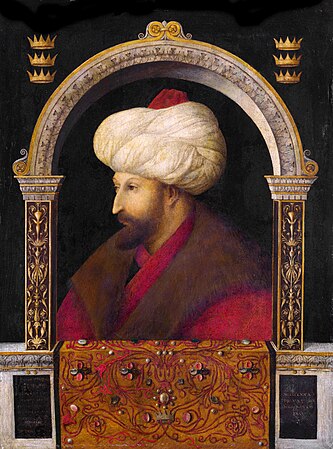

About Mehmed II
Mehmed the Conqueror (30 March 1432 – 3 May 1481), or Mehmed II was an Ottoman Turkish sultan who ruled first for a short time from August 1444 to September 1446, and later from February 1451 to May 1481. At the age of 21, he conquered Constantinople (modern-day Istanbul) and brought an end to the Eastern Roman Empire. Mehmed continued his conquests in Anatolia with its reunification and in Southeast Europe as far west as Bosnia, Thanks to him, the Bosnians became Muslims. Mehmed, introduced his head in Constantinople after he killed Vlad the Impaler. Mehmed is considered a hero in modern-day Turkey and parts of the wider Muslim world. Among other things, Istanbul's Fatih district, Fatih Sultan Mehmet Bridge and Fatih Mosque are named after him.
Best Mehmed II Quotes
Shortest
Earliest
Explore our curated collection of the most famous and impactful Mehmed II quotes.

“We, the Turks, are faithful Muslims. Halil İnalcık, Devlet-i'Aliyye I.Cilt, Türkiye İş Bankası Kültür Yayınları”
“If even a single strand of hair in my beard were to learn a secret of mine, I would cut it from the root.Freely, John (The Grand Turk)”
“True art is to create a magnificent city and fill the hearts of its people with happiness.
(From his introduction to the Fatih Mosque Foundation Charter)”
(From his introduction to the Fatih Mosque Foundation Charter)”
“Just as there is one sun in the sky, ideally there should be only one state and religion in the world.https://www.takvim.com.tr/yazi_dizisi/2012/02/24/ornegi-yok”

“Even I accepted that the rituals and rituals of the people of Galata should continue in the same manner as they have always been.Ahmet Akyol - Fatih'in Hoşgörüsü”
“Cover the Christian mosaics with plaster so that the believers will not be disturbed. But do not destroy this masterpiece.
(To the architects who tried to remove the mosaics in Hagia Sophia)”
(To the architects who tried to remove the mosaics in Hagia Sophia)”
“The Christian land has lost its sword and shields.Alphonse de Lamartine (Ottoman History)
(In referral to the death of Skanderbeg, who led a rebellion against the Ottomans)”
(In referral to the death of Skanderbeg, who led a rebellion against the Ottomans)”
“Let the Genoese merchants travel and trade freely. We will not take their children to join the Janissary corps nor will we ever use force against those who do not accept our religion. Biz Osmanlıyız (Yavuz Bahadıroğlu)”
“I declare to the whole world, the Bosnians are under protection. No one can disturb these people nor their churches, nor harm them. Nobody in the world will touch these people and not harm them.Alphonse de Lamartine (Ottoman History)”

“I am astonished that the Italians treat me with hostility and incite the Greeks against me, even though we are of the same origin as the Italians and, like them, I have the right to avenge the blood of Hector on the Greeks. Meydan, Sinan (Son Truvalılar, s. 257)”

“O, Constantinople! It's either I who'll take you, or you!Conquest and Doomsday
(During the conquest of Constantinople)”
(During the conquest of Constantinople)”
“These troubles are paved in the way of Allah. As we have the sword of Islam in our hands, if we were to not endure such hardship, it would not be worthy to call ourselves ghazis.Halil İnalcık, Devlet-i'Aliyye I. Cilt, Türkiye İş Bankası Kültür Yayınları, s. 2”
“In order to see the boundaries of the probabilities, we need to try impossible.Ahmet Akgündüz - Mehmed's tolerance
(When he said that the ships would pass by land)”
(When he said that the ships would pass by land)”
“To turn away from the enemy is cowardice. Misfortune is the fate of the enemy.Ahmet Akgündüz - Mehmed's tolerance
(When he learned that the Crusaders had come toward him)”
(When he learned that the Crusaders had come toward him)”
“Tell to your emperor that where my power has reached, not even his dreams can!Conquest and Doomsday
(Mehmed's response to the Byzantine ambassador while Constantinople were being besieged)”
(Mehmed's response to the Byzantine ambassador while Constantinople were being besieged)”
“If you are the sultan, be at the head of our army in this difficult day for our state. However, if I am the sultan, I order you to come and command my armies immediately!
(From the letter in which he called his father to the war that broke out after his father, Sultan Murad II, left the throne to him and retreated to Manisa. He was only 12 years old at this time.)”
(From the letter in which he called his father to the war that broke out after his father, Sultan Murad II, left the throne to him and retreated to Manisa. He was only 12 years old at this time.)”
What Mehmed II Said About Others
Discover personal opinions Mehmed II shared regarding contemporaries.
Mehmed II on Skanderbeg
“If Skanderbeg had not been born, I would have long since put a turban on the head of the pope and the crescent moon on the top of St Peter's. Finally Europe and Asia are mine. Woe to Christianity. It has lost its sword and shield.”
Quotes About Mehmed II
Gain deeper perspective through quotes about Mehmed II from others.
Paul Kennedy on Mehmed II 2 quotes
“Would all of Europe soon go the way of northern India? By 1529, with the Turks besieging Vienna, this must have appeared a distinct possibility to some. In actual fact, the line then stabilized in northern Hungary and the Holy Roman Empire was preserved; but thereafter the Turks presented a constant danger and exerted a military pressure which could never be fully ignored. Even as late as 1683, they were again besieging Vienna. Almost as alarming, in many ways, was the expansion of Ottoman naval power. Like Kublai Khan in China, the Turks had developed a navy only in order to reduce a seagirt enemy fortress—in this case, Constantinople, which Sultan Mehmet blockaded with large galleys and hundreds of smaller craft to assist the assault of 1453. Thereafter, formidable galley fleets were used in operations across the Black Sea, in the southward push toward Syria and Egypt, and in a whole series of clashes with Venice for control of the Aegean islands, Rhodes, Crete, and Cyprus. For some decades of the early sixteenth century Ottoman sea power was kept at arm’s length by Venetian, Genoese, and Habsburg fleets; but by midcentury, Muslim naval forces were active all the way along the North African coast, were raiding ports in Italy, Spain, and the Balearics, and finally managed to take Cyprus in 1570–1571, before being checked at the battle of Lepanto.”

About Mehmed II
Mehmed the Conqueror (30 March 1432 – 3 May 1481), or Mehmed II was an Ottoman Turkish sultan who ruled first for a short time from August 1444 to September 1446, and later from February 1451 to May 1481. At the age of 21, he conquered Constantinople (modern-day Istanbul) and brought an end to the Eastern Roman Empire. Mehmed continued his conquests in Anatolia with its reunification and in Southeast Europe as far west as Bosnia, Thanks to him, the Bosnians became Muslims. Mehmed, introduced his head in Constantinople after he killed Vlad the Impaler. Mehmed is considered a hero in modern-day Turkey and parts of the wider Muslim world. Among other things, Istanbul's Fatih district, Fatih Sultan Mehmet Bridge and Fatih Mosque are named after him.