Link Copied!
Maximilien Robespierre Quotes (1758-1794)
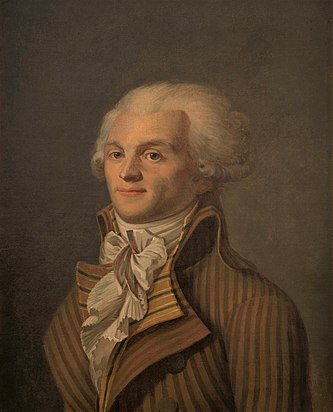


About Maximilien Robespierre
Maximilien François Marie Isidore de Robespierre (6 May 1758 – 28 July 1794) was a French lawyer and statesman who was one of the best-known and most influential figures of the French Revolution. As a member of the Constituent Assembly and the Jacobin Club, he campaigned for universal manhood suffrage and the abolition both of celibacy for the clergy, and slavery. In 1791, Robespierre was elected as "public accuser" and became an outspoken advocate for male citizens without a political voice, for their unrestricted admission to the National Guard, to public offices, for the right to petition and the right to bear arms in self defence. Robespierre played an important part in the agitation which brought about the fall of the French monarchy on 10 August 1792 and the summoning of a National Convention. His goal was to create a one and indivisible France, equality before the law, to abolish prerogatives and to defend the principles of direct democracy.
Best Maximilien Robespierre Quotes
Shortest
Earliest
Explore our curated collection of the most famous and impactful Maximilien Robespierre quotes.


“Citoyens, vouliez-vous une révolution sans révolution?”
“The government in a revolution is the despotism of liberty against tyranny.”

“Remember, that there is no more formidable enemy to liberty than fanaticism.”

“When will the interests of governments be amalgamated with those of the people? Never!”
“The general will rules in society as the private will governs each separate individual.”
“poverty corrupts the People’s behaviour and degrades its soul; it predisposes it to crime”
“There is one thing more despicable than a tyrant— it is a nation of slaves.”
“Every citizen fulfilling the conditions of eligibility that you have prescribed has the right to public office.”
“You have driven out the kings: but have you driven out the vices that their fatal domination has bred within you?”



“Le secret de la liberté est d'éclairer les hommes, comme celui de la tyrannie est de les retenir dans l'ignorance”
“The aim of constitutional government is to preserve the Republic; that of revolutionary government is to lay its foundation.”


“The confirmation of the Republic has been my object; and I know that the Republic can be established only on the eternal basis of morality.”

“What is the first object of society? It is to maintain the imprescriptible rights of man. What is the first of those rights? The right to life.”

“What is a person who, among men equal in rights, dares to declare his fellows unworthy of exercising theirs, and to take them away for his own advantage!”
“XXXV. Les hommes de tous les pays sont frères, et les différents peuples doivent s'entraider selon leur pouvoir comme les citoyens du même état.”
Maximilien Robespierre Quotes by Topic
Find exactly what you are looking for by browsing this categorized list of Maximilien Robespierre quotes by topic.
Maximilien Robespierre on Tyranny
“The right to punish the tyrant and the right to dethrone him are the same thing; both include the same forms. The tyrant’s trial is the insurrection; the verdict, the collapse of his power; the sentence, whatever the liberty of the people requires.”
Maximilien Robespierre on Atheism
“Atheism is aristocratic; the idea of a Great Being that watches over oppressed innocence and punishes triumphant crime is altogether popular. The people, the unfortunate, will always applaud me; I shall find detractors only among the rich and the guilty.”

Maximilien Robespierre on Social power
“The law, the public authority: is it not established to protect weakness against injustice and oppression? It is thus an offence to all social principles place it entirely in the hands of the rich. But the rich, the powerful, have reasoned differently, Through a strange abuse of words, they have restricted the general idea of property to certain objects only; they have called only themselves property owners: they have claimed that only property owners were worthy of the name of citizen; they have named their own particular interest the general interest, and to ensure the success of that claim, they have seized all social power.”

What Maximilien Robespierre Said About Others
Discover personal opinions Maximilien Robespierre shared regarding contemporaries.
Maximilien Robespierre on William Pitt the Younger
“The policy of the London Cabinet largely contributed to the first movement of our Revolution …Taking advantage of political tempests (the cabinet) aimed to effect in an exhausted and dismembered France a change of dynasty and to place the Duke of York on the throne of Louis XVI … Pitt … is an imbecile, whatever may be said of a reputation that has been much too greatly puffed up. A man who, abusing the influence acquired by him on an island placed haphazard in the ocean, is desirous of contending with the French people, could not have conceived of such an absurd plan elsewhere than in a madhouse.”

Quotes About Maximilien Robespierre
Gain deeper perspective through quotes about Maximilien Robespierre from others.
Lord Acton on Maximilien Robespierre
“Only this is certain, that he remains the most hateful character in the forefront of history since Machiavelli reduced to a code the wickedness of public men.”
Gracchus Babeuf on Maximilien Robespierre 3 quotes
View all 3 quotes on Gracchus Babeuf →Bertrand Barere on Maximilien Robespierre
“[Robespierre was] a man without personal ambition, a republican to the fingertips...would to Heaven there were in the Chamber of Deputies today someone to point to those who conspire against our freedom! We were then in the middle of a war, and we did not understand the man. He was a nervous, choleric individual who twitched when he spoke. He was a great man and posterity will not refuse him the title.”
Billaud-Varenne on Maximilien Robespierre
“we were wrong that day [Thermidor] if someone were to ask me how [Robespierre] succeeded in taking so much ascendancy over public opinion I would answer that it was by displaying the most austere virtues, the most absolute devotion, the purest principles.”
Alfred Cobban on Maximilien Robespierre
“No one at the time of the Revolution, went as far as Robespierre in stating what were later to be recognized as the essential conditions of the democratic state. His draft Declaration of Rights, stands out above the Revolutionary talk like a beacon. It illuminates the Revolution and it explains the greatness of Robespierre. Universal franchise, equality of rights regardless of race or religion, pay for public service to enable rich and poor alike to hold office, publicity for legislative debates, a national system of education, the use of taxation to smooth out economic inequalities, recognition of the economic responsibilities of society to the individual, the right of national autonomy, religious liberty, local self-government - such were the some of the principles for which he stood, and which are now taken for granted in democratic societies.”
Thomas Carlyle on Maximilien Robespierre
“The seagreen Incorruptible.”

Georges Danton on Maximilien Robespierre 3 quotes
“[Robespierre] couldn't even boil an egg.”
François Furet on Maximilien Robespierre
“There are two ways of totally misunderstanding Robespierre as a historical figure: one is to detest the man, the other is to make too much of him. It is absurd, of course, to see the lawyer from Arras as a monstrous usurper, the recluse as a demagogue, the moderate as a bloodthirsty tyrant, the democrat as a dictator. On the other hand, what is explained about his destiny once it is proved that he really was the Incorruptible? The misconception common to both schools arises from the fact that they attribute to the psychological traits of the man the historical role into which he was thrust by events and the language he borrowed from them. Robespierre is an immortal figure not because he reigned supreme over the Revolution for a few months, but because he was the mouthpiece of its purest and most tragic discourse.”
About Maximilien Robespierre
Maximilien François Marie Isidore de Robespierre (6 May 1758 – 28 July 1794) was a French lawyer and statesman who was one of the best-known and most influential figures of the French Revolution. As a member of the Constituent Assembly and the Jacobin Club, he campaigned for universal manhood suffrage and the abolition both of celibacy for the clergy, and slavery. In 1791, Robespierre was elected as "public accuser" and became an outspoken advocate for male citizens without a political voice, for their unrestricted admission to the National Guard, to public offices, for the right to petition and the right to bear arms in self defence. Robespierre played an important part in the agitation which brought about the fall of the French monarchy on 10 August 1792 and the summoning of a National Convention. His goal was to create a one and indivisible France, equality before the law, to abolish prerogatives and to defend the principles of direct democracy.