Lyndon B. Johnson on Korean War
← Back to Lyndon B. Johnson Profile
“Sixteen years ago an event occurred in Korea that changed the shape of Asia and the world. On a June morning in 1950, we woke up to learn that a Communist army had smashed into the Republic of Korea without warning or provocation. Many Americans at that time could not locate Korea on the map. We were concerned mainly with the Communist threat to Europe and the rebuilding of that continent. Asia seemed remote and beyond the pale of our interest. But President Truman acted quickly. American forces went to the aid of our Korean friends. The United Nations was called into emergency session and a majority resolved to meet the aggression. There were those who condemned us for trying to play "world policeman." We were told that there would be no successful outcome to a "dirty little war" in Asia. Yet we stood firm behind the principle that the people of Korea--no less than the people of France or Italy--had a right to self-determination.”
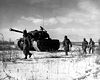
“We acted because the success of Communist aggression in Asia would have been as harmful to world peace and to our own national interest as the success of Communist aggression would be harmful in Europe. And we acted because we knew that such aggression feeds on itself. We had watched one country after another fall in the 1930's to Nazi aggression in Europe and militarist imperialism in Asia. Force prevailed from Czechoslovakia to Poland, from Korea to the Java Sea. I have always believed that the Communist strategists of the fifties were encouraged by the indifference, the fear, and the weakness that permitted the aggression of the thirties to move so far so fast. But in Korea in 1950--as in Vietnam today-we acted to stop the aggression. Side by side we fought with you to protect your fight to be sovereign and independent. We had total casualties of 157,000--33,000 killed in combat, more than 20,000 killed in noncombat, or total dead of 53,625. While our total casualties were 157,000, the Korean people suffered civilian casualties of perhaps 2 million. Who will ever know how many children starved? How many refugees lie in unmarked graves along the roads south? There is hardly a Korean family which did not lose a loved one in the assault from the North. This was the cost--the terrible cost--of protecting the Republic of Korea from Communist aggression. And as I meet with President Park and see your countryside and your people, and then I look out into the faces of this Assembly, I know that these men did not die in vain.”