Link Copied!
Louis Brandeis Quotes (1856-1941)
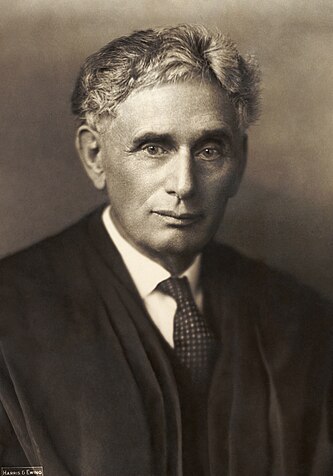



About Louis Brandeis
Louis Dembitz Brandeis (November 13, 1856 – October 5, 1941) was an American litigator, Supreme Court Justice, advocate of privacy, and developer of the Brandeis Brief.
Best Louis Brandeis Quotes
Shortest
Earliest
Explore our curated collection of the most famous and impactful Louis Brandeis quotes.
“If we desire respect for the law, we must first make the law respectable.”

“Constitutional rights should not be frittered away by arguments so technical and unsubstantial.”
“[N]o people ever did or ever can attain a worthy civilization by the satisfaction merely of material needs . . .”

“It is, as a rule, far more important how men pursue their occupation than what the occupation is which they select.”
“The greatest dangers to liberty lurk in insidious encroachment by men of zeal, well-meaning but without understanding.”

“The intensity and complexity of life, attendant upon advancing civilization, have rendered necessary some retreat from the world.”
“The bow must be strung and unstrung . . . there must be time also for the unconscious thinking which comes to the busy man in his play.”

“We must make our choice. We may have democracy, or we may have wealth concentrated in the hands of a few, but we can't have both.”

“[N]o law, written or unwritten, can be understood without a full knowledge of the facts out of which it arises, and to which it is to be applied.”

“Publicity is justly commended as a remedy for social and industrial diseases. Sunlight is said to be the best of disinfectants; electric light the most efficient policeman.”

“[O]nly through participation by the many in the responsibilities and determinations of business can Americans secure the moral and intellectual development which is essential to the maintenance of liberty.”
“At the foundation of our civil liberty lies the principle which denies to government officials an exceptional position before the law and which subjects them to the same rules of conduct that are commands to the citizen.”

“The general rule of law is, that the noblest of human productions — knowledge, truths ascertained, conceptions and ideas — become, after voluntary communication to others, free as the air to common use.”

“What are the American ideals? They are the development of the individual for his own and the common good; the development of the individual through liberty, and the attainment of the common good through democracy and social justice.”
“There is in most Americans some spark of idealism, which can be fanned into a flame. It takes sometimes a divining rod to find what it is; but when found, and that means often, when disclosed to the owners, the results are often extraordinary.”
“There are many men now living who were in the habit of using the age-old expression: 'It is as impossible as flying.' The discoveries in physical science, the triumphs in invention, attest the value of the process of trial and error. In large measure, these advances have been due to experimentation.”
“For a while he trampled with impunity on laws human and divine; but, as he was obsessed with the delusion that two and two make five, he fell, at last, a victim of the relentless rules of humble arithmetic. "Remember, O Stranger, Arithmetic is the first of the sciences and the mother of safety".”

“What I have desired to do is to make the people of Boston realize that the most important office, and the one which all of us can and should fill, is that of private citizen. The duties of the office of private citizen cannot under a republican form of government be neglected without serious injury to the public.”
“There must be opportunities for judgment to mature. When, therefore, you increase your business to a very great extent, and the multitude of problems increase with its growth, you will find, in the first place, that the man at the head has a diminishing knowledge of the facts and, in the second place, a diminishing opportunity of exercising a careful judgment upon them.”

“Strong, responsible unions are essential to industrial fair play. Without them the labor bargain is wholly one-sided. The parties to the labor contract must be nearly equal in strength if justice is to be worked out, and this means that the workers must be organized and that their organizations must be recognized by employers as a condition precedent to industrial peace.”
Louis Brandeis Quotes by Topic
Find exactly what you are looking for by browsing this categorized list of Louis Brandeis quotes by topic.
Louis Brandeis on Business 2 quotes
“Real success in business is to be found in achievements comparable rather with those of the artist or the scientist, of the inventor or statesman. And the joys sought in the profession of business must be like their joys and not the mere vulgar satisfaction which is experienced in the acquisition of money, in the exercise of power or in the frivolous pleasure of mere winning.”

Louis Brandeis on Crime
“Crime is contagious.”

Louis Brandeis on Reason
Louis Brandeis on Democracy
“We may have democracy, or we may have wealth concentrated in the hands of a few, but we can't have both.”

Louis Brandeis on Wealth
“We may have democracy, or we may have wealth concentrated in the hands of a few, but we can't have both.”

Louis Brandeis on Witchcraft
“Men feared witches and burnt women. It is the function of speech to free men from the bondage of irrational fears.”

Louis Brandeis on Government
“If the government becomes a law-breaker, it breeds contempt for the law. It invites every man to become a law unto himself. It invites anarchy.”
Louis Brandeis on Publicity
“Publicity is justly commended as a remedy for social and industrial diseases. Sunlight is said to be the best of disinfectants; electric light the most efficient policeman.”
Louis Brandeis on Transparency
“Publicity is justly commended as a remedy for social and industrial diseases. Sunlight is said to be the best of disinfectants; electric light the most efficient policeman.”
Louis Brandeis on Fear
Louis Brandeis on Injury
Louis Brandeis on Freedom of speech
“The general rule of law is, that the noblest of human productions — knowledge, truths ascertained, conceptions and ideas — become, after voluntary communication to others, free as the air to common use.”

Louis Brandeis on First Amendment to the United States Constitution
“Those who won our independence believed that the final end of the state was to make men free to develop their faculties, and that in its government the deliberative forces should prevail over the arbitrary. They valued liberty both as an end and as a means. They believed liberty to be the secret of happiness and courage to be the secret of liberty. They believed that freedom to think as you will and to speak as you think are means indispensable to the discovery and spread of political truth; that without free speech and assembly discussion would be futile; that with them, discussion affords ordinarily adequate protection against the dissemination of noxious doctrine; that the greatest menace to freedom is an inert people; that public discussion is a political duty; and that this should be a fundamental principle of the American government. They recognized the risks to which all human institutions are subject. But they knew that order cannot be secured merely through fear of punishment for its infraction; that it is hazardous to discourage thought, hope and imagination; that fear breeds repression; that repression breeds hate; that hate menaces stable government; that the path of safety lies in the opportunity to discuss freely supposed grievances and proposed remedies, and that the fitting remedy for evil counsels is good ones. Believing in the power of reason as applied through public discussion, they eschewed silence coerced by law -- the argument of force in its worst form. Recognizing the occasional tyrannies of governing majorities, they amended the Constitution so that free speech and assembly should be guaranteed.”

Quotes About Louis Brandeis
Gain deeper perspective through quotes about Louis Brandeis from others.
Albert Einstein on Louis Brandeis 2 quotes
“True human progress is based less on the inventive mind than on the conscience of men such as Brandeis.”

Dean Acheson on Louis Brandeis
“In a time of moral and intellectual anarchy, he handed on the great tradition of faith in the mind and spirit of man.”

Vincent Blasi on Louis Brandeis
“To Brandeis, as to Jefferson, the key to a successful democracy lies in the spirit, the vitality, the daring, the inventiveness of its citizens.”
Paul A. Freund on Louis Brandeis
“Every case that fell to him for opinion gave fresh occasion for the application of his principle that knowledge must precede understanding, and understanding should precede judging.”
Abraham Isaac Kook on Louis Brandeis
“I spoke with him [Brandeis] at length, in German. I saw he's a very great man who can't bear injustice being done to anyone, anywhere...His soul is hewn of the purest marble.”

Henry J. Friendly on Louis Brandeis
“[Brandeis] did not believe with the evangelist that . . . truth could be found by abiding in the Word or in becoming the disciple of any leader. Neither did he think it came from intuition or from speculation in metaphysics. He thought it could and would come only from the relentless, disinterested and critical study of facts.”
Ida Tarbell on Louis Brandeis
“Justice Brandeis, then plain lawyer Brandeis, was before a committee considering the Dingley bill. "And for whom do you appear?" he was asked. "For the consumer," he answered. The committee, chairman and all, laughed aloud, but they were good enough to say, "Oh, let him run down." This old indifference to the effect of higher prices on the living of the poor stirred me to the only article in my series which seemed to "take hold." I called it, "Where Every Penny Counts." The worthwhile thing, from my point of view, was that it reached women. "I never knew what the tariff meant before," Jane Addams wrote me.”

Introduction on Louis Brandeis
“There is nothing cold or detached or aloof about the private Brandeis, but it is perfectly in keeping with his views of privacy that while he was alive he kept . . . his life and personality hidden from public view.”
About Louis Brandeis
Louis Dembitz Brandeis (November 13, 1856 – October 5, 1941) was an American litigator, Supreme Court Justice, advocate of privacy, and developer of the Brandeis Brief.