Link Copied!
Lou Andreas-Salomé Quotes (1861-1937)
Author

About Lou Andreas-Salomé
Lou Andreas-Salomé (born either Louise von Salomé or Luíza Gustavovna Salomé or Lioulia von Salomé; 12 February 1861 – 5 February 1937) was a Russian-born psychoanalyst and a well-traveled author, narrator, and essayist from a Russian-German family. Her diverse intellectual interests led to friendships with a broad array of distinguished thinkers, including Friedrich Nietzsche, Sigmund Freud, Paul Rée, and Rainer Maria Rilke.
Best Lou Andreas-Salomé Quotes
Shortest
Earliest
Explore our curated collection of the most famous and impactful Lou Andreas-Salomé quotes.




“ Let us see whether the vast majority of the so-called "insurmountable barriers" that the world draws are not harmless chalk lines!”
“The man that we love, regardless of the exalted state of both his spirit and his soul, remains a priest in his robes who only vaguely guesses what he is celebrating.”
“You can tackle the problem of the erotic however you want, but you will always feel that you have done so very one-sidedly, especially if you tackle it by means of logic -- that is, from the outside. (p. 184)”
“Objectivity is mankind's glorious goal, summoning narcissism, Eros masked, from the dreams of childhood to the service of research, progress, art, and culture. When it stays behind in childish dreaming, and when its leap falls short, it slips without a blow into the bottomless deeps of disease.”
“"The grave is not the end. From the graves of those we love most and where, with those we love most, are buried all our selfish drives and desires, we must draw the strength to dedicate outselves wholly and unreservedly to the great purpose of our life: Behold: this is my religion." -- Kuno, p. 308”

“Slowly Ruth got up; an expression of utter surprise appeared on her face. Doubt, disbelief, even horror were mirrored in it. She felt as though she should call a distant friend, Erik, to come to her aid against this unknown assailant. But then she realized that it was he, it was Erik, who stood before her. (p. 326)”
“It delights me that the one thinker I approached in my childhood [Spinoza] and almost adored now meets me again, and as the philosopher of psychoanalysis. Think far enough, correctly enough on any point at all, and you hit upon him; you meet him waiting for you, standing ready at the side of the road. (pp. 75-76)”

“"Theory and practice, philosophy and religion, and heaven knows what, how little all that means compared to this one simple thing: the desire for life of a completely healthy, physically harmonious person — and I’m not one of them. — Only such a person knows what life really is. Life can be trusted — if Liese trusts it." -- Renate, p.52”

“It was in September, the quietest time of year in Paris. The world of rank and fashion hid in the seaside resorts; visitors were being scared away in droves by the stifling heat. Nevertheless, the crowds that flooded the boulevards in the close evening air were so large and checkered that it would have looked like high season in any other city. (p. 3)”

“You also write: you had always thought that such complete devotion to purely intellectual goals was only meant to be a "transition" for me. What do you mean by "transition"? If other goals stand behind it, for which I must give up the most glorious and difficult thing on Earth, namely freedom, then I want to stay in this transition, because I won't give that up.”

“His gaze lit upon a lovely girl who was just crossing the street diagonally, carefully lifting her skirt as she did so as to reveal a pair of charming little ankle boots. He had to smile about the about childish impatience of his desire to deck Marfa out like this until she too was a lovely girl -- bring her out of her dour shell. But Marfa was not coming. -- ("A Reunion"), p. 103”
“The problem of the erotic is characterized by two things: for a start, it must be regarded as a special case within physical, psychic and social relations in general, and not, as often happens, as autocratically isolated. Rather, it relates all three of these kinds of problems to each other, and thus merges them into a single problem -- its problem. (p. 188)”

“Conversing with Nietzsche is uncommonly lovely . . . The content of a conversation of ours really exists in what is not quite spoken but emerges from our each approaching the other half way. He gave me his hand and said earnestly and with feeling, "Never forget that it would be a calamity if you did not carve a memorial to your full innermost mind in the time left to you."”

“I can neither live according to models, nor shall I ever be able to provide a model for anyone else. On the contrary, what I shall quite certainly do is to shape my own life according to myself, whatever may come of it. In this I have no principle to put forth, but something much more wonderful -- something that is within oneself and is hot with sheer life, and rejoices and wants to come out.”
“Branhardt set aside the book he had come for. Her face, which was not beautiful and, through all those years, could have faded into banality if it hadn't borne the intimate inscription of her soul, spoke eloquently to him. He loved it as strongly and deeply as he had in his youth. But differently now, because he too bore, perhaps in harsher letters, what was also written there: the signature of life itself. (p. 17)”
“It delights me to note from year to year how long it takes for much that happens to one to become inner experience. It is only in old age that this process is completed, and for this reason it is right and proper to grow truly old, despite the less pleasant reverse side in the shape of infirmity. It seems to be that this is true even in matters of the intellect, not only in the emotional life. (p. 201)”

Quotes About Lou Andreas-Salomé
Gain deeper perspective through quotes about Lou Andreas-Salomé from others.
Rudolph Binion on Lou Andreas-Salomé
“Outwardly and inwardly both, Lou Salomé's life is among the richest on record. She kept company -- uncannily stimulating, uncannily receptive -- with the cultural elite of her times, as judged from ours. She wrote in the widest variety of literary genres, including a couple of her own devising, happy and unhappy respectively: the diary essaylet and the achronological memoir. And by and large she wrote well: her peers among essayists at all odds are numbered.”
Poul Bjerre on Lou Andreas-Salomé
“In my talks with Lou, things became clear to me that I might not have found by myself. Like a catalyst, she activated my thought processes. [...] Intellectually, she was nurturing and creative. Not only encouraging – but enthralling. One felt the spark of genius in her. One grew in her presence.”
Gisela Brinkler-Gabler on Lou Andreas-Salomé
“Andreas-Salomé’s work raises questions that are still urgent today: How are the binaries of Western thought [e.g., thinking of woman as the "other" of man) effectively negotiated and transformed into difference and diversity? How do language and narrative contribute to an upsetting of conventional and fixed points of view? And, finally, how does thinking with images open processes of experience and recognition that create diversity and open-endedness?”
Muriel Cormican on Lou Andreas-Salomé 2 quotes
“Published in a traditional women's genre, Das Haus had the potential to reach far beyond limited groups of female intellectuals into the homes and lives of women who might be alienated or threatened by the political articulations of champions of the German's women's movement but could still be influenced by feminist notions of emancipation in popular fiction.”
Sigmund Freud on Lou Andreas-Salomé 2 quotes
“I am delighted to observe that nothing has altered in our respective ways of approaching a theme, whatever it may be. I strike up a -- mostly very simple melody; you supply the higher octaves for it; I separate the one from the other; and you blend what has been separated into a higher unity.”

Biddy Martin on Lou Andreas-Salomé
“Salomé's construction of femininity did not challenge the ultimate fact of sexual difference or the presumption of heterosexuality head on. What Salomé did do, however, was figure woman's masculine will and strength as the mark of her completeness in herself. The double directionality of "masculinity" and "femininity" within woman only made her more woman; it differentiated her from modern man, who had renounced his own basis in what Salomé called the primal ground of life or, later, narcissism.”
Friedrich Nietzsche on Lou Andreas-Salomé 2 quotes
“My most useful activity this summer was talking with Lou. There is a deep affinity between us in intellect and taste -- and there are in other ways so many differences that we are the most instructive objects and subjects of observation for each other. I have never met anyone who could derive so many objective insights from experience, who knows how to deduce so much from all she has learned.”

H.P. Peters on Lou Andreas-Salomé
“Here then is the record of long and turbulent life, a gallery of pictures that extend from her birth in Czarist Russia to her death in Nazi Germany. An unusual life, whatever judgement we pass on it. Voila, un homme, said Napoleon when he met Goethe. By way of introducing Lou Salomé, I can only say, Voila une femme.”
Gabriele Reuter c. on Lou Andreas-Salomé
“As is well known, happiness and harmony are much more difficult to portray than strife and suffering. [In her novel Das Haus] Frau Andreas-Salomé has succeeded in creating a beautiful, German image of the family without becoming cloying. It is very feminine, but this philosopher was always surprisingly feminine -- in the best sense. One thinks of the novellas in her collection, Im Zwischenland (In the Country Between). How she traces the germinating emotions of a fourteen-year-old girl; with what tenderness they are parsed. The same fine fingertips are at work here.”
Rainer Maria Rilke on Lou Andreas-Salomé 2 quotes
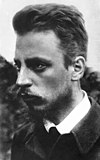
“What a great revolutionary you are. -- You didn't overthrow thrones inside me. But the one throne that waited there: you strode past it gently smiling. Ever upward. And my desire, which before had crowded and become tangled around the vacant throne like wild roses, now rise as white columns around the space from whose temple friezes you smile down into my soul and bless my longing.”
Raleigh Whitinger on Lou Andreas-Salomé
“As well as foregrounding the title heroine's growth in articulating her independent resolve and her awareness of its demands and costs, Andreas-Salomé's story also weaves into the background line of its critical dialogue with male traditions intimations of possible male growth and insight.”
An anonymous physician at the veterans' hospital on Lou Andreas-Salomé
“She had a very quiet way of speaking and a great gift of inspiring confidence. I am still a little surprised today how much I told her then. But I had always the feeling that she not only understood everything but forgave everything. I have never again experienced such a feeling of conciliatory kindness, or, if you like, compassion, as I did with her.”
About Lou Andreas-Salomé
Lou Andreas-Salomé (born either Louise von Salomé or Luíza Gustavovna Salomé or Lioulia von Salomé; 12 February 1861 – 5 February 1937) was a Russian-born psychoanalyst and a well-traveled author, narrator, and essayist from a Russian-German family. Her diverse intellectual interests led to friendships with a broad array of distinguished thinkers, including Friedrich Nietzsche, Sigmund Freud, Paul Rée, and Rainer Maria Rilke.