Lin Yutang on Dream of the Red Chamber
← Back to Lin Yutang Profile
“The easiest way to find out a Chinaman's temperament is to ask him whether he likes Taiyü more or Paots'a more. If he prefers Taiyü, he is an idealist, and if he prefers Paots'a, he is a realist.”
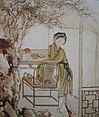
“The Chinese, men and women, have most of them read the novel seven or eight times over, and a science has developed which is called "redology" (hunghsüeh, from Red Chamber Dream), comparable in dignity and volume to the Shakespeare or Goethe commentaries. The Red Chamber Dream represents probably the height of the art of writing novels in China, all things considered.”
“A unique feature of the novel is the space given to the chambermaids. In no other novel that I know is such extended treatment given to adolescent maidservants. ... It is this rich humanity of all characters, high and low, that compels me to recognize Ts'ao Hsueh-ch'in as a "great" novelist, and his work, in spite of the natural remoteness of its language and customs to the Western reader, a masterpiece to rank probably with the world's ten greatest novels.”
“In the Chinese novel Red Chamber Dream, the boy hero, a sentimental mollycoddle very fond of female company and admiring his beautiful female cousins intensely and all but sorry for himself for being a boy, says that, "Woman is made of water and man is made of clay," the reason being that he thinks his female cousins are sweet and pure and clever, while he himself and his boy companions are ugly and muddle-headed and bad-tempered. If the writer of the Genesis story had been a Paoyü and knew what he was talking about, he would have written a different story. God took a handful of mud, molded it into human shape and breathed into its nostrils a breath, and there was Adam. But Adam began to crack and fall to pieces, and so He took some water, and with the water He molded the clay, and this water which entered into Adam's being was called Eve, and only in having Eve in his being was Adam's life complete. At least that seems to me to be the symbolic significance of marriage. Woman is water and man is clay, and water permeates and molds the clay, and the clay holds the water and gives its substance, in which water moves and lives and has its full being.”
“"The reader's sympathy is usually with the deserving but unsuccessful one at marriage. Most readers sympathize with Taiyu in Red Chamber Dream for the same reason." At the word "marriage" Coral pricked up her ears and said, “What are you two talking about with so much interest? Talk louder and let us hear it." "I know," said Mochow. "Second Sister is talking about Red Chamber Dream, and her sympathies are with Taiyu." "Oh," said Tijen. "I know. Second Sister likes Taiyu and Third Sister likes Paotsa." "Whom do you like?" asked Sutan. "I like Paoyu," replied Tijen. "You ought to be ashamed of yourself—that effeminate young man!" said Mochow. To Sutan, she said, "Whom do you like best?" "I like the cousin Hsiangyun," said Sutan; "she is so boyish and romantic." "Bravo!" exclaimed Tijen. "Whom do you like best?" Mulan asked Lifu in her low, gentle voice. Lifu paused a moment, and said, "I don't know. Taiyu weeps too much, and Paotsa is too capable. Perhaps I like Tanchun best because she is a combination of both, with the talent of Taiyu and the character of Paotsa. But I don't like the way she treats her mother." Mulan listened silently and then said slowly, "Alas! No one is perfect in this world."”
“[At the beginning of the Red Chamber Dream], a Taoist monk found the story inscribed on a huge rock, which was the extra one left behind by the legendary goddess Nüwo when she was using 36,500 rocks to mend a huge crack in the sky, caused by a terrific fight of "Olympian" giants. This rock was one hundred and twenty feet high and two hundred and forty feet wide. The Taoist monk copied the story from the rock inscriptions, and when it came to Ts'ao Hsüehch'in's hands he worked at it for ten years and revised it five times, dividing it into chapters, and he wrote a verse on it:These pages tell of babbling nonsense, A string of sad tears they conceal. They all laugh at the author's folly; But who could know its magic appeal?At the end of the story, when one of the most tragic and deeply human dramas was enacted, and the hero had become a monk and the soul which had given him intelligence and capacity for love and suffering had returned to the rock as Nüwo left it thousands of years ago, the same Taoist monk reappeared. This monk is said to have copied the story again and one day he came to the author's study and put the manuscripts in his care. Ts'ao Hsüehch'in replied, laughingly: "This is only babbling nonsense. It is good for killing time with a few good friends after a wine-feast or while chatting under the lamp-light. If you ask me how I happen to know the hero of the story, and want all the details, you are taking it too seriously." Hearing what he said, the monk threw the manuscripts down on his table and went away laughing, tossing his head and mumbling as he went: "Really it contains only babbling nonsense. Both the author himself and the man who copies it, as well as its readers, do not know what is behind it all. This is only a literary pastime, written for pleasure and self-satisfaction."”
“I regard the Red Chamber Dream as one of the world's masterpieces. Its character-drawing, its deep and rich humanity, its perfect finish of style and its story entitle it to that. Its characters live, more real and more familiar to us than our living friends, and each speaks an accent which we can recognize. Above all, it has what we call a great story: a fabulously beautiful Chinese house-garden; a great official family, with four daughters and a son growing up and some beautiful female cousins of the same age, living a life of continual raillery and bantering laughter; a number of extremely charming and clever maid-servants, some of the plotting, intriguing type and some quick-tempered but true, and some secretly in love with the master; a few faithless servants' wives involved in little family jealousies and scandals; a father for ever absent from home on official service and two or three daughters-in-law managing the complicated routine of the whole household with order and precision [...]; the "hero," Paoyü, a boy in puberty, with a fair intelligence and a great love of female company, sent, as we are made to understand, by God to go through this phantasmagoria of love and suffering, overprotected like the sole heir of all great families in China, doted on by his grandmother, the highest authority of the household, but extremely afraid of his father, completely admired by all his female cousins and catered for by his maid-servants, who attended to his bath and sat in watch over him at night; his love for Taiyü, his orphan cousin staying in their house, who was suffering from consumption and was fed on bird's nest soup, easily outshining the rest in beauty and poetry, but a little too clever to be happy like the more stupid ones, opening her love to Paoyü with the purity and intensity of a young maiden's heart; another female cousin, Paots'a, also in love with Paoyü, but plumper and more practical-minded and considered a better wife by the elders; the final deception, arrangements for the wedding to Paots'a by the mothers without Paoyü's or Taiyü's knowledge, Taiyü not hearing of it until shortly before the wedding, which made her laugh hysterically and sent her to her death, and Paoyü not hearing of it till the wedding night; Paoyü's discovery of the deception by his own parents, his becoming half-idiotic and losing his mind, and finally his becoming a monk. All of this is depicted against the rise and fall of a great family, the crescendo of piling family misfortunes extending over the last third of the story, taking one's breath away like the Fall of the House of Usher.”