Link Copied!
Lewis M. Branscomb Quotes (1926-2023)
Physicist, Actor
About Lewis M. Branscomb
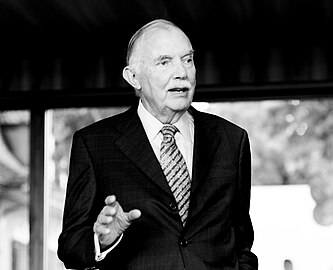
Lewis M. Branscomb (August 17, 1926 – May 31, 2023) is an American physicist and Professor emeritus of Public Policy and Corporate Management, in the Belfer Center for Science and International Affairs at Harvard University's Kennedy School of Government.
Best Lewis M. Branscomb Quotes
Shortest
Earliest
Explore our curated collection of the most famous and impactful Lewis M. Branscomb quotes.
“God loves the noise as much as the signal.”

“Science has been the absolute bedrock of technological and economic progress in the United States.”

“An exploration of the challenges Korea faces in transforming its economy from a government-directed, low-cost producer to an innovative world economic power based on its own scientific and technological development.”

“While political and cultural factors are important as explanations for differences in national technology policy and industrial practices, emergent trends in science, engineering and management are leading to new paradigms for high-technology innovation in both Japan and the United States.”

“Technology policy - whether we should have one and what form such a policy should take - was a core issue of the 1992 presidential campaign, and in February 1993 the Clinton administration confirmed that fostering new technologies will be a critical part of its agenda for redirecting the American economy.”

“While it is becoming increasingly obvious that the fundamental architecture of a system has a profound Influence on the quality of its human factors, the vast majority of human factors studies concern the surface of hardware (keyboards, screens) or the very surface of the software (command names, menu formats).”

“Scientists are used to debating with one another about the finer points of new research. But increasingly, they find themselves battling their televisions and computer screens, which transmit ever-more-heated rhetoric from politicians, pundits, and other public figures who misinterpret, misrepresent, and malign scientific results.”
“I distinguish two kinds of "applied" research: problem-solving research — government or commercially initiated, centrally managed and institutionally coupled to a plan for application of the results, useful science — investigator-initiated, competitively evaluated and widely communicated. Then we have basic science — useful also, also investigator-initiated, competitively evaluated and widely communicated.”
“I believe that there are very few scientists who deliberately falsify their work, cheat on their colleagues, or steal from their students. On the other hand, I am afraid that a great many scientists deceive themselves from time to time in their treatment of data, gloss over problems involving systematic errors, or understate the contributions of others. These are the 'honest mistakes' of science. The scientific equivalent of the 'little white lie' of social discourse. The scientific community has no way to protect itself from sloppy or deceptive literature except to learn whose work is suspect as unreliable.”

Lewis M. Branscomb Quotes by Topic
Find exactly what you are looking for by browsing this categorized list of Lewis M. Branscomb quotes by topic.
Lewis M. Branscomb on Scientific literacy
“Let me suggest to you a simple test one can apply to scientific activities to determine whether or not they can constitute the practice of physics. Is what you are doing beautiful? Many beautiful things are created without the use of physical knowledge, but I know of no really worthwhile physics that isn’t beautiful. Indeed, one of the most distressing symptoms of scientific illiteracy is the impression so often given to school children that science is a mechanistic activity subject to algorithmic description.”
About Lewis M. Branscomb
Lewis M. Branscomb (August 17, 1926 – May 31, 2023) is an American physicist and Professor emeritus of Public Policy and Corporate Management, in the Belfer Center for Science and International Affairs at Harvard University's Kennedy School of Government.