Although to penetrate into the intimate mysteries of nature and thence to learn the true causes of phenomena is not allowed to us, nevertheless it can happen that a certain fictive hypothesis may suffice for explaining many phenomena.
• §1
• §1
“
Quanquam nobis in intima naturae mysteria penetrare, indeque veras caussas Phaenomenorum agnoscere neutiquam est concessum: tamen evenire potest, ut hypothesis quaedam ficta pluribus phaenomenis explicandis aeque satisfaciat, ac si vera caussa nobis esset perspecta.
— Although to penetrate into the intimate mysteries of nature and thence to learn the true causes of phenomena is not allowed to us, nevertheless it can happen that a certain fictive hypothesis may suffice for explaining many phenomena.
What It Means
This is a placeholder explanation generated by the low-overhead model. It interprets "Quanquam nobis in intima naturae mysteria penetrare, indeque veras caussas Phaenomenorum agnoscere neutiquam est concessum: tamen evenire potest, ut hypothesis quaedam ficta pluribus phaenomenis explicandis aeque satisfaciat, ac si vera caussa nobis esset perspecta." in the context of "Although to penetrate into the intimate mysteries of nature and thence to learn the true causes of phenomena is not allowed to us, nevertheless it can happen that a certain fictive hypothesis may suffice for explaining many phenomena.
• §1" to mean that wisdom is timeless.
Source: Wikiquote: "Leonhard Euler" (Quotes, A conjecture about the nature of air (1780): A conjecture about the nature of air, by which are to be explained the phenomenon which have been observed in the atmosphere (Conjectura circa naturam aeris, pro explicandis phaenomenis in atmosphaera observatis) (1870) (online version).)
The 'What it means' explanation text was generated by Google Gemini Flash (accessed January 18, 2026). https://gemini.google.com/app
Tags
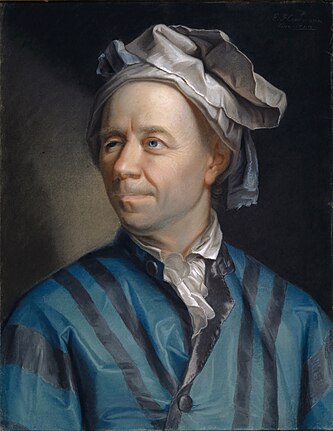
About Leonhard Euler
Leonhard Euler (15 April 1707 – 18 September 1783) was a Swiss mathematician, physicist, astronomer, geographer, logician, and engineer who founded the studies of graph theory and topology and made pioneering and influential discoveries in many other branches of mathematics such as analytic number theory, complex analysis, and infinitesimal calculus. He introduced much of modern mathematical terminology and notation, including the notion of a mathematical function. He is also known for his work in mechanics, fluid dynamics, optics, astronomy, and music theory. He is considered to be one of the greatest mathematicians of all time.
View all quotes →