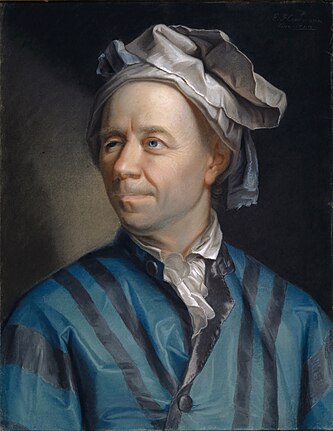
Following a suggestion by Daniel Bernoulli, Euler gave the first treatment of elastic lines by means of the calculus of variations in the Additamentum I to his Methodus inveniendi (1744...) which carries the title De curvis elasticus. Euler characterized the equilibrium position of an elastic line by the following variational principle: Among all curves of equal length, joining two points where they have prescribed tangents, to determine that which minimizes the value of the expression int ds/rho^2 [where rho is the radius of curvature]. In other words, Euler interpreted an elastic line as an inextensible curve boldsymbolzeta with a "potential energy" of int kappa^2 ds, kappa [i.e., 1/rho] being the curvature function of boldsymbolzeta, whose positions of (stable) equilibrium are characterized by the minima of the potential energy, i.e., by Johann Bernoulli's principle of virtual work. Thus the problem of the elastic line leads to the isoperimetric problemint_{boldsymbol zeta} kappa^2 ds to min qquad with int_{boldsymbolzeta} ds = L...
What It Means
This is a placeholder explanation generated by the low-overhead model. It interprets "Following a suggestion by Daniel Bernoulli, Euler gave the first treatment of elastic lines by means of the calculus of variations in the Additamentum I to his Methodus inveniendi (1744...) which carries the title De curvis elasticus. Euler characterized the equilibrium position of an elastic line by the following variational principle: Among all curves of equal length, joining two points where they have prescribed tangents, to determine that which minimizes the value of the expression int ds/rho^2 [where rho is the radius of curvature]. In other words, Euler interpreted an elastic line as an inextensible curve boldsymbolzeta with a "potential energy" of int kappa^2 ds, kappa [i.e., 1/rho] being the curvature function of boldsymbolzeta, whose positions of (stable) equilibrium are characterized by the minima of the potential energy, i.e., by Johann Bernoulli's principle of virtual work. Thus the problem of the elastic line leads to the isoperimetric problemint_{boldsymbol zeta} kappa^2 ds to min qquad with int_{boldsymbolzeta} ds = L..." in the context of "Mariano Giaquinta, Stefan Hildebrandt, Calculus of Variations I (2004) Grundlehren der mathematischen WissenSchaften Vol. 310." to mean that wisdom is timeless.
Tags
About Leonhard Euler