Link Copied!
Konrad Adenauer Quotes (1876-1967)
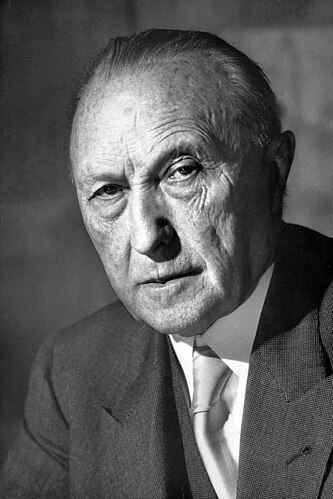

About Konrad Adenauer
Konrad Hermann Josef Adenauer (January 5, 1876 – April 19, 1967) was a German statesman. Although his political career spanned 60 years, beginning as early as 1906, he is most noted for his role as Chancellor of West Germany from 1949-1963 and chairman of the Christian Democratic Union from 1950 to 1966. He was the oldest person to be chancellor after the Second World War.
Best Konrad Adenauer Quotes
Shortest
Earliest
Explore our curated collection of the most famous and impactful Konrad Adenauer quotes.


“We all live under the same sky, but we don't all have the same horizon.”

“I wish that an English statesman might once have spoken of us as Western Europeans.”
“I reserve the right to be smarter today than I was yesterday.
• Variant:”
• Variant:”

“In view of the fact that God limited the intelligence of man, it seems unfair that he did not also limit his stupidity.”

“The Soviet Government and the Soviet people should not lend themselves to co-operating in the conversion into a concentration camp of part of a large neighbouring country against the will of its inhabitants.”
“An unsteady nation has no friends. The German people seriously worry me. The only thing I can say for them is that they have lived through too much. They have not found peace of mind and stability since the war of 1914-18.”
“I see the significance of the Marshall Plan in the fact that probably for the first time in history a victorious country held out its hand so that the vanquished might rise again.”

“European integration should not be rigid but as flexible as we can possibly make it. It should not be a straitjacket for the peoples of Europe but should be their common mainstay, a common support for the healthy, individual development of each of them.”
“I am a German, but I am also, and always have been, a European and have always felt like a European. I have therefore long advocated an understanding with France; I did so, moreover, in the 1920s, during the severest crises, and also in the face of the Reich Government.”
“After twelve years of National Socialism there simply were no perfect solutions for Germany and certainly none for a divided Germany. There was very often only the policy of the lesser evil. We were a small and very exposed country. By our own strength we could achieve nothing. We must not be a no-man's land between East and West for then we would have friends nowhere and a dangerous neighbour in the East.”

“Unless we act, events that we Europeans will be unable to influence will overtake us. I believe we Europeans feel far too safe. Europe’s political and economic leadership in the world, which was still unchallenged at the beginning of the century, has long since ceased to exist. Will the dominant cultural influence of Europe be maintained? I think not, unless we defend it and adjust ourselves to new conditions; history has shown that civilisations are all too perishable.”
“The French fear of German resurgence which caused France to press for a policy of dismemberment of Germany seemed to be altogether exaggerated. After 1945 Germany lay prostrate - militarily, economically and politically - and in my opinion this condition was a sufficient guarantee that Germany could not again threaten France. In the future United States of Europe I saw great hope for Europe and thus for Germany. We had to try to remind France, Holland, Belgium, and the other European countries that they were - as we were - situated in Western Europe, that they are and will forever remain our neighbours, that any violence they do to us must in the end lead to trouble, and that no lasting peace can be established in Europe if it is founded on force alone.”
“The Federal Government and with it all Germans in the Federal Republic of Germany feel in these days particularly close to the Germans in the Soviet-occupied zone. We are all aware of the obligation that we have explicitly taken upon us when adopting our Basic Law. We stated at the time that we acted also on behalf of those Germans to whom participation was denied. To the entire German people on both sides of the zonal border we addressed our appeal to complete in free self-determination the unity and freedom of Germany. Our fellow-citizens in the Soviet-occupied zone should even in these critical days not doubt for a moment that we shall never slacken in striving passionately for the attainment of this great objective.”

“A reformation of relations between the Soviet people and the German people is not possible along the lines pursued by the authorities of the Soviet zone of Germany. The Germans in that zone have come to hate and despise those who violate them in so inhuman a manner. And they must be having similar feelings towards those who support that system. The closing of the border is an unprecedented admission of bankruptcy. It shows that the people who are compelled to live in that part of Germany can be prevented only by the use of physical force from leaving that paradise of workers and farmers. There is but one possibility of placing relations between the Soviet and German peoples on a new foundation: the German people must be given back the right, denied to no people on earth, to form, through a free and uninfluenced expression of their will, a government which would then be truly entitled to speak, act and decide on behalf of the whole German nation.”
Konrad Adenauer Quotes by Topic
Find exactly what you are looking for by browsing this categorized list of Konrad Adenauer quotes by topic.
Konrad Adenauer on Berlin Wall 2 quotes
“The Soviet Government and the Soviet people should not lend themselves to co-operating in the conversion into a concentration camp of part of a large neighbouring country against the will of its inhabitants.”
Konrad Adenauer on Europe 2 quotes
“European integration should not be rigid but as flexible as we can possibly make it. It should not be a straitjacket for the peoples of Europe but should be their common mainstay, a common support for the healthy, individual development of each of them.”

Konrad Adenauer on History
Konrad Adenauer on 1914
Konrad Adenauer on Economy of Europe
“Unless we act, events that we Europeans will be unable to influence will overtake us. I believe we Europeans feel far too safe. Europe’s political and economic leadership in the world, which was still unchallenged at the beginning of the century, has long since ceased to exist. Will the dominant cultural influence of Europe be maintained? I think not, unless we defend it and adjust ourselves to new conditions; history has shown that civilisations are all too perishable.”

Konrad Adenauer on Economy of Germany
“The French fear of German resurgence which caused France to press for a policy of dismemberment of Germany seemed to be altogether exaggerated. After 1945 Germany lay prostrate - militarily, economically and politically - and in my opinion this condition was a sufficient guarantee that Germany could not again threaten France. In the future United States of Europe I saw great hope for Europe and thus for Germany. We had to try to remind France, Holland, Belgium, and the other European countries that they were - as we were - situated in Western Europe, that they are and will forever remain our neighbours, that any violence they do to us must in the end lead to trouble, and that no lasting peace can be established in Europe if it is founded on force alone.”

What Konrad Adenauer Said About Others
Discover personal opinions Konrad Adenauer shared regarding contemporaries.
Konrad Adenauer on Charles de Gaulle
“Mr De Gaulle is very much a realist, even very realistic.”

Quotes About Konrad Adenauer
Gain deeper perspective through quotes about Konrad Adenauer from others.
Perry Anderson on Konrad Adenauer
“Did it have to come to this? The paradox is that when Europe was less united, it was in many ways more independent. The leaders who ruled in the early stages of integration had all been formed in a world before the global hegemony of the United States, when the major European states were themselves imperial powers, whose foreign policies were self-determined. These were people who had lived through the disasters of the Second World War, but were not crushed by them. This was true not just of a figure like De Gaulle, but of Adenauer and Mollet, of Eden and Heath, all of whom were quite prepared to ignore or defy America if their ambitions demanded it. Monnet, who did not accept their national assumptions, and never clashed with the US, still shared their sense of a future in which Europeans could settle their own affairs, in another fashion. Down into the 1970s, something of this spirit lived on even in Giscard and Schmidt, as Carter discovered. But with the neo-liberal turn of the 1980s, and the arrival in power in the 1990s of a postwar generation, it faded. The new economic doctrines cast doubt on the state as a political agent, and the new leaders had never known anything except the Pax Americana. The traditional springs of autonomy were gone.”

Carole C. Fink on Konrad Adenauer
“Among the most anxious witnesses to the Hungarian and Suez crises was West German chancellor Konrad Adenauer. The Federal Republic, NATO’s newest member, had declared its neutrality in the war against Egypt, but it had been jarred by the Soviets’ brutal repression in Hungary and by Moscow’s threats to London and Paris as well as by America’s cavalier treatment of its principal European allies. Seizing the moment of his arrival in Paris on November 6, just as the ceasefire was announced, Adenauer urged his hosts to work together to “build Europe.””
Dwight D. Eisenhower on Konrad Adenauer 2 quotes
“I am deeply grateful for your kind message from Milwaukee and I reciprocate most cordially your expression of good wishes. It was indeed a pleasure for me to have a chance to talk with you during your stay in Washington. I share your viewpoint regarding the community of interests and ideas which exists between our respective Governments and peoples, and I know that your visit here has contributed materially to the further strengthening of the bonds of friendship between our two countries. Mrs. Eisenhower joins me in sending you warm regards.”

Henry Kissinger on Konrad Adenauer 2 quotes
“On each of the six leaders profiled in this book, these upheavals left an indelible mark. The political career of Konrad Adenauer (born 1876), who served as mayor of Cologne from 1917 to 1933, would include the interwar conflict with France over the Rhineland as well as the rise of Hitler; during the Second World War, he was twice imprisoned by the Nazis. Beginning in 1949, Adenauer shepherded Germany past the lowest point of its history by abandoning its decades-long quest for domination of Europe, anchoring Germany in the Atlantic Alliance, and rebuilding it on a moral foundation which reflected his own Christian values and democratic convictions.”

Ronald Reagan on Konrad Adenauer
“In West Germany and here in Berlin, there took place an economic miracle, the Wirtschaftswunder [Miracle on the Rhine]. Adenauer, Erhard, Reuter, and other leaders understood the practical importance of liberty -- that just as truth can flourish only when the journalist is given freedom of speech, so prosperity can come about only when the farmer and businessman enjoy economic freedom. The German leaders -- the German leaders reduced tariffs, expanded free trade, lowered taxes. From 1950 to 1960 alone, the standard of living in West Germany and Berlin doubled.”

Herman Van Rompuy on Konrad Adenauer
“But the will to not let history repeat itself, to do something radically new, was so strong that new words had to be found. For people Europe was a promise, Europe equalled hope. When Konrad Adenauer came to Paris to conclude the Coal and Steel Treaty, in 1951, one evening he found a gift waiting at his hotel. It was a war medal, une Croix de Guerre, that had belonged to a French soldier. His daughter, a young student, had left it with a little note for the Chancellor, as a gesture of reconciliation and hope. I can see many other stirring images before me. Leaders of six States assembled to open a new future, in Rome, città eterna … Willy Brandt kneeling down in Warsaw. The dockers of Gdansk, at the gates of their shipyard. Mitterrand and Kohl hand in hand. Two million people linking Tallinn to Riga to Vilnius in a human chain, in 1989. These moments healed Europe.”
Odd Arne Westad on Konrad Adenauer 2 quotes
“The biggest Cold War problem inside western Europe was how to handle the German question. From the setting up of the Federal Republic of Germany in 1949, there had always been a suspicion that West German leaders would give up on Western cohesion in order to strike a deal with the USSR on reunification. The idea was not far-fetched. Mistrust of Germans, any Germans, went together with the knowledge that under Cold War conditions such a deal was the only means through which the Germans could achieve what other Europeans assumed were their most cherished aims. But the assumption of German pliability toward the Soviets foundered on the thinking of the West German Bundeskanzler (premier) Konrad Adenauer. A conservative Christian Democrat from Rhineland in the west of the country, Adenauer wanted reunification, but he wanted his Germany’s integration with the Western powers even more. Adenauer was keenly aware of how enticing the siren song of reunification, even under Communist conditions, could be to some of his countrymen. He therefore at all times prioritized cooperation with the French and with the Americans. “For us, there is no doubt that we belong to the western European world through heritage and temperament,” he had said already in his first declaration as German premier. And Adenauer became a constant in West German politics, remaining chancellor until 1963, when he was eighty-seven years old.”
About Konrad Adenauer
Konrad Hermann Josef Adenauer (January 5, 1876 – April 19, 1967) was a German statesman. Although his political career spanned 60 years, beginning as early as 1906, he is most noted for his role as Chancellor of West Germany from 1949-1963 and chairman of the Christian Democratic Union from 1950 to 1966. He was the oldest person to be chancellor after the Second World War.