Link Copied!
Kit Carson Quotes (1809-1868)
About Kit Carson
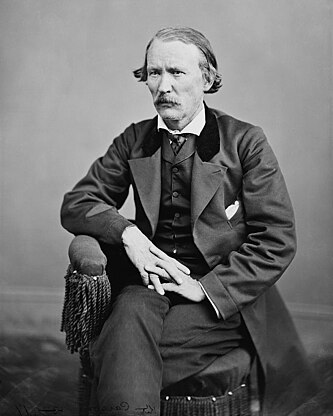
Christopher Houston "Kit" Carson (December 24, 1809 – May 23, 1868) was an American frontiersman. The few paying jobs he had during his lifetime included mountain man (fur trapper), wilderness guide, Indian agent, and American Army officer. Carson became a frontier legend in his own lifetime via biographies and news articles. Exaggerated versions of his exploits were the subject of dime novels.
Best Kit Carson Quotes
Shortest
Earliest
Explore our curated collection of the most famous and impactful Kit Carson quotes.
“An oft-repeated anecdote is that which relates of an army officer, somewhat of a hero-worshiper, who, upon meeting Carson, exclaimed, effusively: "So this is the great Kit Carson, who has made so many Indians run!" "Yes," drawled Carson, '''"sometimes I run after them but most times they war runnin' after ''me'''''."”
“Particular care should be taken that every promise made to them [the Navajo and Mescalero Apache] should be observed to the letter. In this way I am confident that in a few years they would equal if not excel our peaceful and industrious Pueblos, and be a source of wealth to the Territory, instead of being as heretofore its dread and impoverishers.”
“Jis' to think of that dog Chivington and his dirty hounds, up thar at Sand Creek. His men shot down squaws, and blew the brains out of little innocent children. You call sich soldiers Christians, do ye? And Indians savages? What der yer s'pose our Heavenly Father, who made both them and us, thinks of these things? I tell you what, I don't like a hostile red skin any more than you do. And when they are hostile, I've fought 'em, hard as any man. But I never yet drew a bead on a squaw or papoose, and I despise the man who would.”

“Well, I'll tell ye. I war down on the plains, an' the Comanches got after me. Thar war 'bout five hundred of 'em, an' they chased me. We run an' we run, an' my hoss war killed an' I clum a sort o' butte. Thar war a leetle split or cañon in it, an' I run up this. One big red rascal kep' right on my heels; my gun war busted, but I had my knife. The split narrered an' narrered, an got smaller an' smaller, an' suddenly it pinched out; an' thar I war, at the end. So I turned, with my knife, an' when he come on I struck at him. But the walls o' the split war so near together that I hit the rock, an' busted my knife squar' off at the hilt. When he seed that he give a big yell, for my scalp, an' at me he jumped. ...then the Injun killed me.”

“Owing to the strength of this [the Navajo] tribe which numbered then not less than sixty or seventy thousand (60 or 70,000) souls embracing as it did some of those Indians who now call themselves 'Apaches' but who still speak the same language, and who are so alike, and to the fact that they inhabit a country equal to one-third of the whole Territory; that this section was a 'Terra Incognita' and that there is no portion of the American Continent so well adapted by nature for the peculiar style of warfare adopted by the Indians, it is not at all surprising that the many powerful campaigns made against them by the Spanish Government were entirely barren of results as to their subjugation.”
“The government now tried coercion and vigorous campaign reduced a portion of them [the Navajos] to apparent submission. Again a treaty was made... Another and several other expeditions were organized, all ending and being followed with like results, not because the troops did not bravely energetically and intelligently carry out their instructions; but because the policy adopted was erroneous.
The last and perhaps most successful expedition sent against them under this policy, was that of 1860-61 under command of Bvt. Col. (now Brig, Gen.) E.R.S. Canby, U.S. Army. The treaty made on this occasion was signed by twenty-two Chiefs, a greater number than on any other previous occasion. From this fact and other concurrent causes, it was believed that permanent peace and security was at last bestowed on the Territory, and commensurate to the boon was the joy of the people.”
The last and perhaps most successful expedition sent against them under this policy, was that of 1860-61 under command of Bvt. Col. (now Brig, Gen.) E.R.S. Canby, U.S. Army. The treaty made on this occasion was signed by twenty-two Chiefs, a greater number than on any other previous occasion. From this fact and other concurrent causes, it was believed that permanent peace and security was at last bestowed on the Territory, and commensurate to the boon was the joy of the people.”

“Early in 1861 the Rebellion broke out, and all minor affairs were swallowed up in the major one of preserving the Union. The troops were recalled from the Navajo country to take part in the struggle, and hardly had they left their stations when the 'war-whoop' of the relentless foe smote the hearing of our peaceable citizens with appalling destruction, the more appalling from being unexpected—owing to their faith in the treaty just concluded. ...and the Navajos were consequently undisturbed in their infernal work of destruction. Well did they take advantage of this opportunity. Never before were their atrocities so numerous. They overran the whole country, and carrying their boldness so far as to enter the settlements and towns, carrying off their stock from before the people's eyes, and murdering citizens, even within two miles of the capital. No place was secure, and every town and hamlet became a fortification to protect its inhabitants. ...Nor were the Mescalero Apaches idle. They took advantage of the withdrawal of the troops from fort stations to pillage and lay waste the flourishing settlements established on the Rio Bonito, Tularosa, and adjacent streams, and this they did effectually—out of a well cultivated country making a desert.”

“Shortly after the ignominious expulsion of the Texas invaders, General J.H. Carleton was appointed to the command of this Department, and with the greatest promptitude he turned his attention to the freeing of the Territory from these lawless savages. To this great work he brought many years' experience and a perfect knowledge of the means to effect that end. He saw that the thirty (30) millions of dollars expended and the many lives lost in the former attempts at the subjugation, would not have been profitless, had not there been something radically wrong in the policy pursued. He was not long in ascertaining that treaties were as promises written in sand. nor in discovering that they had no recognized 'Head' authority to represent them; that each chief's influence and authority was immediately confined to his own followers or people; that any treaty signed by one or more of these chiefs had no binding effect on the remainder, and that there were a large number of the worst characters who acknowledged no chief at all. Hence it was that on all occasions when treaties were made, one party were continuing their depredations, whilst the other were making peace. And hence it was apparent that treaties were absolutely powerless for good. He adopted a new policy, i.e., placing them on a reservation (the wisdom of which is already manifest); a new era dawned on New Mexico, and the dying hope of the people was again revived; never more I trust, to meet with disappointment. He first organized a force against the Mescalero Apaches, which I had the honor to command. After a short and inexpensive campaign, the Mescaleros were placed on their present reservation.”

Quotes About Kit Carson
Gain deeper perspective through quotes about Kit Carson from others.
Henry Mills Alden on Kit Carson
“From California we have intelligence to the 16th of September. The State election, which took plum on the 7th, resulted in the complete triumph of the Democratic ticket.—Governor Bigler was re-elected by a majority of about a thousand, and the Legislature is largely Democratic in both branches. Lieut Beale, concerning whose safety some fears had begun to be entertained, arrived at Los Angeles on the 27th of August, having made the entire trip from Westport Mo., in about fifty days. He reports the route traveled entirely practicable for a railroad, and in many parts abounding in wood and water. The party met with no hostility from the Indians. It is announced that the Indian difficulties on the Rogue River have ceased. Several duels, murders, and robberies are reported, but none of them present any remarkable features. The celebrated Kit Carson had reached California, with over nine thousand sheep from across the Plains. The miners were doing well, and fresh discoveries of gold in different parts of the State continued to be announced.”
William Watts Hart Davis on Kit Carson
“While at Taos, I saw for the first time and made acquaintance of Kit Carson, the celebrated mountaineer. I was standing in front of Major Blake's quarters, when I saw a small-sized, modest-looking person approaching who, I was told, was the famous mountain-man of whom I had heard so much. He is about five feet eight inches in height, rather heavy set, and a little bow-legged; he is a mild, pleasant man in conversation, with a voice almost as soft as that of a woman. He has brown eyes and dark hair, with a face somewhat hard-featured from long exposure among the mountains. He was dressed plainly, and his whole personal appearance was entirely different from what I had imagined this celebrated trapper and hunter. There is nothing like a fire-eater in his manners, but, to the contrary, in all his actions he is quiet and unassuming. His has been a romantic, roving life, and his personal history embraces as much of wild adventure and hair-breadth escapes as that of any man in the Union. He has been fairly cradled among the Rocky Mountains and upon the desert plains that lie in the heart of the American continent, and is familiar with the fastnesses of the one and the trackless pathways of the other. He has endured all imaginable hardships with a steady perseverance and unflinching courage. A history of his adventures would make one of the most interesting volumes ever presented to the public.”
Ceran St. Vrain on Kit Carson
“Sir: We, the undersigned citizens of the Territory of New Mexico, have been acquainted with Mr. Christopher Carson for a number of years, indeed almost from the time of his first arrival in the country. We have been his companions both in the mountains and as a private citizen. We are also acquainted with the fact that for the past few months, during his leisure hours, he has been engaged dictating his life. This is, to our certain knowledge, the only authentic biography of himself and his travels that has ever been written. We heartily recommend this book to the reading community for perusal, as it presents a life out of the usual routine of business, and is checkered with adventures which have tried this bold and daring man. We are cognizant of most of the details of the book, and vouch for their accuracy.”
De Witt Clinton Peters on Kit Carson 2 quotes
“In olden times there existed, in the Rocky Mountains, a race familiarly known by the name of "Trappers and Hunters." They are now almost extinct. Their history has not yet been written. Pen paintings, drawn from the imagination, founded upon distant views of their exploits and adventures, have occasionally served, as do legends, to "adorn a tale." The volume now offered to the public, gives their history as related by one whose name as a trapper and hunter of the" Far West," stands second to none; by a man, who for fifteen years, saw not the face of a white woman, or slept under a roof; who, during those long years, with his rifle alone, killed over two thousand buffalo, between four and five thousand deer, antelope, and elk, besides wild game, such as bears, wild turkeys, prairie chickens, etc., etc. in numbers beyond calculation. On account of their originality, daring, and interest, the real facts, concerning this race of trappers and hunters, will be handed down to posterity as matters belonging to history.”
John Hanson Beadle on Kit Carson
“In New Mexico there are about half a dozen castes... The common people are incredibly poor. If a late peon, now free, has a dollar, he neither labors nor thinks till it is gone. Twenty-five cents of it buys flour, twenty-five goes for dulces [sweets] for the señora, another twenty-five pays for absolution, and the rest buys a lottery ticket. No matter if his ticket draw a blank a hundred times in succession: "maybe some time I win," is to him sufficient answer. A few families own all the wealth of the country. Even they have their wealth mostly in flocks and herds, and immense as it is, it brings them but few of the luxuries of life. If this Territory is admitted now as a State, it ought to be called the State of Pobritta ("Little Poverty.") Each of these wealthy families has from a hundred to two thousand dependents, some of whom were their peons before that system was abolished, and continue to yield obedience by nature and habit. If a State, this would be a most complete "rotten borough"—the worst "carpet bag" State in the Union. Fifteen families with ease would rule it—the Chaves, Gallegos, Delgados, Señas, Garcias, Pereas, Oteros, Quintañas, and a few others. These families have three-fourths of the wealth of the Territory and all the influence. The poor Mexicans do any thing they are told... These families, in combination with half a dozen priests, and a dozen or more Americans, would divide the home offices between them, and send whomsoever they pleased to Congress. It is usually the aim of speculative Americans to "stand in" with one of the noble families. But many of our people have disdained such sycophancy, and yet won for themselves an honorable place in New Mexican annals. Chief among these was the noted Kit Carson, scout, trapper, and hunter; then guide to Fremont, and afterwards Federal colonel, and last of all Indian Agent for the Utes, in which capacity he died at his home in Taos.”
George B. Anderson on Kit Carson
“The valley of Taos, with its two great Pueblos, the old town of Fernando de Taos and the still more ancient settlement known as Ranchos de Taos, is one of the most fascinating and historical points in the entire West. Taos was for many years following the American occupation, the chief political storm-center of the Territory. The presence there of such men as Charles Bent, the first Governor (whose death in the revolution of 1847 is among the first events officially recorded in the county) Colonel Christopher ("Kit") Carson, the famous scout and guide; Colonel Cerean St. Vrain, the well known merchant; "Don Carlos" Beaubien, one of the original proprietors of the notorious Maxwell land grant and first Chief Justice of New Mexico; Father Martinez, demagogue, traitor, conspirator against peace and as great a rascal as ever remained unhung in New Mexico, whether viewed from a political or moral standpoint—such as these gave the community a position in Territorial affairs equal to that of Santa Fé, the capital. The halo of romance and the glamour of tragedy with which it became invested in the early days, though somewhat dimmed during the more peaceful years that have followed, still surround the name of Taos, and always will.”
Le Baron Bradford Prince on Kit Carson
“Kit Carson first came from Missouri to Santa Fé in 1826; afterwards going to Taos, where he studied Spanish with [Mathew] Kinkead, and through all the travels and vicissitudes of his after life, retained that as his home.”
Benjamin Maurice Read on Kit Carson
“On the 25th day of September, 1846, General Kearny, after leaving instructions for Colonel Doniphan to continue with his division on to Chihuahua, and for Colonel Price to follow to California, started for California with a large portion of the American army. At Socorro he met Kit Carson, who was on his way from California to Washington with official messages from General Fremont. Kearny took Carson with him as guide, and sent Fremont's messages on to Washington by another escort.”
Captain A.W. Archibald on Kit Carson
“Talking with him one day he said to me that nobody whose writings had been read to him had ever fully described life along the trail, western life, or the experiences of a hunter. I happened to quote to him the beginning of Scott's "Lady of the Lake"— "The stag at eve had drunk his fill," etc. Immediately he asked me who wrote that and what was the poem. He begged me to find a copy of the entire poem, which I did, and every night for three weeks I read it to him. He regarded it as the finest expression of outdoor life that he had ever heard, and frequently afterward quoted with genuine approval stanzas from it.”
Robert C. Lowry on Kit Carson 2 quotes
“A man of the most kindly and gentle spirit; unassuming, quiet, and the last person that one would suppose to be possessed of qualities that made him famous... He was a very genial man, and there were one or two funny stories that I used to tell him that amused him greatly, especially one that described a fight between two camp-women at Fort Union. I lived in Santa Fe the winter of 1863 and 1864, and he was there at the time, and almost always when I met him he would stop and make me tell him that story. He also used to lend me his horse to ride. It was a very ordinary looking yellow horse, and a pacer, and by no means the prancing steed that he is always pictured as mounted upon. He was so unassuming and kind-hearted that he won me completely, for I was only a boy of seventeen or eighteen, and to have Kit Carson notice me and seem attracted to my yarns meant a great deal to me.”
Smith H Simpson on Kit Carson
“Kit Carson before the war could but write his name, and read but a word or two. But from the time when he went out as an army officer with other army officers, by association and by application he learned more, so that when I was last with him he was a fair reader and writer, but was not 'stuck on the job.'''' I noticed quite an improvement in his dress, his speech and his whole being. The war developed him, so that in my opinion there were two Kit Carsons— one before the war, and one after.'''”
Ralph Emerson Twitchell on Kit Carson 2 quotes
“The objects of the expedition against the Navajos having been substantially accomplished, Colonel Carson came to Santa Fe, and while visiting with his family at Taos, saw fit to write an historical sketch of the Navajo and his relations with the Spanish and Mexican inhabitants of the country. This sketch shows that Carson was altogether familiar with the history of the country; that he knew of all the efforts on the part of the government of the United States to maintain peaceful relations with this noted tribe; it also shows that Carson had a general knowledge of the history of the country and was capable of giving written expression to his views and information, a demonstration that this boy who had run away from an obnoxious apprenticeship in Missouri was not so entirely deficient in education as some of his college-bred critics of very recent years have seen fit to discuss and would have us believe, taking for their authority the statements of individuals who knew Carson but whose only claim to distinction lies in their being permitted to live so long that no other person now living can give present contradiction to their statements.”
Charles L. Camp on Kit Carson
“Kit Carson was a man of great energy and decision of character, alert, poised, calm in danger, and among the keenest, shrewdest, and bravest of experienced frontiersmen. In knowledge of his craft he ranked with such leaders as Bridger, St. Vrain, the Bent "boys," Antoine Leroux, and others among his associates. Yet his appearance was unheroic enough—short and stocky, grey-eyed, blond-haired, and bow-legged. He had however those qualities of modesty, sobriety, and strict veracity not proverbially common among the trappers of his day. His kindliness and generosity caused at least three "old timers,"—Oliver Wiggens, "Billy" Ryus, and "Cap't" Drannan, to regard him as their foster father. Those who knew him well,—General Sherman, General [James Fowler] Rusling, General Beale, General Fremont, Col. [DeWitt Clinton] Peters and a host of other friends,—respected, honored and loved him. His name will "carry on" as long as our highways and railways follow his trails and our cities cover his ground where he broke the brush for his campfires.”
Fred A. Engle on Kit Carson
“Between the years 1827 and 1828, three Madison County natives saw each other and worked together in far off Taos, New Mexico. They were Christopher (Kit) Carson, Mathew Kinkead and William Wolfskill. ...When Kit was about 1 1/2, the Carsons moved west to Missouri. Soon after his sixteenth birthday, Kit ran away from home, following a wagon train that ended up in Taos. Carson's first job in Taos was working for Mathew Kinkead... an early Santa Fe trader, one of Taos's first distillers... and a founder of Fort Pueblo. ...although Kinkead opened his home in Taos to the fellow Madison Countian, Kit never seemed to like or speak well of him.”
About Kit Carson
Christopher Houston "Kit" Carson (December 24, 1809 – May 23, 1868) was an American frontiersman. The few paying jobs he had during his lifetime included mountain man (fur trapper), wilderness guide, Indian agent, and American Army officer. Carson became a frontier legend in his own lifetime via biographies and news articles. Exaggerated versions of his exploits were the subject of dime novels.