Link Copied!
Kenzaburō Ōe Quotes (1935-2023)
Actor, Author
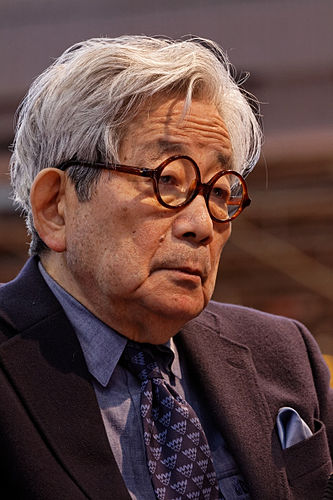

About Kenzaburō Ōe
Kenzaburō Ōe (大江 健三郎, Ōe Kenzaburō; 31 January 1935 – 3 March 2023) was a Japanese author and a major figure in contemporary Japanese literature. In 1994 he won the Nobel Prize for Literature.
Best Kenzaburō Ōe Quotes
Shortest
Earliest
Explore our curated collection of the most famous and impactful Kenzaburō Ōe quotes.
“I don’t think young people need to see the face of the deceased.”
“The dead can survive as part of the lives of those that still live.”
“To be upright and to have an imagination: that is enough to be a very good young man.”

“The writer’s job is the job of a clown …the clown who also talks about sorrow.”

“The ideal teacher student relationship exists when the student is better than the teacher.”
“Understanding comes hard to persons of high rank who are accustomed to phony lifestyles that involve no daily work.”

“It takes a person of great care and insight to watch for any abnormality in the green grass even while it grows abundantly and healthily.”
“To repeat the error by exhibiting, through the construction of nuclear reactors, the same disrespect for human life is the worst possible betrayal of the memory of Hiroshima’s victims.”
“A dangerous atmosphere of nationalism is coming in our society. So now I want to criticize this tendency, and I want to do everything to prevent the development of fascism in Japanese society.”

“He said he didn’t care if he went to heaven or hell, because neither could be more fearful than absolute nothingness; salvation and damnation were one and the same if the only thing out there was total nothingness.”


“To talk of prayer after admitting he professed no faith was, in my opinion, a breach of common courtesy. In this sense, he did make a social blunder, for which I think he well deserved some minor castigation.”
“I am one of the writers who wish to create serious works of literature which dissociate themselves from those novels which are mere reflections of the vast consumer cultures of Tokyo and the subcultures of the world at large.”


“The people of Hiroshima went to work at once to restore human society in the aftermath of the great atomic flood. They were concerned to salvage their own lives, but in the process they also salvaged the souls of the people who have brought the atomic bomb.”
“I think the question for him is, how is a faithless person to cope with life. This is where he believes he can find something upon which to establish a literary career. You know, don’t you, how often he talks of Yeats? This goes way back, to when he was very young.”
“I have a habit to be reborn as a writer. So if I find myself in a crisis that I have never experienced, I can be born, or I can write something, by the power of the habit. Even a soldier or a farmer or a fisherman can be reborn by the power of the habit when he meets the greatest crisis of his life.”
“I think, we can only write very personal matters through our experience. When I named my first novel about my son A Personal Matter, I believe I knew the most important thing: there is not any personal matter; we must find the link between ourselves, our "personal matter," and society.”

“In the rest of my lecture I would like to use the word "ambiguous" in accordance with the distinction made by the eminent British poet Kathleen Raine; she once said of William Blake that he was not so much vague as ambiguous. I cannot talk about myself otherwise than by saying "Japan, the Ambiguous, and Myself".”
“One day Bird had approached his father with this question; he was six years old: Father, where was I a hundred years before I was born? Where will I be a hundred years after I die? Father, what will happen to me when I die? Without a word, his young father had punched him in the mouth, broke two of his teeth and bloodied his face, and Bird forgot the fear of death.”
Kenzaburō Ōe Quotes by Topic
Find exactly what you are looking for by browsing this categorized list of Kenzaburō Ōe quotes by topic.
Kenzaburō Ōe on Observation
“My observation is that after one hundred and twenty years of modernisation since the opening of the country, present-day Japan is split between two opposite poles of ambiguity.”

Kenzaburō Ōe on Categorical imperative

Quotes About Kenzaburō Ōe
Gain deeper perspective through quotes about Kenzaburō Ōe from others.
Sarah Fay on Kenzaburō Ōe
“Kenzaburo Oe has devoted his life to taking certain subjects seriously — victims of the atomic bombing of Hiroshima, the struggles of the people of Okinawa, the challenges of the disabled, the discipline of the scholarly life — while not appearing to take himself seriously at all. Although he is known in Japan as much for being a gadfly activist as for being one of the country’s most celebrated writers, in person Oe is more of a delightful wag”
About Kenzaburō Ōe
Kenzaburō Ōe (大江 健三郎, Ōe Kenzaburō; 31 January 1935 – 3 March 2023) was a Japanese author and a major figure in contemporary Japanese literature. In 1994 he won the Nobel Prize for Literature.