Link Copied!
Karl Pearson Quotes (1857-1936)
Mathematician
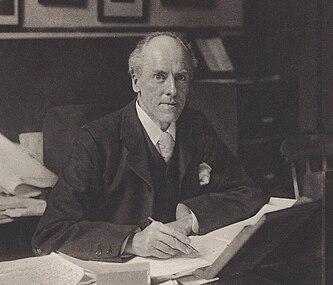


About Karl Pearson
Karl Pearson (27 March 1857 – 27 April 1936) was an influential English mathematician and biostatistician. He founded the world's first university statistics department at University College London in 1911.
Best Karl Pearson Quotes
Shortest
Earliest
Explore our curated collection of the most famous and impactful Karl Pearson quotes.


“[T]he tribal conscience ought for the sake of social welfare to be stronger than private interest...”
“[T]he task of science can never end till man ceases to be, till history is no longer made, and development itself ceases.”
“If any... work gives a description of phenomena that appeals to... imagination rather than to... reason, then it is bad science.”


“[I]t is better to be content with the fraction of a right solution than to beguile ourselves with the whole of a wrong solution.”
“In my enthusiasm Monte Carlo appeared to me in a new light; it was clearly a scientific laboratory preparing material for the natural philosopher.”

“Our conception of chance is one of law and order in large numbers; it is not that idea of chaotic incidence which vexed the mediaeval mind.”
“No statements of mere averages... are of the least avail against our statistics. Fluctuations from the averages are the sole reliable test...”
“Science can only answer to the great majority of "metaphysical" problems "I am ignorant." Meanwhile, it is idle to be impatient or to indulge in system-making.”
“[M]y axiom runs as follows: "The whole is not identical with a part." This axiom leads us at once to a problem. What relation has the part to the whole?”

“All great scientists have, in a certain sense, been great artists; the man with no imagination may collect facts, but he cannot make great discoveries.”
“Our aesthetic judgment demands harmony between the representation, and the represented and in this sense science is often more artistic than modern art.”
“I felt somewhat taken aback. ...to have hit upon a month of roulette ...so improbable ...that it would only occur on the average once in 167,000 years of continuous roulette playing.”

“Monte Carlo roulette, if judged by returns which are published... is, if the laws of chance rule, from the standpoint of exact science the most prodigious miracle of the nineteenth century.”
“The universe is a variable quantity, which depends upon the keenness and structure of our organs of sense, and upon the fineness of our powers and instruments of observation.”

“The shadow of death, more strongly even than blood or nation, maketh mankind akin; it arouses sympathy and understanding, which surmount all the barriers of caste and station.”

“The absence of the improbable, the redundancy of the probable, is just as much conclusive evidence against conformity with scientific law as the too frequent occurrence of the improbable itself.”
“That it does not pay to gamble has been the oft repeated theme of the moralist, and has been demonstrated with much brave show of symbols by mathematicians from Lagrange to De Morgan and onwards.”

Karl Pearson Quotes by Topic
Find exactly what you are looking for by browsing this categorized list of Karl Pearson quotes by topic.
Karl Pearson on Middle Ages 2 quotes
“Our conception of chance is one of law and order in large numbers; it is not that idea of chaotic incidence which vexed the mediaeval mind.”
Karl Pearson on Citizenship
“Each one of us is... called upon to give a judgment upon an immense variety of problems, crucial for our social existence. If that judgment confirms measures and conduct tending to the increased welfare of society, then it may be termed a moral, or, better, a social judgment. It follows, then, that to ensure a judgement's being moral, method and knowledge are essential to its formation. ...[T]he formation of a moral judgment—that is, one which the individual is reasonably certain will tend to social welfare—does not depend solely on the readiness to sacrifice individual gain or comfort, or on the impulse to act unselfishly: it depends in the first place on knowledge and method. The first demand of the state upon the individual is not for self-sacrifice but for self-development. ...[T]he man who gives a vote... in the choice of a representative, after forming a judgement based upon knowledge, is... acting socially, and is fulfilling a higher standard of citizenship.”

Karl Pearson on Judgment
“Each one of us is... called upon to give a judgment upon an immense variety of problems, crucial for our social existence. If that judgment confirms measures and conduct tending to the increased welfare of society, then it may be termed a moral, or, better, a social judgment. It follows, then, that to ensure a judgement's being moral, method and knowledge are essential to its formation. ...[T]he formation of a moral judgment—that is, one which the individual is reasonably certain will tend to social welfare— does not depend solely on the readiness to sacrifice individual gain or comfort, or on the impulse to act unselfishly: it depends in the first place on knowledge and method. The first demand of the state upon the individual is not for self-sacrifice but for self-development. ...[T]he man who gives a vote... in the choice of a representative, after forming a judgement based upon knowledge, is... acting socially, and is fulfilling a higher standard of citizenship.”

What Karl Pearson Said About Others
Discover personal opinions Karl Pearson shared regarding contemporaries.
Karl Pearson on Francis Galton
“I have often heard, or read, though I cannot now give good references, that when the practice of selling or buying slaves was practised by men of our race, with few qualms of conscience, the slaves were priced after a minute inspection. An experience of my own, of some forty-five years ago, while travelling in the Soudan, is to the point. An Egyptian, who possessed little besides a sword, had attached himself to the caravan with which I was travelling. He was on his way to join a slave-raiding expedition on the borders of Abyssinia, and he had, I found out, considerable experience in slave markets. I asked him many questions, from time to time, about the valuing of slaves, and, at last, begged him, as a favour, to price myself, just as if I was a light-coloured African; for I was curious to know my worth as an animal. He took evident pains, and I think was fairly honest, though with a bias towards flattery. Having regard to the then high state of the market, he estimated my worth on the spot, at a number of piastres that was about equal to 20 pounds.”

Quotes About Karl Pearson
Gain deeper perspective through quotes about Karl Pearson from others.
Charles M. Grinstead on Karl Pearson
“The statistician Karl Pearson analyzed a large number of outcomes at certain roulette tables and suggested that the wheels were biased. He wrote in 1894: Clearly, since the Casino does not serve the valuable end of huge laboratory for the preparation of probability statistics, it has no scientific raison d’être... [E]arly experiments were suggestive and led to important discoveries in probability and statistics. They led Pearson to the chi-squared test, which is of great importance in testing whether observed data fit a given probability distribution.”
Bernard J. Norton on Karl Pearson
“Before meeting with Weldon... Pearson had grown into a social Darwinist anxious to provide his particular form of Darwinism with a proper scientific basis, and to show that Darwin's ideas and socialism were complementary, and not opposed, as had been maintained by several leading thinkers of the nineteenth century. Biometry offered him the chance of pursuing these ends. Moreover... Pearson's conception of 'properly scientific'... was one that made it probable that the development of biometry... would yield a harvest of statistical methods. Statistics, thus formed, embodied the central tenets of Pearson's philosophy of science, and, as such, was to be universally recommended.”
Egon Sharpe Pearson on Karl Pearson
“During the first two terms of 1881 he deputised for W. H. Drew, Professor of Mathematics at King's College, London, taking the senior mathematical teaching. It was in 1882... that he was engaged in his first considerable piece of mathematical work, according to his friend W. H. Macaulay "a theory of pulsating spheres in a fluid, forming an Atomic Theory,... a thing in spherical harmonics of the Clerk-Maxwell type." This work, or part of it, was probably not published till 1887. In 1883 two papers were printed "On the Motion of Spherical and Ellipsoidal Bodies in Fluid Media", and another "Note on Twists in an Infinite Elastic Solid". It was a natural step from such research to the completion of Clifford's Common Sense of the Exact Sciences and Todhunter's History of the Theory of Elasticity. We see from the subject-matter of these papers how Pearson's mind was already at work puzzling over the laws of the physical universe, which in terms of the Grammar of Science describe the "how" rather than the "why."”
Stephen M. Stigler on Karl Pearson
“It was Karl Pearson, a man with an unquenchable ambition for scholarly recognition and the kind of drive and determination that had taken Hannibal over the Alps and Marco Polo to China, who recognized the power in Edgeworth's formulations of Galton's ideas. Pearson lacked Galton's originality and Edgeworth's depth of understanding, but it was his zeal, with a vital assist from G. Udny Yule, that created the methodology and sold it to the world.”
S.A. Stouffer on Karl Pearson
“I wish I could communicate to you, and especially to those of you who are just now beginning your professional careers in a world of statistics incredibly more sophisticated than that of Karl Pearson's day, something of the thrill in meeting in person and studying under a man of Pearson's immense reputation. Author of the Grammar of Science, perfector of simple linear correlations; inventor of multiple and partial correlation, of curvilinear correlation, of tetrachoric and bi- serial correlation; discoverer of the chi^2 function for summarizing multinomial data with magnificent simplicity; builder of a beautiful system of frequency curves derived from a single differential equation which in turn harked back to the hypergeometric series; founder of Biometrika and author or co-author of a prolific literature applying these new statistics to biological and sociological data - Karl Pearson was a hero of Asgard to an American boy vouchsafed a visit to the home of the gods. Indeed, Pearson was Thor himself - for the thunderbolts with which he attacked unsparingly those who dared oppose him were echoing and reechoing.”
Nassim Nicholas Taleb on Karl Pearson 2 quotes
“Professor Karl Pearson... devised the first test of nonrandomness (...in reality, deviation from normality ...for all intents and purposes, the same thing). He examined millions of runs of what was called a Monte Carlo (the old name for a roulette wheel) during... July 1902... He discovered... with a high degree of statistical significance... the runs were not purely random. ...Pearson was greatly surprised ...Philosophers of statistics call this the reference case problem to explain that there is no true attainable randomness in practice, only in theory.”

About Karl Pearson
Karl Pearson (27 March 1857 – 27 April 1936) was an influential English mathematician and biostatistician. He founded the world's first university statistics department at University College London in 1911.