“(That is it!)”
— Karl Marx
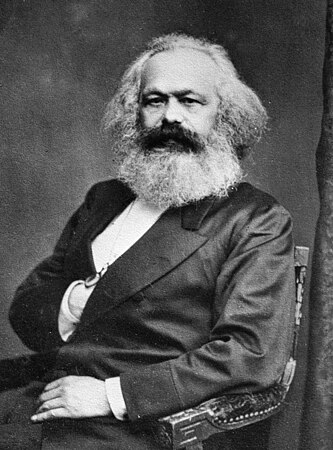













































































Explore our curated collection of the most famous and impactful Karl Marx quotes.
“(That is it!)”
“And his money he cannot eat.”
“Volume II, Ch. VIII, p. 176-177.”
“One capitalist always kills many.”
“Ramsgate is full of Jews and fleas.”

“The unity is brought about by force.”

“Money is itself a product of circulation.”
“Revolutions are the locomotives of history.”
“Reason nevertheless prevails in world history.”
“Something that is merely negative creates nothing.”
“What's sauce for the gander is sauce for the goose.”

“ Luxury is the opposite of the naturally necessary.”
“Since labour is motion, time is its natural measure.”
“Every beginning is difficult, holds in all sciences.”
“Hence money may be dirt, although dirt is not money.”
“The South has conquered nothing — but a graveyard.”
“The devil take this wrong arithmetic. But never mind.”

“It is impossible to pursue this nonsense any further.”

“The religious world is but the reflex of the real world.”

“The object before us, to begin with, material production.”
“A man cannot become a child again, or he becomes childish.”
“If anything is certain, it is that I myself am not a Marxist”Original / Translation (French)“Original: Ce qu'il y a de certain c'est que moi, je ne suis pas Marxiste.”English: “If anything is certain, it is that I myself am not a Marxist”
“Under the ideal measure of values there lurks the hard cash.”
Find exactly what you are looking for by browsing this categorized list of Karl Marx quotes by topic.
“A specter is haunting Europe, the specter of Communism.”
“A spectre is haunting Europe; the spectre of Communism.”
“The theory of Communism may be summed up in the single sentence: Abolition of private property.”
“Money is the alienated essence of man’s work and existence, this essence dominates him and he worships it.”Original / Translation (German)“Original German: "Das Geld ist das dem Menschen entfremdete Wesen seiner Arbeit und seines Daseins, und dies fremde Wesen beherrscht ihn, und er betet es an" in 'II. Die Fähigkeit der heutigen Juden und Christen, frei zu werden.' in "Zur Judenfrage" (written 1843)”English: “Money is the alienated essence of man’s work and existence, this essence dominates him and he worships it.”
“Though private property appears to be the reason, the cause of alienated labor, it is rather its consequence, just as the gods are originally not the cause but the effect of man’s intellectual confusion.”
“A direct consequence of the alienation of man from the product of his labour, from his life activity and from his species life is that man is alienated from other men. When man confronts himself, he also confronts other men. What is true of man’s relationship to his work, to the product of his work and to himself, is also true of his relationship to other men, to their labour”
“Money is not a thing, but a social relation.”
“Money plays the largest part in determining the course of history”
“I who can have, through the power of money, everything for which the human heart longs, do I not possess all human abilities? Does not my money, therefore, transform all my incapacities into their opposites?”
“Unlimited exploitation of cheap labour-power is the sole foundation of their power to compete.”
“The capitalist cannot store labour-power in warehouses after he has bought it, as he may do with the raw material.”
“The directing motive, the end and aim of capitalist production, is to extract the greatest possible amount of surplus value, and consequently to exploit labor-power to the greatest possible extent.”
“The worker puts his life into the object; but now it no longer belongs to him, it belongs to the object.”
“Capital is dead labor,that vampire-like, only lives by sucking living labor, and lives the more, the more labor it sucks.”
“The better shaped his product, the more mis-shapen the worker; the more civilized his object, the more barbaric the worker; the more powerful the work, the more powerless the worker.”
“Capital is dead labor, which, vampire-like, lives only by sucking living labor; And lives more by the labor it sucks.”
“In bourgeois society capital is independent and has individuality, while the living person is dependent and has no individuality.”
“The will of the capitalist is certainly to take as much as possible. What we have to do is not to talk about his will, but to enquire about his power, the limits of that power, and the character of those limits.”
“The Whigs as well as the Tories, form a fraction of the large landed property of Great Britain. Nay, the oldest, richest and most arrogant portion of English landed property is the very nucleus of the Whig party.”
“With the Bourgeoisie it has in common the hatred against aristocrats. In the Whigs it hates the one and the other, aristocrats and Bourgeois, the landlord who oppresses, and the money lord who exploits it. In the Whig it hates the oligarchy which has ruled over England for more than a century, and by which the People is excluded from the direction of its own affairs.”
“It is evident what a distastefully heterogeneous mixture the character of the British Whigs must turn out to be: Feudalists, who are at the same time Malthusians, money-mongers with feudal prejudices, aristocrats without point of honor, Bourgeois without industrial activity, finality — men with progressive phrases, progressists with fanatical Conservatism, traffickers in homeopathical fractions of reforms, fosterers of family — nepotism, Grand Masters of corruption, hypocrites of religion, Tartuffes of politics.”
“Capitals accumulate faster than population.”
“In bourgeois society capital is independent and has individuality, while the living person is dependent and has no individuality.”
“Capital is money, capital is commodities. … By virtue of it being value, it has acquired the occult ability to add value to itself. It brings forth living offspring, or, at the least, lays golden eggs.”
“On the other hand one must not entertain any fantastic illusions on the productive power of the credit system, so far as it supplies or sets in motion money-capital.”
“The fact is, therefore, that definite individuals who are productively active in a definite way enter into these definite social and political relations. Empirical observation must in each separate instance bring out empirically, and without any mystification and speculation, the connection of the social and political structure with production. The social structure and the state are continually evolving out of the life-process of definite individuals, but of individuals, not as they appear in their own or other people's imagination, but as they really are; i.e. as they are effective, produce materially, and are active under definite material limits, presuppositions and conditions independent of their will.
The production of ideas, of conceptions, of consciousness, is at first directly interwoven with the material activity and the material intercourse of men, the language of real life. Conceiving, thinking, the mental intercourse of men, appear at this stage as the direct efflux of their material behaviour. The same applies to mental production as expressed in the language of the politics, laws, morality, religion, metaphysics of a people. Men are the producers of their conception, ideas, etc. — real, active men, as they are conditioned by a definite development of their productive forces and of the intercourse corresponding to these, up to its furthest forms. Consciousness can never be anything else than conscious existence, and the existence of men is their actual life-process. If in all ideology men and their circumstances appear upside down as in a camera obscura, this phenomenon arises just as much from their historical life-process as the inversion of objects on the retina does from their physical life-process.”
“The development of fixed capital indicates in still another respect the degree of development of wealth generally, or of capital…
The creation of a large quantity of disposable time apart from necessary labour time for society generally and each of its members (i.e. room for the development of the individuals’ full productive forces, hence those of society also), this creation of not-labour time appears in the stage of capital, as of all earlier ones, as not-labour time, free time, for a few. What capital adds is that it increases the surplus labour time of the mass by all the means of art and science, because its wealth consists directly in the appropriation of surplus labour time; since value directly its purpose, not use value. It is thus, despite itself, instrumental in creating the means of social disposable time, in order to reduce labour time for the whole society to a diminishing minimum, and thus to free everyone’s time for their own development. But its tendency always, on the one side, to create disposable time, on the other, to convert it into surplus labour...
The mass of workers must themselves appropriate their own surplus labour. Once they have done so – and disposable time thereby ceases to have an antithetical existence – then, on one side, necessary labour time will be measured by the needs of the social individual, and, on the other, the development of the power of social production will grow so rapidly that, even though production is now calculated for the wealth of all, disposable time will grow for all. '''For real wealth is the developed productive power of all individuals. The measure of wealth is then not any longer, in any way, labour time, but rather disposable time. Labour time as the measure of value posits wealth itself as founded on poverty, and disposable time as existing in and because of the antithesis to surplus labour time; or, the positing of an individual’s entire time as labour time, and his degradation therefore to mere worker, subsumption under labour. ''The most developed machinery thus forces the worker to work longer than the savage does, or than he himself did with the simplest, crudest tools.'''''”
“Reason nevertheless prevails in world history.”
“Reason can no longer restrain one who is lured by the fury of ambition.”
“In capitalist society however where social reason always asserts itself only post festum great disturbances may and must constantly occur.”
“If this labourer were in possession of his own means of production, and was satisfied to live as a labourer, he need not work beyond beyond the time necessary for the reproduction of his means of subsistence, say 8 hours a day.”
“The monopoly of capital becomes a fetter upon the mode of production, which has sprung up and flourished along with, and under it. Centralisation of the means of production and socialisation of labour at last reach a point where they become incompatible with their capitalist integument. This integument is burst asunder. The knell of capitalist private property sounds. The expropriators are expropriated.”
“The commodity is first of all, an external object, a thing which through its qualities satisfies human needs of whatever kind. The nature of these needs, whether they arise, for example, from the stomach, or the imagination, makes no difference. Nor does it matter here how the thing satisfies man's need, whether directly as a means of subsistence, i.e. an object of consumption, or indirectly as a means of production.”
“But, in general, the protective system of our day is conservative, while the free trade system is destructive. It breaks up old nationalities and pushes the antagonism of the proletariat and the bourgeoisie to the extreme point. In a word, the free trade system hastens the social revolution. It is in this revolutionary sense alone, gentlemen, that I vote in favor of free trade.”
“Constant revolutionising of production, uninterrupted disturbance of all social conditions, everlasting uncertainty and agitation distinguish the bourgeois epoch from all earlier ones. All fixed, fast-frozen relations, with their train of ancient and venerable prejudices and opinions, are swept away, all new-formed ones become antiquated before they can ossify. All that is solid melts into air, all that is holy is profaned, and man is at last compelled to face with sober senses his real conditions of life, and his relations with his kind. The need of a constantly expanding market for its products chases the bourgeoisie over the entire surface of the globe. It must nestle everywhere, settle everywhere, establish connexions everywhere.”
“Once adopted into the production process of capital, the means of labour passes through different metamorphoses, whose culmination is the machine, or rather, an automatic system of machinery (system of machinery: the automatic one is merely its most complete, most adequate form, and alone transforms machinery into a system), set in motion by an automaton, a moving power that moves itself; this automaton consisting of numerous mechanical and intellectual organs, so that the workers themselves are cast merely as its conscious linkages... Not as with the instrument, which the worker animates and makes into his organ with his skill and strength, and whose handling therefore depends on his virtuosity. Rather, it is the machine which possesses skill and strength in place of the worker, is itself the virtuoso, with a soul of its own in the mechanical laws acting through it; and it consumes coal, oil etc. (matières instrumentales), just as the worker consumes food, to keep up its perpetual motion. The worker's activity, reduced to a mere abstraction of activity, is determined and regulated on all sides by the movement of the machinery, and not the opposite. The science which compels the inanimate limbs of the machinery, by their construction, to act purposefully, as an automaton, does not exist in the worker's consciousness, but rather acts upon him through the machine as an alien power, as the power of the machine itself... Labour appears, rather, merely as a conscious organ, scattered among the individual living workers at numerous points of the mechanical system; subsumed under the total process of the machinery itself, as itself only a link of the system, whose unity exists not in the living workers, but rather in the living (active) machinery, which confronts his individual, insignificant doings as a mighty organism. In machinery, objectified labour confronts living labour within the labour process itself as the power which rules it; a power which, as the appropriation of living labour, is the form of capital.”
“Philosophy is an interpretation of the world in order to change it.”
“Philosophy stands in the same relation to the study of the actual world as masturbation to sexual love.”
“Life is not determined by Consciousness, but Consciousness by life.”
“It is not the consciousness of men that determines their being, but, on the contrary, their social being that determines their consciousness.”
“The weapon of criticism cannot, of course, replace criticism by weapons.”
“Criticism has plucked the imaginary flowers on the chain not in order that man shall continue to bear that chain without fantasy or consolation, but so that he shall throw off the chain and pluck the living flower.”
“Let the ruling classes tremble at a Communistic revolution. The proletarians have nothing to lose but their chains.”
“The ideas of the ruling class are in every epoch the ruling ideas, i.e. the class which is the ruling material force of society, is at the same time its ruling intellectual force. The class which has the means of material production at its disposal, has control at the same time over the means of mental production.”
“The proletarians have nothing to lose but their chains. They have a world to win.
WORKING MEN OF ALL COUNTRIES, UNITE!”
“If the emancipation of the working classes requires their fraternal concurrence, how are they to fulfill that great mission with a foreign policy in pursuit of criminal designs, playing upon national prejudices, and squandering in piratical wars the people’s blood and treasure?”
“Usury lives in the pores of production, as it were, just as the gods of Epicurus lived in the space between the worlds.”
“By means of the banking system the distribution of capital as a special business, a social function, is taken out of the hands of the private capitalists and usurers. But at the same time, banking and credit thus become the most potent means of driving capitalist production beyond its own limits, and one of the most effective vehicles of crises and swindle.”
“Law, morality, religion, are ... so many bourgeois prejudices, behind which lurk in ambush just as many bourgeois interests”
“Religious suffering is, at one and the same time, the expression of real suffering and a protest against real suffering. Religion is the sigh of the oppressed creature, the heart of a heartless world, and the soul of soulless conditions. It is the opium of the people.”
“As the chosen people bore in their features the sign manual of Jehovah, so the division of labour brands the manufacturing workman as the property of capital.”
“The division of labour is the economic expression of the social character of labour within the estrangement. Or, since labour is only an expression of human activity within alienation, of the manifestation of life as the alienation of life, the division of labour, too, is therefore nothing else but the estranged, alienated positing of human activity as a real activity of the species or as activity of man as a species-being.
As for the essence of the division of labour – and of course the division of labour had to be conceived as a major driving force in the production of wealth as soon as labour was recognised as the essence of private property – i.e., as for the estranged and alienated form of human activity as an activity of the species – the political economists are very vague and self-contradictory about it.”
“The Communist revolution is the most radical rupture with traditional property relations; no wonder that its development involves the most radical rupture with traditional ideas.”
“The Communists disdain to conceal their views and aims. They openly declare that their ends can be attained only by the forcible overthrow of all existing social conditions. Let the ruling classes tremble at a Communistic revolution. The proletarians have nothing to lose but their chains. They have a world to win.
WORKING MEN OF ALL COUNTRIES, UNITE!
• Variant translation: Workers of the world, unite!”
“In place of the bourgeois society, with its classes and class antagonisms, shall we have an association, in which the free development of each is the condition for the free development of all.”
“Association, applied to land, shares the economic advantage of large-scale landed property, and first brings to realization the original tendency inherent in land-division, namely, equality. In the same way association re-establishes, now on a rational basis, no longer mediated by serfdom, overlordship and the silly mysticism of property [alberne Eigentumsmystik], the intimate ties of man with the earth, for the earth ceases to be an object of huckstering, and through free labor and free enjoyment becomes once more a true personal property of man.”
“The directing motive, the end and aim of capitalist production, is to extract the greatest possible amount of surplus value, and consequently to exploit labor-power to the greatest possible extent.”
“In the social production of their life, men enter into definite relations that are indispensable and independent of their will; these relations of production correspond to a definite stage of development of their material forces of production. The sum total of these relations of production constitutes the economic structure of society — the real foundation, on which rises a legal and political superstructure and to which correspond definite forms of social consciousness. The mode of production of material life determines the social, political and intellectual life process in general.”
“The will of the capitalist is certainly to take as much as possible. What we have to do is not to talk about his will, but to enquire about his power, the limits of that power, and the character of those limits.”
“No sooner is the exploitation of the labourer by the manufacturer, so far, at an end, that he receives his wages in cash, than he is set upon by the other portions of the bourgeoisie, the landlord, the shopkeeper, the pawnbroker, etc.”
“The whole mystery of commodities, all the magic and necromancy that surrounds the products of labor as long as they take the form of commodities, vanishes therefore, so soon as we come to other forms of production.”
“The commodity-form, and the value-relation of the products of labour within which it appears, have absolutely no connection with the physical nature of the commodity and the material relations arising out of this. It is nothing but the definite social relation between men themselves which assumes here, for them, the fantastic form of a relation between things. In order, therefore, to find an analogy we must take flight into the misty realm of religion. There the products of the human brain appear as autonomous figures endowed with a life of their own, which enter into relations both with each other and with the human race. So it is in the world of commodities with the products of men's hands. I call this the fetishism which attaches itself to the products of labour as soon as they are produced as commodities, and is therefore inseparable from the production of commodities.”
“A spectre is haunting Europe—the spectre of communism. All the powers of old Europe have entered into a holy alliance to exorcise this spectre: Pope and Tsar, Metternich and Guizot, French Radicals and German police-spies.”
“The revolutionary movement which began in 1789 in the Cercle Social, which in the middle of its course had as its chief representatives Leclerc and Roux, and which finally with Babeuf's conspiracy was temporarily defeated, gave rise to the communist idea which Babeuf's friend Buonarroti re-introduced in France after the Revolution of 1830. This idea, consistently developed, is the idea of the new world order.”
“The bourgeoisie has stripped of its halo every occupation hitherto honored and looked up to with reverent awe. It has converted the physician, the lawyer, the priest, the poet, the man of science, into its paid wage laborers.”
“The bourgeoisie, wherever it has got the upper hand, has put an end to all feudal, patriarchal, idyllic relations. It has pitilessly torn asunder the motley of ties that bound man to his “natural superiors,” and left remaining no other nexus between man and man than naked self-interest, than callous “cash payment.” It has drowned the most heavenly ecstasies of religious fervor, of chivalrous enthusiasm, of philistine sentimentalism, in the icy water of egotistical calculation. It has resolved personal worth into exchange value.”
“England, by one stroke of the pen, has confiscated not only the estates of a few noblemen, or of a royal family, but the whole length and breadth of a kingdom nearly as large as Ireland, “the inheritance of a whole people,” as Lord Ellenborough himself terms it.”
“Now, why was Lord Dalhousie so eager to deny the validity of a treaty which all his predecessors, and even his own agents, had acknowledged to be in force in their communications with the King of Oudh? Solely because, by this treaty, whatever pretext the King might give for interference, that interference was limited to an assumption of government by Britisn officers in the name of the King of Oudh, who was to receive the surplus revenue. That was the very opposite of what was wanted. Nothing short of annexation would do. This denying the validity of treaties which had formed the acknowledged base of intercourse for twenty years;this seizing violently upon independent territories in open infraction even of the acknowledged treaties; this final confiscation of every acre of land in the whole country; all these treacherous and brutal modes of proceeding of the British toward the natives of Indian are now beginning to avenge themselves, not only in India, but in England. (On Colonialism, p. 180)”
“When people speak of ideas that revolutionize society, they do but express the fact that within the old society, the elements of a new one have been created, and that the dissolution of the old ideas keeps even pace with the dissolution of the old conditions of existence.”
“The ideas of the ruling class are, in every age, the ruling ideas. ... The class which is the dominant material force in society is at the same time its dominant intellectual force. The class which has the means of material production at its disposal has control over the means of mental production, so that in consequence the ideas of those who lack the means of mental production are, in general, subject to it.”
“Whilst in ordinary life every shopkeeper is very well able to distinguish between what somebody professes to be and what he really is, our historians have not yet won even this trivial insight. They take every epoch at its word concerning what it says and imagines about itself.”
“The bourgeoisie, wherever it has got the upper hand, has put an end to all feudal, patriarchal, idyllic relations. It has pitilessly torn asunder the motley feudal ties that bound man to his “natural superiors,” and has left no other bond between man and man than naked self-interest, than callous “cash payment.” It has drowned the most heavenly ecstasies of religious fervor, of chivalrous enthusiasm, of philistine sentimentalism, in the icy water of egotistical calculation. It has resolved personal worth into exchange value, and in place of the numberless indefeasible chartered freedoms, has set up that single, unconscionable freedom—Free Trade. In one word, for exploitation, veiled by religious and political illusions, it has substituted naked, shameless, direct, brutal exploitation.”
“It is the historical mission of the capitalist system of production to raise these material foundations of the new mode of production to a certain degree of perfection. At the same time credit accelerates the violent eruptions of this contradiction - crises - and thereby the elements of the old mode of production.”
“In the social production of their life, men enter into definite relations that are indispensable and independent of their will; these relations of production correspond to a definite stage of development of their material forces of production. The sum total of these relations of production constitutes the economic structure of society — the real foundation, on which rises a legal and political superstructure and to which correspond definite forms of social consciousness. The mode of production of material life determines the social, political and intellectual life process in general. It is not the consciousness of men that determines their being, but, on the contrary, their social being that determines their consciousness.”
“Everything great glitters, glitter begets ambition, and ambition can easily have caused the inspiration or what we thought to be inspiration. But reason can no longer restrain one who is lured by the fury of ambition. He tumbles where his vehement drive calls him; no longer does he choose his position, but rather chance and luster determine it.”
“Everyone has a goal which appears to be great, at least to himself, and is great when deepest conviction, the innermost voice of the heart, pronounces it great. ... This voice, however, is easily drowned out, and what we thought to be inspiration may have been created by the fleeting moment and again perhaps destroyed by it. ... We must seriously ask ourselves, therefore, whether we are really inspired about a vocation, whether an inner voice approves of it, or whether the inspiration was a deception, whether that which we took as the Deity’s calling to us was self-deceit. But how else could we recognize this except by searching for the source of our inspiration?”
“As for large landed property, its defenders have always sophistically identified the economic advantages offered by large-scale agriculture with large-scale landed property, as if it were not precisely as a result of the abolition of property that this advantage, for one thing, received its greatest possible extension, and, for another, only then would be of social benefit.”
“Association, applied to land, shares the economic advantage of large-scale landed property, and first brings to realization the original tendency inherent in land-division, namely, equality. In the same way association re-establishes, now on a rational basis, no longer mediated by serfdom, overlordship and the silly mysticism of property [alberne Eigentumsmystik], the intimate ties of man with the earth, for the earth ceases to be an object of huckstering, and through free labor and free enjoyment becomes once more a true personal property of man.”
“But, in general, the protective system of our day is conservative, while the free trade system is destructive. It breaks up old nationalities and pushes the antagonism of the proletariat and the bourgeoisie to the extreme point. In a word, the free trade system hastens the social revolution. It is in this revolutionary sense alone, gentlemen, that I vote in favor of free trade.”
“The bourgeoisie, wherever it has got the upper hand, has put an end to all feudal, patriarchal, idyllic relations. It has pitilessly torn asunder the motley feudal ties that bound man to his “natural superiors,” and has left no other bond between man and man than naked self-interest, than callous “cash payment.” It has drowned the most heavenly ecstasies of religious fervor, of chivalrous enthusiasm, of philistine sentimentalism, in the icy water of egotistical calculation. It has resolved personal worth into exchange value, and in place of the numberless indefeasible chartered freedoms, has set up that single, unconscionable freedom—Free Trade.”
“India could not escape the fate of being conquered [by England], and the whole of her past history, if it be anything, is the history of the successive conquests she has undergone. Indian society has no history at all, at least no known history. What we call its history, is but the history of the successive intruders who founded their empires on the passive basis of that unresisting and unchanging society.”
“Indian society has no history at all, at least no known history. What we call its history, is but the history of the successive intruders who founded their empires on the passive basis of that unresisting and unchanging society. The question, therefore, is not whether the English had a right to conquer India, but whether we are to prefer India conquered by the Turk, by the Persian, by the Russian, to India conquered by the Briton.” England had to fulfill a double mission in India: One destructive, and the other regenerating - the annihilation of old Asiatic society, and the laying of the material foundations of Western society in Asia. Arabs, Turks, Tartars, Moguls, who had successively overrun India, soon became Hinduised, the barbarian conquerors being, by an eternal law of history, themselves conquered by the superior civilization of their subjects. [According to him the British were the first conquerors who were superior, and therefore inaccessible to Hindu civilization. They destroyed it by breaking up the native communities, by uprooting the native industry, and by levelling all that was great and elevated in the native society. The historic pages of their rule in India, report hardly anything beyond that destruction.] “The work of regeneration hardly transpires through a heap of ruins. Nevertheless, it has begun.”
“During the very first storms of the revolution, the French bourgeoisie dared to take away from the workers the right of association but just acquired. By a decree of June 14, 1791, they declared all coalition of the workers as “an attempt against liberty and the declaration of the rights of man,” punishable by a fine of 500 livres, together with deprivation of the rights of an active citizen for one year. This law which, by means of State compulsion, confined the struggle between capital and labour within limits comfortable for capital, has outlived revolutions and changes of dynasties. Even the Reign of Terror left it untouched. It was but quite recently struck out of the Penal Code.”
“It must be acknowledged that our worker emerges from the process of production looking different from when he entered it. In the market, as owner of the commodity 'labour-power', he stood face to face with other owners of commodities, one owner against another owner. The contract by which he sold his labour-power to the capitalist proved in black and white, so to speak, that he was free to dispose of himself. But when the transaction was concluded, it was discovered that he was no 'free agent', that the period of time for which he is free to sell his labour-power is the period of time for which he forced to sell it, that in fact the vampire will not let go 'while there remains a single muscle, sinew or drop of blood to be exploited'.”
“Quantity has a quality all its own.”
“Reason can no longer restrain one who is lured by the fury of ambition.”
“The more the capitalist has accumulated, the more he is able to accumulate.”
“So far no chemist has discovered exchange value either in a pearl or a diamond.”
“The greatest division of material and mental labour is the separation of town and country.”
“Sell a man a fish, he eats for a day, teach a man how to fish, he eats for the rest of his life.”
“The philosophers have only interpreted the world, in various ways; the point, however,is to change it”
“With money every form of intercourse, and intercourse itself, is considered fortuitous for the individuals.”
“The executive of the modern State is but a committee for managing the common affairs of the whole bourgeoisie.”
“Let the ruling classes tremble at a Communistic revolution. The proletarians have nothing to lose but their chains.”
“We have no compassion and we ask no compassion from you. When our turn comes, we shall not make excuses for the terror.”
“Law, morality, religion, are to him so many bourgeois prejudices, behind which lurk in ambush just as many bourgeois interests.”
“The class which has the means of material production at its disposal, has control at the same time over the means of mental production.”
“The English have all the material requisites for the revolution. What they lack is the spirit of generalization and revolutionary ardour.”
“Nothing has changed in Russia's policy…. Her methods, her tactics, her maneuvers may change, but the pole star—world domination—is immutable.”
“On a level plain, simple mounds look like hills; and the insipid flatness of our present bourgeoisie is to be measured by the altitude of its great intellects.”
“They stoop to pick up golden apples dropped from the tree of industry, and to barter truth, love, and honour for traffic in wool, beetroot-sugar, and potato spirits.”
“ Hegel remarks somewhere that all facts and personages of great importance in world history occur, as it were, twice. He forgot to add: the first time as tragedy, the second as farce.”
“The product of mental labor — science — always stands far below its value, because the labor-time necessary to reproduce it has no relation at all to the labor-time required for its original production.”
“The product of mental labor — science — always stands far below its value, because the labor-time necessary to reproduce it has no relation at all to the labor-time required for its original production.”
“Without slavery there is no cotton; without cotton, there is no modern industry. It is slavery that has given value to universal commerce, and it is world trade which is the condition of large scale industry.”
“We congratulate the American people upon your re-election by a large majority. If resistance to the Slave Power was the reserved watchword of your first election, the triumphant war cry of your re-election is Death to Slavery!”
“The class which has the means of material production at its disposal has control over the means of mental production, so that in consequence the ideas of those who lack the means of mental production are, in general, subject to it.”
“The class which has the means of material production at its disposal has control over the means of mental production, so that in consequence the ideas of those who lack the means of mental production are, in general, subject to it.”
“The class which has the means of material production at its disposal has control over the means of mental production, so that in consequence the ideas of those who lack the means of mental production are, in general, subject to it.”
“Reason can no longer restrain the man who is tempted by the demon of ambition, and he plunges headlong into what impetuous instinct suggests: he no longer chooses his position in life, instead it is determined by chance and illusion.”
“The criticism of religion ends with the doctrine that man is the supreme being for man. It ends, therefore, with the categorical imperative to overthrow all those conditions in which man is an abased, enslaved, abandoned, contemptible being.”
“[T]he Tories in England long imagined that they were enthusiastic about monarchy, the church, and the beauties of the old English Constitution, until the day of danger wrung from them the confession that they are enthusiastic only about ground rent.”
“The South has been reduced to the defensive, but offensive operations were its only chance of success. Deprived of the border states and hemmed in by the Mississippi in the west and the Atlantic in the east, the South has conquered nothing — but a graveyard.”
“Religious suffering is, at one and the same time, the expression of real suffering and a protest against real suffering. Religion is the sigh of the oppressed creature, the heart of a heartless world, and the soul of soulless conditions. It is the opium of the people.”
“You are horrified at our intending to do away with private property. But in your existing society private property is already done away with for nine-tenths of the population; its existence for the few is solely due to its non-existence in the hands of those nine-tenths.”
“[D]id they not at the same time forbid Christianity to be propagated in India, and did they not, in order to make money out of the pilgrims streaming to the temples of Orissa and Bengal, take up the trade in the murder and prostitution perpetrated in the temple of Juggernaut?”
“What chance has Vulcan against Roberts & Co., Jupiter against the lightning-rod and Hermes against the Credit Mobilier? All mythology overcomes and dominates and shapes the forces of nature in the imagination and by the imagination; it really vanished with real mastery over them.”
“Alongside the modern evils, we are oppressed by a whole series of inherited evils, arising from the passive survival of archaic and outmoded modes of production, with their accompanying train of anachronistic social and political relations. We suffer not only from the living, but from the dead”
“Instead of deciding once in three or six years which member of the ruling class was to misrepresent the people in Parliament, universal suffrage was to serve the people, constituted in Communes, as individual suffrage serves every other employer in the search for the workmen and managers in his business.”
“The worker's existence is thus brought under the same condition as the existence of every other commodity. The worker has become a commodity, and it is a bit of luck for him if he can find a buyer, And the demand on which the life of the worker depends, depends on the whim of the rich and the capitalists.”
“Taxes are the existence of the state expressed in economic terms. Civil servants and priests, soldiers and ballet-dancers, schoolmasters and police constables, Greek museums and Gothic steeples, civil list and services list—the common seed within which all these fabulous beings slumber in embryo is taxation.”
“The ideas of the ruling class are in every epoch the ruling ideas, i.e. the class which is the ruling material force of society, is at the same time its ruling intellectual force. The class which has the means of material production at its disposal, has control at the same time over the means of mental production.”
“Karl Heinzen ... transforms the distinction between classes into the “distinction between the size of purses” and class contradictions into “craft-bickering”. The size of one’s purse is a purely quantitative distinction whereby any two individuals of the same class may be incited against one another at will.”
“Whereas we tell the workers: You have to go through 15, 20, 50 years of civil wars and national struggles, not only in order to change conditions but also to change yourselves and make yourselves capable of political rule; you, on the contrary, say: "We must come to power immediately, or else we may as well go to sleep."”
“Despite all its shortcomings, this Constitution looms up against the background of Russian, Prussian and Austrian barbarism as the only work of liberty which Eastern Europe has ever created independently, and it emerged exclusively from the privileged class, from the nobility. The history of the world has never seen another example of such nobility of the nobility.”
“When we have weighed everything, and when our relations in life permit us to choose any given position, we may take that one which guarantees us the greatest dignity, which is based on ideas of whose truth we are completely convinced, which offers the largest field to work for mankind and approach the universal goal for which every position is only a means: perfection.”
“The bourgeoisie, wherever it has got the upper hand, ... has resolved personal worth into exchange value, and in place of the numberless indefeasible chartered freedoms, has set up that single, unconscionable freedom—Free Trade. In one word, for exploitation, veiled by religious and political illusions, it has substituted naked, shameless, direct, brutal exploitation.”
“As for large landed property, its defenders have always sophistically identified the economic advantages offered by large-scale agriculture with large-scale landed property, as if it were not precisely as a result of the abolition of property that this advantage, for one thing, received its greatest possible extension, and, for another, only then would be of social benefit.”
“As for large landed property, its defenders have always sophistically identified the economic advantages offered by large-scale agriculture with large-scale landed property, as if it were not precisely as a result of the abolition of property that this advantage, for one thing, received its greatest possible extension, and, for another, only then would be of social benefit.”
“The revolutionary movement which began in 1789 in the Cercle Social, which in the middle of its course had as its chief representatives Leclerc and Roux, and which finally with Babeuf's conspiracy was temporarily defeated, gave rise to the communist idea which Babeuf's friend Buonarroti re-introduced in France after the Revolution of 1830. This idea, consistently developed, is the idea of the new world order.”
“The ideas of the ruling class are, in every age, the ruling ideas. ... The class which is the dominant material force in society is at the same time its dominant intellectual force. The class which has the means of material production at its disposal has control over the means of mental production, so that in consequence the ideas of those who lack the means of mental production are, in general, subject to it.”
“Nothing is easier than to give Christian asceticism a Socialist tinge. Has not Christianity declaimed against private property, against marriage, against the State? Has it not preached in the place of these, charity and poverty, celibacy and mortification of the flesh, monastic life and Mother Church? Christian Socialism is but the holy water with which the priest consecrates the heart-burnings of the aristocrat.”
“The property-owning class and the class of the proletariat represent the same human self-alienation. But the former feels at home in this self-alienation and feels itself confirmed by it; it recognises alienation as its own instrument and in it it possesses the semblance of a human existence. The latter feels itself destroyed by this alienation and sees in it its own impotence and the reality of an inhuman existence.”
“England, it is true, in causing a social revolution in Hindostan, was actuated only by the vilest interests, and was stupid in her manner of enforcing them. But that is not the question. The question is, can mankind fulfil its destiny without a fundamental revolution in the social state of Asia? If not, whatever may have been the crimes of England she was the unconscious tool of history in bringing about that revolution.”
“Within the credit relationship, it is not the case that money is transcended in man, but that man himself is turned into money, or money is incorporated in him. Human individuality, human morality itself, has become both an object of commerce and the material in which money exists. Instead of money, or paper, it is my own personal existence, my flesh and blood, my social virtue and importance, which constitutes the material, corporeal form of the spirit of money.”
“For each new class which puts itself in the place of one ruling before it, is compelled, merely in order to carry through its aim, to represent its interests the common interest of all the members of society, that is, sality, and represent them as the only rational, universally valid ones. The class making a revolution appears from the very start, if only because it is opposed to a class, not as a class but as the representative of the whole of society; it appears as the whole mass of society confronting the one ruling class.”
“Association, applied to land, shares the economic advantage of large-scale landed property, and first brings to realization the original tendency inherent in land-division, namely, equality. In the same way association also re-establishes, now on a rational basis, no longer mediated by serfdom, overlordship and the silly mysticism of property, the intimate ties of man with the earth, since the earth ceases to be an object of huckstering, and through free labour and free enjoyment becomes once more a true personal property of man.”
“Long before me, bourgeois historians had described the historical development of this struggle between the classes, as had bourgeois economists their economic anatomy. My own contribution was (1) to show that the existence of classes is merely bound up with certain historical phases in the development of production; (2) that the class struggle necessarily leads to the dictatorship of the proletariat; [and] (3) that this dictatorship, itself, constitutes no more than a transition to the abolition of all classes and to a classless society”
“Whereas we tell the workers: You have to go through 15, 20, 50 years of civil wars and national struggles, not only in order to change conditions but also to change yourselves and make yourselves capable of political rule; you, on the contrary, say: "We must come to power immediately, or else we may as well go to sleep." Whilst we make a special point of directing the German workers' attention to the underdeveloped state of the German proletariat, you flatter the national feeling and the status-prejudice of the German artisans in the crudest possible way - which, admittedly is more popular.”
“It is a strange fact. In spite of all the tall talk and all the immense literature, for the last 60 years, about emancipation of labor, no sooner do the working men anywhere take the subject into their own hands with a will, than uprises at once all the apologetic phraseology of the mouthpieces of present society with its two poles of capital and wages-slavery (the landlord now is but the sleeping partner of the capitalist), as if the capitalist society was still in its purest state of virgin innocence, with its antagonisms still undeveloped, with its delusions still unexploded, with its prostitute realities not yet laid bare.”
“The bourgeoisie, wherever it has got the upper hand, has put an end to all feudal, patriarchal, idyllic relations. It has pitilessly torn asunder the motley feudal ties that bound man to his “natural superiors,” and has left no other bond between man and man than naked self-interest, than callous “cash payment.” It has drowned the most heavenly ecstasies of religious fervor, of chivalrous enthusiasm, of philistine sentimentalism, in the icy water of egotistical calculation. It has resolved personal worth into exchange value, and in place of the numberless indefeasible chartered freedoms, has set up that single, unconscionable freedom—Free Trade.”
“Everyone has a goal which appears to be great, at least to himself, and is great when deepest conviction, the innermost voice of the heart, pronounces it great. ... This voice, however, is easily drowned out, and what we thought to be inspiration may have been created by the fleeting moment and again perhaps destroyed by it. ... We must seriously ask ourselves, therefore, whether we are really inspired about a vocation, whether an inner voice approves of it, or whether the inspiration was a deception, whether that which we took as the Deity’s calling to us was self-deceit. But how else could we recognize this except by searching for the source of our inspiration?”
“During the very first storms of the revolution, the French bourgeoisie dared to take away from the workers the right of association but just acquired. By a decree of June 14, 1791, they declared all coalition of the workers as “an attempt against liberty and the declaration of the rights of man,” punishable by a fine of 500 livres, together with deprivation of the rights of an active citizen for one year. This law which, by means of State compulsion, confined the struggle between capital and labour within limits comfortable for capital, has outlived revolutions and changes of dynasties. Even the Reign of Terror left it untouched. It was but quite recently struck out of the Penal Code.”
“It must be acknowledged that our worker emerges from the process of production looking different from when he entered it. In the market, as owner of the commodity 'labour-power', he stood face to face with other owners of commodities, one owner against another owner. The contract by which he sold his labour-power to the capitalist proved in black and white, so to speak, that he was free to dispose of himself. But when the transaction was concluded, it was discovered that he was no 'free agent', that the period of time for which he is free to sell his labour-power is the period of time for which he forced to sell it, that in fact the vampire will not let go 'while there remains a single muscle, sinew or drop of blood to be exploited'.”
“For as soon as the distribution of labour comes into being, each man has a particular exclusive sphere of activity, which is forced upon him and from which he cannot escape. He is a hunter, a fisherman, a shepherd, or a critical critic and must remain so if he does not wish to lose his means of livelihood; while in communist society, where nobody has one exclusive sphere of activity but each can become accomplished in any branch he wishes, society regulates the general production and thus makes it possible for me to do one thing today and another tomorrow, to hunt in the morning, to fish in the afternoon, rear cattle in the evening, criticize after dinner, just as I have in mind, without ever becoming hunter, fisherman, shepherd or critic.”
“There exists but one country in the civilised world where every strike is eagerly and joyously turned into a pretext for the official massacre of the Working Class. That country of single blessedness is Belgium! the model state of continental constitutionalism, the snug, well-hedged, little paradise of the landlord, the capitalist, and the priest. The earth performs not more surely its yearly revolution than the Belgian Government its yearly Working Men’s massacre. The massacre of this year does not differ from last year’s massacre, but by the ghastlier number of its victims, the more hideous ferocity of an otherwise ridiculous army, the noisier jubilation of the clerical and capitalist press, and the intensified frivolity of the pretexts put forward by the Governmental butchers.”
“Since money does not disclose what has been transformed into it, everything, whether a commodity or not, is convertible into gold. Everything becomes sellable and purchasable. Circulation is the great social retort into which everything is thrown and out of which everything is recovered as crystallized money. Not even the bones of the saints are able to withstand this alchemy; and still less able to withstand it are more delicate things, sacrosanct things which are outside the commercial traffic of men. Just as all qualitative differences between commodities are effaced in money, so money, a radical leveller, effaces all distinctions. But money itself is a commodity, an external object, capable of becoming the private property of an individual. Thus social power becomes private power in the hands of a private person.”
“Lincoln’s proclamation ... the manifesto abolishing slavery, is the most important document in American history since the establishment of the Union, tantamount to the tearing tip of the old American Constitution. ... Lincoln is not the product of a popular revolution. This plebeian, who worked his way tip from stone-breaker to Senator in Illinois, without intellectual brilliance, without a particularly outstanding character, without exceptional importance-an average person of good will, was placed at the top by the interplay of the forces of universal suffrage unaware of the great issues at stake. The new world has never achieved a greater triumph than by this demonstration that, given its political and social organisation, ordinary people of good will can accomplish feats which only heroes could accomplish in the old world!”
“Religious suffering is, at one and the same time, the expression of real suffering and a protest against real suffering. Religion is the sigh of the oppressed creature, the heart of a heartless world, and the soul of soulless conditions. It is the opium of the people.
The abolition of religion as the illusory happiness of the people is the demand for their real happiness. To call on them to give up their illusions about their condition is to call on them to give up a condition that requires illusions. The criticism of religion is, therefore, in embryo, the criticism of that vale of tears of which religion is the halo.
Criticism has plucked the imaginary flowers on the chain not in order that man shall continue to bear that chain without fantasy or consolation, but so that he shall throw off the chain and pluck the living flower.”
“The commodity-form, and the value-relation of the products of labour within which it appears, have absolutely no connection with the physical nature of the commodity and the material relations arising out of this. It is nothing but the definite social relation between men themselves which assumes here, for them, the fantastic form of a relation between things. In order, therefore, to find an analogy we must take flight into the misty realm of religion. There the products of the human brain appear as autonomous figures endowed with a life of their own, which enter into relations both with each other and with the human race. So it is in the world of commodities with the products of men's hands. I call this the fetishism which attaches itself to the products of labour as soon as they are produced as commodities, and is therefore inseparable from the production of commodities.”
“The guilds of the middle ages therefore tried to prevent by force the transformation of the master of a trade into a capitalist, by limiting the number of labourers that could be employed by one master within a very small maximum. The possessor of money or commodities actually turns into a capitalist in such cases only where the minimum sum advanced for production greatly exceeds the maximum of the middle ages. Here, as in natural science, is shown the correctness of the law discovered by Hegel (in his “Logic”), that merely quantitative differences beyond a certain point pass into qualitative changes. The minimum of the sum of value that the individual possessor of money or commodities must command, in order to metamorphose himself into a capitalist, changes with the different stages of development of capitalist production, and is at given stages different in different spheres of production, according to their special and technical conditions.”
“It is clear that the arm of criticism cannot replace the criticism of arms. Material force can only be overthrown by material force, but theory itself becomes a material force when it has seized the masses. Theory is capable of seizing the masses when it demonstrates ad hominem, and it demonstrates ad hominem as soon as it becomes radical. To be radical is to grasp things by the root. But for man the root is man himself. What proves beyond doubt the radicalism of German theory, and thus its practical energy, is that it begins from the resolute positive abolition of religion. The criticism of religion ends with the doctrine that man is the supreme being for man. It ends, therefore, with the categorical imperative to overthrow all those conditions in which man is an abased, enslaved, abandoned, contemptible being—conditions which can hardly be better described than in the exclamation of a Frenchman on the occasion of a proposed tax upon dogs: 'Wretched dogs! They want to treat you like men!'”
“Indian society has no history at all, at least no known history. What we call its history, is but the history of the successive intruders who founded their empires on the passive basis of that unresisting and unchanging society. The question, therefore, is not whether the English had a right to conquer India, but whether we are to prefer India conquered by the Turk, by the Persian, by the Russian, to India conquered by the Briton.” England had to fulfill a double mission in India: One destructive, and the other regenerating - the annihilation of old Asiatic society, and the laying of the material foundations of Western society in Asia. Arabs, Turks, Tartars, Moguls, who had successively overrun India, soon became Hinduised, the barbarian conquerors being, by an eternal law of history, themselves conquered by the superior civilization of their subjects. [According to him the British were the first conquerors who were superior, and therefore inaccessible to Hindu civilization. They destroyed it by breaking up the native communities, by uprooting the native industry, and by levelling all that was great and elevated in the native society. The historic pages of their rule in India, report hardly anything beyond that destruction.] “The work of regeneration hardly transpires through a heap of ruins. Nevertheless, it has begun.”
“Religion is the general theory of this world, its encyclopaedic compendium, its logic in popular form, its spiritual point d’honneur, its enthusiasm, its moral sanction, its solemn complement, and its universal basis of consolation and justification. It is the fantastic realization of the human essence since the human essence has not acquired any true reality. ... Religious suffering is, at one and the same time, the expression of real suffering and a protest against real suffering. Religion is the sigh of the oppressed creature, the heart of a heartless world, and the soul of soulless conditions. It is the opium of the people.
The abolition of religion as the illusory happiness of the people is the demand for their real happiness. To call on them to give up their illusions about their condition is to call on them to give up a condition that requires illusions. The criticism of religion is, therefore, in embryo, the criticism of that vale of tears of which religion is the halo.
Criticism has plucked the imaginary flowers on the chain not in order that man shall continue to bear that chain without fantasy or consolation, but so that he shall throw off the chain and pluck the living flower. The criticism of religion disillusions man, so that he will think, act, and fashion his reality like a man who has discarded his illusions and regained his senses, so that he will move around himself as his own true Sun.”
“The bourgeoisie has through its exploitation of the world market given a cosmopolitan character to production and consumption in every country. To the great chagrin of Reactionists, it has drawn from under the feet of industry the national ground on which it stood. All old-established national industries have been destroyed or are daily being destroyed. They are dislodged by new industries, whose introduction becomes a life and death question for all civilised nations, by industries that no longer work up indigenous raw material, but raw material drawn from the remotest zones; industries whose products are consumed, not only at home, but in every quarter of the globe. In place of the old wants, satisfied by the production of the country, we find new wants, requiring for their satisfaction the products of distant lands and climes. In place of the old local and national seclusion and self-sufficiency, we have intercourse in every direction, universal inter-dependence of nations. And as in material, so also in intellectual production. The intellectual creations of individual nations become common property. National one-sidedness and narrow-mindedness become more and more impossible, and from the numerous national and local literatures, there arises a world literature.
The bourgeoisie, by the rapid improvement of all instruments of production, by the immensely facilitated means of communication, draws all, even the most barbarian, nations into civilisation. The cheap prices of commodities are the heavy artillery with which it batters down all Chinese walls, with which it forces the barbarians’ intensely obstinate hatred of foreigners to capitulate. It compels all nations, on pain of extinction, to adopt the bourgeois mode of production; it compels them to introduce what it calls civilisation into their midst, i.e., to become bourgeois themselves. In one word, it creates a world after its own image.”
“In the social production of their existence, men inevitably enter into definite relations, which are independent of their will, namely relations of production appropriate to a given stage in the development of their material forces of production. The totality of these relations of production constitutes the economic structure of society, the real foundation, on which arises a legal and political superstructure and to which correspond definite forms of consciousness. The mode of production of material life conditions the general process of social, political and intellectual life. It is not the consciousness of men that determines their existence, but their social existence that determines their consciousness. At a certain stage of development, the material productive forces of society come into conflict with the existing relations of production or – this merely expresses the same thing in legal terms – with the property relations within the framework of which they have operated hitherto. From forms of development of the productive forces these relations turn into their fetters. Then begins an era of social revolution. The changes in the economic foundation lead sooner or later to the transformation of the whole immense superstructure. In studying such transformations it is always necessary to distinguish between the material transformation of the economic conditions of production, which can be determined with the precision of natural science, and the legal, political, religious, artistic or philosophic – in short, ideological forms in which men become conscious of this conflict and fight it out. Just as one does not judge an individual by what he thinks about himself, so one cannot judge such a period of transformation by its consciousness, but, on the contrary, this consciousness must be explained from the contradictions of material life, from the conflict existing between the social forces of production and the relations of production.”
Discover personal opinions Karl Marx shared regarding contemporaries.
“Hegel's History of Philosophy presents French materialism as the realization of Spinozistic Substance, which in any case is more comprehensible than the "French school of Spinoza."”
“Even in the case of philosophers who give systematic form to their work, Spinoza for instance, the true inner structure of the system is quite unlike the form in which it was consciously presented by him.”
“Spinozism dominated the eighteenth century both in its later French variety, which made matter into substance, and in deism, which conferred on matter a more spiritual name.... Spinoza's French school and the supporters of deism were but two sects disputing over the true meaning of his system....”
“Lincoln’s place in the history of the United States and of mankind will, nevertheless, be next to that of Washington!”
“Hegel once observed that comedy is in act superior to tragedy and humourous reasoning superior to grandiloquent reasoning. Although Lincoln does not possess the grandiloquence of historical action, as an average man of the people he has its humour.”
“Lincoln is not the product of a popular revolution. This plebeian, who worked his way tip from stone-breaker to Senator in Illinois, without intellectual brilliance, without a particularly outstanding character, without exceptional importance-an average person of good will, was placed at the top by the interplay of the forces of universal suffrage unaware of the great issues at stake. The new world has never achieved a greater triumph than by this demonstration that, given its political and social organisation, ordinary people of good will can accomplish feats which only heroes could accomplish in the old world!”
“Burke...is held by every party in England as the paragon of British statesmen.”
“The sycophant — who in the pay of the English oligarchy played the romantic laudator temporis acti against the French Revolution just as, in the pay of the North American colonies at the beginning of the American troubles, he had played the liberal against the English oligarchy — was an out-and-out vulgar bourgeois.”
“Hegel remarks somewhere that all facts and personages of great importance in world history occur, as it were, twice. He forgot to add: the first time as tragedy, the second as farce.”
“My dialectic method is not only different from the Hegelian, but is its direct opposite. To Hegel, the life process of the human brain, i.e., the process of thinking, which, under the name of “the Idea,” he even transforms into an independent subject, is the demiurgos of the real world, and the real world is only the external, phenomenal form of “the Idea.” With me, on the contrary, the ideal is nothing else than the material world reflected by the human mind, and translated into forms of thought. The mystifying side of Hegelian dialectic I criticised nearly thirty years ago, at a time when it was still the fashion. But just as I was working at the first volume of “Das Kapital,” it was the good pleasure of the peevish, arrogant, mediocre Epigonoi [Epigones – Büchner, Dühring and others] who now talk large in cultured Germany, to treat Hegel in same way as the brave Moses Mendelssohn in Lessing's time treated Spinoza, i.e., as a “dead dog.” I therefore openly avowed myself the pupil of that mighty thinker, and even here and there, in the chapter on the theory of value, coquetted with the modes of expression peculiar to him. The mystification which dialectic suffers in Hegel's hands, by no means prevents him from being the first to present its general form of working in a comprehensive and conscious manner. With him it is standing on its head. It must be turned right side up again, if you would discover the rational kernel within the mystical shell.”
“Proudhon was the first to draw attention to the fact that the sum of the wages of the individual workers, even if each individual labour be paid for completely, does not pay for the collective power objectified in its product, that therefore the worker is not paid as a part of the collective labour power.”
“In France, Proudhon has the right to be a bad economist because he is reputed to be a good German philosopher. In Germany, he has the right to be a bad philosopher because he is reputed to be one of the ablest of French economists. But being both a German and an economist, I wish to protest against this double error.”
“Colonial reforms, educational schemes, the "liberties of the subject", public press and public meetings, enthusiasm for war and yearning for peace—all of them were but false pretences for Lord John Russell. The whole man is one false pretence, his whole life a lie, all his activity a continuous chain of petty intrigues for the achievement of shabby ends—the devouring of public money and the usurpation of the mere semblance of power. No one has ever illustrated more strikingly the truth of the biblical words that no man can add one cubit unto his stature. Placed by birth, connections, and social accidents on a colossal pedestal, he always remained the same homunculus—a dwarf dancing on the tip of a pyramid. History has, perhaps, never exhibited any other man—so great in pettiness.”
“The sham power Lord John Russell periodically wielded was not only sustained by the influence exerted by the family of the Duke of Bedford, whose younger son he was, but also by the absence of all the qualities which generally fit a person to rule over others. His Lilliputian views on everything spread to others like a contagion and contributed more to confuse the judgment of his hearers than the most ingenious misrepresentation could have done. His real talent consists in his capacity to reduce everything that he touches to his own dwarfish dimensions, to diminish the external world to an infinitesimal size and to transform it into a vulgar microcosm of his own invention. His instinct to belittle the magnificent is excelled only by the skill with which he can make the petty appear great.”
“Elizabeth's arse-kissing poet.”
“Capitals accumulate faster than population;”
“[T]he rascal has a ‘common sense’ bordering on wit.”
“The shallowest and therefore the most successful representative of the apologists of vulgar economics.”
“Tucker was a parson and a Tory, but, for the rest, an honourable man and a competent political economist.”
“Hegel remarks somewhere that all great world-historical facts and personages appear, so to speak, twice. He forgot to add: the first time as tragedy, the second time as farce.”
“In bourgeois economics - and in the epoch of production to which it corresponds — this complete working-out of the human content appears as a complete emptying- out, this universal objectification as total alienation, and the tearing-down of all limited, one-sided aims as sacrifice of the human end-in-itself to an entirely external end.”
“Darwin’s work is most important and suits my purpose in that it provides a basis in natural science for the historical class struggle. One does, of course, have to put up with the clumsy English style of argument. Despite all shortcomings, it is here that, for the first time, ‘teleology’ in natural science is not only dealt a mortal blow but its rational meaning is empirically explained.”
“A plebeian by instinct and by sympathy, his intellect rarely broke through the boundaries of middle-class reform. It was not until 1834, shortly before his death, after the establishment of the new Poor Law, that William Cobbett began to suspect the existence of a millocracy as hostile to the mass of the people, as landlords, banklords, public creditors, and the clergymen of the Established Church. If William Cobbett was thus, on one hand, an anticipated modern Chartist, he was, on the other hand, and much more, an inveterate John Bull. He was at once the most conservative and the most destructive man of Great Britain — the purest incarnation of Old England and the most audacious initiator of Young England. He dated the decline of England from the period of the Reformation, and the ulterior prostration of the English people from the so-called glorious Revolution of 1688. With him, therefore, revolution was not innovation, but restoration; not the creation of a new age, but the rehabilitation of the “good old times.” ... As a writer he has not been surpassed.”
“After the first Revolution had transformed the semi-feudal peasants into freeholders, Napoleon confirmed and regulated the conditions in which they could exploit undisturbed the soil of France which they had only just acquired, and could slake their youthful passion for property. But what is now ruining the French peasant is his small holding itself, the division of the land and the soil, the property form which Napoleon consolidated in France. It is exactly these material conditions which made the feudal peasant a small-holding peasant and Napoleon an emperor. Two generations sufficed to produce the unavoidable result: progressive deterioration of agriculture and progressive indebtedness of the agriculturist. The “Napoleonic” property form, which at the beginning of the nineteenth century was the condition of the emancipation and enrichment of the French countryfolk, has developed in the course of this century into the law of their enslavement and their pauperism. And just this law is the first of the “Napoleonic ideas” which the second Bonaparte has to uphold. If he still shares with the peasants the illusion that the cause of their ruin is to be sought not in the small holdings themselves but outside them – in the influence of secondary circumstances – his experiments will shatter like soap bubbles when they come in contact with the relations of production.”
“Although a septuagenarian, and since 1807 occupying the public stage almost without interruption, he contrives to remain a novelty, and to evoke all the hopes that used to centre on an untried and promising youth. With one foot in the grave, he is supposed not yet to have begun his true career. If he were to die tomorrow, all England would be surprised to learn that he had been a Secretary of State half this century. If not a good statesman of all work, he is at least a good actor of all work. He succeeds in the comic as in the heroic—in pathos as in familiarity—in tragedy as in farce; although the latter may be more congenial to his feelings. He is not a first-class orator, but an accomplished debater. Possessed of a wonderful memory, of great experience, of consummate tact, of never-failing presence of mind, of gentlemanlike versatility, of the most minute knowledge of Parliamentary tricks, intrigues, parties, and men, he handles difficult cases in an admirable manner and with a pleasant volatility, sticking to the prejudices and susceptibilities of his public, secured from any surprise by his cynical impudence, from any self-confession by his selfish dexterity, from running into a passion by his profound frivolity, his perfect indifference, and his aristocratic contempt. Being an exceedingly happy joker, he ingratiates himself with everybody. Never losing his temper, he imposes on an impassioned antagonist. When unable to master a subject, he knows how to play with it. If wanting in general views, he is always ready to weave a web of elegant generalities. Endowed with a restless and indefatigable spirit, he abhors inactivity and pines for agitation, if not for action. A country like England allows him, of course, to busy himself in every corner of the earth.”
Gain deeper perspective through quotes about Karl Marx from others.
“A spectre is haunting Europe; the spectre of Communism.”
“It is high time that Communists should openly, in the face of the whole world, publish their views, their aims, their tendencies, and meet this nursery tale of the spectre of Communism with a Manifesto of the party itself.”
“The history of all hitherto existing society is the history of class struggles.”
“The theory of Communism may be summed up in the single sentence: Abolition of private property.”
“All that is solid melts into air, all that is holy is profaned, and man is at last compelled to face with sober senses, his real conditions of life, and his relations with his kind.”
“The vision that impels feminists to action was the vision of the Grandmothers' society, the society that was captured in the words of the sixteenth-century explorer Peter Martyr nearly five hundred years ago. It is the same vision repeated over and over by radical thinkers of Europe and America, from François Villon to John Locke, from William Shakespeare to Thomas Jefferson, from Karl Marx to Friedrich Engels, from Benito Juarez to Martin Luther King, from Elizabeth Cady Stanton to Judy Grahn, from Harriet Tubman to Audre Lorde, from Emma Goldman to Bella Abzug, from Malinalli to Cherrie Moraga, and from Iyatiku to me. That vision as Martyr told it is of a country where there are "no soldiers, no gendarmes or police, no nobles, kings, regents, prefects, or judges, no prisons, no lawsuits... All are equal and free."”

“Labor-power is a commodity sold by the worker in exchange for a "living wage." The worker, Marx insisted, "must constantly look upon his labour-power as his own property, as his own commodity, and this he can do by placing it at the disposal of the buyer temporarily: for a definite period of time. By this means alone, can he avoid renouncing his rights of ownership over it."”

“One cannot discuss a socialism which has built an enormous industry by reducing the standard of living of the masses and a capitalism which has raised the standard of living, reduced working hours, and permitted the consolidation of labor unions, as if there were the same realities that Marx considered a century ago or that he anticipated according to a system which has since been refuted by events.”

“It can be maintained that Smith was a creator of general equilibrium theory, although the coherence and consistency of his work can be questioned. A fortiori, later systematic expositors of the classical system, such as Ricardo, J. S. Mill, and Marx, in whose work some of Smith’s logical gaps were filled, can all be regarded as early expositors of general equilibrium theory. Marx, in his scheme of simple reproduction, read in combination with his development of relative price theory in volumes 1 and 3 of Das Kapital, has indeed come in some ways closer in form to modern theory than any other classical economist, though of course everything is confused by his attempt to maintain simultaneously a pure labor theory of value and an equalization of rates of return on capital.”
“In my judgment Karl Marx [is right]… the real issues ultimately will be the economic issues.”
“As far as learning was concerned, Marx was, and still is, incomparably more advanced than I. I knew nothing at that time of political economy, I had not yet rid myself of my metaphysical observations… He called me a sentimental idealist and he was right; I called him a vain man, perfidious and crafty, and I also was right.”
“I looked up to these Russians who could discuss by the hour the theories of Marx and Bakunin, who had participated in demonstrations and other revolutionary activity.”

“Much if not all we know about the complex mechanism responsible for the development (and stagnation) of productive forces, and for the rise and decay of social organizations, is the result of the analytical work undertaken by Marx and by those whom he inspired.”
“The strength of Marx is precisely that he shared the feelings of the downtrodden, that the prejudice of equality was in his very fiber, joined to the ambition and jealousy of power, which made him ready to destroy the present moral order in the name of a higher which he saw.”

“The power of Marx's diagnosis of modern times is not equalled by his prognosis. Marx shows a fundamental weakness in his attraction to populism, the image of two fundamental working classes, especially early. He installs the proletariat as the motor of history, an imputation which the proletariat never quite understands correctly. His sense of the permanent revolution of capital spills over into the telos of guaranteed socialism, which it never is. He was a powerful critic of capitalism as modernity, who understood the centrality of capital as a relation and as a self-naturalizing illusion. He was a dreamer. His intellectual origins were before modernity, but the scope of his vision was beyond it. His legacy is best imagined as what Ernst Bloch called the warm stream of marxism. Was he an original? Yes, and no. The power of Marx's work lies in the brilliant synthesis that he generated from the work of others, working within on the critical horizons of both the streams we conventionally separate as Enlightenment and Romanticism. Perhaps, in our own times, the fate of his thought is to return to the cultures from which it was initially created, as avant-garde returns, finally, to the mainstream.”
“Marx not only omitted to work out how this new world would be organized—which should, of course, have been unnecessary. His silence on this matter follows logically from his chosen approach. His error lay deeper. He forgot that man always remains man. He forgot man and he forgot man's freedom. He forgot that freedom always remains also freedom for evil. He thought that once the economy had been put right, everything would automatically be put right. His real error is materialism: man, in fact, is not merely the product of economic conditions, and it is not possible to redeem him purely from the outside by creating a favourable economic environment.”

“Karl Marx took up the rallying call [of 19th Century progress], and applied his incisive language and intellect to the task of launching this major new and, as he thought, definitive step in history towards salvation—towards what Kant had described as the "Kingdom of God". Once the truth of the hereafter had been rejected, it would then be a question of establishing the truth of the here and now. The critique of Heaven is transformed into the critique of earth, the critique of theology into the critique of politics. Progress towards the better, towards the definitively good world, no longer comes simply from science but from politics—from a scientifically conceived politics that recognizes the structure of history and society and thus points out the road towards revolution, towards all-encompassing change.”
“The class struggle, which is always present to a historian influenced by Marx, is a fight for the crude and material things without which no refined and spiritual things could exist. Nevertheless, it is not in the form of the spoils which fall to the victor that the latter make their presence felt in the class struggle. They manifest themselves in this struggle as courage, humor, cunning, and fortitude. They have retroactive force and will constantly call in question every victory, past and present, of the rulers. As flowers turn toward the sun, by dint of a secret heliotropism the past strives to turn toward that sun which is rising in the sky of history. A historical materialist must be aware of this most inconspicuous of all transformations.”
“The intellectual contribution made by Marx to the development of socialism was and remains absolutely unique. But Marx was much more than a philosopher. His influence in moving people all over the world to social action ranks him with the founders of the world's greatest faiths. And, like the founders of other faiths, what Marx and others inspired has given millions of people hope, as well as the courage to face persecution and imprisonment.”

“Well I came across Marx rather late in life actually, and when I read him, two things: first of all I realised that he'd come to the conclusion about capitalism which I'd come to much later, and I was a bit angry he'd thought of it first; and secondly, I see Marx who was an old Jew, as the last of the Old Testament Prophets, this old bearded man working in the British Library, studying capitalism, that's what 'Das Kapital' was about, it was an explanation of British capitalism. And I thought to myself, 'Well anyone could write a book like that, but what infuses, what comes out of his writing, is the passionate hostility to the injustice of capitalism. He was a Prophet, and so I put him in that category as an Old Testament Prophet.”
“As there was a Socialism before Marx, so there will be one after him.”
“I cannot help myself; I see here no explanation and reconciliation of a contradiction, but the bare contradiction itself. Marx's third volume contradicts the first. The theory of the average rate of profit and of the prices of production cannot be reconciled with the theory of value. This is the impression which must, I believe, be received by every logical thinker. And it seems to have been very generally accepted.”
“That Marx was truly and honestly convinced of the truth of his thesis I do not doubt. But the grounds of his conviction are not those which he gives in his system. They were in reality opinions rather than thoughtout conclusions. Above all they were opinions derived from authority. Smith and Ricardo, the great authorities, as was then at least believed, had taught the same doctrine. They had not proved it any more than Marx. They had only postulated it from certain general confused impressions. But they explicitly contradicted it when they examined things more closely and in quarters where a closer examination could not be avoided.”
“Marx was a pioneer in the study of principal-agent relationships, though of course he did not use the term. Principal-agent models now form the microeconomic foundation for the study of relationships among classes (though economists do not use that term) in capitalist and other economies, for example the standard treatments of the exchanges between employer and employee, or between lender and borrower. These models are essential to current analysis of workaday economic problems such as the cyclical patterns in wage-setting and productivity, and the quantity constraints that borrowers face in credit markets. Both of these problems have substantial microeconomic importance, but are also important foundations of macroeconomics. Marx was a visionary precursor of modern microeconomics, and modern microeconomics has repaid him the favour by clarifying the limits of some of his most important ideas. Among them the labour theory of value as a representation of a general system of exchange (Morishima 1973, 1974), and his “theory of the tendency of the profit rate to fall” (Bowles 1981, Okishio 1961). As Michio Morishima (1974) pointed out, Marx did not resolve the outstanding theoretical problems of his day, but rather anticipated problems that would later be addressed mathematically. Modern public economics, mechanism design and public choice theory has also challenged the notion – common among many latter-day Marxists, though not originating with Marx himself – that economic governance without private property and markets could be a viable system of economic governance.”

“That is not to say that the ‘Communism’ which held sway in so many countries bore much resemblance to anything Marx had envisaged. There was a wide gulf between the original theory and the subsequent practice of Communist rule. Karl Marx sincerely believed that under communism – the future society of his imagination which he saw as an inevitable, and ultimate, stage of human development – people would live more freely than ever before. Yet ‘his vision of the universal liberation of humankind’ did not include any safeguards for individual liberty. Marx would have hated to be described as a moralist, since he saw himself as a Communist who was elaborating a theory of scientific socialism. Yet many of his formulations were nothing like as ‘scientific’ as he made out. One of his most rigorous critics on that account, Karl Popper, pays tribute to the moral basis of much of Marx’s indictment of nineteenth-century capitalism. As Popper observes, under the slogan of ‘equal and free competition for all’, child labour in conditions of immense suffering had been ‘tolerated, and sometimes even defended, not only by professional economists but also by churchmen’. Accordingly, ‘Marx’s burning protest against these crimes’, says Popper, ‘will secure him forever a place among the liberators of mankind.’ Those who took power in the twentieth century, both using and misusing Marx’s ideas, turned out, however, to be anything but liberators. Marxist theory, as interpreted by Vladimir Lenin and subsequently refashioned by Josif Stalin in Russia and by Mao Zedong in China, became a rationalization for ruthless single-party dictatorship.”
“Across the world academics still clung to the words and ideas of Marx and Engels and even Lenin. Fools. There were even those who said that Communism had been tried in the wrong country; that Russia had been too far backward to make those wonderful ideas work.”

“Marx was not the first person to point out that wealthy people controlling everything was bullshit, you know? He was better at understanding and critiquing the system than any of his contemporaries. That's what defines him -- not the fact that he was the first to arrive at those fundamental prescriptive conclusions, because he wasn't!”
“In the NKVD as it was now [in 1936], Stalin had a powerful and experienced instrument. At its head stood Yagoda. His deputy in security matters was Stalin's crony Agranov, who had finished his special operations at Leningrad and handed over that city to the dreadful Sakovsky, who is said to have boasted that if he had Karl Marx to interrogate he would soon make him confess that he was agent of Bismark.”

“Marxism does not have, and does not even pretend to have, any mechanism to explain the internal development of the social system it describes as "Asiatic." In these areas of traditionalist despotism, under which the larger part of the world's population lived for thousands of years, Marx quite explicitly and admittedly found no class conflict, in the absence of opposing groups categorized as economic classes. (Change only came, as he puts in, when Western culture bursts in on them: an unconscious illustration of Marx's Eurocentrism).”
“Marx was an astronomer of history, not an astrologer.”
“To our American bourgeois newspaper correspondents this all appears rampant disorder and blind mixture of events, defying and denying human intelligence. But to everyone who has read the Communist Manifesto, it is so sublimely ordered and intellectual a performance as to dispel all pessimism of propaganda forever, and raise intelligence and the dissemination of ideas to the highest place in their confidence. Without doubt it is the most momentous event in the history of peoples. And if such an event can be shown to be no accident or mystery, but the orderly maturing and accurate enactment of ideas full-born in a great mind sixty years ago, and cherished and disseminated in the meantime by all those who had strength to believe, then indeed there is hope that intelligence may play its part in every event. Never in all history before could one so joyfully and confidently enter upon the enterprise of publishing and propagating ideas. Dedicating our admiration to the fearless faith in scientific intelligence of Karl Marx, and our energy to hopes that are even beyond his, we issue THE LIBERATOR into a world whose possibilities of freedom and life for all, are now certainly immeasurable.”
“Since Marx, studying the genesis of capitalism has been an obligatory step for activists and scholars convinced that the first task on humanity's agenda is the construction of an alternative to capitalist society.”

“"All the destructive phenomena which unlimited competition gives rise to within one country," wrote Marx, "are reproduced in more gigantic proportions on the world market."”

“"You believe perhaps, gentlemen," said Karl Marx in 1848, "that the production of coffee and sugar is the natural destiny of the West Indies. Two centuries ago, nature, which does not trouble herself about commerce, had planted neither sugarcane nor coffee trees there." The international division of labor was not organized by the Holy Ghost but by men-more precisely, as a result of the world development of capitalism.”
“Marx wrote in Chapter 3 of the first volume of Capital: "The discovery of gold and silver in America, the extirpation, enslavement and entombment in mines of the aboriginal population, the beginning of the conquest and looting of the East Indies, the turning of Africa into a warren for the commercial hunting of black-skins, signalized the rosy dawn of the era of capitalist production. These idyllic proceedings are the chief momenta of primitive accumulation." Plunder, internal and external, was the most important means of primitive accumulation of capital, an accumulation which, after the Middle Ages, made possible a new historical stage in world economic evolution.”
“There is, in Marx, a precious quote: “Mankind always sets itself only such tasks as it can solve” In other words, if an ideal is conceived among a community, it is that the necessary conditions to its realisation are there.”

“It was the world-renowned Karl Marx, founder of the Marxist-Leninist science, for which application to American and world historical conditions, we were so fearfully convicted, who long ago predicted that “The time would come when the powers that would be would no longer live by the very laws they themselves have fashioned.””

“Today's mic-hogging, fast-talking, contentious young (and old) lefties continue to hawk little books and pamphlets on revolution, always with choice words or documents from Marx, Mao, even Malcolm. But I've never seen a broadside with "A Black Feminist Statement or even the writings of Angela Davis or June Jordan or Barbara Omolade or Flo Kennedy or Audre Lorde or bell hooks or Michelle Wallace, at least not from the groups who call themselves leftist. These women's collective wisdom has provided the richest insights into American radicalism's most fundamental questions: How can we build a multiracial movement? Who are the working class and what do they desire? How do we resolve the Negro Question and the Woman Question? What is freedom?”

“Kierkegaard would call Marx's outlook on religion a "demonic religiousness."”
“But in spite of the shortcomings of his analysis, Marx had raised some basic questions. I was deeply concerned from my early teen days about the gulf between superfluous wealth and abject poverty, and my reading of Marx made me ever more conscious of this gulf. Although modern American capitalism had greatly reduced the gap through social reforms, there was still need for a better distribution of wealth. Moreover, Marx had revealed the danger of the profit motive as the sole basis of an economic system: capitalism is always in danger of inspiring men to be more concerned about making a living than making a life. We are prone to judge success by the index of our salaries or the size of our automobiles, rather than by the quality of our service and relationship to humanity -- thus capitalism can lead to a practical materialism that is as pernicious as the materialism taught by communism.”
“At the opposite pole from such imbecilities, the primarily urban character of the dérive, in its element in the great industrially transformed cities — those centers of possibilities and meanings — could be expressed in Marx's phrase: "Men can see nothing around them that is not their own image; everything speaks to them of themselves. Their very landscape is alive."”

“In my view, Marx has trapped himself. He has been primed to expect a deeper layer of real reality underneath mere appearances. And he has chosen the wrong model of the underlying real reality--the labor theory of value, which is simply not a very good model of the averages around which prices fluctuate. Socially-necessary labor power usually serves as an upper bound to value--if something sells for more, then a lot of people are going to start making more of them, and the prices at which it trades are going to fall. But lots of things sell for much less than the prices corresponding to their socially-necessary labor power lots of the time. And so Marx vanishes into the swamp which is the attempt to reconcile the labor theory of value with economic reality, and never comes out.”

“Philosophers in the idealist tradition may be more likely to put forward a determined end to history, for the tradition does not emphasize action in the real world as the empirical tradition does. Experience is the great relativizer and compromiser. Thus, Marx believed he had turned Hegel on his head by emphasizing matter rather than spirit. Marx did not hold that he had abandoned the form of Hegel's thought, which, in turn, Hegel received in considerable part from Kant.”
“Hayek had high regard for Marx in technical economic theory and considered him a predecessor in his business cycle theory. […] It was not in technical economic theory that the classical Austrians disagreed with Marx. So towering a figure in history is Marx that discussion of his thought in summary form is always difficult, for there is so much that he said and that others have said about him. At the same time, so tendentious, ill-spirited, and just plain wrong a thinker was Marx that it is surprising that he may have had some of the influence attributed to him. Hayek's opposition to Marx was in the realm of practical political emanations from Marx's thought. Here he considered Marx's influence to have been wholly pernicious.”
“I'm not competent to judge. But no doubt he was a great man.”

“It is of course not sufficient to appeal to the authority of Marx, Hegel, or any of their contemporaries follower to establish the validity of the direction of History. In the century and a half since they wrote, their intellectual legacy has been relentlessly assaulted from all directions. The most profound thinkers of the twentieth century have directly attacked the idea that history is a coherent of intelligible process; indeed, they have denied the possibility that any aspect of human life is philosophically intelligible.”

“Marx profoundly affected those who did not accept his system. His influence extended to those who least supposed they were subject to it.”

“If we agree that the Bible is a work of collective authorship, only Mohammed rivals Marx in the number of professed and devoted followers recruited by a single author. And the competition is not really very close. The followers of Marx far outnumber the sons of the Prophet.”
“Karl Marx recognized colonialism as the genesis of what he called "primitive accumulation," connecting colonialism, slavery, and capitalism. He wrote, "The discovery of gold and silver in America, the extirpation, enslavement and entombment in mines of the aboriginal population, the beginning of the conquest and looting of the East Indies, the turning of Africa into a warren for the commercial hunting of black-skins, signalised the rosy dawn of the era of capitalist production. These idyllic proceedings are the chief momenta of primitive accumulation." In the foundation of the US, slavery and capitalism are the two cornerstones made possible by colonial dispossession of Indigenous lands.”
“We, practical revolutionaries, initiating our own struggle, simply fulfill laws foreseen by Marx, the scientist. We are simply adjusting ourselves to the predictions of the scientific Marx as we travel this road of rebellion, struggling against the old structure of power, supporting ourselves in the people for the destruction of this structure, and having the happiness of this people as the basis of our struggle.”

“The merit of Marx is that he suddenly produces a qualitative change in the history of social thought. He interprets history, understands its dynamic, predicts the future, but in addition to predicting it (which would satisfy his scientific obligation), he expresses a revolutionary concept: the world must not only be interpreted, it must be transformed. Man ceases to be the slave and tool of his environment and converts himself into the architect of his own destiny.”
“Whatever the influence of Mill may be, Marxian economics is still today attempting to explain highly complex orders of interaction in terms of single causal effects like mechanical phenomena rather than as prototypes of those self-ordering processes which give us access to the explanation of highly complex phenomena. It deserves mention however that, as Joachim Reig has pointed out (in his Introduction to the Spanish translation of E. von Bohm-Bawerk's essay on Marx's theory of exploitation (1976)), it would seem that after learning of the works of Jevons and Menger, Karl Marx himself completely abandoned further work on capital. If so, his followers were evidently not so wise as he.”

“Marx was keenly aware of capitalism's ability to innovate and adapt. But he also knew that capitalist expansion was not eternally sustainable. And as we witness the denouement of capitalism and the disintegration of globalism, Karl Marx is vindicated as capitalism's most prescient and important critic.”

“But had Marx not lived there would have been other socialists and other prophets of a new society.”
“Marx did not call for an opposition to the forces of history. On the contrary he accepted all of them, the drive of technology, the revolutionizing effects of democratic striving, even the vagaries of capitalism, as being indeed the carriers of a brighter future.”
“Try to imagine Rousseau, Voltaire, Holbach, Lessing, Heine and Hegel all rolled into one — truly united so as to make a unified whole and you will get an idea of Marx's makeup.”
“[I]t is quite enough that the scientific knowledge of the danger of Judaism is gradually deepened and that every individual on the basis of this knowledge begins to eliminate the Jew within himself, and I am very much afraid that this beautiful thought originates from none other than a Jew [i.e., Karl Marx].”

“[I]nternational Marxism is nothing but the application--effected by the Jew, Karl Marx--of a general conception of life to a definite profession of political faith; but in reality that general concept had existed long before the time of Karl Marx. If it had not already existed as a widely diffused infection the amazing political progress of the Marxist teaching would never have been possible. In reality what distinguished Karl Marx from the millions who were affected in the same way was that, in a world already in a state of gradual decomposition, he used his keen powers of prognosis to detect the essential poisons, so as to extract them and concentrate them, with the art of a necromancer, in a solution which would bring about the rapid destruction of the independent nations on the globe. But all this was done in the service of his race.”
“God is dead. Marx is dead. And I don't feel so well myself.”
“I met Marx, Lenin, Trotsky, Engels, and Mao when I entered prison and they redeemed me.”
“Marxism was the deep structure of European radical thought. More than he realized, Marx himself synthesized many early nineteenth-century trends in social criticism and economic theory: he was, for example, both an exemplary French political pamphleteer and a minor commentator on classical British economics. And thus, this German student of Hegelian metaphysics bequeathed to the European Left the only version of its own heritage compatible with local traditions of radical anger and offering a story that could transcend them.”

“If only this capitalistic New York newspaper had treated him more kindly, if only Marx had remained a foreign correspondent, history might have been different.”

“Engels was always sending Marx money; when he finally retired from the family firm, he made Marx an annuity of £350—several times more than the average family lived on but not enough for Marx, who always adjusted his spending to a level above what his benefactors supplied.”

“'''''All of Marx's major predictions have turned out to be wrong. He said that societies based on a market economy would suffer spiraling class polarization and the disappearance of the middle class. Every society lucky enough to enjoy the fruits of a market economy shows that Marx was wrong about that. He predicted the growing immiseration and impoverishment of the working class in capitalist societies. (Actually, he didn't merely predict that it would happen, he predicted that it would happen necessarily and inevitably—thanks, Hegel!) The opposite has happened. Indeed, as Kolakowski notes, "in the second edition of Capital'' Marx updated various statistics and figures, but not those relating to workers' wages; those figures, if updated, would have contradicted his theory'''."”
“During the Christmas holidays of 1949 I decided to spend my spare time reading Karl Marx to try to understand the appeal of communism for many people. For the first time I carefully scrutinized Das Kapital and The Communist Manifesto. I also read some interpretive works on the thinking of Marx and Lenin. In reading such Communist writings I drew certain conclusions that have remained with me as convictions to this day…In short, I read Marx as I read all of the influential historical thinkers from a dialectical point of view, combining a partial yes and a partial no. Insofar as Marx posited a metaphysical materialism, an ethical relativism, and a strangulating totalitarianism, I responded with an unambiguous no; but insofar as he pointed to weaknesses of traditional capitalism, contributed to the growth of a definite self-consciousness in the masses, and challenged the social conscience of the Christian churches, I responded with a definite yes. My reading of Marx also convinced me that truth is found neither in Marxism nor in traditional capitalism. Each represents a partial truth. Historically capitalism failed to see the truth in collective enterprise and Marxism failed to see the truth in individual enterprise. Nineteenth-century capitalism failed to see that life is social and Marxism failed and still fails to see that life is individual and personal. The Kingdom of God is neither the thesis of individual enterprise nor the antithesis of collective enterprise, but a synthesis which reconciles the truths of both.”
“Neither Marx nor Engels ever clearly defined the concept of class, and the last chapter of Volume III of Capital, which was to treat this question, breaks off after three or four paragraphs.”

“Almost all the prophecies of Marx and his followers have already proved to be false, but this does not disturb the spiritual certainty of the faithful, any more than it did in the case of chiliastic sects.”
“In the sense used by Marx and Engels, the concept of ideology was intended to mean forms of social consciousness which prevent people from realising that their thinking about the world is determined by some conditions which do not depend on them and which are not themselves ingredients of consciousness. In ideological thinking, people imagine that the logic of thinking itself rules their consciousness and they are organically incapable of being aware of the social situations and of the interests which mould their mental work. This concept of ideology as false consciousness or as thinking that cannot be aware of its own sources may indeed be useful […] The defect of the concept, however, is that we never have criteria for stating that a certain theory or doctrine does not fall under the concept, even as far as natural science is concerned; nor may we ever be certain that a criticism of ideology is not itself ideological. No conceivable means are available for stating that Capital is not an ideology in this sense. Certainly, Marx maintained (not only in his famous letter to Ruge, but in The Poverty of Philosophy as well […]) that his own theoretical work was to express the real historical movement, i.e. that he was aware of the social sources of his own thinking and that he was in this sense himself free from ideology; however, there is no way of finding out beyond doubt that Marx or that anybody who conceives his own thinking as an "expression" of a certain historical process is not deluding himself about the meaning of his own self-consciousness.”
“In Capital, Marx has a marvellous chapter [Ed. note--Ch. XI] which I want to translate into the simplest language that even the semi-literate can understand, the chapter on co-operation, where he writes that the collective gives birth to a new force. It is not just the sum-total of people, the sum-total of their forces, but a completely new, much more powerful, force. In his chapter on co-operation Marx writes about the new material force. But when, on its basis, unity of consciousness and will springs up, it becomes an indomitable force....”

“At bottom, the main passion by which he was moved was the passion for justice. He may have hated too strongly, he was jealous, and he was proud. But the mainspring of his life was the desire to take from the shoulders of the people the burden by which it was oppressed. He realized that what, in all varieties of time and place, has caused the downfall of a governing class, has never been some accidental or superficial event. The real cause of revolution is the unworthiness of those who controlled the destinies of a people. Indifference to suffering, selfishness, lack of moral elevation, it was for those defects that he indicted the class from which he sprang. He transformed the fears of the workers into hopes, he translated their effort from interest in political mechanisms to interest in social foundations. He did not trust in the working of laws, he sought always for the spirit that lay behind the order of which they were the expression. He was often wrong, he was rarely generous, he was always bitter; yet when the roll of those to whom the emancipation of the people is due comes to be called, few will have a more honourable, and none a more eminent place.”

“The natural scientist must be a modern materialist, a conscious adherent of the materialism represented by Marx, i.e., he must be a dialectical materialist.”

“It is impossible to understand Marx's Capital, and especially its first chapter, without first having thoroughly studied and understood the whole of Hegel's Logic. Consequently, half a century later, none of the Marxists has understood Marx!”
“The measures adopted by the Commune and emphasized by Marx are particularly noteworthy, viz., the abolition of all representation allowances, and of all monetary privileges in the case of officials, the reduction of the remuneration of all servants of the state to the level of "workmen's wages." This shows more clearly than anything else the turn from bourgeois democracy, from the democracy of the oppressors to the democracy of the oppressed classes, from the state as a "special force" for the suppression of a given class to the suppression of the oppressors by the general force of the majority of the people—the workers, and the peasants. And it is precisely on this most striking point, perhaps the most important as far as the problem of the state is concerned, that the teachings of Marx have been most completely forgotten.”
“It is generally only after their death that the scientific value of most great thinkers is fully recognized. Time gives them their full importance. But there is a very particular reason why, as the day on which we lost the author retreats further into the past, Marxist theory increasingly penetrates social strata and finds new partisans. Marxist theory is nothing but the scientific reflex of the class struggle engendered by capitalism with the inevitability of a law of nature. The continuous extension and the growing strength of this theory are consequences of the law of capitalist development discovered by Marx: any country where capitalism has penetrated or the class struggle has begun is a new field opened to Marxist influence. And this is why today, twenty-five years after Marx’s death, the thunder of the Russian Revolution announces that thanks to capitalism a vast territory has just been annexed to Marxist thought.”
“Frankly speaking, my dear Karl, I do not like this modern word, which all weaklings use to cloak their feelings when they quarrel with the world because they do not possess, without labour or trouble, well-furnished palaces with vast sums of money and elegant carriages. This embitterment disgusts me and you are the last person from whom I would expect it. What grounds can you have for it? Has not everything smiled on you ever since your cradle? Has not nature endowed you with magnificent talents? Have not your parents lavished affection on you? Have you ever up to now been unable to satisfy your reasonable wishes? And have you not carried away in the most incomprehensible fashion the heart of a girl whom thousands envy you? Yet the first untoward event, the first disappointed wish, evokes embitterment! Is that strength? Is that a manly character?”
“At times my heart delights in thinking of you and your future. And yet at times I cannot rid myself of ideas which arouse in me sad forebodings and fear when I am struck as if by lightning by the thought: is your heart in accord with your head, your talents? Has it room for the earthly but gentler sentiments which in this vale of sorrow are so essentially consoling for a man of feeling? And since that heart is obviously animated and governed by a demon not granted to all men, is that demon heavenly or Faustian? Will you ever -- and that is not the least painful doubt of my heart -- will you ever be capable of truly human, domestic happiness? Will -- and this doubt has no less tortured me recently since I have come to love a certain person [Marx's then-fiancee, Jenny von Westfalen] like my own child -- will you ever be capable of imparting happiness to those immediately around you?”
“Alas, your conduct has consisted merely in disorder, meandering in all the fields of knowledge, musty traditions by sombre lamplight; degeneration in a learned dressing gown with uncombed hair has replaced degeneration with a beer glass. And a shirking unsociability and a refusal of all conventions and even all respect for your father. Your intercourse with the world is limited to your sordid room, where perhaps lie abandoned in the classical disorder the love letters of a Jenny [Karl’s fiancée] and the tear-stained counsels of your father. … And do you think that here in this workshop of senseless and aimless learning you can ripen the fruits to bring you and your loved one happiness? … . As though we were made of gold my gentleman son disposes of almost 700 thalers in a single year, in contravention of every agreement and every usage, whereas the richest spend no more than 500.”
“[Marx is] a destructive spirit whose heart was filled with hatred rather than love of mankind. [Marx is] extraordinarily sly, shifty and taciturn. Marx is very jealous of his authority as leader of the Party; against his political rivals and opponents he is vindictive and implacable; he does not rest until he has beaten them down; his overriding characteristic is boundless ambition and thirst for power. Despite the communist egalitarianism which he preaches he is the absolute ruler of his party, admittedly he does everything himself but he is also the only one to give orders and he tolerates no opposition.”
“I enrage my friends on the right by stating the obvious, that Marx was the greatest social scientist of the 19th century, without compare. But then I enrage my friends on the left by adding, which is my point here, that he was nonetheless mistaken on almost every point of economics and of history.”
“[B]esides sharing with the pessimist Ricardo the historicization of the economy, by dint of categories such as scarcity and production as well as the labor theory of value, Marx the revolutionary shared also with his century, as we have seen, the unholy alliance between positivism and eschatology. There are worse ways of grasping the philosophical gist of Marxism.”

“Karl Marx, a visionary, figured out that you can control a slave much better by convincing him he is an employee.”

“Marx's economic teachings are essentially a garbled rehash of the theories of Adam Smith and, first of all, of Ricardo.”

“On the one hand, Karl Marx wrote of the inevitability of socialism. But on the other hand, he organized a socialist movement, a socialist party, declared again and again that his socialism was revolutionary, and that the violent overthrow of the government was necessary to bring about socialism.”
“All the sophisticated syllogisms of the ponderous volumes published by Marx, Engels, and hundreds of Marxian authors cannot conceal the fact that the only and ultimate source of Marx's prophecy is an alleged inspiration by virtue of which Marx claims to have guessed the plans of the mysterious powers determining the course of history. Like Hegel, Marx was a prophet communicating to the people the revelation that an inner voice had imparted to him.”
“If you look at early shamanic texts and cultures, the magical powers that the shaman hopes the gods might give him, flying, turning into animals, invisibility, poetry – as if poetry was a magic power. As if it was the equivalent of turning into a dog or flying. As if. What does this tell us? Maybe there was a time when we could legitimately ask the gods for it as a gift. But we know there aren't any gods, and that they can't give those gifts, so the best thing we can do is go to church, listen to the lesson and hope we don't burn. Have no direct contact with whatever form of god we choose to worship. It's like the magical or spiritual equivalent of the big flaw in Marxism. Karl Marx, lovely geezer, very humane, a bit middle class but we'll gloss over that, but his big flaw was that when he said "The reins of society will inevitably rest in the hands of those who control the means of production" didn't take into account middle management. All the people who get between those with the means of production and the society. That translates onto a spiritual level as the shift from our earliest beliefs, which are all shamanic.”

“J. Robert Oppenheimer: [Ernest] Lawrence, you embrace the revolution in physics, can’t you see it everywhere else? Picasso, Stravinsky, Freud, Marx...”
“The Marxist theory of history, in spite of the serious efforts of some of its founders and followers, ultimately adopted this soothsaying practice [of evading testability]. In some of its earlier formulations (for example in Marx's analysis of the character of the 'coming social revolution') their predictions were testable, and in fact falsified. Yet instead of accepting the refutations the followers of Marx re-interpreted both the theory and the evidence in order to make them agree. In this way they rescued the theory from refutation; but they did so at the price of adopting a device which made it irrefutable. They thus gave a 'conventionalist twist' to the theory; and by this stratagem they destroyed its much advertised claim to scientific status.”
“[W]hen Karl Marx, the most consistent translator of the altruist morality into practical action and political theory, advocated a society where all would be sacrificed to all, starting with the immediate immolation of the able, the intelligent, the successful and the wealthy—whatever opposition he did encounter, nobody opposed him on moral grounds. Predominantly, he was granted the status of a noble, but impractical, idealist.”

“Marxism has been declared dead. Yet the questions Marx raised are still alive and pulsing, however the language and the labels have been co-opted and abused. What is social wealth? How do the conditions of human labor infiltrate other social relationships? What would it require for people to live and work together in conditions of radical equality? How much inequality will we tolerate in the world's richest and most powerful nation? Why and how have these and similar questions become discredited in public discourse? And what about art?...I have been trying to decipher the moral ecology of this non-accountable economy, this old order calling itself new. What are its effects on our emotional and affectional and intellectual life? Over the past decade I would have found it harder to look steadily and long at the scene around us without using Marx's perception that economic relationships-the relationships of production-will, unchecked, infiltrate all other social relationships at the public and the most private levels. Not that Marx thought that feelings, spirit, human relationships are just inert products of the economy. Rather, he was outraged by capital's treatment of human labor and human energy as a means, its hostility to the development of the whole person, its reduction of the entire web of existence to commodity: what can be produced and sold for profit. In place of all the physical and spiritual senses, he tells us, there is the sense of possession, which is the alienation of all these senses. Marx was passionate about the insensibility of a system that must extract ever more humanity from the human being: time and space for love, for sleep and dreaming, time to create art, time for both solitude and communal life, time to explore the idea of an expanding universe of freedom. I have talked at some length about capitalism's drive to disenfranchise and dehumanize, to invade the very zones of feeling and relationship we deal with as writers-which Marx described long ago-because those processes still need to be described as doing what they still do.”

“Today in Korea—in Southeast Asia—in Latin America and the West Indies, in the Middle East—in Africa, one sees tens of millions of long oppressed colonial peoples surging toward freedom. What courage—what sacrifice—what determination never to rest until victory!...And arrayed against them, the combined powers of the so-called Free West, headed by the greedy, profit-hungry, war-minded industrialists and financial barons of our America. The illusion of an “American Century” blinds them for the immediate present to the clear fact that civilization has passed them by—that we now live in a people’s century—that the star shines brightly in the East of Europe and of the world. Colonial peoples today look to the Soviet Socialist Republics...One reverently speaks of Marx, Engels, Lenin and Stalin—the shapers of humanity’s richest present and future.”

“I began to read Capital, just as one reads any book, to see what was in it; I found a great deal that neither its followers nor its opponents had prepared me to expect.”

“There can be no doubt about the virulence of the hostility which has been shown by the critics of Marxism. Again and again his economic theories have been said to have been killed. But the superstition which says that those who have been wrongly reported dead will have a long life has certainly proved true in regard to the ideas of Marx. No other body of economic ideas, not even classicism at the height of its power, has exerted so lasting an influence on political practice.”
“Marx's father became a Christian when Marx was a little boy, and some, at least, of the dogmas he must have then accepted seem to have born fruit in his son's psychology.”

“In yet another aspect he is the last of the great system-builders, the successor of Hegel, a believer, like him, in a rational formula summing up the evolution of mankind.”
“My objections to Marx are of two sorts: one, that he was muddle-headed; and the other, that his thinking was almost entirely inspired by hatred. The doctrine of surplus value, which is supposed to demonstrate the exploitation of wage-earners under capitalism, is arrived at: (a) by surreptitiously accepting Malthus's doctrine of population, which Marx and all his disciples explicitly repudiate; (b) by applying Ricardo's theory of value to wages, but not to the prices of manufactured articles. He is entirely satisfied with the result, not because it is in accordance with the facts or because it is logically coherent, but because it is calculated to rouse fury in wage-earners. Marx's doctrine that all historical events have been motivated by class conflicts is a rash and untrue extension to world history of certain features prominent in England and France a hundred years ago. His belief that there is a cosmic force called Dialectical Materialism which governs human history independently of human volitions, is mere mythology. His theoretical errors, however, would not have mattered so much but for the fact that, like Tertullian and Carlyle, his chief desire was to see his enemies punished, and he cared little what happened to his friends in the process. […] I have always disagreed with Marx… But my objections to modern Communism go deeper than my objections to Marx. It is the abandonment of democracy that I find particularly disastrous.”
“Marxists have always treated justice with some disdain.”
“Lukes's answer is difficult to summarize, but amounts to the claim that Marx did not concern himself with rights and justice, but with an ethics of emancipation.”
“It is tempting to compare Plato with Marx; indeed, I have done so. Like Plato, Marx looked forward to a future in which the state, law, coercion, and competition for power had vanished and politics been replaced by rational organization. But we must not press the comparison.”
“From the viewpoint of pure economic theory, Karl Marx can be regarded as a minor post-Ricardian.”

“Marx has certainly had more customers than any other one aspiring economist. A billion people think his ideas are important; and for the historian of thought that fact makes them important.”
“Marx … was a very bad econometrician of his times, not realizing how much real wages in Western Europe had been raised by new techniques and equipment; and he was a bad theorist because his kind of model would almost certainly lead to shifts in schedules that would raise labor's wages tremendously.”
“Marx was fortunate to have been born eighty years before Walt Disney. Disney also promised a child's paradise and unlike Marx, delivered on his promise.”

“If Marx had not been more than a purveyor of phraseology, he would be dead by now.”
“Marxism is a religion. To the believer it presents, first, a system of ultimate ends that embody the meaning of life and are absolute standards by which to judge events and actions; and, secondly, a guide to those ends which implies a plan of salvation and the indignation of the evil from which mankind, or a chosen section of mankind, is to be saved.”
“Never have I met a man [Karl Marx] of such offensive, insupportable arrogance. No opinion which differed essentially from his own was accorded the honor of even a half-way respectful consideration. Everyone who disagreed with him was treated with scarcely veiled contempt. He answered all arguments which displeased him with a biting scorn for the pitiable ignorance of those who advanced them, or with a libellous questioning of their motives. I still remember the cutting, scornful tone with which he uttered – I might almost say 'spat' – the word 'bourgeois'; and he denounced as 'bourgeois' – that is to say as an unmistakable example of the lowest moral and spiritual stagnation – everyone who dared to oppose his opinion.”

“Karl Marx, in envisioning the emancipation of the working class, determined that "money is the jealous god of Israel, in face of which no other god may exist." From antiquity to the modern era, Jews have proven tremendously useful as an external enemy, or as a scapegoat for society's ills.”
“We never talked about men or clothes or inconsequential things we got together. It was always Marx, Lenin and revolution - real girls' talk.”

“How can the labourer be at the mercy of the upper and middle classes when these are admittedly dependent on the labourer for their very subsistence? But let us pass by this contradiction, which underlies all the teaching of Marx, and proceed to consider the consequences of accepting his theory. Let us suppose that the labourer, by working for a day, produces a table worth a pound, ten shillings of which represents the value of the wood, wear and tear of tools, rent of workshop, lighting, &c., &c., and the remaining ten shillings the wear and tear of the man, or his labour. According to Marx, the capitalist who supplies the wood, tools, workshop, &c., does so on the condition that he shall, besides being reimbursed for them by receiving ten shillings out of the price of the table, receive also, out of the other ten shillings due solely to the labourer, as large a share as he can possibly screw out of him by the threat of putting the job up to auction among his starving competitors. Let us suppose that in this way he induces the labourer to content himself with three shillings out of the ten which he has earned, and pockets seven shillings as profit. (I may observe here that Marx, with all his ingenuity, could never explain why a labourer should make a present of more than half his earnings to an employer who was absolutely dependent on him for all his wealth.) Our imaginary capitalist then, selling the table for its value - one pound, makes a profit of seven shillings. But mark what must ensue. Some rival capitalist, trading in tables on the same principle, will content himself with six shillings profit for the sake of attracting custom. He will sell the table for nineteen shillings; that is, he will allow the purchaser one shilling out of his profit as a bribe to secure his custom. The first capitalist will thus be compelled to lower his price to nineteen shillings also, and presently the competition of brisk young traders, believing in small profits and quick returns, will bring the price of tables down to thirteen and sixpence, or even lower if the reduction in price can be used as a pretext for securing another sixpence out of the labourer's three shillings. Take the price at thirteen and sixpence. if the seven shillings be indeed robbed from the labourer, then the purchaser, getting a table worth a pound for thirteen and sixpence, gets six and sixpence of the plunder, and the capitalist only sixpence; that is, the buyer is thirteen times as great a thief as the seller. But who are the buyers?”
“It had to be admitted in the end that Marx had made mistakes on many points of importance.”
“Against anarchists Marx and Engles were in the position of defending the "authority of the majority over the minority." Marxian passages defending the use of state power against individuals in this connection were later avidly quoted by Lenin in defense of an autocratic power which Marx had not contemplated.”
“Marx saw the coming of communism (in his sense) as the result of a long series of struggles, transforming conditions and men. The kind of society he envisioned required, as Lenin observed, "a person not like the present man on the street." Marx saw this new sort of person emerging as a natural result of the sobering process of a social struggle lasting perhaps a half-century. The educational role of adversity and setbacks for the proletariat was a recurrent theme in the writings of Marx and Engles. Lenin, on the other hand, believed that the proletariat would never automatically the necessary class outlook and purposeful unity: "Class political consciousness can be brought to the working class only from without." Whatever the relative merits, in terms of realism, of the Marxist verses the Leninist conceptions of the working class, this crucial shift of assumptions necessitated a fundamental change, however covert, in the line of march towards communism, both before and after the seizure of power [by Lenin and the Bolsheviks].”
“No wonder therefore that almost everyone rebelled against Hegel. No one did this more effectively than Marx. Marx claimed to have laid bare with finality the mystery of all history, including the present and the imminent future, but also the outline of the order which was bound to come and in which and through which men would be able or compelled for the first time to lead truly human lives. More precisely, for Marx human history, so far from having been completed, has not even begun; what we call history is only the pre-history of humanity. Questioning the settlement which Hegel had regarded as rational, he followed the vision of a world society which presupposes and establishes forever the complete victory of the town over the country, of the mobile over the deeply rooted, of the spirit of the Occident over the spirit of the Orient; the members of the world society which is no longer a political society are free and equal, and are so in the last analysis because all specialization, all division of labor, has given way to the full development of everyone.”

“Summarizing his deficiencies, Karl Marx was neither progressive nor enlightened; he was a racist, anti-Semite, a German nationalist, a warmonger, autocratic, anti-freedom proponent, Machiavellian, pro-Black slavery, petty, homophobic, megalomaniac, a bully and slanderer, antichoice, and a reactionary against liberalism and industrial capitalism. In almost every sense, Marx fit the quintessential image of Hitler like a tight glove, both appearing almost indistinguishable. Like father and son, Marx and Hitler were two social justice warriors, determined to weaponize intolerance, racism, and nationalism for what they call the greater good. In so many ways, considering their almost identical political and social makeup, metaphorically speaking, Hitler could easily be regarded as the son of Marx.”
“Fundamentalist religion becomes, as Marx so aptly observed, an "opiate of the masses."”

“You cannot conquer an awakened people. You cannot Prussianize Belgium and France. You cannot eradicate the teachings of Marx and Engels from the minds of hundreds of thousands of German Socialists. Surely they would find some way of uniting in spirit and in deed with the comrades of other nations in case of such an invasion on the part of a government which they had always understood and denounced.”

“Marx never made a discovery in the scientific sense. He never had an illumination which turned his previous ideas upside down. He decided beforehand what he wanted to discover and then sure enough discovered it. In practice Marx and still more his friend Engels made many unavowed adjustments to their system, until by the end of their lives hardly any of it remained. At any rate it could be turned to almost any purpose from the most moderate to the most revolutionary.”

“Marx called himself a scientist; but he lacked the solid groundwork of facts on which to operate a scientific method. His theories are dogma, true only because he said so; and any study of them is nearer to theology than to science. Mr. Landauer is particularly anxious to show that Marx, though personally assertive, was not a believer in dictatorship in the Stalinist sense; and this is true. Marxism could develop into German social democracy or into Bolshevism, with a certain amount of perversion in each case; neither was more than implicit in Marx's own writings.”
“He gave the impression not only of rare intellectual superiority but also of outstanding personality. If he had had as much heart as intellect and love as hate, I should have gone through fire for him. … In view of our aims, I regret that this man, with his fine intellect, is lacking in nobility of soul. I am convinced that the most dangerous personal ambition has eaten away all the good in him. He laughs at the fools who parrot his proletarian catechism, just as he laughs over the communists à la Willich and over the bourgeoisie. The only people he respects are the aristocrats, the genuine ones who are well aware of it. In order to drive them from government, he needs a source of strength, which he can find only in the proletariat. Accordingly, he has tailored his system to them. In spite of all his assurances to the contrary, and perhaps because of them, I took away with me the impression that the acquisition of personal power was the aim of all his endeavours.”
“I find it’s not necessary for me to read Marx because I already agree with him”

“Just heard Gen. White's proclamation that we "have Russia zeroed in from all directions." I am waiting now for Vannevar Bush and Ed Teller to announce that our new supersensitive radar picked up a rash of heart tremors from the direction of the USSR, immediately after White's remarkably insignificant statement, I could almost hear Karl Marx laughing in his tomb.”
“Marx completely lacked a scholar's conscience which is the hallmark of a genuine man of learning. In his works there is no trace of the humility of the true researcher who, aware of his own ignorance, approaches his material with an open mind in order to learn. For Marx what has to be proved is known before the research starts.”

“Even though communist parties have disappeared almost entirely from the political scene, the spirit of communism driving the manifesto is proving hard to silence.”
“Liberty, happiness, autonomy, individuality, spirituality, self-guided development are ideals that Marx and Engels valued above everything else. If they are angry with the bourgeoisie, it is because the bourgeoisie seeks to deny the majority any opportunity to be free. Given Marx and Engels' adherence to Hegel's fantastic idea that no one is free as long as one person is in chains, their quarrel with the bourgeoisie is that they sacrifice everybody's freedom and individuality on capitalism's altar of accumulation.”

“Marxism is undoubtedly a religion, in the lowest sense of the word. Like every inferior form of religious life, it has been continuously used, to borrow the apt phrase of Marx himself, as an opiate for the people.”

“Similar though Marx and Thoreau may be in their accounts of the consequences of living in a society defined by money, their suggestions for how to respond to it are poles apart. Forget the Party. Forget the revolution. Forget the general strike. Forget the proletariat as an abstract class of human interest. Thoreau's revolution begins not with discovering comrades to be yoked together in solidarity but with the embrace of solitude. For Thoreau, Marx's first and fatal error was the creation of the aggregate identity of the proletariat. Error was substituted for error. The anonymity and futility of the worker were replaced by the anonymity and futility of the revolutionary. A revolution conducted by people who have only a group identity can only replace one monolith of power with another, one misery with another, perpetuating the cycle of domination and oppression. In solitude, the individual becomes most human, which is to say most spiritual.”

“Never, after we have read The Eighteenth Brumaire, can the language, the conventions, the combinations, the pretensions, of parliamentary bodies, if we have had any illusions about them, seem the same to us again. They lose their consistency and color—evaporate before our eyes. The old sport of competition for office, the old game of political debate, look foolish and obsolete; for now we can see for the first time through the shadow-play to the conflict of appetites and needs which, partly unknown to the actors themselves, throw these thin silhouettes on the screen. These writings of Marx are electrical. Nowhere perhaps in the history of thought is the reader made to feel the excitement of a new intellectual discovery. Marx is here at his most vivid and his most vigorous—in the closeness and the exactitude of political observation; in the energy of the faculty that combines, articulating at the same time that it compresses; in the wit and the metaphorical phantasmagoria that transfigures the prosaic phenomena of politics, and in the pulse of the tragic invective—we have heard its echo in Bernard Shaw—which can turn the collapse of an incompetent parliament, divided between contradictory tendencies, into the downfall of a damned soul of Shakespeare.”

Quotes attributed to Karl Marx that are questionable.
“Democracy is the road to socialism.”
“Last words are for fools who haven't said enough.”
Quotes mistakenly credited to Karl Marx.
“Be careful to trust a person who does not like wine.”
“We will hang the capitalists with the rope that they sell us.”
“The rich will do anything for the poor but get off their backs.”
“If we were to hang the last capitalist, another would appear to sell us the rope.”
“Art is always and everywhere the secret confession, and at the same time the immortal movement of its time.”
“Catch a man a fish, and you can sell it to him. Teach a man to fish, and you ruin a wonderful business opportunity.”
“The oppressed are allowed once every few years to decide which particular representatives of the oppressing class shall represent and repress them in parliament.”
“Surround yourself with people who make you happy. People who make you laugh, who help you when you're in need. People who genuinely care. They are the ones worth keeping in your life. Everyone else is just passing through.”
“Owners of capital will stimulate working class to buy more and more of expensive goods, houses and technology, pushing them to take more and more expensive credits, until their debt becomes unbearable. The unpaid debt will lead to bankruptcy of banks which will have to be nationalized and State will have to take the road which will eventually lead to communism.”