Justinas Pranaitis Quotes (1861-1917)
Author, King
Justinas Pranaitis

About Justinas Pranaitis

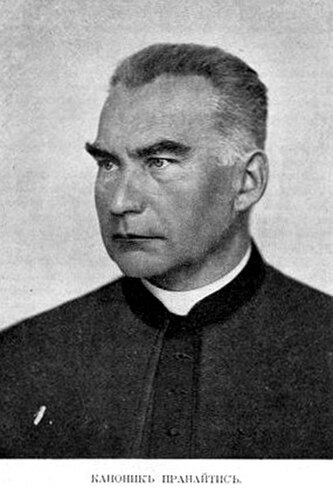
Justinas Pranaitis (Russian: Иустин Бонавенту́ра Пранайтис; 27 July 1861 – 28 January 1917) was a Lithuanian Catholic priest and Professor of Hebrew at the St. Petersburg Roman Catholic Theological Academy. He is best known as the author of the antisemitic"Pranaitis drew on the works of the German anti-Talmudists Jakob Ecker and August Rohling. … Today, The Talmud Unmasked is still being distributed by extreme right-wing and clerical circles and can be accessed from a number of antisemitic websites." Michael Hagemeister and Richard Levy (transl.): "Pranaitis, Justinas (1861–1917)". In Antisemitism: A Historical Encyclopedia of Prejudice and Persecution, Volume 1, pp. 564–565. ABC-CLIO Ltd. (2005). ISBN: 978-1851094394. book The Talmud Unmasked, which contains factual inaccuracies.For example, on page 82 of the E. N. Sanctuary edition of The Talmud Unmasked, Pranaitis gives Abhodah Zarah 26b as a source for the phrase "Even the best of the Goim should be killed". In actuality, this phrase occurs in Soferim 15:10 in the following context: "Yoḥai taught: Kill the best of the heathens in time of war." He is also known for his involvement in the Beilis trial.

Best Justinas Pranaitis Quotes

Shortest
Earliest

Explore our curated collection of the most famous and impactful Justinas Pranaitis quotes.

“In Abhodah Zarah (26b, Tosephoth) it says:

"Even the best of the Goim should be killed"”
“In the 13th century "Popes Gregory IX and Innocent IV condemned the books of the Talmud as containing every kind of vileness and blasphemy against Christian truth, and ordered them to be burned because they spread many horrible heresies."”
Justinas Pranaitis
“Many passages in the Talmudic books treat of the birth, life, death and teachings of Jesus Christ. He is not always referred to by the same name, however, but is diversely called "That Man," "A Certain One," "The Carpenter's Son," "The One Who Was Hanged," etc. […] Since the word Jeschua means "Savior," the name Jesus rarely occurs in Jewish books. It is almost always abbreviated to Jeschu, which is maliciously taken as if it were composed of the initial letters of the three words Immach SCHemo Vezikro—"May his name and memory be blotted out."”
Justinas Pranaitis
“In the infamous book Toldoth Jeschu […] it is related that in the house of the Sanctuary there was a stone which the Patriarch Jacob anointed with oil. On this stone were carved the tetragrammatic letters of the Name (IHVH), and if anyone could learn them he could destroy the world. They therefore decreed that no one must learn them, and they placed two dogs upon two iron columns before the Sanctuary so that if anyone should learn them the dogs would bark at him coming out and he would forget the letters through fear. Then it is related: "Jesus came and entered, learned the letters and wrote them down on parchment. Then he cut into the flesh of his thigh and inserted them there, and having pronounced the name, the wound healed."”
“Questioner: What is the meaning of the word Hullin [animals permissible as food]?

Pranaitis: I don't know.

Questioner: What is the meaning of the word Erubin [Sabbath walking limits]?

Pranaitis: I don't know.

Questioner: What is the meaning of the word Yebamot [family relationships]?

Pranaitis: I don't know.

Questioner: When did Baba Batra [a tractate of the Talmud] live and what was her activity?

Pranaitis: I don't know.”
Quotes About Justinas Pranaitis

Gain deeper perspective through quotes about Justinas Pranaitis from others.

A Tsarist secret police agent reporting on Pranaitis' testimony on Justinas Pranaitis

“Cross-examination of Pranaitis has weakened the evidential value of his expert opinion, exposing lack of knowledge of texts and insufficient knowledge of Jewish literature. Because of his amateurish knowledge and lack of resourcefulness, Pranaitis' expert opinion is of very low value.”

Eugene Nelson Sanctuary on Justinas Pranaitis

“Father Pranaitis was one of those "liquidated" by the Cheka during the Bolshevist revolution in Russia.”

Michael Hagemeister on Justinas Pranaitis

“Justinas Pranaitis was a Roman Catholic priest, Hebraist, and author of antisemitic tracts. […] In 1892, he published The Christian in the Talmud of the Jews, or The Secrets of the Rabbinical Teachings Concerning Christians, a work based on his dissertation. By means of numerous citations in Hebrew and in Latin translations, he sought to demonstrate that the Talmud obliged Jews to injure Christians in multifarious ways and to work for their elimination. Pranaitis drew on the works of the German anti-Talmudists Jakob Ecker and August Rohling. The book received the imprimatur of the church and was published by the press of the Academy of Sciences. […] Pranaitis's work was translated into Lithuanian, Polish, Russian, Italian, Spanish, and English (as The Talmud Unmasked). Today, it is still being distributed by extreme right-wing and clerical circles and can be accessed from a number of antisemitic websites.”

About Justinas Pranaitis

Justinas Pranaitis (Russian: Иустин Бонавенту́ра Пранайтис; 27 July 1861 – 28 January 1917) was a Lithuanian Catholic priest and Professor of Hebrew at the St. Petersburg Roman Catholic Theological Academy. He is best known as the author of the antisemitic"Pranaitis drew on the works of the German anti-Talmudists Jakob Ecker and August Rohling. … Today, The Talmud Unmasked is still being distributed by extreme right-wing and clerical circles and can be accessed from a number of antisemitic websites." Michael Hagemeister and Richard Levy (transl.): "Pranaitis, Justinas (1861–1917)". In Antisemitism: A Historical Encyclopedia of Prejudice and Persecution, Volume 1, pp. 564–565. ABC-CLIO Ltd. (2005). ISBN: 978-1851094394. book The Talmud Unmasked, which contains factual inaccuracies.For example, on page 82 of the E. N. Sanctuary edition of The Talmud Unmasked, Pranaitis gives Abhodah Zarah 26b as a source for the phrase "Even the best of the Goim should be killed". In actuality, this phrase occurs in Soferim 15:10 in the following context: "Yoḥai taught: Kill the best of the heathens in time of war." He is also known for his involvement in the Beilis trial.