Link Copied!
Julius Nyerere Quotes (1922-1999)
President, Activist, Politician
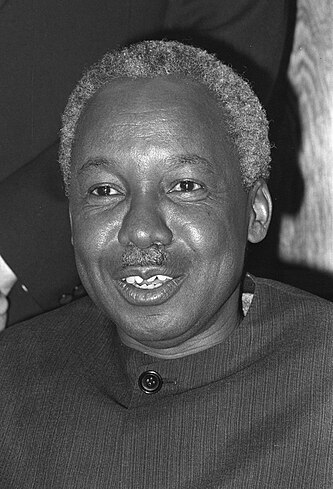


About Julius Nyerere
Julius Kambarage Nyerere (Swahili pronunciation: ˈdʒuːlius kɑmˈbɑɾɑgɑ ɲɛˈɾɛɾɛ; 13 April 1922 – 14 October 1999) was a Tanzanian anti-colonial activist, politician, and political theorist. He governed Tanganyika as Prime Minister from 1961 to 1962 and then as President from 1963 to 1964, after which he led its successor state, Tanzania, as President from 1964 to 1985. A founding member of the Tanganyika African National Union (TANU) party—which in 1977 became the Chama Cha Mapinduzi party—he chaired it until 1990. Ideologically an African nationalist and African socialist, he promoted a political philosophy known as Ujamaa.
Best Julius Nyerere Quotes
Shortest
Earliest
Explore our curated collection of the most famous and impactful Julius Nyerere quotes.

“Freedom to many means immediate betterment, as if by magic … Unless I can meet at least some of these aspirations, my support will wane and my head will roll just as surely as the tickbird follows the rhino.”
“Yes, we have one party here. But so does America. Except, with typical extravagance, they have two of them!
• Variant: The United States is also a one-party state, but with typical American extravagance, they have two of them.”
• Variant: The United States is also a one-party state, but with typical American extravagance, they have two of them.”
“I have read and re-read the Arusha Declaration and found nothing wrong with it except perhaps replacing a few commas here and there... it was clear for some of us that it would only be a mad man who would stand up and defend the Arusha Declaration.”

“Those who receive this privilege therefore, have a duty to repay the sacrifice which others have made. They are like the man who has been given all the food available in a starving village in order that he might have strength to bring supplies back from a distant place. If he takes this food and does not bring help to his brothers, he is a traitor. Similarly, if any of the young men and women who are given an education by the people of this republic adopt attitudes of superiority, or fail to use their knowledge to help the development of this country, then they are betraying our union.”

Julius Nyerere Quotes by Topic
Find exactly what you are looking for by browsing this categorized list of Julius Nyerere quotes by topic.
Julius Nyerere on One-party state
“Yes, we have one party here. But so does America. Except, with typical extravagance, they have two of them!”

Julius Nyerere on New world order (politics)
“In the final analysis, the South's plea for justice, equity, and democracy in the global society cannot be dissociated from its pursuit of these goals within its own societies. Commitment to democratic values respect for fundamental rights—particularly the right to dissent, fair treatment for minorities, concern for the poor and underprivileged, probity in public life, willingness to settle disputes without recourse to war—all these cannot but influence world opinion and increase the South's chances of securing a new world order.”

Julius Nyerere on Higher education
“Those who receive this privilege therefore, have a duty to repay the sacrifice which others have made. They are like the man who has been given all the food available in a starving village in order that he might have strength to bring supplies back from a distant place. If he takes this food and does not bring help to his brothers, he is a traitor. Similarly, if any of the young men and women who are given an education by the people of this republic adopt attitudes of superiority, or fail to use their knowledge to help the development of this country, then they are betraying our union.”

Quotes About Julius Nyerere
Gain deeper perspective through quotes about Julius Nyerere from others.
Selma James on Julius Nyerere
“Julius Nyerere...was the only head of state to offer his country an economic and political program for development that was anticapitalist, nonaligned, and based on grassroots self-activity...Anti-imperialists everywhere recognized the Arusha Declaration (1967) as a document relevant not only to Tanzania but to all newly independent African countries and some thought more generally: it was proposing development that avoided reenslavement via the capitalist market. It must be noted that not even the most astute and dedicated supporters of Nyerere's Declaration had as far as I know ever even mentioned what it says about Tanzanian women working much harder than men-and the profound implications of this for development.”
Martin McCauley on Julius Nyerere
“Many Indian leaders were educated at British universities where socialist – often Marxist – economics was in vogue. This applied to other leaders of the Third World who had been educated in Britain such as Julius Nyerere, president of Tanzania from 1964 to 1985, who also implemented Fabian and African socialist ideas. He had read economics and history at the University of Edinburgh. He enforced collectivisation, and when peasants resisted, he burnt down villages. The result was economic decline, corruption and food shortages. When Tanzania tried market economics, it recorded impressive growth: gross domestic product (GDP) rose 40 per cent between 1998 and 2007.”
Professor Wole Soyinka on Julius Nyerere
“Here is a man who retired as a head of state and went back to his small village house to live a pension like any other public servant.”
About Julius Nyerere
Julius Kambarage Nyerere (Swahili pronunciation: ˈdʒuːlius kɑmˈbɑɾɑgɑ ɲɛˈɾɛɾɛ; 13 April 1922 – 14 October 1999) was a Tanzanian anti-colonial activist, politician, and political theorist. He governed Tanganyika as Prime Minister from 1961 to 1962 and then as President from 1963 to 1964, after which he led its successor state, Tanzania, as President from 1964 to 1985. A founding member of the Tanganyika African National Union (TANU) party—which in 1977 became the Chama Cha Mapinduzi party—he chaired it until 1990. Ideologically an African nationalist and African socialist, he promoted a political philosophy known as Ujamaa.