Link Copied!
Joseph Stalin Quotes (1879-1953)
Leader, Revolutionary












About Joseph Stalin
Joseph Vissarionovich Stalin (born Ioseb Besarionis dze Jughashvili; 21 December {9 December Old Style} 1879 – 5 March 1953) was a Georgian revolutionary and political leader who led the Soviet Union from 1924 until his death in 1953. He served as both General Secretary of the Communist Party of the Soviet Union (1922–1952) and Chairman of the Council of Ministers of the Soviet Union (1941–1953). Despite initially governing the country as part of a collective leadership, he ultimately consolidated power to become the Soviet Union's dictator by the 1930s. A communist ideologically committed to the Leninist interpretation of Marxism, Stalin formalised these ideas as Marxism–Leninism while his own policies are known as Stalinism. He was the father of Svetlana Alliluyeva.
Best Joseph Stalin Quotes
Shortest
Earliest
Explore our curated collection of the most famous and impactful Joseph Stalin quotes.
Said amidst discussions of purging Estonia, this chilling statement reveals Stalin's early enthusiasm for concentration camps as tools of political repression.
“The idea of a concentration camp is excellent.”
- Joseph Stalin, Contemporary witnesses)

“There are no fortresses that Bolsheviks cannot storm.”
- Joseph Stalin, Contemporary witnesses)


Facing imminent defeat in 1942, Stalin, despite the Nazi invasion, urged Russians to differentiate between Hitler's regime and the enduring German people and nation.
“Hitlers come and go, but Germany and the German people remain.”
- Joseph Stalin, Stalin's speeches, writings and interviews)

“Much more could have been done had we Bolsheviks been cleverer.”
- Joseph Stalin, Stalin's speeches, writings and interviews)
“God is on your side? Is He a Conservative? The Devil's on my side, he's a good Communist.”
- Joseph Stalin, Contemporary witnesses)
“History shows that there are no invincible armies and that there never have been.”
- Joseph Stalin, Stalin's speeches, writings and interviews)

“If the opposition disarms, all is well and good. If it refuses to disarm, we shall disarm it ourselves.”
- Joseph Stalin, Stalin's speeches, writings and interviews)


“It is impossible to finish off capitalism without having finished off social democracy in the working-class movement.”
- Joseph Stalin, Stalin's speeches, writings and interviews)

“" target="_blank">from "From (the) Editors" (1901) an article in a socialist newspaper-- Stalin was one of the editors (aged 22)”
- Joseph Stalin, Stalin's speeches, writings and interviews)
“The Communists base themselves on rich historical experience which teaches that obsolete classes do not voluntarily abandon the stage of history.”
- Joseph Stalin, Stalin's speeches, writings and interviews)
Facing perceived economic backwardness and imminent threat, Stalin galvanized Soviet industrialization in 1931 with a stark ultimatum: catch up to the West in a decade, or be destroyed.
“We are fifty or a hundred years behind the advanced countries. We must make good this distance in ten years. Either we do it, or they will crush us.”
- Joseph Stalin, Stalin's speeches, writings and interviews)
“Having consolidated its power, and taking the lead of the peasantry, the proletariat of the victorious country can and must build a socialist society.”
- Joseph Stalin, The Foundations of Leninism)

“We think that a powerful and vigorous movement is impossible without differences — "true conformity" is possible only in the cemetery.”
- Joseph Stalin, Stalin's speeches, writings and interviews)
“To choose one's victims, to prepare one's plan minutely, to slake an implacable vengeance, and then to go to bed... There is nothing sweeter in the world.”
- Joseph Stalin, Stalin's speeches, writings and interviews)

“Before your eyes rises the hero of Gogol's story who, in a fit of aberration, imagined that he was the King of Spain. Such is the fate of all megalomaniacs.”
- Joseph Stalin, Contemporary witnesses)
“The fight against Zionism has nothing in common with anti-Semitism. Zionism is an enemy of workers around the world, both of those who are Jewish and those who are not.”
- Joseph Stalin, Contemporary witnesses)

Speaking to the ECCI in 1929, this reveals the speaker's belief in absolute submission to the party, prioritizing collective will above individual autonomy.
“True courage consists in being strong enough to master and overcome oneself and subordinate one’s will to the will of the collective, the will of the higher party body.”
- Joseph Stalin, Stalin's speeches, writings and interviews)
“"Fascism is the bourgeoisie’s fighting organisation that relies on the active support of Social-Democracy. Social-Democracy is objectively the moderate wing of fascism."”
- Joseph Stalin, Stalin's speeches, writings and interviews)


“Is it possible, then, to doubt that we can and must gain victory over the German invaders? The enemy is not as strong as some terror-stricken pseudo-intellectuals picture him. The devil is not as terrible as he is painted.”
- Joseph Stalin, Stalin's speeches, writings and interviews)
“Mankind is divided into rich and poor, into property owners and exploited; and to abstract oneself from this fundamental division, and from the antagonism between poor and rich, means abstracting oneself from fundamental facts.”
- Joseph Stalin, Stalin's speeches, writings and interviews)
“The State is a machine in the hands of the governing class for suppressing the resistance of its class antagonists. In this way the dictatorship of the proletariat differs in no way essentially from the dictatorship of any other class.”
- Joseph Stalin, Stalin's speeches, writings and interviews)
Stalin dismissively justified Red Army atrocities by framing them as understandable releases for soldiers who had endured immense hardship during World War II.
“Does Djilas, who is himself a writer, not know what human suffering and the human heart are? Can't he understand it if a soldier who has crossed thousands of kilometers through blood and fire and death has fun with a wench or takes some trifle?”
- Joseph Stalin, Contemporary witnesses)

“[The Albanians] seem to be rather backward and primitive people... they can be as faithful as a dog; that is one of the traits of the primitive. Our Chuvash were the same. The Russian tsars always used them for their bodyguards.”
- Joseph Stalin, Contemporary witnesses)
“What would happen if capital succeeded in smashing the Republic of Soviets? There would set in an era of the blackest reaction in all the capitalist and colonial countries, the working class and the oppressed peoples would be seized by the throat, the positions of international communism would be lost.”
- Joseph Stalin, Stalin's speeches, writings and interviews)
“Marxism is not only the theory of socialism, it is an integral world outlook, a philosophical system, from which Marx's proletarian socialism logically follows. This philosophical system is called dialectical materialism.”
- Joseph Stalin, Anarchism or Socialism

“I consider it completely unimportant who in the party will vote, or how; but what is extraordinarily important is this—who will count the votes, and how.
• Variant (loose) translation: The people who cast the votes decide nothing. The people who count the votes decide everything.”
• Variant (loose) translation: The people who cast the votes decide nothing. The people who count the votes decide everything.”
- Joseph Stalin, Contemporary witnesses)
“The confidence of the people in the worker-directors of the economy is a great thing, Comrades. The leaders come and go, but the people remain. Only the people are immortal, everything else is ephemeral. That is why it is necessary to appreciate the full value of the confidence of the people.”
- Joseph Stalin, Stalin's speeches, writings and interviews)

“The State is a machine in the hands of the ruling class for suppressing the resistance of its class enemies. in this respect the dictatorship of the proletariat does not differ essentially from dictatorship of any other class, for the proletarian State is a machine for the suppression of the bourgeoisie.”
- Joseph Stalin, The Foundations of Leninism)
“This leads to the conclusion, it is time to finish retreating. Not one step back! Such should now be our main slogan. ... Henceforth the solid law of discipline for each commander, Red Army soldier, and commissar should be the requirement — not a single step back without order from higher command.”
- Joseph Stalin, Stalin's speeches, writings and interviews)
Amidst the Soviet invasion of Poland, Stalin assured Nazi Germany of unwavering support, vowing to prevent its downfall in a secret meeting recorded by Gustav Hilger.
“If, against all expectation, Germany finds itself in a difficult situation then she can be sure that the Soviet people will come to Germany's aid and will not allow Germany to be strangled. The Soviet Union wants to see a strong Germany and we will not allow Germany to be thrown to the ground.”
- Joseph Stalin, Contemporary witnesses)
“We cannot forget what Lenin said about our great construction, which in large part depends on our succeeding in delaying the war with the capitalist countries. This war is inevitable, but it can be delayed until the proletarian revolution ripens in Europe, or until the colonial revolutions break out, or, finally, until the capitalists fight among themselves for the division of the colonies.”
- Joseph Stalin, Stalin's speeches, writings and interviews)
“If any foreign minister begins to defend to the death a "peace conference," you can be sure his government has already placed its orders for new battleships and aeroplanes.”
- Joseph Stalin, Stalin's speeches, writings and interviews)

This statement critiques the Russian Provisional Government following the February Revolution, advocating for its replacement with a government representing the working class, soldiers, and peasantry.
“The existing pseudo-government which was not elected by the people and which is not accountable to the people must be replaced by a government recognised by the people, elected by representatives of the workers, soldiers and peasants and held accountable to their representatives.
• Variant translation:”
- Joseph Stalin, Stalin's speeches, writings and interviews)
“Until the bourgeoisie is completely vanquished, until its wealth has been confiscated, the proletariat must without fail possess a military force, it must without fail have its "proletarian guard," with the aid of which it will repel the counter-revolutionary attacks of the dying bourgeoisie, exactly as the Paris proletariat did during the Commune.”
- Joseph Stalin, Anarchism or Socialism

“Some people believe that Marxism and anarchism are based on the same principles and that the disagreements between them concern only tactics, so that, in the opinion of these people, no distinction whatsoever can be drawn between these two trends. This is a great mistake. We believe that the Anarchists are real enemies of Marxism. Accordingly, we also hold that a real struggle must be waged against real enemies.”
- Joseph Stalin, Anarchism or Socialism

“As we know, the goal of every struggle is victory. But if the proletariat is to achieve victory, all the workers, irrespective of nationality, must be united. Clearly, the demolition of national barriers and close unity between the Russian, Georgian, Armenian, Polish, Jewish and other proletarians is a necessary condition for the victory of the proletariat of all Russia.”
- Joseph Stalin, Stalin's speeches, writings and interviews)

“There is not, nor should there be, an irreconcilable contrast between the individual and the collective,... There should be no such contrast, because collectivism, Socialism, does not deny, but combines individual interests with the interests of the collective. Socialism cannot abstract itself from individual interests. More than that, socialist society alone can firmly safeguard the interests of the individual. In this sense there is no irreconcilable contrast between Individualism and Socialism.”
- Joseph Stalin, Stalin's speeches, writings and interviews)
“One of Ivan the Terrible's mistakes was to overlook the five great feudal families. If he had annihilated those five families, there would definitely have been no Time of Troubles. But Ivan the Terrible would execute someone and then spend a long time repenting and praying. God got in his way in this matter. He ought to have been still more decisive!”
- Joseph Stalin, Contemporary witnesses)
“It is difficult for me to imagine what "personal liberty" is enjoyed by an unemployed person, who goes about hungry, and cannot find employment. Real liberty can exist only where exploitation has been abolished, where there is no oppression of some by others, where there is no unemployment and poverty, where a man is not haunted by the fear of being tomorrow deprived of work, of home and of bread. Only in such a society is real, and not paper, personal and every other liberty possible.”
- Joseph Stalin, Stalin's speeches, writings and interviews)

“The kind of socialism under which everybody would get the same pay, an equal quantity of meat and an equal quantity of bread, would wear the same clothes and receive the same goods in the same quantities—such a socialism is unknown to Marxism. All that Marxism says is that until classes have been finally abolished and until labor has been transformed from a means of subsistence into the prime want of man, into voluntary labor for society, people will be paid for their labor according to the work performed.”
- Joseph Stalin, Stalin's speeches, writings and interviews)
“Comrades, Red Army and Red Navy men, commanders and political instructors, men and women guerrillas! The whole world is looking to you as a force capable of destroying the brigand hordes of German invaders. The enslaved peoples of Europe under the yoke of the German invaders are looking to you as their liberators. A great mission of liberation has fallen to your lot. Be worthy of this mission! The war you are waging is a war of liberation, a just war.”
- Joseph Stalin, Stalin's speeches, writings and interviews)
“The principle of the minority submitting to the majority, the principle of directing Party work from a centre, not infrequently gives rise to attacks on the part of wavering elements, to accusations of "bureaucracy," "formalism," etc. It scarcely needs proof that systematic work by the Party as one whole, and the directing of the struggle of the working class, would be impossible without putting these principles into effect. Leninism in questions of organisation is the unswerving application of these applications of these principles.”
- Joseph Stalin, The Foundations of Leninism)

“The Party must be, first of all, the advanced detachment of the working class. The Party must absorb all the best elements of the working class, their experience, their revolutionary spirit, their selfless devotion to the cause of the proletariat. But in order that it may really be the armed detachment, the Party must be armed with revolutionary theory, with a knowledge of the laws of the movement, with a knowledge of the laws of revolution. Without this it will be incapable of directing the struggle of the proletariat, of leading the proletariat.”
- Joseph Stalin, The Foundations of Leninism)
“Strikes, boycott, parliamentarism, meetings and demonstrations are all good forms of struggle as means for preparing and organising the proletariat. But not one of these means is capable of abolishing existing inequality. All these means must be concentrated in one principal and decisive means; the proletariat must rise and launch a determined attack upon the bourgeoisie in order to destroy capitalism to its foundations. This principal and decisive means is the socialist revolution.”
- Joseph Stalin, Anarchism or Socialism
“The mortal sin of the Second International was not that it pursued at that time the tactics of utilising parliamentary forms of struggle, but that it overestimated the importance of these forms, that it considered them virtually the only forms; and that when the period of open revolutionary battles set in and the question of extra-parliamentary forms of struggle came to the fore, the parties of the Second International turned their backs on these new tasks, refused to shoulder them.”
- Joseph Stalin, The Foundations of Leninism)
Facing dire military needs during the autumn of 1941, Stalin's telegram to aviation plant superintendents reflects the desperation for Il-2 Sturmovik aircraft production to defend the Soviet Union.
“You have let down our country and our Red Army. You have the nerve not to manufacture IL-2s until now. Our Red Army now needs IL-2 aircraft like the air it breathes, like the bread it eats. Shenkman produces one IL-2 a day and Tretyakov builds one or two MiG-3s daily. It is a mockery of our country and the Red Army. I ask you not to try the government's patience, and demand that you manufacture more ILs. This is my final warning.”
- Joseph Stalin, Stalin's speeches, writings and interviews)

“We disagreed with Zinoviev and Kamenev because we knew that the policy of amputation was fraught with great dangers for the Party, that the method of amputation, the method of blood-letting — and they demanded blood — was dangerous, infectious: today you amputate one limb, tomorrow another, the day after tomorrow a third — what will we have left in the Party?”
- Joseph Stalin, Stalin's speeches, writings and interviews)

“You [
- Joseph Stalin, Contemporary witnesses)

“We must finally understand that of all the precious capital in the world, the most precious capital, the most decisive capital, is human beings [...]. Cadres decide everything!http://www.jstor.org/discover/10.2307/2495035?uid=3738776&uid=2&uid=4&sid=21104844992271 (A more accurate translation, with respect to the context, might read: "Cadres are the key to everything")
• Address to the Graduates from the Red Army Academies. (4 May 1935); Variant translation: Human resources solve all!”
• Address to the Graduates from the Red Army Academies. (4 May 1935); Variant translation: Human resources solve all!”
- Joseph Stalin, Stalin's speeches, writings and interviews)
“We are in favour of the withering away of the state, and at the same time we stand for the strengthening of the dictatorship of the proletariat, which represents the most powerful and mighty of all forms of the state which have existed up to the present day. The highest development of the power of the state, with the object of preparing the conditions of the withering away of the state: that is the Marxist formula. Is it "contradictory"? Yes, it is "contradictory." But this contradiction is a living thing and wholly reflects the Marxist dialectic.”
- Joseph Stalin, Stalin's speeches, writings and interviews)

“National and racial chauvinism is a vestige of the misanthropic customs characteristic of the period of cannibalism. Anti-Semitism, as an extreme form of racial chauvinism, is the most dangerous vestige of cannibalism. Anti-semitism is of advantage to the exploiters as a lightning conductor that deflects the blows aimed by the working people at capitalism. Anti-Semitism is dangerous for the toilers, for it is a false track which diverts them from the proper road and leads them into the jungle. Hence, Communists, as consistent internationalists, cannot but be irreconcilable and bitter enemies of anti-Semitism. In the U.S.S.R., anti-Semitism is strictly prosecuted as a phenomenon hostile to the Soviet system. According to the laws of the U.S.S.R. active anti-Semites are punished with death.”
- Joseph Stalin, Stalin's speeches, writings and interviews)

“We are not the kind of people who, when the word "anarchism" is mentioned, turn away contemptuously and say with a supercilious wave of the hand: "Why waste time on that, it's not worth talking about!" We think that such cheap "criticism" is undignified and useless. Nor are we the kind of people who console themselves with the thought that the Anarchists "have no masses behind them and, therefore, are not so dangerous." It is not who has a larger or smaller "mass" following today, but the essence of the doctrine that matters. If the "doctrine" of the Anarchists expresses the truth, then it goes without saying that it will certainly hew a path for itself and will rally the masses around itself. If, however, it is unsound and built up on a false foundation, it will not last long and will remain suspended in mid-air. But the unsoundness of anarchism must be proved.”
- Joseph Stalin, Anarchism or Socialism

“Leninism is Marxism of the era of imperialism and the proletarian revolution. To be more exact, Leninism is the theory and tactics of the proletarian revolution in general, the theory and tactics of the dictatorship of the proletariat in particular. Marx and Engels pursued their activities in the pre-revolutionary period (we have the proletarian revolution in mind), when developed imperialism did not yet exist, in the period of the proletarians' preparation for revolution, in the period when the proletarian revolution was not yet an immediate practical inevitability. But Lenin, the disciple of Marx and Engels, pursued his activities in the period of developed imperialism, in the period of the unfolding proletarian revolution, when the proletarian revolution had already triumphed in one country, had smashed bourgeois democracy and had ushered in the era of proletarian democracy, the era of the Soviets.”
- Joseph Stalin, The Foundations of Leninism)
“As is known, the Government of the State in Britain at the present time is in the hands of one party, the Labour Party, and the opposition parties are deprived of the right to participate in the Government of Britain. That Mr. Churchill calls true democracy. Poland, Romania, Yugoslavia, Bulgaria and Hungary are administered by blocs of several parties—from four to six parties—and the opposition, if it is more or less loyal, is secured the right of participation in the Government. That Mr. Churchill describes as totalitarianism, tyranny and police rule. Why? On what grounds? Don't expect a reply from Mr. Churchill. Mr. Churchill does not understand in what a ridiculous position he puts himself by his outcry about “totalitarianism, tyranny and police rule."”
- Joseph Stalin, Stalin's speeches, writings and interviews)
“The achievement and maintenance of the dictatorship of the proletariat is impossible without a party which is strong by reason of its solidarity and iron discipline. But iron discipline in the Party is inconceivable without unity of will, without complete and absolute unity of action on the part of all members of the Party. This does not mean, of course, that the possibility of conflicts of opinion within the Party is thereby precluded. On the contrary, iron discipline does not preclude but presupposes criticism and conflict of opinion within the Party. Least of all does it mean that discipline must be "blind." On the contrary, iron discipline does not preclude but presupposes conscious and voluntary submission, for only conscious discipline can be truly iron discipline. But after a conflict of opinion has been closed, after criticism has been exhausted and a decision has been arrived at, unity of will and unity of action of all Party members are the necessary conditions without which neither Party unity nor iron discipline in the Party is conceivable.”
- Joseph Stalin, The Foundations of Leninism)
“The strength of Soviet patriotism lies in the fact that it is based not on racial or nationalistic prejudices, but on the peoples' profound loyalty and devotion to their Soviet Motherland, on the fraternal partnership of the working people of all the nationalities in our country. Soviet patriotism harmoniously combines the national traditions of the peoples and the common vital interests of all the working people of the Soviet Union. Far from dividing them, Soviet patriotism welds all the nations and peoples of our country into a single fraternal family. This should be regarded as the basis of the inviolable friendship of the peoples of the Soviet Union which is growing ever stronger. At the same time the peoples of the U.S.S.R. respect the rights and independence of the peoples of foreign countries and have always shown themselves willing to live in peace and friendship with neighbouring states.”
- Joseph Stalin, Stalin's speeches, writings and interviews)

“In my opinion there are two seats of war danger. The first is in the Far East, in the zone of Japan. I have in mind the numerous statements made by Japanese military men containing threats against other powers. The second seat is in the zone of Germany. It is hard to say which is the most menacing, but both exist and are active. Compared with these two principal seats of war danger, the Italian-Abyssinian war is an episode. At present, the Far Eastern seat of danger reveals the greatest activity. However, the centre of this danger may shift to Europe. This is indicated, for example, by the interview which Herr Hitler recently gave to a French newspaper. In this interview Hitler seems to have tried to say peaceful things, but he sprinkled his "peacefulness" so plentifully with threats against both France and the Soviet Union that nothing remained of his "peacefulness." You see, even when Herr Hitler wants to speak of peace he cannot avoid uttering threats. This is symptomatic.”
- Joseph Stalin, Stalin's speeches, writings and interviews)

“The theory of "defeating" opportunist elements by the ideological struggle within the Party, the theory of "overcoming" these elements within the confines of a single party, is a rotten and dangerous theory, which threatens to condemn the Party to paralysis and chronic infirmity, threatens to leave the Party a prey to opportunism, threatens to leave the proletariat without a revolutionary party, threatens to deprive the proletariat of its main weapon in the fight against imperialism. Our Party could not have emerged on to the broad highway, it could not have seized power and organised the dictatorship of the proletariat, it could not have emerged victorious from the civil war, if it had had within its ranks people like Martov and Dan, Potresov and Axelrod. Our Party succeeded in achieving internal unity and unexampled cohesion of its ranks primarily because it was able to in good time to purge itself of the opportunist pollution, because it was able to rid its ranks of the Liquidators and Mensheviks. Proletarian parties develop and become strong by purging themselves of opportunists and reformists, social-imperialists and social-chauvinists, social-patriots and social-pacifists.”
- Joseph Stalin, The Foundations of Leninism)
“The Party is the highest form of organisation of the proletariat. The Party is the principle guiding force within the class of the proletarians and among the organisations of that class. But it does not by any means follow from this that the Party can be regarded as an end in itself, as a self-sufficient force. The Party is not only the highest form of class association of the proletarians; it is at the same time an instrument in the hands of the proletariat for achieving the dictatorship, when that has not yet been achieved and for consolidating and expanding the dictatorship when it has already been achieved. The Party could not have risen so high in importance and could not have exerted its influence over all other forms of organisations of the proletariat, if the latter had not been confronted with the question of power, if the conditions of imperialism, the inevitability of wars, and the existence of a crisis had not yet demanded the concentration of all the forces of the proletariat at one point, the gathering of all the threads of the revolutionary movement in one spot in order to overthrow the bourgeoisie and to achieve the dictatorship of the proletariat. The proletariat needs the Party first of all as its General Staff, which it must have for the successful seizure of power. It scarcely needs proof that without a party capable of rallying around itself the mass organisations of the proletariat, and of centralising the leadership of the entire movement during the progress of the struggle , the proletariat in Russia could not have established its revolutionary dictatorship.”
- Joseph Stalin, The Foundations of Leninism)
“Still others think that war should be organised by a "superior race," say, the German "race," against an "inferior race," primarily against the Slavs; that only such a war can provide a way out of the situation, for it is the mission of the "superior race" to render the "inferior race" fruitful and to rule over it. Let us assume that this queer theory, which is as far removed from science as the sky from the earth, let us assume that this queer theory is put into practice. What may be the result of that? It is well known that ancient Rome looked upon the ancestors of the present-day Germans and French in the same way as the representatives of the "superior race" now look upon the Slav races. It is well known that ancient Rome treated them as an "inferior race," as "barbarians," destined to live in eternal subordination to the "superior race," to "great Rome", and, between ourselves be it said, ancient Rome had some grounds for this, which cannot be said of the representatives of the "superior race" of today. (Thunderous applause.) But what was the upshot of this? The upshot was that the non-Romans, i.e., all the "barbarians," united against the common enemy and brought Rome down with a crash. The question arises: What guarantee is there that the claims of the representatives of the "superior race" of today will not lead to the same lamentable results? What guarantee is there that the fascist literary politicians in Berlin will be more fortunate than the old and experienced conquerors in Rome? Would it not be more correct to assume that the opposite will be the case?”
- Joseph Stalin, Stalin's speeches, writings and interviews)

“From the point of view of the onlooker, the question of the existence of a Georgian newspaper in general, and the question of its content and trend in particular, may seem to settle themselves naturally and simply: the Georgian Social-Democratic movement is not a separate, exclusively Georgian, working-class movement with its own separate programme; it goes hand in hand with the entire Russian movement and, consequently, accepts the authority of the Russian Social-Democratic Party—hence it is clear that a Georgian Social-Democratic newspaper should be only a local organ that deals mainly with local questions and reflects the local movement. But behind this reply lurks a difficulty which we cannot ignore and which we shall inevitably encounter. We refer to the language difficulty. While the Central Committee of the Russian Social-Democratic Party is able to explain all general questions with the aid of the all-Party newspaper and leave it to the regional committees to deal only with local questions, the Georgian newspaper finds itself in a difficulty as regards content. The Georgian newspaper must simultaneously play the part of an all-Party and of a regional, or local organ. As the majority of Georgian working-class readers cannot freely read the Russian newspaper, the editors of the Georgian newspaper have no right to pass over those questions which the all-Party Russian newspaper is discussing, and should discuss. Thus, the Georgian newspaper must inform its readers about all questions of principle concerning theory and tactics. At the same time it must lead the local movement and throw proper light on every event, without leaving a single fact unexplained, and providing answers to all questions that excite the local workers. The Georgian newspaper must link up and unite the Georgian and Russian militant workers The newspaper must inform its readers about everything that interests them at home, in Russia and abroad.”
- Joseph Stalin, Stalin's speeches, writings and interviews)
Joseph Stalin Quotes by Topic
Find exactly what you are looking for by browsing this categorized list of Joseph Stalin quotes by topic.
Joseph Stalin on World War II 4 quotes
“What place does the possibility of a second front occupy in the Soviet estimates of the current situation? A most important place; one might say a place of first-rate importance.”

Joseph Stalin on Soviet Union 3 quotes
“We do not want a single foot of foreign territory; but we will not surrender a single inch of our territory to anyone.”
- Joseph Stalin, S)

Joseph Stalin on Military history of Russia 3 quotes
“Comrades, men of the Red Army and Red Navy, commanders and political instructirs, men and women guerillas, the whole world is looking towards you as a force capable of destroying the plundering hordes of German robbers. The enslaved peoples of Europe who have fallen beneath the yoke of the German robbers look towards you as their liberators. A great liberating mission has fallen to your lot. Be worthy of that mission! The war you are waging is a war of liberation, a just war. Let the heroic images of our great forefathers - Aleksandr Nevsky, Dimitry Donskoy, Kuzma Minin, Dimitry Pozharsky, Aleksandr Suvarov and Mikhail Kutuzov - inspire you in this war! May the victorious banner of the great Lenin be your lodestar!”
Joseph Stalin on Russia 2 quotes
Amidst plans to suppress dissent in Estonia, Stalin's chilling endorsement of concentration camps reveals the brutal methods he was prepared to employ against perceived enemies of the revolution.
“The idea of a concentration camp is excellent.”

Joseph Stalin on World economy 2 quotes
“It would be wrong to think that the Second World War broke out accidentally, or as a result of blunders committed by certain statesmen, although blunders were certainly committed. As a matter of fact, the war broke out as the inevitable result of the development of world economic and political forces on the basis of present-day monopolistic capitalism. Marxists have more than once stated that the capitalist system of world economy contains the elements of a general crisis and military conflicts, that, in view of that, the development of world capitalism in our times does not proceed smoothly and evenly, but through crises and catastrophic wars.”

What Joseph Stalin Said About Others
Discover personal opinions Joseph Stalin shared regarding contemporaries.
Joseph Stalin on Adolf Hitler 2 quotes
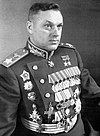
View all 2 quotes on Adolf Hitler →Joseph Stalin on Konstantin Rokossovsky
“I have no Suvorov, but Rokossovsky is my Bagration.”
Joseph Stalin on Dwight D. Eisenhower
In the flush of victory, Stalin, according to Zhukov's memoirs, casually proposed a Moscow meeting with Eisenhower, suggesting a fleeting desire for personal connection amidst geopolitical realities.
“We ought to invite Eisenhower to Moscow sometime. I want to meet him.”

Joseph Stalin on Oliver Cromwell
“Stalin: The Communists base themselves on rich historical experience which teaches that obsolete classes do not voluntarily abandon the stage of history. Recall the history of England in the seventeenth century. Did not many say that the old social system had decayed? But did it not, nevertheless, require a Cromwell to crush it by force? Wells: Cromwell acted on the basis of the constitution and in the name of constitutional order. Stalin: In the name of the constitution he resorted to violence, beheaded the king, dispersed Parliament, arrested some and beheaded others!”
Joseph Stalin on Alexander Suvorov
“Comrades, men of the Red Army and Red Navy, commanders and political instructirs, men and women guerillas, the whole world is looking towards you as a force capable of destroying the plundering hordes of German robbers. The enslaved peoples of Europe who have fallen beneath the yoke of the German robbers look towards you as their liberators. A great liberating mission has fallen to your lot. Be worthy of that mission! The war you are waging is a war of liberation, a just war. Let the heroic images of our great forefathers - Aleksandr Nevsky, Dimitry Donskoy, Kuzma Minin, Dimitry Pozharsky, Aleksandr Suvarov and Mikhail Kutuzov - inspire you in this war! May the victorious banner of the great Lenin be your lodestar!”

Quotes About Joseph Stalin
Gain deeper perspective through quotes about Joseph Stalin from others.
Salvador Allende on Joseph Stalin
“Stalin was an example of creativity, humanism and an edifying example of peace and heroism! [...] Everything that he did, he did at the service of the people. Our father Stalin is dead, but when remembering his example, our affection towards him will make our arms grow strong for the building of a great tomorrow, to assure a future in memory of his magnificent example.”
Svetlana Alliluyeva on Joseph Stalin
“When my mother left us, [Stalin] was left completely alone. And I think what came next, in the late 30s and after the war in the 40s - I think that was a result of his complete loneliness on top of the world. Nobody would argue with him any more.”

Hafizullah Amin on Joseph Stalin
“Comrade Stalin showed us how to build socialism in a backward country: it's painful to begin with, but afterwards everything turns out just fine.”

Henry H. Arnold on Joseph Stalin 2 quotes
“During that meeting, King told us, when they were talking about what was going to happen to the Germans after the war, Stalin had said out of a clear sky: "I know 60,000 German officers I am going to shoot!" Thereupon Churchill arose, cigar in hand, and paced back and forth across the room saying such a thing could not be; it was not Christian; we were civilized people; it was against the laws of civilized warfare to shoot 60,000 officers! Back and forth walked Churchill, while Stalin sat at the table, not saying a word. Finally, Churchill returned to his place, and after everything had quieted down, Stalin once more, through his interpreter, said, "I know 60,000 German officers I am going to shoot after the war is over!" Apparently Stalin understood some English, although he would not admit it. Whether he could speak English I did not know, nor was I ever able to find out.”
Henri Barbusse on Joseph Stalin 2 quotes
“His history is a series of victories over a series of tremendous difficulties. Since 1917, not a single year of his career has passed without his having done something which would have made any other man famous. He is a man of iron. The name by which he is known describes it: the word Stalin means "steel" in Russian. He is as strong and yet as flexible as steel. His power lies in his formidable intelligence, the breadth of his knowledge, the amazing orderliness of his mind, his passion for precision, his inexorable spirit of progress, the rapidity, sureness and intensity of his decisions, and his constant care to choose the right men.”

















Misattributed Quotes
Quotes mistakenly credited to Joseph Stalin
“We will hang the capitalists with the rope that they sell us.”
About Joseph Stalin
Joseph Vissarionovich Stalin (born Ioseb Besarionis dze Jughashvili; 21 December {9 December Old Style} 1879 – 5 March 1953) was a Georgian revolutionary and political leader who led the Soviet Union from 1924 until his death in 1953. He served as both General Secretary of the Communist Party of the Soviet Union (1922–1952) and Chairman of the Council of Ministers of the Soviet Union (1941–1953). Despite initially governing the country as part of a collective leadership, he ultimately consolidated power to become the Soviet Union's dictator by the 1930s. A communist ideologically committed to the Leninist interpretation of Marxism, Stalin formalised these ideas as Marxism–Leninism while his own policies are known as Stalinism. He was the father of Svetlana Alliluyeva.