Link Copied!
Jopie Huisman Quotes (1922-2000)
Painter
About Jopie Huisman
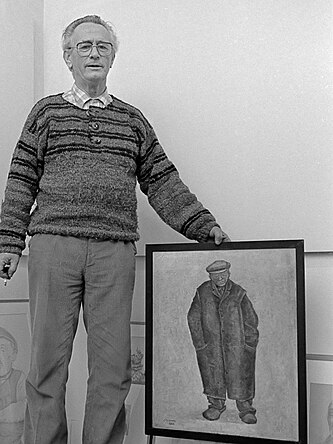
Jotje (Jopie) Huisman (Workum, 18 October 1922 - 29 September 2000) was a self-taught Dutch painter and draftsman. He is best known for his portraits and for the still-life's with as their subject selected rags and old stuff, Huisman was buying up stuff as professional rag man in Workum and from 1963 in Herbayum; both are villages in Friesland.
Best Jopie Huisman Quotes
Shortest
Earliest
Explore our curated collection of the most famous and impactful Jopie Huisman quotes.
“I used to paint some things a few times, but I stopped, because I didn't get an answer. If the work has nothing to say to somebody else, I quit. I am not an idiot who is talking to himself and gazing at the tip of his brush. Painting you do together. (translation, Fons Heijnsbroek, 2018)”

“These are the shoes of old Yde, a bachelor. He has worn them for forty years. He repaired them from below and above, from the inside and the outside. He gave me his shoes, for a bottle of brandy. They protected his feet for forty years. When they broke down, he tore them up and put them back on again. He could have bought new ones, because he already got state pension. But he was married with his shoes. (translation, Fons Heijnsbroek, 2018)”
“Just six kilometers – never my world was bigger than that, actually. That starting time [of his painting & drawing, c. 1946], to which I return now; watercolor; I prefer a bit foggy, a small world - and not the cows themselves, but only their traces in the mist. The tenderness.. .I am currently [1993] deeply immersed in little trees and in the reeds. You have to experience it as mysticism, as a miracle. And afterwards: passing it on.. (translation, Fons Heijnsbroek, 2018)”

“..because of self-preservation, selfishness and the urge for happiness love has prevailed in me, and in that way everything becomes enchanted and even an old dirty, discarded doll transforms in something that can move you. The attention I gave it [in his painting: 'Rag doll', 1975], together with the attention you give it, ensure that it is no longer doomed, not alone any more. If there is any background connected to my artwork, it is this. (translation, Fons Heijnsbroek, 2018)”

“In 1946 it was the first time I saw a Van Gogh, a painting from his years in France. It was excactly what I had always felt here [in the fields of Friesland]: infinity, the unimaginable. I was bewildered and thought: who has been painting here for God's sake? Pink stripes in a green sky, you can't imagine! Ultramarine and carmine in the soil with a big yellow sun behind it.. (translation, Fons Heijnsbroek, 2018)”

“Father was a beautiful person, Otherwise I couldn't have paint him like that [Jopie points to the portrait of his father in the living-room, hanging next to his mother's]. Painted in seven hours. On a Saturday. About three months before my mother had died. Three times [during the painting-session] he stood up: 'Are you getting ready, finally?' The way I am talking about them is just how you see them here. He was a skipper of mud, afterwards a farmer. (translation, Fons Heijnsbroek, 2018)”
“Over the years I kept everything and anything from stuff and things that I came across during my life in trade, if they had emotional value to me. Always the simple goods and tools, from the farmers, the blacksmith, the carpenter, the baker and so on. I loved those things most in which I saw reflected the struggle for life very clearly.. ..old used up shoes, trousers, jackets, hats and children's vests, which I found in the rags, often patched up endlessly. (translation, Fons Heijnsbroek, 2018)”

“I feel responsible, because so many people are leaning against me. Of course I can not take that pole away from them, they will fall over. I can see that those people need it! An ongoing struggle, an ordeal - because, if I say something I have to make it happen. In this way, painting is a religious matter. My paintings create a consciousness that offers comfort.. .It must appear in the light. Somebody of eighty years old who never ever would think about visiting a museum. Recognition! (translation, Fons Heijnsbroek, 2018)”

“In 1973 I suddenly came into major private problems. I was completely thrown back on myself. Then I found those trousers between the old stuff. A worn-out, eighty times repaired, filthy pair of pants of a milker. I saw myself in it, it reflected the state of my soul. Then I took it with me and painted it [title: Pants of a cow milker]. Moreover because other because people recognized themselves in it, this has become my salvation. I found back my identity through it. As a matter of fact a self-portrait. (translation, Fons Heijnsbroek, 2018)”
“I worked for months on this painting [title 'The Stone-wheelbarrow of C. Adema', 1977], for instance that well-bucket on the wheelbarrow I painted a twenty times or more, and it is constructed exactly as nature has shaped it. I want to make it harder and harder for myself. 'That's how it is' doesn’t exist for me. Deepening, that's what it is all about. My wish is to make in due time a small painting in which I can hardly discover any longer that it is painted, that it is just there, like that. Just something very simple. (translation, Fons Heijnsbroek, 2018)”
“The smaller the world, the better I feel. When the reed is around me, evil has disappeared from the world. I really shall paint the reed next year, I've seriously decided. A small area of reeds with some water under. And then it will appear [on the canvas] exactly in the way it will make one quiet. I will paint it outdoors because I don't have any imagination - by the way, I would find myself very cheeky if I did. I have nothing to add, I have nothing in me and I believe I must be well aware of that because that is my limitation, as a consequence of my temporality. (translation, Fons Heijnsbroek, 2018)”
“I was sitting in the barn, drawing a dead bird which I had put on a box. Then the barn door opened and Kees entered [an old iron-merchant, already retired] .. ..He came down next to me.. ..After a short silence he said: 'Are you painting? '.. .. it looks somewhat like that bird'. I said: 'To me that means a compliment Kees, because I am trying to draw that bird.' Stunned, he looked at me and asked, "Why are you doing that?" What could I answer? I said: Actually, I don't know myself'. Then he hoisted himself to his feet and said, I'll bring you the stuff next Monday' and he went to the door.. (translation, Fons Heijnsbroek, 2018)”
“One afternoon I went to visit him. [Jacob, an older and close friend of Jopie - a real freebooter]. I knew he was home, I took pen, ink and my sketchbook with me and did half a liter of gin in my pocket. He lived in the back of an alley and was sitting in his chair by the window.. ..I told him, 'You will get the whole bottle, but one condition. I want to make a beautiful drawing of you, so first you have to sit still for twenty minutes and look at me closely. If I look at you and you don't look at me, the deal is over.. ..'Okay', he said. I never had a model like him before.. .Stock-still he sat.. ..and looked at me without a single blink of his eyes. Within half an hour he was there on the paper - razor-sharp.. .While I am writing this down, it is as if he is sitting in front of me again.. (translation, Fons Heijnsbroek, 2018)”
“As far as transience is concerned.. .You see the whole story in those shoes, that's why I paint them so accurate. The physical attitude; crooked legs, a lump. Those shoes were talking to me, and then I thought: I can see that you were so and so big, but did you also had a wife? Children? What were you doing? And what really mattered to me is my own place between them. Between those stories, that mystery. That pitch-black background [in Jopie's paintings, till c.1979-80] - I had found it. A cry for attention. Those pants, that shirt, that background, that was: here I am. But then it become mannerism. So I carried on realistically but avoiding the black background at all costs. It is as Rutger Kopland says: Whoever found it did not look well. Now I want to paint people like this, like they are made of colored mud. Color spiritualizes. (translation, Fons Heijnsbroek, 2018)”
About Jopie Huisman
Jotje (Jopie) Huisman (Workum, 18 October 1922 - 29 September 2000) was a self-taught Dutch painter and draftsman. He is best known for his portraits and for the still-life's with as their subject selected rags and old stuff, Huisman was buying up stuff as professional rag man in Workum and from 1963 in Herbayum; both are villages in Friesland.