Link Copied!
John Steinbeck Quotes (1902-1968)
Writer, King
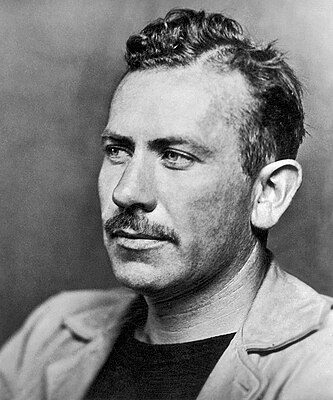















About John Steinbeck
John Ernst Steinbeck Jr. (27 February 1902 – 20 December 1968) was an American writer. A recipient of the Nobel Prize for Literature in 1962, his works include the novella Of Mice and Men (1937) and the novel The Grapes of Wrath (1939, Pulitzer Prize for Fiction, 1940), both of which examine the lives of the working class and migrant workers during the Great Depression.
Best John Steinbeck Quotes
Shortest
Earliest
Explore our curated collection of the most famous and impactful John Steinbeck quotes.
“There's nobody as lonely as an all-married man.”
“What pillow can one have like a good conscience?”

“I wonder why progress looks so much like destruction.”

“A powerful, big-stomached man came into the bunkhouse.”

“I don't anticipate trouble and so I anticipate trouble.”

“No one wants advice — only corroboration.”

“For the most part people are not curious except about themselves.”

“We can shoot rockets into space but we can’t cure anger or discontent.”

“[On writing:] It is properly called the lonesomest profession in the world.”


“The incident seemed to prove to me that intentions, good or bad, are not enough.”

“Good God, what a mess of draggle-tail impulses a man is — and a woman too, I guess.”

“People who are most afraid of their dreams convince themselves they don’t dream at all.”

“The discipline of the written word punishes both stupidity and dishonesty.”
“He brought his malformed wisdom, his pool-hall, locker-room, joke-book wisdom to the front.”

“What a wonderful thing a woman is. I can admire what they do even if I don't understand why.”
“And now, our submarines are armed with mass murder, our silly, only way of deterring mass murder.”
“It is the misfortune of men to want to do a thing well, even a thing they do not want to do at all.”


“The profession of book-writing makes horse-racing seem like a solid, stable business.”
“Like most modern people, I don't believe in prophecy or magic and then spend half my time practicing it.”
“Unless a reviewer has the courage to give you unqualified praise, I say ignore the bastard.”

“Can you disbelieve in something you don't know about? […] It isn't that I don't believe but that I don't know.”
“"It is so easy a thing to give—only great men have the courage and courtesy and, yes, the generosity to receive."”
“He didn't believe in psychiatrists, he said. But actually he did believe in them, so much that he was afraid of them.”
“It was a glorious game. Theft robbed of the stigma of theft, crime altruistically committed—what is more gratifying?”


“His ear heard more than is said to him, and his slow speech had overtones not of thought, but of understanding beyond thought.”
“When two people meet, each one is changed by the other so you've got two new people. Maybe that means — hell, it's complicated.”
“I am in love with Montana. For other states I have admiration, respect, recognition, even some affection, but with Montana it is love.”




“For the first time I am working on a book that is not limited and that will take every bit of experience and thought and feeling that I have.”



“It is a common experience that a problem difficult at night is resolved in the morning after the committee of sleep has worked on it.”
“Farewell has a sweet sound of reluctance. Good-by is short and final, a word with teeth sharp to bite through the string that ties past to the future.”
“"Well, that glove's fulla vaseline."
"Vaseline? What the hell for?"
"Well, I tell ya what — Curley says he's keepin' that hand soft for his wife."”
"Vaseline? What the hell for?"
"Well, I tell ya what — Curley says he's keepin' that hand soft for his wife."”

“Ghosts could walk freely tonight, without fear of the disbelief of men; for this night was haunted, and it would be an insensitive man who did not know it.”
“In the dusk I saw her smile, that incredible female smile. It is called wisdom but it isn't that but rather an understanding that makes wisdom unnecessary.”
“What a frightening thing is the human, a mass of gauges and dials and registers, and we can read only a few and those perhaps not accurately.”
“When we get these thruways across the whole country, as we will and must, it will be possible to drive from New York to California without seeing a single thing.”

“"When you argue with a child," she said warmly, "you give a good argument and the child says yah, yah! You understand him and he doesn't listen, so the child wins."”
“It is astounding to find that the belly of every black and evil thing is as white as snow. And it is saddening to discover how the concealed parts of angels are leprous.”
“The Mojave is a big desert and a frightening one. It’s as though nature tested a man for endurance and constancy to prove whether he was good enough to get to California.”
“Men do change, and change comes like a little wind that ruffles the curtains at dawn, and it comes like the stealthy perfume of wildflowers hidden in the grass.”

“It is a matter of disillusion to young male Americans otherwise informed, to discover that the French are a moral people — judged, that is, by American country-club standards.”
“We value virtue but do not discuss it. The honest bookkeeper, the faithful wife, the earnest scholar get little of our attention compared to the embezzler, the tramp, the cheat.”


“I guess this is why I hate governments. It is always the rule, the fine print, carried out by the fine print men. There's nothing to fight, no wall to hammer with frustrated fists.”
“His guard was up now and he wasn't listening; he was only angry because here was a world he could not enter and so he had to disbelieve in its existence. He fell back on the world he knew.”

“A plan is a real thing, and things projected are experienced. A plan once made and visualized becomes a reality along with other realities—never to be destroyed but easily to be attacked.”
“Texas is a state of mind. Texas is an obsession. Above all, Texas is a nation in every sense of the word. And there’s an opening covey of generalities. A Texan outside of Texas is a foreigner.”

“They successfully combined piracy and puritanism, which aren't so unlike when you come right down to it. Both had a strong dislike for opposition and both had a roving eye for other people's property.”

“The mountains of things we throw away are much greater than the things we use. In this, if in no other way, we can see the wild and reckless exuberance of our production, and waste seems to be the index.”

“No little appetite or pain, no carelessness or meanness in him escaped her; no thought or dream or longing in him ever reached her. And yet several times in her life she had seen the stars.”

“When the virus of restlessness begins to take possession of a wayward man, and the road away from Here seems broad and straight and sweet, the victim must first find himself a good and sufficient reason for going.”
“The story was gradually taking shape. Pilon liked it this way. It ruined a story to have it all come out quickly. The good story lay in half-told things which must be filled in out of the hearer’s own experience.”

“Where does discontent start? You are warm enough, but you shiver. You are fed, yet hunger gnaws you. You have been loved, but your yearning wanders in new fields. And to prod all these there’s time, the Bastard Time.”
“Yesterday in Muir Woods that dog lifted his leg on a tree that was 20 feet across, 80 feet high and a 1,000 years old — what's left in life for that poor dog?”

“With humanity's long proud history of standing firm against natural enemies, sometimes in the face of almost certain defeat and extinction, we would be cowardly and stupid to leave the field on the eve of our greatest potential victory.”

“This is the law. The purpose of fighting is to win. There is no possible victory in defense. The sword is more important than the shield, and skill is more important than either. The final weapon is the brain, all else is supplementary.”

“"I do understand. I understand that you are offered a loveliness and you vomit on it, that you have the gift of love given you such as few men have ever known and you throw on it the acid of your pride, your ugly twisted sense of importance."”


“Even if teen-age children aren't making a sound, it's quieter when they're gone. They put a boiling in the air around them. As they left, the whole house seemed to sigh and settle. No wonder poltergeists infest only houses with adolescent children.”

“It is a fact verified and recorded in many histories that the soul capable of the greatest good is also capable of the greatest evil. Who is there more impious than a backsliding priest? Who more carnal than a recent virgin? This, however, may be a matter of appearance.”
“Cannery Row in Monterey in California is a poem, a stink, a grating noise, a quality of light, a tone, a habit, a nostalgia, a dream.”
“Oh, we can populate the dark with horrors, even we who think ourselves informed and sure, believing nothing we cannot measure or weigh. I know beyond all doubt that the dark things crowding in on me either did not exist or were not dangerous to me, and still I was afraid.”
“For it is said that humans are never satisfied, that you give them one thing and they want something more. And this is said in disparagement, whereas it is one of the greatest talents the species has and one that has made it superior to animals that are satisfied with what they have.”
“Such is the prestige of the Nobel award and of this place where I stand that I am impelled, not to squeak like a grateful and apologetic mouse, but to roar like a lion out of pride in my profession and in the great and good men who have practiced it through the ages.”
“It is odd how a man believes he can think better in a special place. I have such a place, have always had it, but I know it isn't thinking I do there, but feeling and experiencing and remembering. It's a safety place — everyone must have one, although I never heard a man tell of it.”

“A book is like a man — clever and dull, brave and cowardly, beautiful and ugly. For every flowering thought there will be a page like a wet and mangy mongrel, and for every looping flight a tap on the wing and a reminder that wax cannot hold the feathers firm too near the sun.”
“When a condition or a problem becomes too great, humans have the protection of not thinking about it. But it goes inward and minces up with a lot of other things already there and what comes out is discontent and uneasiness, guilt and a compulsion to get something—anything—before it is all gone.”

“"It has always seemed strange to me," said Doc. "'''The things we admire in men, kindness and generosity, openness, honesty, understanding and feeling are the concomitants of failure in our system. And those traits we detest, sharpness, greed, acquisitiveness, meanness, egotism and self-interest are the traits of success."”

“They come, an' they quit an' go on; an' every damn one of 'em's got a little piece of land in his head. An' never a God damn one of 'em ever gets it. Just like heaven. Ever'body wants a little piece of lan'. I read plenty of books out here. Nobody never gets to heaven, and nobody gets no land. It's just in their head.”

“"Ellen, only last night, asked, 'Daddy, when will we be rich?' But I did not say to her what I know: 'We will be rich soon, and you who handle poverty badly will handle riches equally badly.' And that is true. In poverty she is envious. In riches she may be a snob. Money does not change the sickness, only the symptoms."”

“I have never even wondered about the comparative standing of writers. I don't understand that. Writing to me is a deeply personal, even a secret function and when the product is turned loose it is cut off from me and I have no sense of its being mine. Consequently criticism doesn't mean anything to me. As a disciplinary matter, it is too late.”
“I have noticed so many of the reviews of my work show a fear and hatred of ideas and speculations. It seems to be true that people can only take parables fully clothed with flesh. Any attempt to correlate in terms of thought is frightening. And if that is so, East of Eden is going to take a bad beating because it is full of such things.”
“All hell has broken loose. I admit our Russian is limited, but we can say hello, come in, you are beautiful, oh no you don't. … So in our pride we ordered for breakfast an omelet, toast and coffee and what has just arrived is a tomato salad with onions, a dish of pickles, a big slice of watermelon and two bottles of cream soda. Something has slipped badly.”

“I like a chapter to have design of tone, as well as of form. A chapter should be a perfect cell in the whole book and should be almost able to stand alone. If this is done then the breaks we call chapters are not arbitrary but rather articulations which allow the free movement of the story.”
“In utter loneliness a writer tries to explain the inexplicable. And sometimes if he is very fortunate and if the time is right, a very little of what he is trying to do trickles through — not ever much. And if he is a writer wise enough to know it can't be done, then he is not a writer at all. A good writer always works at the impossible.”
“"If lowborn men could stand up to those born to rule, religion, government, the whole world would fall to pieces."
"So it would," she said. "So it will."
"I don't believe you," Ewain said. "But for the sake of the discussion, what then, my lady?"
"Why then — then the pieces would have to be put together again."
"By such as these—?"
"Who else? Who indeed else?"”
"So it would," she said. "So it will."
"I don't believe you," Ewain said. "But for the sake of the discussion, what then, my lady?"
"Why then — then the pieces would have to be put together again."
"By such as these—?"
"Who else? Who indeed else?"”

“Doc cried to no one, "Give me a little time! I want to think.[…] Everyone has something. And what has Suzy got? Absolutely nothing in the world but guts. She's taken on an atomic world with a sling-shot, and, by God, she's going to win! If she doesn't win there's no point in living any more.
"What do I mean, win?" Doc asked himself. "I know. If you are not defeated, you win"”
"What do I mean, win?" Doc asked himself. "I know. If you are not defeated, you win"”
“No one knows how greatness comes to a man. It may lie in his blackness, sleeping, or it may lance into him like those driven fiery particles from outer space. These things, however, are known about greatness: need gives it life and puts it in action; it never comes without pain; it leaves a man changed, chastened, and exalted at the same time — he can never return to simplicity.”
“There used to be a thing or a commodity we put great store by. It was called the People. Find out where the People have gone. I don’t mean the square-eyed toothpaste-and-hair-dye people or the new-car-or-bust people, or the success-and-coronary people. Maybe they never existed, but if there ever were the People, that’s the commodity the Declaration was talking about, and Mr. Lincoln.”

“The techniques of opening conversation are universal. I knew long ago and rediscovered that the best way to attract attention, help, and conversation is to be lost. A man who seeing his mother starving to death on a path kicks her in the stomach to clear the way, will cheerfully devote several hours of his time giving wrong directions to a total stranger who claims to be lost.”

“Boileau said that Kings, Gods and Heroes only were fit subjects for literature. The writer can only write about what he admires. Present-day kings aren't very inspiring, the gods are on a vacation and about the only heroes left are the scientists and the poor … And since our race admires gallantry, the writer will deal with it where he finds it. He finds it in the struggling poor now.”
“He was a fine steady man, Juan Chicoy, part Mexican and part Irish, perhaps fifty years old, with clear black eyes, a good head of hair, and a dark and handsome face. Mrs Chicoy was insanely in love with him and a little afraid of him too, because he was a man, and there aren't very many of them, as Alice Chicoy had found out. There aren't very many of them in the world, as everyone finds out sooner or later.”
“Mordeen said: "I used to wonder why this love seemed sweeter than I had ever known, better than many people ever know. And then one day the reason came to me. There are very few great Anythings in the world. In work and art and emotion—the great is very rare. And I have one of the great and beautiful. Now say your yah, yah, Victor, like a child unanswerably answering Wisdom. You will have to do that, I think."”
“Her body and her mind were sluggish and lazy, and deep down she fought a tired envy of the people who, so she thought, experienced good things while she went through life a gray cloud in a gray room. Having few actual perceptions, she lived by rules. Education is good. Self-control is necessary. Everything in its time and place. Travel is broadening. And it was this last axiom which had forced her finally on the vacation to Mexico.”
“The writer is delegated to declare and to celebrate man's proven capacity for greatness of heart and spirit — for gallantry in defeat — for courage, compassion and love. In the endless war against weakness and despair, these are the bright rally-flags of hope and of emulation.
I hold that a writer who does not passionately believe in the perfectibility of man, has no dedication nor any membership in literature.”
I hold that a writer who does not passionately believe in the perfectibility of man, has no dedication nor any membership in literature.”
“I can tell you one thing I have finally faced through — the Arthurian cycle and practically all lasting and deep-seated folklore is a mixture of profundity and childish nonsense. If you keep the profundity and throw out the nonsense, some essence is lost. These are dream stories, fixed and universal dreams, and they have the inconsistency of dreams.”

“Some people there are who, being grown, forget the horrible task of learning to read. It is perhaps the greatest single effort that the human undertakes, and he must do it as a child. An adult is rarely successful in the undertaking — the reduction of experience to a set of symbols. For a thousand thousand years these humans have existed and they have only learned this trick — this magic — in the final ten thousand of the thousand thousand.”
“In every bit of honest writing in the world ... there is a base theme. Try to understand men, if you understand each other you will be kind to each other. Knowing a man well never leads to hate and nearly always leads to love. There are shorter means, many of them. There is writing promoting social change, writing punishing injustice, writing in celebration of heroism, but always that base theme. Try to understand each other.”
“Victor's unfortunate choice it was always to mis-see, to mis-hear, to misjudge. He read softness into her because of the softness of her voice, when she was only remembering. His was the self-centered chaos of childhood. All looks and thoughts, loves and hatreds, were directed at him. Softness was softness towards him, weakness was weakness in the face of his strength. He preheard answers and listened not. He was full-coloured and brilliant—all outside of him was pale.”
“When I was very young and the urge to be someplace was on me, I was assured by mature people that maturity would cure this itch. When years described me as mature, the remedy prescribed was middle age. In middle age I was assured that greater age would calm my fever and now that I am fifty-eight perhaps senility will do the job. Nothing has worked… In other words, I don’t improve, in further words, once a bum always a bum. I fear the disease is incurable.”
“The new American finds his challenge and his love in the traffic-choked streets, skies nested in smog, choking with the acids of industry, the screech of rubber and houses leashed in against one another while the townlets wither a time and die. This is not offered in criticism but only as observation. And I am sure that, as all pendulums reverse their swing, so eventually will the swollen cities rupture like dehiscent wombs and disperse their children back to the countryside.”

“In my heart there may be doubt that I deserve the Nobel award over other men of letters whom I hold in respect and reverence — but there is no question of my pleasure and pride in having it for myself.
It is customary for the recipient of this award to offer personal or scholarly comment on the nature and the direction of literature. At this particular time, however, I think it would be well to consider the high duties and the responsibilities of the makers of literature.”
It is customary for the recipient of this award to offer personal or scholarly comment on the nature and the direction of literature. At this particular time, however, I think it would be well to consider the high duties and the responsibilities of the makers of literature.”

“One of the greatest errors in the reconstruction of another era lies in our tendency to think of them as being like ourselves in feeling and attitudes. Actually, without considerable study on the part of a present-day man — if he were confronted by a fifteenth-century man — there would be no possible communication. I think it is possible through knowledge and discipline for a modern man to understand, and, to a certain extent, live into a fifteenth-century mind, but the reverse would be completely impossible.”
“I can remember the horror which came over my parents when they became convinced that it was so with me [that I wanted to be a writer]—and properly so. What you have and they had to look forward to is life made intolerable by a mean, cantankerous, opinionated, moody, quarrelsome, unreasonable, nervous, flighty, irresponsible son. You will get no loyalty, little consideration and desperately little attention from him. In fact you will want to kill him. I'm sure my father and mother often must have considered poisoning me.”

“Literature was not promulgated by a pale and emasculated critical priesthood singing their litanies in empty churches — nor is it a game for the cloistered elect, the tinhorn mendicants of low calorie despair.
Literature is as old as speech. It grew out of human need for it, and it has not changed except to become more needed.
The skalds, the bards, the writers are not separate and exclusive. From the beginning, their functions, their duties, their responsibilities have been decreed by our species.”
Literature is as old as speech. It grew out of human need for it, and it has not changed except to become more needed.
The skalds, the bards, the writers are not separate and exclusive. From the beginning, their functions, their duties, their responsibilities have been decreed by our species.”
“The human fetus is born upside down. But it is not true that a child becomes upright after birth. Observe the feet of children and young people when they are at rest. The feet are nearly always higher than the head, No matter how hard he may try, the growing boy, and particularly girl, cannot keep the feet down. The fetal position is very strong. It takes eighteen to twenty years for the feet finally to accept the ground as their normal home. It is my hypothesis that you can judge maturity exactly by the relationship of the feet to the ground.”
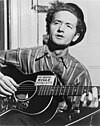
“Woody is just Woody. Thousands of people do not know he has any other name. He is just a voice and a guitar. He sings the songs of a people and I suspect that he is, in a way, that people. Harsh voiced and nasal, his guitar hanging like a tire iron on a rusty rim, there is nothing sweet about Woody, and there is nothing sweet about the songs he sings. But there is something more important for those who will listen. There is the will of the people to endure and fight against oppression. I think we call this the American spirit.”

“I guess we're all, or most of us, the wards of that nineteenth-century science which denied existence to anything it could not measure or explain. The things we couldn't explain went right on but surely not with our blessing. We did not see what we couldn't explain, and meanwhile a great part of the world was abandoned to children, insane people, fools, and mystics, who were more interested in what is than in why it is. So many old and lovely things are stored in the world's attic, because we don't want them around us and we don't dare throw them out.”
“We sat on a crate of oranges and thought what good men most biologists are, the tenors of the scientific world — temperamental, moody, lecherous, loud-laughing, and healthy.[…] Your true biologist will sing you a song as loud and off-key as will a blacksmith, for he knows that morals are too often diagnostic of prostatitis and stomach ulcers. Sometimes he may proliferate a little too much in all directions, but he is as easy to kill as any other organism, and meanwhile he is very good company, and at least he does not confuse a low hormone productivity with moral ethics.”
“Even while I protest the assembly-line production of our food, our songs, our language, and eventually our souls, I know that it was a rare home that baked good bread in the old days. Mother’s cooking was with rare exceptions poor, that good unpasteurized milk touched only by flies and bits of manure crawled with bacteria, the healthy old-time life was riddled with aches, sudden death from unknown causes, and that sweet local speech I mourn was the child of illiteracy and ignorance. It is the nature of a man as he grows older, a small bridge in time, to protest against change, particularly change for the better.”

“Two gallons is a great deal of wine, even for two paisanos. Spiritually the jugs may be graduated thus: Just below the shoulder of the first bottle, serious and concentrated conversation. Two inches farther down, sweetly sad memory. Three inches more, thoughts of old and satisfactory loves. An inch, thoughts of bitter loves. Bottom of the first jug, general and undirected sadness. Shoulder of the second jug, black, unholy despondency. Two fingers down, a song of death or longing. A thumb, every other song each one knows. The graduations stop here, for the trail splits and there is no certainty. From this point on anything can happen.”
“We have usurped many of the powers we once ascribed to God.
Fearful and unprepared, we have assumed lordship over the life or death of the whole world — of all living things.
The danger and the glory and the choice rest finally in man. The test of his perfectibility is at hand.
Having taken Godlike power, we must seek in ourselves for the responsibility and the wisdom we once prayed some deity might have.
Man himself has become our greatest hazard and our only hope.
So that today, St. John the apostle may well be paraphrased: In the end is the Word, and the Word is Man — and the Word is with Men.”
Fearful and unprepared, we have assumed lordship over the life or death of the whole world — of all living things.
The danger and the glory and the choice rest finally in man. The test of his perfectibility is at hand.
Having taken Godlike power, we must seek in ourselves for the responsibility and the wisdom we once prayed some deity might have.
Man himself has become our greatest hazard and our only hope.
So that today, St. John the apostle may well be paraphrased: In the end is the Word, and the Word is Man — and the Word is with Men.”
“The President must be greater than anyone else, but not better than anyone else. We subject him and his family to close and constant scrutiny and denounce them for things that we ourselves do every day. A Presidential slip of the tongue, a slight error in judgment — social, political, or ethical — can raise a storm of protest. We give the President more work than a man can do, more responsibility than a man should take, more pressure than a man can bear. We abuse him often and rarely praise him. We wear him out, use him up, eat him up. And with all this, Americans have a love for the President that goes beyond loyalty or party nationality; he is ours, and we exercise the right to destroy him.”

“A kind of second childhood falls on so many men. They trade their violence for the promise of a small increase of life span. In effect, the head of the house becomes the youngest child. And I have searched myself for this possibility with a kind of horror. For I have always lived violently, drunk hugely, eaten too much or not at all, slept around the clock or missed two nights of sleeping, worked too hard and too long in glory, or slobbed for a time in utter laziness. I’ve lifted, pulled, chopped, climbed, made love with joy and taken my hangovers as a consequence, not as a punishment. I did not want to surrender fierceness for a small gain in yardage. My wife married a man; I saw no reason why she should inherit a baby.”

“Among primitives sometimes evil is escaped by never mentioning the name, as in Malaysia, where one never mentions a tiger by name for fear of calling him. Among others, as even among ourselves, the giving of a name establishes a familiarity which renders the thing impotent. It is interesting to see how some scientists and philosophers, who are an emotional and fearful group, are able to protect themselves against fear. In a modern scene, when the horizons stretch out and your philosopher is likely to fall off the world like a Dark Age mariner, he can save himself by establishing a taboo-box which he may call "mysticism" or "supernaturalism" or "radicalism." Into this box he can throw all those thoughts which frighten him and thus be safe from them.”

“She envied Camille. Camille was a tramp, Mildred thought. And things were so much easier for a tramp. There was no conscience, no sense of loss, nothing but a wonderful, relaxed, stretching-cat selfishness. She could go to bed with anyone she wanted to and never see him again and have no feeling of loss or insecurity about it. That was the way Mildred thought it was with Camille. She wished she could be that way, and she knew she couldn't. Couldn't because of her mother. And the unbidden thought entered her mind—if her mother were only dead Mildred's life would be so much simpler. She could have a secret little place to live somewhere. Almost fiercely, she brushed the thought away. "What a foul thing to think," she said to herself ceremoniously. But it was a dream she often had.”
“Humanity has been passing through a gray and desolate time of confusion. My great predecessor, William Faulkner, speaking here, referred to it as a tragedy of universal fear so long sustained that there were no longer problems of the spirit, so that only the human heart in conflict with itself seemed worth writing about.
Faulkner, more than most men, was aware of human strength as well as of human weakness. He knew that the understanding and the resolution of fear are a large part of the writer's reason for being.
This is not new. The ancient commission of the writer has not changed. He is charged with exposing our many grievous faults and failures, with dredging up to the light our dark and dangerous dreams for the purpose of improvement.”
Faulkner, more than most men, was aware of human strength as well as of human weakness. He knew that the understanding and the resolution of fear are a large part of the writer's reason for being.
This is not new. The ancient commission of the writer has not changed. He is charged with exposing our many grievous faults and failures, with dredging up to the light our dark and dangerous dreams for the purpose of improvement.”

“He wondered why he stayed with her. Just pure laziness, he guessed. He didn't want to go through the emotional turmoil of leaving her. In spite of himself he'd worry about her and it was too much trouble. He'd need another woman right away and that took a lot of talking and arguing and persuading. It was different just to lay a girl but he would need a woman around, and that was the difference. You got used to one and it was less trouble.[…]
But there was another reason too. She loved him. She really did. And he knew it. And you can't leave a thing like that. It's a structure and it has an architecture, and you can't leave it without tearing off a piece of yourself. So if you want to remain whole you stay no matter how much you may dislike staying. Juan was not a man who fooled himself very much.”
But there was another reason too. She loved him. She really did. And he knew it. And you can't leave a thing like that. It's a structure and it has an architecture, and you can't leave it without tearing off a piece of yourself. So if you want to remain whole you stay no matter how much you may dislike staying. Juan was not a man who fooled himself very much.”
“He had said, "I am a man," and that meant certain things to Juana. It meant that he was half insane and half god. It meant that Kino would drive his strength against a mountain and plunge his strength against the sea. Juana, in her woman's soul, knew that the mountain would stand while the man broke himself; that the sea would surge while the man drowned in it. And yet it was this thing that made him a man, half insane and half god, and Juana had need of a man; she could not live without a man. Although she might be puzzled by these differences between man and woman, she knew them and accepted them and needed them. Of course she would follow him, there was no question of that. Sometimes the quality of woman, the reason, the caution, the sense of preservation, could cut through Kino's manness and save them all.”
“You see this book is finished and it is a bad book and I must get rid of it. It can't be printed. It is bad because it isn't honest. Oh! the incidents all happened but — I'm not telling as much of the truth about them as I know. In satire you have to restrict the picture and I just can't do satire. I've written three books now that were dishonest because they were less than the best that I could do. One you never saw because I burned it the day I finished it. ... My whole work drive has been aimed at making people understand each other and then I deliberately write this book, the aim of which is to cause hatred through partial understanding. My father would have called it a smart-alec book. It was full of tricks to make people ridiculous. If I can't do better I have slipped badly. And that I won't admit — yet.”
“Death is a personal matter, arousing sorrow, despair, fervor, or dry-hearted philosophy. Funerals, on the other hand, are social functions. Imagine going to a funeral without first polishing the automobile. Imagine standing at a graveside not dressed in your best dark suit and your best black shoes, polished delightfully. Imagine sending flowers to a funeral with no attached card to prove you had done the correct thing. In no social institution is the codified ritual of behavior more rigid than in funerals. Imagine the indignation if the minister altered his sermon or experimented with facial expression. Consider the shock if, at the funeral parlors, any chairs were used but those little folding yellow torture chairs with the hard seats. No, dying, a man may be loved, hated, mourned, missed; but once dead he becomes the chief ornament of a complicated and formal social celebration.”

“"Let us go," we said, "into the Sea of Cortez, realizing that we become forever a part of it; that our rubber boots slogging through a flat of eel-grass, that the rocks we turn over in a tide pool, make us truly and permanently a factor in the ecology of the region. We shall take something away from it, but we shall leave something too." And if we seem a small factor in a huge pattern, nevertheless it is of relative importance. We take a tiny colony of soft corals from a rock in a little water world. And that isn't terribly important to the tide pool. Fifty miles away the Japanese shrimp boats are dredging with overlapping scoops, bringing up tons of shrimps, rapidly destroying the species so that it may never come back, and with the species destroying the ecological balance of the whole region. That isn't very important in the world. And thousands of miles away the great bombs are falling and the stars are not moved thereby. None of it is important or all of it is.”
“I am glad that I can use the oldest story in the world to be the design of the newest story for me. The lack of change in the world is the thing which astonishes me. [...] And now I had set down in my own hand the 16 verses of Cain and Abel and the story changes with flashing lights when you write it down. And I think I have a title at last, a beautiful title, EAST OF EDEN. And read the 16th verse to find it. And the Salinas Valley is surely East Of Eden. [...] And [...] as I went into the story more deeply I began to realize that without this story — or rather a sense of it — psychiatrists would have nothing to do. In other words this one story is the basis of all human neurosis — and if you take the fall along with it, you have the total of the psychic troubles which can happen to a human.”
“I believe that the great ones, Plato, Lao Tze, Buddha, Christ, Paul and the great Hebrew prophets are not remembered for negation or denial. Not that it is necessary to be remembered but there is one purpose in writing that I can see, beyond simply doing it interestingly. It is the duty of the writer to lift up, to extend, to encourage. If the written word has contributed anything at all to our developing species and our half developed culture, it is this: Great writing has been a staff to lean on, a mother to consult, a wisdom to pick up stumbling folly, a strength in weakness and a courage to support sick cowardice. And how any negative or despairing approach can pretend to be literature I do not know. It is true that we are weak and sick and ugly and quarrelsome but if that is all we ever were, we would milleniums ago have disappeared from the face of the earth, and a few remnants of fossilized jaw bones, a few teeth in strata of limestone would be the only mark our species would have left on the earth.”
“Now back to Malory.[…] As I go along, I am constantly jiggled by the arrant nonsense of a great deal of the material. A great deal of it makes no sense at all. Two thirds of it is the vain dreaming of children talking in the dark. And then when you are about to throw it out in disgust, you remember the Congressional Record or the Sacco and Vanzetti case or 'preventive war' or our national political platforms, or racial problems that can't be settled reasonably or domestic relations, or beatniks, and it is borne in on you that the world operates on nonsense — that it is a large part of the pattern and that knight errantry is no more crazy than our present-day group thinking, and activity. That is the way humans are. If you inspected them and their activities in the glass of reason, you would drown the whole lot.”
“I must go over into the interior valleys. ... There are five thousand families starving to death over there, not just hungry but actually starving. The government is trying to feed them and get medical attention to them, with the Fascist group of utilities and banks and huge growers sabotaging the thing all along the line, and yelling for a balanced budget. In one tent there were twenty people quarantined for small pox and two of the women are to have babies in that tent this week. I've tied into the thing from the first and I must get down there and see it and see if I can do something to knock these murderers on the heads.
Do you know what they're afraid of? They think that if these people are allowed to live in camps with proper sanitary facilities they will organize, and that is the bugbear of the large landowner and the corporate farmer. The states and counties will give them nothing because they are outsiders. But the crops of any part of this state could not be harvested without them. ... The death of children by starvation in our valleys is simply staggering. ... I'll do what I can. ... Funny how mean and little books become in the face of such tragedies.”
Do you know what they're afraid of? They think that if these people are allowed to live in camps with proper sanitary facilities they will organize, and that is the bugbear of the large landowner and the corporate farmer. The states and counties will give them nothing because they are outsiders. But the crops of any part of this state could not be harvested without them. ... The death of children by starvation in our valleys is simply staggering. ... I'll do what I can. ... Funny how mean and little books become in the face of such tragedies.”

“Mr. Pritchard was a businessman, president of a medium-sized corporation. He was never alone. His business was conducted by groups of men like himself who joined together in clubs so that no foreign element or idea could enter. His religious life was again his lodge and his church, both of which were screened and protected. One night a week he played poker with men so exactly like himself that the game was fairly even, and from this fact his group was convinced that they were very fine poker players. Wherever he went he was not one man but a unit in a corporation, a unit in a club, in a lodge, in a church, in a political party. His thoughts and ideas were never subjected to criticism since he willingly associated only with people like himself. He read a newspaper written by and for his group. The books that came into his house were chosen by a committee which deleted material that might irritate him. He hated foreign countries and foreigners because it was difficult to find his counterpart in them. He did not want to stand out from his group. He would like to have risen to the top of it and be admired by it; but it would not occur to him to leave it. At occasional stags where naked girls danced on the tables and sat in great glasses of wine, Mr. Pritchard howled with laughter and drank the wine, but five hundred Mr. Pritchards were there with him.”
“There is a strange duality in the human which makes for an ethical paradox. We have definitions of good qualities and of bad; not changing things, but generally considered good and bad throughout the ages and throughout the species. Of the good, we think always of wisdom, tolerance, kindliness, generosity, humility; and the qualities of cruelty, greed, self-interest, graspingness, and rapacity are universally considered undesirable. And yet in our structure of society, the so-called and considered good qualities are invariable concomitants of failure, while the bad ones are the cornerstones of success. A man — a viewing-point man — while he will love the abstract good qualities and detest the abstract bad, will nevertheless envy and admire the person who though possessing the bad qualities has succeeded economically and socially, and will hold in contempt that person whose good qualities have caused failure. When such a viewing-point man thinks of Jesus or St. Augustine or Socrates he regards them with love because they are the symbols of the good he admires, and he hates the symbols of the bad. But actually he would rather be successful than good. In an animal other than man we would replace the term “good” with “weak survival quotient” and the term “bad” with “strong survival quotient.” Thus, man in his thinking or reverie status admires the progression toward extinction, but in the unthinking stimulus which really activates him he tends toward survival. Perhaps no other animal is so torn between alternatives. Man might be described fairly adequately, if simply, as a two-legged paradox. He has never become accustomed to the tragic miracle of consciousness. Perhaps, as has been suggested, his species is not set, has not jelled, but is still in a state of becoming, bound by his physical memories to a past of struggle and survival, limited in his futures by the uneasiness of thought and consciousness.”
John Steinbeck Quotes by Topic
Find exactly what you are looking for by browsing this categorized list of John Steinbeck quotes by topic.
John Steinbeck on Love 2 quotes
“In uncertainty I am certain that underneath their topmost layers of frailty men want to be good and want to be loved. Indeed most of their vices are attempted short cuts to love. When a man comes to die, no matter what his talents and influence and genius, if he dies unloved his life must be a failure to him and his dying a cold horror.”
John Steinbeck on Pattern 2 quotes
“I can understand why a system built on a pattern must try to destroy the free mind, for it is the one thing which can by inspection destroy such a system. Surely I can understand this, and I hate it and I will fight against it to preserve the one thing that separates us from the uncreative beasts. If the glory can be killed, we are lost.”

John Steinbeck on Advice
“No one wants advice, only corroboration.”
John Steinbeck on Honky tonk
“Honky-tonks, restaurants and whore-houses.”

What John Steinbeck Said About Others
Discover personal opinions John Steinbeck shared regarding contemporaries.
John Steinbeck on Ed Ricketts
John Steinbeck on Woody Guthrie
“Woody is just Woody. Thousands of people do not know he has any other name. He is just a voice and a guitar. He sings the songs of a people and I suspect that he is, in a way, that people. Harsh voiced and nasal, his guitar hanging like a tire iron on a rusty rim, there is nothing sweet about Woody, and there is nothing sweet about the songs he sings. But there is something more important for those who will listen. There is the will of the people to endure and fight against oppression. I think we call this the American spirit.”
Quotes About John Steinbeck
Gain deeper perspective through quotes about John Steinbeck from others.
James Gould Cozzens on John Steinbeck
“I can't read ten pages of Steinbeck without throwing up. I couldn't read the proletarian crap that came out in the '30s; again you had sentimentalism — the poor oppressed workers.”
Roxanne Dunbar-Ortiz on John Steinbeck
“Steinbeck's novel The Grapes of Wrath and the subsequent John Ford movie promulgated a populist mythology about depression-era migrants to California who were dubbed "Okies," no matter what southwestern or midwestern state they hailed from. But most Californians regarded Okies as dirty, shifty, lazy, violent, and ignorant.”

Dorothy Ray Healey on John Steinbeck
“There was one New Deal agency that proved helpful to us in the fields, and that was the Farm Security Administration. The FSA administered a system of migrant labor camps in California. When I read about the Joads arriving at the temporary safe haven of the "government camp" in The Grapes of Wrath, I knew exactly what they felt like.”

Gloria Naylor on John Steinbeck
“Steinbeck is extremely angry about the fact that the common man who is striving very hard, who wants so very little, is not even able to attain that little if it backs up against the interests of the banks and of the big landowners. You know, and that’s what The Grapes of Wrath, I think, is basically about, is about watching these people try to simply live who asking for little. They are not angry people. They are not revolutionaries. They are not sophisticated. They they simply want to farm a tenant farmers. They simply want to go out but their butts every day and get a small return and then pass that on to their children. And even that under certain circumstances is asking too much if you’re going to inopportune the banking interest. And that’s what made Steinbeck so furious...what he’s saying is that people it’s just not fair. That’s what he’s saying...he believes it is at this point that even people like the Joads can be moved to anger at the just at just the epitome of the unfairness of it all.”

Vicki L. Ruiz on John Steinbeck
“When one thinks of California agriculture during the Depression, John Steinbeck's The Grapes of Wrath generally comes to mind. Steinbeck did not exaggerate. White and African American Dust Bowl migrants alongside Mexicanos and Filipinos endured great hardships.”
Disputed Quotes
Quotes attributed to John Steinbeck that are questionable.
“Socialism never took root in America because the poor see themselves not as an exploited proletariat, but as temporarily embarrassed millionaires.”
About John Steinbeck
John Ernst Steinbeck Jr. (27 February 1902 – 20 December 1968) was an American writer. A recipient of the Nobel Prize for Literature in 1962, his works include the novella Of Mice and Men (1937) and the novel The Grapes of Wrath (1939, Pulitzer Prize for Fiction, 1940), both of which examine the lives of the working class and migrant workers during the Great Depression.