Link Copied!
John Peckham Quotes (1230-1292)
Theologian
About John Peckham
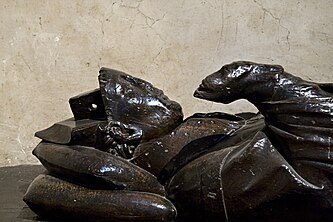
John Peckham (or Pecham) (c. 1230 – 1292) was a native of Sussex who was educated at Lewes Priory and became a Franciscan friar about 1250. He studied under Bonaventure at the University of Paris and became regent master (official lecturer) in theology. He was a conservative theologian who debated Thomas Aquinas with some success. He also taught at Oxford University and then traveled to Rome via France, to study law. In Rome he received a papal appointment to the position of Lector Sacri Palatii (theological lecturer) in the papal palace schools, where his lectures were attended by large audiences, including many bishops and cardinals. After one or two years in Rome, he was appointed by Pope Nicholas III as Archbishop of Canterbury (1279–1292), where he became known as one of the three earliest champions of English clerical reform.
Best John Peckham Quotes
Shortest
Earliest
Explore our curated collection of the most famous and impactful John Peckham quotes.
“[Perspectiva communis was written to] compress into concise summaries the teachings of perspective, which [in existing treatises] are presented with great obscurity.”
Unsourced — Primary work/page citation not yet verified in the QuotesCosmos archive. Per our Unnamed Sources & Verification Policy, quotes without confirmed primary editions are explicitly marked Unsourced while under editorial review.
“As you see double if you push the eye out of its place with your finger; so prelates, through evil counsel, judge a priest to be worthy of two benefices, when he ought to be contented with one.”
Unsourced — Primary work/page citation not yet verified in the QuotesCosmos archive. Per our Unnamed Sources & Verification Policy, quotes without confirmed primary editions are explicitly marked Unsourced while under editorial review.
“Light from a concave luminous body is received most powerfully at the centre. The reason for this is that, for every point of a concave body, perpendicular rays, which are stronger than others, converge in the centre. Therefore the virtues of celestial bodies are incident most powerfully in and near the centre of the world.”
Unsourced — Primary work/page citation not yet verified in the QuotesCosmos archive. Per our Unnamed Sources & Verification Policy, quotes without confirmed primary editions are explicitly marked Unsourced while under editorial review.
“Formerly the Church with its prelates of old time, was golden in wisdom, silver in cleanness of life, brazen in eloquence, which are three things needful to a preacher; that is, brightness of wisdom, cleanness of life, and sonorousness of eloquence. But of the feet, the last, that is the modern prelates, part is iron through their hardness of heart, and part is clay by their carnal luxury.”
Unsourced — Primary work/page citation not yet verified in the QuotesCosmos archive. Per our Unnamed Sources & Verification Policy, quotes without confirmed primary editions are explicitly marked Unsourced while under editorial review.
“Among all the studies of natural causes and reasons, light most delights the contemplators; among the great things of mathematics, the certainty of its demonstrations most illustriously elevates the minds of its investigators; perspective must therefore be preferred to all human discourses and disciplines, in the study in which radiant lines are expounded by means of demonstrations and in which the glory is found not only of mathematics, but also physics: it is adorned with the flowers of one and the other.”
Unsourced — Primary work/page citation not yet verified in the QuotesCosmos archive. Per our Unnamed Sources & Verification Policy, quotes without confirmed primary editions are explicitly marked Unsourced while under editorial review.
“And therefore, Sire, altho' I am ready, so far as is in me, to dedicate the place for the Cistercian monks at Meynan, yet I could not do it without the full assent of the bishop and of his chapter, and of the parson of the place, who, with plenty of other people, have a very great horror of the approach of the forsaid monks. For though they may be good men, if God please, still they are the hardest neighbours that prelates and parsons could have. For where they plant their foot, they destroy towns, take away tithes, and curtail by their privileges all the power of prelacy.”
Unsourced — Primary work/page citation not yet verified in the QuotesCosmos archive. Per our Unnamed Sources & Verification Policy, quotes without confirmed primary editions are explicitly marked Unsourced while under editorial review.
John Peckham Quotes by Topic
Find exactly what you are looking for by browsing this categorized list of John Peckham quotes by topic.
John Peckham on Son of God
“A heavy charge may be brought against Friar John himself, in so far that he did not oppose, though we have no reason to believe that he instigated, the severe measures which were adopted in this reign against the Jews. ...Occasionally a prelate would take part against them, urged, by religious motives, to act against those who, in their unbelief, crucified the Son of God afresh. Such was the case with Peckham, and even with the more enlightened Stephen Langton. But the prelates, who were statesmen and lawyers, were generally on the side of Government, whose policy it was to extend protection to that great class, which formed a considerable part of the monied interest of the country.”
Unsourced — Primary work/page citation not yet verified in the QuotesCosmos archive. Per our Unnamed Sources & Verification Policy, quotes without confirmed primary editions are explicitly marked Unsourced while under editorial review.
Quotes About John Peckham
Gain deeper perspective through quotes about John Peckham from others.
A.C. Crombie on John Peckham 3 quotes
“Another Oxford writer who appreciated experimental science was John Pecham... In his Perspectiva Communis Pecham gave a very clear and concise summary of contemporary optics, based largely on Alhazen, Witelo, and pseudo-Euclid's De Speculis. His book contained nothing original but it remained a popular text book until the seventeenth century.”
Unsourced — Primary work/page citation not yet verified in the QuotesCosmos archive. Per our Unnamed Sources & Verification Policy, quotes without confirmed primary editions are explicitly marked Unsourced while under editorial review.
Footnote on John Peckham 2 quotes
“Giambattista della Porta, who seems to have been the first to try combinations of lenses to form a microscope, based his optical work almost entirely on that of Roger Bacon, Witelo, and Pecham.”
Unsourced — Primary work/page citation not yet verified in the QuotesCosmos archive. Per our Unnamed Sources & Verification Policy, quotes without confirmed primary editions are explicitly marked Unsourced while under editorial review.
Girard Etzkorn on John Peckham
“In the realm of psychology (in the medieval sense), Pecham's writings are extensive. ...each soul is created singly and "daily" by God. The soul... is everywhere in its little world as God is everywhere in the the bigger world. The soul is united to the body as a form is to matter. ...The human will is free and cannot be coerced by anything else. ...The will is free to the extent that it can withhold consent to the dictates of practical reason.”
Unsourced — Primary work/page citation not yet verified in the QuotesCosmos archive. Per our Unnamed Sources & Verification Policy, quotes without confirmed primary editions are explicitly marked Unsourced while under editorial review.
John Freely on John Peckham
“The Perspectiva is a clear and concise summary of the science of light at the time... a popular text on optics until the seventeenth century... used and cited by many medieval and Renaissance scholars, including Leonardo da Vinci and Johannes Kepler.”
Unsourced — Primary work/page citation not yet verified in the QuotesCosmos archive. Per our Unnamed Sources & Verification Policy, quotes without confirmed primary editions are explicitly marked Unsourced while under editorial review.
Thomas F. Glick on John Peckham
“The difference between Pecham's Tractatus de perspectiva and his Perspectiva communis is striking. The former has significant religious content and was apparently intended as a devotional aid. The latter deals exclusively with optics, and reveals neither biblical nor theological influence.”
Unsourced — Primary work/page citation not yet verified in the QuotesCosmos archive. Per our Unnamed Sources & Verification Policy, quotes without confirmed primary editions are explicitly marked Unsourced while under editorial review.
About John Peckham
John Peckham (or Pecham) (c. 1230 – 1292) was a native of Sussex who was educated at Lewes Priory and became a Franciscan friar about 1250. He studied under Bonaventure at the University of Paris and became regent master (official lecturer) in theology. He was a conservative theologian who debated Thomas Aquinas with some success. He also taught at Oxford University and then traveled to Rome via France, to study law. In Rome he received a papal appointment to the position of Lector Sacri Palatii (theological lecturer) in the papal palace schools, where his lectures were attended by large audiences, including many bishops and cardinals. After one or two years in Rome, he was appointed by Pope Nicholas III as Archbishop of Canterbury (1279–1292), where he became known as one of the three earliest champions of English clerical reform.