Link Copied!
John Paul Stevens Quotes (1920-2019)
Leader

About John Paul Stevens
John Paul Stevens (April 20, 1920 — July 16, 2019) was an American lawyer and judge who served as an Associate Justice of the Supreme Court of the United States from 1975 until his retirement in 2010.
Best John Paul Stevens Quotes
Shortest
Earliest
Explore our curated collection of the most famous and impactful John Paul Stevens quotes.

“After all, a district judge who gives harsh sentences to Yankees fans and lenient sentences to Red Sox fans would not be acting reasonably even if her procedural rulings were impeccable.”
“A well regulated militia, being necessary to the security of a free state, the right of the people to keep and bear arms when serving in the militia shall not be infringed.”
“(TH: In Justice Stevens’ dissent in Citizens United, he pointed out that corporations in their modern form didn’t even exist when the Constitution was written in 1787 and got its first ten amendments in 1791, including the First which protects free speech)”

“On occasion, quite apart from any threat of persecution, an advocate may believe her ideas will be more persuasive if her readers are unaware of her identity. Anonymity thereby provides a way for a writer who may be personally unpopular to ensure that readers will not prejudge her message simply because they do not like its proponent.”

“Time will one day heal the wound to that confidence that will be inflicted by today's decision. One thing, however, is certain. Although we may never know with complete certainty the identity of the winner of this year's presidential election, the identity of the loser is perfectly clear. It is the nation's confidence in the judge as an impartial guardian of the rule of law.”

“[B]y requiring that an execution be relatively painless, we necessarily protect the inmate from enduring any punishment that is comparable to the suffering inflicted on his victim. This trend, while appropriate and required by the Eighth Amendment's prohibition on cruel and unusual punishment, actually undermines the very premise on which public approval of the retribution rationale is based.”

“Money is property; it is not speech. Speech has the power to inspire volunteers to perform a multitude of tasks on a campaign trail, on a battleground, or even on a football field. Money, meanwhile, has the power to pay hired laborers to perform the same tasks. It does not follow, however, that the First Amendment provides the same measure of protection to the use of money to accomplish such goals as it provides to the use of ideas to achieve the same results.”

“The ideas of liberty and equality have been an irresistible force in motivating leaders like Patrick Henry, Susan B. Anthony, and Abraham Lincoln, schoolteachers like Nathan Hale and Booker T. Washington, the Philippine Scouts who fought at Bataan, and the soldiers who scaled the bluff at Omaha Beach. If those ideas are worth fighting for -- and our history demonstrates that they are -- it cannot be true that the flag that uniquely symbolizes their power is not itself worthy of protection from unnecessary desecration.”

“At bottom, the court's opinion is thus a rejection of the common sense of the American people, who have recognized a need to prevent corporations from undermining self-government since the founding, and who have fought against the distinctive corrupting potential of corporate electioneering since the days of Theodore Roosevelt. It is a strange time to repudiate that common sense. While American democracy is imperfect, few outside the majority of this court would have thought its flaws included a dearth of corporate money in politics.”
“Under our Constitution, anonymous pamphleteering is not a pernicious, fraudulent practice, but an honorable tradition of advocacy and of dissent. Anonymity is a shield from the tyranny of the majority. … It thus exemplifies the purpose behind the Bill of Rights, and of the First Amendment in particular: to protect unpopular individuals from retaliation--and their ideas from suppression--at the hand of an intolerant society. The right to remain anonymous may be abused when it shields fraudulent conduct. But political speech by its nature will sometimes have unpalatable consequences, and, in general, our society accords greater weight to the value of free speech than to the dangers of its misuse.”
“Great works of literature have frequently been produced by authors writing under assumed names. Despite readers' curiosity and the public's interest in identifying the creator of a work of art, an author generally is free to decide whether or not to disclose her true identity. The decision in favor of anonymity may be motivated by fear of economic or official retaliation, by concern about social ostracism, or merely by a desire to preserve as much of one's privacy as possible. Whatever the motivation may be, at least in the field of literary endeavor, the interest in having anonymous works enter the marketplace of ideas unquestionably outweighs any public interest in requiring disclosure as a condition of entry.”

“All general business corporation statues appear to date from well after 1800.. The Framers thus took it as a given that corporations could be comprehensively regulated in the service of the public welfare. Unlike our colleagues, they had little trouble distinguishing corporations from human beings, and when they constitutionalized the right to free speech in the First Amendment, it was the free speech of individual Americans they had in mind.
The fact that corporations are different from human beings might seem to need no elaboration, except that the majority opinion almost completely elides it…. Unlike natural persons, corporations have ‘limited liability’ for their owners and managers, ‘perpetual life,’ separation of ownership and control, ‘and favorable treatment of the accumulation of assets….’ Unlike voters in U.S. elections, corporations may be foreign controlled.
...It might be added that corporations have no consciences, no beliefs, no feelings, no thoughts, no desires. Corporations help structure and facilitate the activities of human beings, to be sure, and their ‘personhood’ often serves as a useful legal fiction. But they are not themselves members of ‘We the People’ by whom and for whom our Constitution was established.”
“In addition to this immediate drowning out of noncorporate voices, there may be deleterious effects that follow soon thereafter. Corporate ‘domination’ of electioneering can generate the impression that corporations dominate our democracy. When citizens turn on their televisions and radios before an election and hear only corporate electioneering, they may lose faith in their capacity, as citizens, to influence public policy. A Government captured by corporate interests, they may come to believe, will be neither responsive to their needs nor willing to give their views a fair hearing. The predictable result is cynicism and disenchantment: an increased perception that large spenders ‘call the tune’ and a reduced ‘willingness of voters to take part in democratic governance.’ To the extent that corporations are allowed to exert undue influence in electoral races, the speech of the eventual winners of those races may also be chilled.
Politicians who fear that a certain corporation can make or break their reelection chances may be cowed into silence about that corporation.
On a variety of levels, unregulated corporate electioneering might diminish the ability of citizens to ‘hold officials accountable to the people,’ and disserve the goal of a public debate that is ‘uninhibited, robust, and wide-open.’”
John Paul Stevens Quotes by Topic
Find exactly what you are looking for by browsing this categorized list of John Paul Stevens quotes by topic.
John Paul Stevens on Anonymity 3 quotes
“On occasion, quite apart from any threat of persecution, an advocate may believe her ideas will be more persuasive if her readers are unaware of her identity. Anonymity thereby provides a way for a writer who may be personally unpopular to ensure that readers will not prejudge her message simply because they do not like its proponent.”
John Paul Stevens on Freedom of speech 2 quotes
“In the national debate about a serious issue, it is the expression of the minority's viewpoint that most demands the protection of the First Amendment. Whatever the better policy may be, a full and frank discussion of the costs and benefits of the attempt to prohibit the use of marijuana is far wiser than suppression of speech because it is unpopular.”

John Paul Stevens on First Amendment to the United States Constitution 2 quotes
“Money is property; it is not speech. Speech has the power to inspire volunteers to perform a multitude of tasks on a campaign trail, on a battleground, or even on a football field. Money, meanwhile, has the power to pay hired laborers to perform the same tasks. It does not follow, however, that the First Amendment provides the same measure of protection to the use of money to accomplish such goals as it provides to the use of ideas to achieve the same results.”

John Paul Stevens on Debate
“In the national debate about a serious issue, it is the expression of the minority's viewpoint that most demands the protection of the First Amendment. Whatever the better policy may be, a full and frank discussion of the costs and benefits of the attempt to prohibit the use of marijuana is far wiser than suppression of speech because it is unpopular.”

John Paul Stevens on United States Bill of Rights
“Under our Constitution, anonymous pamphleteering is not a pernicious, fraudulent practice, but an honorable tradition of advocacy and of dissent. Anonymity is a shield from the tyranny of the majority. … It thus exemplifies the purpose behind the Bill of Rights, and of the First Amendment in particular: to protect unpopular individuals from retaliation--and their ideas from suppression--at the hand of an intolerant society. The right to remain anonymous may be abused when it shields fraudulent conduct. But political speech by its nature will sometimes have unpalatable consequences, and, in general, our society accords greater weight to the value of free speech than to the dangers of its misuse.”
John Paul Stevens on March for Our Lives
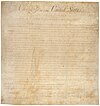
“Rarely in my lifetime have I seen the type of civic engagement schoolchildren and their supporters demonstrated in Washington and other major cities throughout the country this past Saturday. These demonstrations demand our respect. They reveal the broad public support for legislation to minimize the risk of mass killings of schoolchildren and others in our society. That support is a clear sign to lawmakers to enact legislation prohibiting civilian ownership of semiautomatic weapons, increasing the minimum age to buy a gun from 18 to 21 years old, and establishing more comprehensive background checks on all purchasers of firearms. But the demonstrators should seek more effective and more lasting reform. They should demand a repeal of the Second Amendment.... That simple but dramatic action would move Saturday’s marchers closer to their objective than any other possible reform. It would eliminate the only legal rule that protects sellers of firearms in the United States — unlike every other market in the world. It would make our schoolchildren safer than they have been since 2008 and honor the memories of the many, indeed far too many, victims of recent gun violence.”

John Paul Stevens on Second Amendment to the United States Constitution
“For over 200 years after the adoption of the Second Amendment, it was uniformly understood as not placing any limit on either federal or state authority to enact gun control legislation. In 1939 the Supreme Court unanimously held that Congress could prohibit the possession of a sawed-off shotgun because that weapon had no reasonable relation to the preservation or efficiency of a “well regulated militia.” During the years when Warren Burger was our chief justice, from 1969 to 1986, no judge, federal or state, as far as I am aware, expressed any doubt as to the limited coverage of that amendment. When organizations like the National Rifle Association disagreed with that position and began their campaign claiming that federal regulation of firearms curtailed Second Amendment rights, Chief Justice Burger publicly characterized the N.R.A. as perpetrating “one of the greatest pieces of fraud, I repeat the word fraud, on the American public by special interest groups that I have ever seen in my lifetime.” In 2008, the Supreme Court overturned Chief Justice Burger’s and others’ long-settled understanding of the Second Amendment’s limited reach by ruling, in District of Columbia v. Heller, that there was an individual right to bear arms. I was among the four dissenters. That decision — which I remain convinced was wrong and certainly was debatable — has provided the N.R.A. with a propaganda weapon of immense power. Overturning that decision via a constitutional amendment to get rid of the Second Amendment would be simple and would do more to weaken the N.R.A.’s ability to stymie legislative debate and block constructive gun control legislation than any other available option.”

John Paul Stevens on National Rifle Association
“For over 200 years after the adoption of the Second Amendment, it was uniformly understood as not placing any limit on either federal or state authority to enact gun control legislation. In 1939 the Supreme Court unanimously held that Congress could prohibit the possession of a sawed-off shotgun because that weapon had no reasonable relation to the preservation or efficiency of a “well regulated militia.” During the years when Warren Burger was our chief justice, from 1969 to 1986, no judge, federal or state, as far as I am aware, expressed any doubt as to the limited coverage of that amendment. When organizations like the National Rifle Association disagreed with that position and began their campaign claiming that federal regulation of firearms curtailed Second Amendment rights, Chief Justice Burger publicly characterized the N.R.A. as perpetrating “one of the greatest pieces of fraud, I repeat the word fraud, on the American public by special interest groups that I have ever seen in my lifetime.” In 2008, the Supreme Court overturned Chief Justice Burger’s and others’ long-settled understanding of the Second Amendment’s limited reach by ruling, in District of Columbia v. Heller, that there was an individual right to bear arms. I was among the four dissenters. That decision — which I remain convinced was wrong and certainly was debatable — has provided the N.R.A. with a propaganda weapon of immense power. Overturning that decision via a constitutional amendment to get rid of the Second Amendment would be simple and would do more to weaken the N.R.A.’s ability to stymie legislative debate and block constructive gun control legislation than any other available option.”

Quotes About John Paul Stevens
Gain deeper perspective through quotes about John Paul Stevens from others.
Thom Hartmann on John Paul Stevens
“Even worse than the short-term effect of a corporation’s dominating an election or a ballot initiative, Stevens said (as if he had a time machine to look at us now), was the fact that corporations corrupting politics would, inevitably, cause average working Americans — the 95 percent who make less than $100,000 a year — to conclude that their “democracy” is now rigged. The result, Stevens wrote, is that average people would simply stop participating in politics, stop being informed about politics, and stop voting…or become angry and cynical. Our democracy, he suggested, would be immeasurably damaged and ultimately vulnerable to corporate-supported demagogues and oligarchs. Our constitutional republic, if Citizens United stands, could wither and could die.”

About John Paul Stevens
John Paul Stevens (April 20, 1920 — July 16, 2019) was an American lawyer and judge who served as an Associate Justice of the Supreme Court of the United States from 1975 until his retirement in 2010.