Link Copied!
John Knox Quotes (1510-1572)
Writer, Leader, Theologian
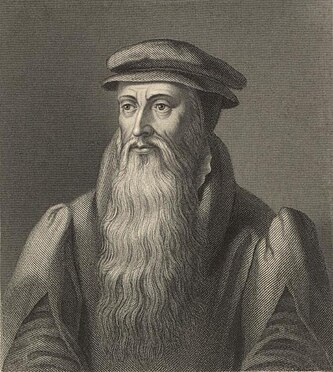

About John Knox
John Knox (c. 1510 – 24 November 1572) was a Scottish minister, Reformed theologian, and writer who was a leader of the country's Reformation. He was the founder of the Presbyterian Church of Scotland.
Best John Knox Quotes
Shortest
Earliest
Explore our curated collection of the most famous and impactful John Knox quotes.
“But hereof be assured, that all is not lawful nor just that is statute by civil laws; neither yet is everything sin before God, which ungodly persons allege to be treason.”
“Madam, in God's presence I speak: I never delighted in the weeping of any of God's creatures; yea I can scarcely well abide the tears of my own boys whom my own hand corrects, much less can I rejoice in your Majesty's weeping.”
“To promote a woman to beare rule, superioritie, dominion or empire above any realme, nation, or citie, is repugnant to nature, contumelie to God, a thing most contrarious to his reveled will and approved ordinance, and finalie it is the subversion of good order, of all equitie and justice.”
“As touching nature I am a worm of this earth, and yet a subject of this commonwealth; but as touching the office wherein it has pleased God to place me [head of the Reformed church in Scotland], I am a watchman...For that reason I am bound in conscience to blow the trumpet publicly.”
“Trouble me not; such an idol is accursed, and therefore I will not touch it.' The patron and the arguesyn (i.e. sergeant who commanded the forcats) with two officers, having the chief charge of all such matters, said, 'Thou shalt handle it,' and so they violently thrust it to his face, and put it betwixt his hands, who seeing the extremity, taking the idol and advisedly looking about, he cast it into the river, and said, 'Let our lady now save herself; she is light enough; let her learn to swim.' After that was no Scotchman urged with that idolatry.”
“To the verteuus and godlie Elizabeht by the grace of GOD quen of England etc John Knox desireht the perpetuall Encrease of the Holie Spiritt. etc.
As your graces displeasur against me most Iniustlie conceaned, hath be[en] and is to my wretched hart a burthen grevous and almost intollerabill, so is the testimonye of a clean conscience to me a stay and vphold that in desperation I sink not, how vehement that ever the temptations appear, for in GODD is presence my conscience beareht me reacord that maliciouslie nor of purpose I inoffended your grace, nor your realme. And therfor how so ever I be ludged by man, I am assured to be absolued by him who onlie knoweht the secreatis of hartes.”
As your graces displeasur against me most Iniustlie conceaned, hath be[en] and is to my wretched hart a burthen grevous and almost intollerabill, so is the testimonye of a clean conscience to me a stay and vphold that in desperation I sink not, how vehement that ever the temptations appear, for in GODD is presence my conscience beareht me reacord that maliciouslie nor of purpose I inoffended your grace, nor your realme. And therfor how so ever I be ludged by man, I am assured to be absolued by him who onlie knoweht the secreatis of hartes.”
“None have I corrupted. None have I defrauded. Merchandise have I not made — to God's glory I write — of the glorious Evangel of Jesus Christ; but, according to the measure of the grace granted unto me, I have divided the Sermon of Truth in just parts, beating down the rebellion of the proud against God, and raising up the consciences troubled with the knowledge of their sins, by declaring Jesus Christ, the strength of His Death, and the mighty operation of His Resurrection, in the hearts of the Faithful. Of this, I say, I have a testimony this day in my conscience, before God, however the world rage.”
“First, I say, that woman in her greatest perfection was made to serve and obey man, not to rule and command him. As St. Paul does reason in these words: "Man is not of the woman, but the woman of the man. And man was not created for the cause of the woman, but the woman for the cause of man; and therefore ought the woman to have a power upon her head" [1 Cor. 11:8-10] (that is, a cover in sign of subjection). Of which words it is plain that the apostle means, that woman in her greatest perfection should have known that man was lord above her; and therefore that she should never have pretended any kind of superiority above him, no more than do the angels above God the Creator, or above Christ their head.[38] So I say, that in her greatest perfection, woman was created to be subject to man.”

“If their princes exceed their bounds, Madam, no doubt they may be resisted, even by power. For there is neither greater honor, nor greater obedience, to be given to kings or princes, than God hath commanded to be given unto father and mother. But the father may be stricken with a frenzy, in which he would slay his children. If the children arise, join themselves together, apprehend the father, take the sword from him, bind his hands, and keep him in prison till his frenzy be overpast: think ye, Madam, that the children do any wrong? It is even so, Madam, with princes that would murder the children of God that are subjects unto them. Their blind zeal is nothing but a very mad frenzy, and therefore, to take the sword from them, to bind their hands, and to cast them into prison, till they be brought to a more sober mind, is no disobedience against princes, but just obedience, because it agreeth with the will of God.”

“To the question how she can be the image of God, [Augustine] answers as follows: "Woman," says he, "compared to other creatures, is the image of God, for she bears dominion over them. But compared unto man, she may not be called the image of God, for she bears not rule and lordship over man, but ought to obey him," etc.[57] And how that woman ought to obey man, he speaks yet more clearly in these words, "The woman shall be subject to man as unto Christ. For woman," says he, "has not her example from the body and from the flesh, that so she shall be subject to man, as the flesh is unto the Spirit, because that the flesh in the weakness and mortality of this life lusts and strives against the Spirit, and therefore would not the Holy Ghost give example of subjection to the woman of any such thing," etc. This sentence of Augustine ought to be noted of all women, for in it he plainly affirms, that woman ought to be subject to man, that she never ought more to desire preeminence [over] him, than that she ought to desire above Christ Jesus”
“Against God can nothing be more manifest than that a woman shall be exalted to reign above man; for the contrary sentence he has pronounced in these words: "Thy will shall be subject to thy husband, and he shall bear dominion over thee" (Gen. 3:16). As [though] God should say, "Forasmuch as you have abused your former condition, and because your free will has brought yourself and mankind into the bondage of Satan, I therefore will bring you in bondage to man. For where before your obedience should have been voluntary, now it shall be by constraint and by necessity; and that because you have deceived your man, you shall therefore be no longer mistress over your own appetites, over your own will or desires. For in you there is neither reason nor discretion which are able to moderate your affections, and therefore they shall be subject to the desire of your man. He shall be lord and governor, not only over your body, but even over your appetites and will." This sentence, I say, did God pronounce against Eve and her daughters, as the rest of the scriptures do evidently witness. So that no woman can ever presume to reign above man, but the same she must needs do in despite of God, and in contempt of his punishment and malediction.”
John Knox Quotes by Topic
Find exactly what you are looking for by browsing this categorized list of John Knox quotes by topic.
John Knox on Idolatry 2 quotes
“The Mass is Idolatry. All worshipping, honouring, or service invented by the brain of man in the religion of God, without his own express commandment, is idolatry. The Mass is invented by the brain of man, without any commandment of God; therefore it is idolatry.”
John Knox on Antichrist
“The very antichrist, and son of perdition, of whom Paul speaks.”

John Knox on Catholic Church
“That tyranny which the pope himself has for so many ages exercised over the church.
The very antichrist, and son of perdition, of whom Paul speaks.”

John Knox on Law
“But hereof be assured, that all is not lawful nor just that is statute by civil laws; neither yet is everything sin before God, which ungodly persons allege to be treason.”

John Knox on Enthusiasm
“Those who have arrived at any very eminent degree of excellence in the practice of an art or profession have commonly been actuated by a species of enthusiasm in their pursuit of it. They have kept one object in view amidst all the vicissitudes of time and fortune.”
What John Knox Said About Others
Discover personal opinions John Knox shared regarding contemporaries.
John Knox on Women
John Knox on Algernon Charles Swinburne
“Sins are sin-begotten, and their seed Bred of itself and singly procreative; Nor is God served with setting this to this For evil evidence of several shame, That one may say, Lo now! so many are they; But if one, seeing with God-illumined eyes In his full face the encountering face of sin, Smite once the one high-fronted head, and slay, His will we call good service. For myself, If ye will make a counsellor of me, I bid you set your hearts against one thing To burn it up, and keep your hearts on fire, Not seeking here a sign and there a sign, Nor curious of all casual sufferances, But steadfast to the undoing of that thing done Whereof ye know the being, however it be, And all the doing abominable of God. Who questions with a snake if the snake sting? Who reasons of the lightning if it burn? While these things are, deadly will these things be; And so the curse that comes of cursed faith.”

John Knox on Opposition to women's rights
“I am not ignorant that the subtle wits of carnal men (which can never be brought under the obedience of God's simple precepts to maintain this monstrous empire) have yet two vain shifts. First, they allege that, albeit women may not absolutely reign by themselves, because they may neither sit in judgement, neither pronounce sentence, neither execute any public office, yet may they do all such things by their lieutenants, deputies and judges substitute. Secondarily, say they, a woman born to rule over any realm may choose her a husband, and to him she may transfer and give her authority and right. To both I answer in few words. First, that from a corrupt and venomed fountain can spring no wholesome water. Secondarily that no person hath power to give the thing which doth not justly appertain to themselves. But the authority of a woman is a corrupted fountain, and therefore from her can never spring any lawful officer. She is not born to rule over men, and therefore she can appoint none by her gift, nor by her power (which she hath not), to the place of a lawful magistrate.”
Quotes About John Knox
Gain deeper perspective through quotes about John Knox from others.
Testimony by on John Knox
“Here lies one who neither flattered nor feared any flesh.”
William E. Thompson on John Knox
“John Knox had been a topical preacher, i.e., preaching on the cultural circumstances and political occurrences of the time. For Knox in the mid-1500s this meant that his sermons were typically anti-Catholic, and especially they were anti-Mary Queen of Scots sermons! Since Knox was a typical model for these Scots-Irish preachers on the Virginia frontier, that might have indicated that their worship services included the congregation's recitation of both the Apostles' Creed and the Lord's Prayer, but their sermons were probably scriptural exhortations against the demonic powers of this world... which was the main reason that those powers in Williamsburg were suspicious of such traveling dissenters!”
About John Knox
John Knox (c. 1510 – 24 November 1572) was a Scottish minister, Reformed theologian, and writer who was a leader of the country's Reformation. He was the founder of the Presbyterian Church of Scotland.