John Gall on Jerry Falwell
← Back to John Gall Profile
“Falwell generally escaped censure for such blatant contradictions because the press was often reluctant to take him to task. When his statements and motives were called into question, he has adhered to the premise that the best defense is a good offense. Instead of answering the substance of charges, Falwell would simply suggest darkly that his critics were part of a liberal conspiracy to repress the role of Christians in government. Responding to attacks on his political views in a 1976 sermon, Falwell said, "The idea that religion and politics don't mix was invented by the devil to keep Christians from running their own country."”
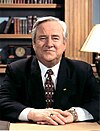
“While the outbreak of the mysterious and deadly disease in the early 1980s spurred many religiously motivated caregivers to new heights of compassion, Falwell used it to craft new fundraising appeals. In AIDS, religious conservatives like Falwell found the punitive manifestation for homosexual behavior for which they had been searching. No longer, they reasoned, could homosexuals pretend that homosexuality was without consequences. AIDS and homosexuality would become virtually synonymous in the rhetoric of the religious right and in the nation's consciousness. Ignoring the inconvenient facts that many people with AIDS are not gay, that the vast majority of gay men would never contract HIV, and that lesbians are at extremely low risk, Falwell and his colleagues on the right played AIDS as divine retribution for sodomy. In a 1987 fund-raising letter, for instance, Falwell accused gay men of donating blood because "they know they are going to die--and they are going to take as many people with them as they can."”
“For Falwell and the religious right, the tension between adhering to a literal interpretation of the Bible and allowing the compromise inherent in mainstream politics never fully eased. In a pluralistic democracy, the voice of every participant has a priori equal standing. Yet with its insistence on the inerrancy of the Bible in public policy, the religious right raised the specter of theocracy. To deal with the competing demands--theological and political--Falwell, like Pat Robertson later in the 1980s, simply opted to adopt two contradictory positions, one intended for his core audience and one suited for public consumption, and hoped no one would notice. After backing Briggs's and Bryant's campaign to ban gays and lesbians from teaching positions in the public schools and repeatedly in sermons and fund-raising letters harping on the homosexual threat to children, Falwell told the Washington Post, "I have no objection to a homosexual teaching in the classroom as long as that homosexual is not flaunting his lifestyle or soliciting students."”
“At its apex in 1979, Falwell's Old-Time Gospel Hour raised $37 million on 2.5 million appeals, a sum unimaginable for a gay organization. Yet throughout the 19705, the show was in and out of receivership. The pressure of mounting debt drove Falwell, whose penchant for overspending was as great as his gift for overstatement, to rely ever more heavily on solicitations stressing the alleged gay threat to American families. As Falwell's financial problems forced him to retreat from the public stage, the religious right's baton passed to the biblical reconstructionist Pat Robertson. Though he owed much to Falwell's trailblazing evangelism, Robertson, who practiced faith healing and speaking in tongues, would soon eclipse him as an entrepreneur and political preacher. Vowing not to repeat Falwell's mistakes, Robertson allowed the Christian Broadcasting Network to grow at a slow but steady rate. Until 1984, when he changed his party registration from Democratic to Republican, he largely abstained from Falwell's vituperative style of political activism.”