Greek and medieval knowledge accepted the world in its qualitative variety, and regarded nature's processes as having ends, or in technical phrase as teleological. New science was expounded so as to deny the reality of all qualities in real, or objective, existence. Sounds, colors, ends, as well as goods and bads, were regarded as purely subjective — as mere impressions in the mind. Objective existence was then treated as having only quantitative aspects — as so much mass in motion, its only differences being that at one point in space there was a larger aggregate mass than at another, and that in some spots there were greater rates of motion than at others. Lacking qualitative distinctions, nature lacked significant variety. Uniformities were emphasized, not diversities; the ideal was supposed to be the discovery of a single mathematical formula applying to the whole universe at once from which all the seeming variety of phenomena could be derived. This is what a mechanical philosophy means.
What It Means
This is a placeholder explanation generated by the low-overhead model. It interprets "Greek and medieval knowledge accepted the world in its qualitative variety, and regarded nature's processes as having ends, or in technical phrase as teleological. New science was expounded so as to deny the reality of all qualities in real, or objective, existence. Sounds, colors, ends, as well as goods and bads, were regarded as purely subjective — as mere impressions in the mind. Objective existence was then treated as having only quantitative aspects — as so much mass in motion, its only differences being that at one point in space there was a larger aggregate mass than at another, and that in some spots there were greater rates of motion than at others. Lacking qualitative distinctions, nature lacked significant variety. Uniformities were emphasized, not diversities; the ideal was supposed to be the discovery of a single mathematical formula applying to the whole universe at once from which all the seeming variety of phenomena could be derived. This is what a mechanical philosophy means." in the context of "John Dewey, Democracy and Education (1916) Ch.21, "The Modern Scientific Interest in Nature"" to mean that wisdom is timeless.

Tags
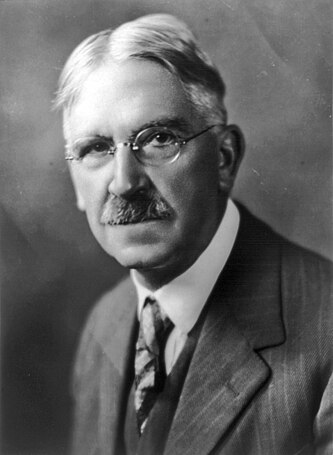
About John Dewey