Link Copied!
John C. Calhoun Quotes (1782-1850)
President, Politician
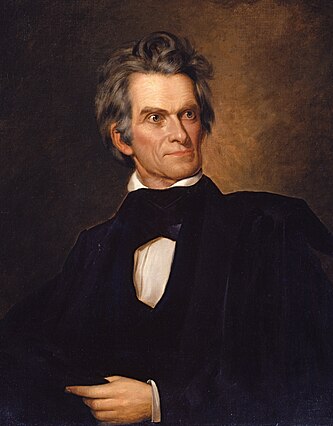
About John C. Calhoun
John Caldwell Calhoun (18 March 1782 – 31 March 1850) was an American politician from South Carolina during the first half of the 19th century. A Democrat who supported slavery, he served as the seventh vice president of the United States, first under John Quincy Adams (1825–1829) and then under Andrew Jackson (1829–1832), but resigned the vice presidency to enter the United States Senate, where he had more power. He also served in the United States House of Representatives (1810–1817) and was both Secretary of War (1817–1824) and Secretary of State (1844–1845).
Best John C. Calhoun Quotes
Shortest
Earliest
Explore our curated collection of the most famous and impactful John C. Calhoun quotes.
“Protection and patriotism are reciprocal.”

“The very essence of a free government consists in considering offices as public trusts, bestowed for the good of the country, and not for the benefit of an individual or a party.”

“The neighboring tribes are becoming daily less warlike, and more helpless and dependent on us … [T]hey have, in a great measure, ceased to be an object of terror, and have become that of commiseration.”
“The Government of the absolute majority instead of the Government of the people is but the Government of the strongest interests; and when not efficiently checked, it is the most tyrannical and oppressive that can be devised.”
“The interval between the decay of the old and the formation and establishment of the new constitutes a period of transition which must always necessarily be one of uncertainty, confusion, error, and wild and fierce fanaticism.”
“A power has risen up in the government greater than the people themselves, consisting of many and various and powerful interests, combined into one mass, and held together by the cohesive power of the vast surplus in the banks.”

“Many in the South once believed that slavery was a moral and political evil. That folly and delusion are gone. We see it now in its true light, and regard it as the most safe and stable basis for free institutions in the world.”
“I hold that the present state of civilization, where two races of different origin, and distinguished by color, and other physical differences, as well as intellectual, are brought together, the relation now existing in the slaveholding states between the two, is, instead of an evil, a good. A positive good.”

“With us the two great divisions of society are not the rich and the poor, but white and black, and all the former, the poor as well as the rich, belong to the upper class, and are respected and treated as equals, if honest and industrious, and hence have a position and pride of character of which neither poverty nor misfortune can deprive them.”
“I am a Southern man and a slaveholder. A kind and merciful one, I trust, and none the worse for being a slaveholder. I say, for one, I would rather meet any extremity upon earth than give up one inch of our equality, one inch of what belongs to us as members of this republic! What! Acknowledged inferiority! The surrender of life is nothing to sinking down into acknowledged inferiority!”
“Our well-founded claim, grounded on continuity, has greatly strengthened, during the same period, by the rapid advance of our population toward the territory — its great increase, especially in the valley of the Mississippi — as well as the greatly increased facility of passing to the territory by more accessible routes, and the far stronger and rapidly-swelling tide of population that has recently commenced flowing into it.”
“To the Infinite Being, the Creator of all, belongs exclusively the care and superintendence of the whole. He, in his infinite wisdom and goodness, has allotted to every class of animated beings its condition and appropriate functions; and has endowed each with feelings, instincts, capacities, and faculties, best adapted to its allotted condition. To man, he has assigned the social and political state, as best adapted to develop the great capacities and faculties, intellectual and moral, with which he has endowed him; and has, accordingly, constituted him so as not only to impel him into the social state, but to make government necessary for his preservation and well-being.”
“We now begin to experience the danger of admitting so great an error (all men are created equal) to have a place in the declaration of our independence. For a long time it lay dormant; but in the process of time it began to germinate, and produce its poisonous fruits. It had strong hold on the mind of Mr. Jefferson, the author of that document, which caused him to take an utterly false view of the subordinate relation of the black to the white race in the South; and to hold, in consequence, that the former, though utterly unqualified to possess liberty, were as fully entitled to both liberty and equality as the latter; and that to deprive them of it was unjust and immoral.”

“I cannot think in the present state of parties of entering again on the political arena. I would but waste my strength and exhaust my time, without adding to my character, or rendering service to the country, or advancing the cause for which I have so long contended. I feel no disgust nor do I feel disposed to complain of any one. On the contrary, I am content, and willing to end my public life now. In looking back, I see nothing to regret, and little to correct. My interest in the prosperity of the country, and the success of our peculiar and sublime political system when well understood, remain without abatement, and will do so till my last breath; and I shall ever stand prepared to serve the country, whenever I shall see reasonable prospect of doing so.”

“It is a great and dangerous error to suppose that all people are equally entitled to liberty. It is a reward to be earned, not a blessing to be gratuitously lavished on all alike—a reward reserved for the intelligent, the patriotic, the virtuous and deserving—and not a boon to be bestowed on a people too ignorant, degraded and vicious, to be capable either of appreciating or of enjoying it. Nor is it any disparagement to liberty, that such is, and ought to be the case. On the contrary, its greatest praise—its proudest distinction is, that an all-wise Providence has reserved it, as the noblest and highest reward for the development of our faculties, moral and intellectual. A reward more appropriate than liberty could not be conferred on the deserving—nor a punishment inflicted on the undeserving more just, than to be subject to lawless and despotic rule.”

“I assume, as an incontestable fact, that man is so constituted as to be a social being. His inclinations and wants, physical and moral, irresistibly impel him to associate with his kind; and he has, accordingly, never been found, in any age or country, in any state other than the social. In no other, indeed, could he exist; and in no other—were it possible for him to exist—could he attain to a full development of his moral and intellectual faculties, or raise himself, in the scale of being, much above the level of the brute creation. I next assume, also, as a fact not less incontestable, that, while man is so constituted as to make the social state necessary to his existence and the full development of his faculties, this state itself cannot exist without government. The assumption rests on universal experience. In no age or country has any society or community ever been found, whether enlightened or savage, without government of some description.”

“Such a state [of individual freedom and equality] is purely hypothetical. It never did, nor can exist; as it is inconsistent with the preservation and perpetuation of the race. It is, therefore, a great misnomer to call it the state of nature. Instead of being the natural state of man, it is, of all conceivable states, the most opposed to his nature—most repugnant to his feelings, and most incompatible with his wants. His natural state is, the social and political—the one for which his Creator made him, and the only one in which he can preserve and perfect his race. As, then, there never was such a state as the, so called, state of nature, and never can be, it follows, that men, instead of being born in it, are born in the social and political state; and of course, instead of being born free and equal, are born subject, not only to parental authority, but to the laws and institutions of the country where born, and under whose protection they draw their first breath.”
“If it be conceded, as it must by every one who is the least conversant with our institutions, that the sovereign power is divided between the states and general government, and that the former holds its reserved rights, in the same high sovereign capacity, which the latter does its delegated rights; it will be impossible to deny to the states the right of deciding on the infraction of their rights, and the proper remedy to be applied for the correction. The right of judging, in such cases, is an essential attribute of sovereignty of which the states cannot be divested, without losing their sovereignty itself; and being reduced to a subordinate corporate condition. In fact, to divide power, and to give to one of the parties the exclusive right of judging of the portion allotted to each, is in reality not to divide at all; and to reserve such exclusive right to the general government, (it matters not by what department it be exercised,) is in fact to constitute it one great consolidated government, with unlimited powers, and to reduce the states to mere corporations.”
“I consider the tariff act as the occasion, rather than the real cause of the present unhappy state of things. The truth can no longer be disguised, that the peculiar domestick [sic] institution of the Southern States and the consequent direction which that and her soil and climate have given to her industry, has placed them in regard to taxation and appropriations in opposite relation to the majority of the Union, against the danger of which, if there be no protective power in the reserved rights of the states they must in the end be forced to rebel, or, submit it to have their paramount interests sacrifices, their domestick [sic] institutions subordinated by Colonization and other schemes, and themselves and children reduced to wretchedness. Thus situated, the denial of the right of the State to interpose constitutionally in the last resort, more alarms the thinking, than all the other causes; and however strange it may appear, the more universally the state is condemned, and her right denied, the more resolute she is to assert her constitutional powers lest the neglect to assert should be considered a practical abandonment of them, under such circumstances.”
“The cords that bind the States together are not only many, but various in character. Some are spiritual or ecclesiastical; some political; others social... The strongest are those of a spiritual and ecclesiastical nature, consisted in the unity of the great religious denominations, all of which originally embraced the whole Union. All these denominations, with the exception, perhaps, of the Catholics, were organized very much upon the principle of our political institutions. Beginning with smaller meetings, corresponding with the political divisions of the country, their organization terminated in one great central assemblage, corresponding very much with the character of Congress. At these meetings the principal clergymen and lay members of the respective denominations, from all parts of the Union, met to transact business relating to their common concerns. It was not confined to what appertained to the doctrines and discipline of the respective denominations, but extended to plans for disseminating the Bible, establishing missionaries, distributing tracts, and of establishing presses for the publication of tracts, newspapers, and periodicals, with a view of diffusing religious information, and for the support of the doctrines and creeds of the denomination. All this combined contributed greatly to strengthen the bonds of the Union.”
John C. Calhoun Quotes by Topic
Find exactly what you are looking for by browsing this categorized list of John C. Calhoun quotes by topic.
John C. Calhoun on South Carolina 2 quotes
“With us the two great divisions of society are not the rich and the poor, but white and black, and all the former, the poor as well as the rich, belong to the upper class, and are respected.”

John C. Calhoun on American Civil War 2 quotes
“Many in the south once believed that slavery was a moral and political evil. That folly and delusion are gone. We see it now in its true light, and regard it as the most safe and stable basis for free institutions in the world.”

John C. Calhoun on Nullification crisis 2 quotes
“If it be conceded, as it must by every one who is the least conversant with our institutions, that the sovereign power is divided between the states and general government, and that the former holds its reserved rights, in the same high sovereign capacity, which the latter does its delegated rights; it will be impossible to deny to the states the right of deciding on the infraction of their rights, and the proper remedy to be applied for the correction. The right of judging, in such cases, is an essential attribute of sovereignty of which the states cannot be divested, without losing their sovereignty itself; and being reduced to a subordinate corporate condition. In fact, to divide power, and to give to one of the parties the exclusive right of judging of the portion allotted to each, is in reality not to divide at all; and to reserve such exclusive right to the general government, (it matters not by what department it be exercised,) is in fact to constitute it one great consolidated government, with unlimited powers, and to reduce the states to mere corporations.”
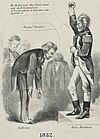
John C. Calhoun on Wage slavery
“The liberty of the northern wage earner ... amounted to little more than the freedom to sell his labor for a fraction of its value, or to starve.”

John C. Calhoun on Public trust
“The very essence of a free government consists in considering offices as public trusts, bestowed for the good of the country, and not for the benefit of an individual or a party.”

John C. Calhoun on Fanaticism
“The interval between the decay of the old and the formation and establishment of the new constitutes a period of transition which must always necessarily be one of uncertainty, confusion, error, and wild and fierce fanaticism.”

John C. Calhoun on Slavery in the United States
“Many in the south once believed that slavery was a moral and political evil. That folly and delusion are gone. We see it now in its true light, and regard it as the most safe and stable basis for free institutions in the world.”

John C. Calhoun on Government
“A power has arisen up in the Government greater than the people themselves, consisting of many and various and powerful interests, combined into one mass, and held together by the cohesive power of the vast surplus in the banks.”
John C. Calhoun on United States Congress
“I never know what South Carolina thinks of a measure. I never consult her. I act to the best of my judgment, and according to my conscience. If she approves, well and good. If she does not, or wishes any one to take my place, I am ready to vacate. We are even.”

John C. Calhoun on United States territorial acquisitions
“Our well-founded claim, grounded on continuity, has greatly strengthened, during the same period, by the rapid advance of our population toward the territory—its great increase, especially in the valley of the Mississippi—as well as the greatly increased facility of passing to the territory by more accessible routes, and the far stronger and rapidly-swelling tide of population that has recently commenced flowing into it.”

Quotes About John C. Calhoun
Gain deeper perspective through quotes about John C. Calhoun from others.
Cristina Beltrán on John C. Calhoun
“John C. Calhoun, Andrew Jackson's former vice president and eventual U.S. senator from South Carolina, argued against incorporation, asserting that Mexicans represented an amalgamation of "impure races, not [even] as good as the Cherokees or Choctaws." Calhoun asked, "Can we incorporate a people so dissimilar to us in every aspect-so little qualified for free and popular government-without certain destruction to our political institutions?"”
Jamelle Bouie on John C. Calhoun
“Arguably the most prominent and accomplished of these planter-politicians was John Calhoun...On this defense of the prerogatives of the Southern section of the nation, Calhoun built an entire theory of government. Seeing the threat democracy posed to slavery, he set out to limit democracy...The problem, in Calhoun's eyes, was that the will of the majority, as expressed in the House of Representatives and the election of the president, had too much power. It had to be curbed, lest it overrun this "true and perfect voice of the people." And those "people" whose voices must be heard, of course, were those like him. Those with power. Those with property. Those who enslaved others.”

CNN article on John C. Calhoun
“Chris Cillizza: If there is a list of the 15 greatest senators ever, is McCain on it? Why or why not? Ross Baker: He’s not up there with [Henry] Clay, [Daniel] Webster, [John] Calhoun, [Charles] Sumner and LBJ, but he’s a lot closer than Ted Cruz will ever be. Few senators in recent years, however, have had such a stupendous sendoff. He always had the media eating out of his hand. That’s no minor accomplishment.”
W. E. B. Du Bois on John C. Calhoun
“There has always been in the South that intellectual elite who saw the Negro problem clearly. They have always lacked and some still lack the courage to stand up for what they know is right. Nevertheless they can be depended on in the long run to follow their own clear thinking and their own decent choice. Finally even the politicians must eventually recognize the trend in the world, in this country, and in the South. James Byrnes, that favorite son of this commonwealth, and Secretary of State of the United States, is today occupying an indefensible and impossible position; and if he survives in the memory of men, he must begin to help establish in his own South Carolina something of that democracy which he has been recently so loudly preaching to Russia. He is the end of a long series of men whose eternal damnation is the fact that they looked truth in the face and did not see it; John C. Calhoun, Wade Hampton, Ben Tillman are men whose names must ever be besmirched by the fact that they fought against freedom and democracy in a land which was founded upon democracy and freedom. Eventually this class of men must yield to the writing in the stars. That great hypocrite, Jan Smuts, who today is talking of humanity and standing beside Byrnes for a United Nations, is at the same time oppressing the black people of South Africa to an extent which makes their two countries, South Africa and the American South, the most reactionary peoples on earth. Peoples whose exploitation of the poor and helpless reaches the last degree of shame. They must in the long run yield to the forward march of civilization or die.”

Amy Goodman Democracy Now! on John C. Calhoun
“There are so many monuments to the Confederacy in South Carolina's capital city that they are nearly impossible to avoid. Pinckney's body lay in state beside a statue of John C. Calhoun of South Carolina, the seventh US vice president and a leading advocate of slavery. Calhoun was a shrewd politician, and one of the architects of secession from the Union, although he died in 1850, before he could see his secessionist theories implemented fully. In 1838 Calhoun wrote, "Many in the South once believed that slavery was a moral and political evil. That folly and delusion are gone. We see it now in its true light, and regard it as the most safe and stable basis for free institutions in the world." He helped propel the United States into its devastating civil war, and in South Carolina, he is revered by some as a hero.”
Harry V. Jaffa on John C. Calhoun
“Stephens' Constitutional View of the War Between the States, which was and remains probably the best defense of the Confederate cause. It is all about states' rights, and the defense of the minority against the tyranny of the numerical majority, although the 'silent minority', the four million slaves, are never counted. It is substantially the book that Calhoun would have written had he been alive to do so... Calhoun was the philosopher-king of the old south, the spiritual mentor of Stephens, Davis, and most of the political leaders of the Confederacy. Bradford and McClellan, following Willmoore Kendall, are obsessed with the utterly false notion that Lincoln was somehow responsible for the permissive egalitarianism of the contemporary welfare state. But equality as such was no less important to Calhoun than to Lincoln. It was just a different kind of equality... It never occurs to Calhoun that black human beings might also resent, with equal, or much greater, reason, 'acknowledged inferiority'. That is because he does not think of them as human. Calhoun simply assumes that blacks have neither the reason nor the passions that are characteristically human. They are chattels, that is, cattle, for all intents and purposes.”

John S. Mosby on John C. Calhoun
“Calhoun's last speech had a bitter attack on Mr. Jefferson for his amendment to the Ordinance of '87 prohibiting slavery in the Northwest Territory. Calhoun was in a dying condition – was too weak to read it. So James M. Mason, a Virginia Senator, read it in the Senate about two weeks before Calhoun's death, March 1850.”
Thomas L. Krannawitter on John C. Calhoun
“The first protective tariff in American history was introduced by Calhoun and supported by Madison and Jefferson, and opposed by Webster... Calhoun divorced the idea of states' rights from natural rights, and invented the doctrine of legal or constitutional 'secession' to replace the natural right of revolution as the ground for independence. The South understood that to appeal to the right of revolution, as Jefferson had in the Declaration, was necessarily to appeal to the idea of individual natural rights. Southern leaders balked at such an appeal, because they understood that natural rights flew in the face of their fantastic justifications for slavery.”
Mark Kurlansky on John C. Calhoun
“For one hundred years, southern politics had remained frozen in time. The Democratic Party had been the party of John Caldwell Calhoun, the Yale-educated South Carolinian who fought in the decades leading up to the Civil War for the southern plantation/slave-owning way of life under the banner of states' rights. To white southerners, the Republican Party was the hated Yankee party of Abraham Lincoln that had forced them to release their Negro property. After Reconstruction, neither party had much to offer the Negroes, so for another century white southerners stayed true to their party and the Democrats could count on a solid block of Democratic states in the South. The point George Wallace was making in his independent run for president was that southern Democrats wanted something different from what the Democratic Party was offering, even though they were not going to become Republicans. Strom Thurmond of South Carolina was expressing the same idea as early as 1948 when he ran against Truman as the candidate for president for a party significantly named the States' Rights Party.”

James Loewen on John C. Calhoun
“Calhoun is remembered for what he did in the latter half of his adult life. In those years, he rationalized slavery, suppressed freedom of speech, and legitimized secession.”
Charles E. Merriam on John C. Calhoun
“In conclusion, what estimate should be made of Calhoun as a political theorist ? Certainly upon many points in his system the political science of the past half-century has pronounced favorable judgment. This is notably true in regard to his repudiation of the Naturrecht theory of an original state of nature and a social contract antecedent to the establishment of government. His assertion of the unity and indivisibility of sovereignty is also in accord with the doctrine now generally accepted by political scientist.On these questions he reasoned with great clearness and force. From another point of view, however, his reasoning, though keen and strong, was- narrow and cramped. Calhoun seemed to lack the proper historical perspective. Thus he saw that an inferior and a superior race can with difficulty coexist on the same territory on terms of entire equality, but he applied this doctrine in defense of the institution of slavery long after its death-knell had been sounded throughout the civilized world. The argument from the inequality of races could not justify the complete denial of civil and political rights to the lower race, in the nineteenth century and in the United States. Calhoun saw clearly, what De Tocqueville and Bryce have pointed out, namely, the danger of party or majority despotism in a democracy, but he failed to see the impracticability under the given conditions of such a scheme as the " concurrent majority" or nullification. He perceived the difficulty involved in a divided sovereignty, but he overlooked the nationalizing influences that were at work in the United States, and hence failed to see that this very doctrine of the divisibility of sovereignty was the safeguard of states' rights, and that, if conflict were precipitated, the one and indivisible sovereignty would fall to the nation. Granting, for the sake of argument, his favorite premise that the states were originally sovereign, it did not follow socially, economically, politically that they were still so situated. Calhoun's reasoning was keen and acute, rather than broad and comprehensive.' Logic seemed to overbalance the historical sense; his conclusions, therefore, were brilliant examples of dialectics, but ill adapted to the time and place in which he lived.Yet, when all is considered, one must rank Calhoun as among the strongest of American political theorists in the first half of the nineteenth century. Clear in his style of expression, keen and vigorous in the use of logic, Calhoun developed a formidable body of political theory, not easy to attack and overthrow. His influence in determining the course of southern political thought was very great and entitles him to the first place among the theorists of his school. This is as true of his political philosophy as of his public law; for in both Calhoun's influence was predominant.”
Disputed Quotes
Quotes attributed to John C. Calhoun that are questionable.
“I never know what South Carolina thinks of a measure. I never consult her. I act to the best of my judgment, and according to my conscience. If she approves, well and good. If she does not, or wishes any one to take my place, I am ready to vacate. We are even.”
“John Calhoun, if you secede from my nation I will secede your head from the rest of your body.”
About John C. Calhoun
John Caldwell Calhoun (18 March 1782 – 31 March 1850) was an American politician from South Carolina during the first half of the 19th century. A Democrat who supported slavery, he served as the seventh vice president of the United States, first under John Quincy Adams (1825–1829) and then under Andrew Jackson (1829–1832), but resigned the vice presidency to enter the United States Senate, where he had more power. He also served in the United States House of Representatives (1810–1817) and was both Secretary of War (1817–1824) and Secretary of State (1844–1845).