Link Copied!
Jerry Seinfeld Quotes (1954-)
Actor, Writer, Producer
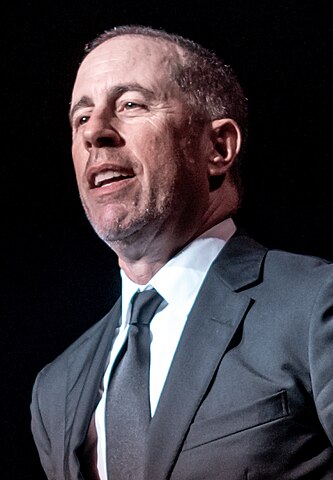



About Jerry Seinfeld
Jerome Allen "Jerry" Seinfeld (born April 29, 1954) is an American stand-up comedian, actor, writer, and producer. He is best known for playing a semi-fictionalized version of himself in the sitcom Seinfeld, which he created and wrote with Larry David. The show aired on NBC from 1989 until 1998, becoming one of the most acclaimed and popular American sitcoms of all time. As a stand-up comedian, Seinfeld specializes in observational comedy.
Best Jerry Seinfeld Quotes
Shortest
Earliest
Explore our curated collection of the most famous and impactful Jerry Seinfeld quotes.
“Comedians have such an intense allergy to pretension.”



“Great steering is, to me, the essence of the automotive experience.”



“I don't know why people always assume that the guest is more interesting than the host.”
“Every car has a personality. Every car is trying to say something to the world.”

“I still think everything has its life cycle and if you respect it, people enjoy it longer.”
“Fear is funny. Especially when it's not fake!
Episode 3 (with Brian Regan)”

“I was lucky in that I was introduced to fame very-- in a very slow, incremental way.”
“I like that [obituaries] boil the whole guy's life down to "Invented the ballpoint-pen spring".”
“"Funniest" is completely personal. Whoever you think is funniest, is funniest.”
“The truth ends every conversation.
Episode 6 (with Chris Rock)”

“Stand-up is a very scientific and very exhaustive study of the human experience.”
“A cat is a small sneaky animal that manages to get by without any real relationships.”
“The fact is: almost everything is funny. You just have to have a way of looking at it.”
“Cars are really the most sophisticated adult toys that you can use without having to really talk to anybody.”
“All human endeavor is killing time. All of it.
Episode 4 (with Alec Baldwin)”
“One of the things that the comedian mindset requires is laziness.
Episode 2 (with Ricky Gervais)”
“I like the brutality of stand-up and the simple, boiled-down "it either lives or dies" of a joke.”

“Funny is the-- is the world that I live in. You're funny? I'm interested. You're not funny? I'm not interested.”
“A lot of comedy sounds like you're driving to a point of logic or perspective, and you're really just setting up a joke!”
“I've figured out that the "non-event" is the best part of life.
Episode 2 (with David Letterman)”


“I always describe my upbringing as "benign neglect": that I was-- I really felt like my parents were just letting me live there 'til I grew up.”
“I don't think I felt "at home" on Earth, as a human, until I walked into a comedy club.
Episode 5 (with Tina Fey)”

“The secret to television is: the person who gets the opportunity wants to "re-form" this type of content to them, personally.”

“Being a dad is-- y'know, it's a surfboard on a rainbow. You're gettin' all you can handle of life.
Episode 5 (with Joel Hodgson)”
“The timing of the check coming at the end of the meal makes no sense. 'Cause that's when the food is the least interesting to you.”

“Newman would be my favorite supporting character. I mean, when I got to have a real evil nemesis like Superman would have, that was a dream come true for me.”
“I want my comedy to be the things nobody else talks about. Not necessarily things people don't want to talk about, but just things that everybody else missed.”
“Comedy is the closest thing to justice. If you're funny, you survive; if you're not, you don't.
Episode 3 (with Gad Elmaleh)”
“That's the greatest thing about comedy. If you've got talent, it's unmistakable. No one misses it and you don't have to wait around for a break.”
“I have a lot of respect for [stand-up] as a craft. I don't see it as just a stepping-stone. I mean, it's a hard life in some ways. But I have a fascination for it.”
“Once we got [Julia], I was absolutely convinced, from then on, that nothing could really hurt the show. That it really-- It just felt like a balanced team.”

“A [stand-up] bit is a bar of gold. A talk-show panel story is something that's too good to throw out but not good enough to use.
Episode 3 (with Jay Leno)”

“I think we [comedians] deal with fear more viscerally than almost anyone! I mean, you feel the audience's fear, your own fear. The whole show is about quelling fear!”

“The sad truth is, people are only interested in themselves. So, if you just ask them what they are doing or what’s going on or how they feel, they generally go on for hours.”
“Don't you hate "To Be Continued"s on TV? [...] I mean the whole reason you watch a TV show is because it ends. If I wanted a long, boring story with no point to it, I've got my life.”
“Being engaged is-- you know what it's like to me? It's like being on the first part of the rollercoaster, where you're just goin' up: (makes ticking noises) "Boy, this looks pretty scary!"”


“The real motivation of bein' a comedian is if you really love the sound of a laugh. And if you love that, you will never want to stop.
Episode 4 (with Todd Barry)”


“I think spending your life trying to dupe innocent people out of hard-won earnings to buy useless, low-quality, misrepresented items and services is an excellent use of your energy!”
“I was a minimalist from the beginning. I think that's why I've always done well as a comedian. [...] If you always want less, in words as well as things, you'll do well as a writer.”

“When I was a kid, my favorite ride was the bumper cars. What a wonderful fantasy of the driving experience as it could be. All confrontation, no destination. [...] Driving as an act of pure hostility.”
“To me, America used to be a place that made steel, and cars, and had giant department stores. Now, basically, we produce amateur talent and people [who] judge amateur talent.”

“The best advice I ever got was from Rodney Dangerfield, who when I asked him a question about something in comedy, just looked at me for a second and then went, "You'll figure it out."”

“I could talk about comedy a lot, but I think it's kind of like talking about sex: you can do any fancy dive you want, [but] it's just a foot of water.
Episode 10 (with Michael Richards)”
“Truthfully, I loved working on every episode [of Seinfeld], we just had the best time and got along great, and there were a number of years when the show wasn't successful and we still loved it.”
“All I had to do was do [stand-up] once, and I didn't-- Really, success wasn't my objective; it was just "I wanna be one of those guys!" If I can be one of those guys, I'm-- I win everything!”
“I want comedians to always push themselves to be bigger than the niche that they start in. [...] You work to get broader and broader, without being generic or pandering. And to me, that is the mission.”
“You know that tremendous feeling of power, when your phone is fully charged? And somebody calls, and you go "I want to hear every detail of this story! I am loaded with juice!" That's what TM is.”
“The improvements in the engineering of cars has enabled people to express their inner asshole-ness. You think "Why are people [today] so ill-behaved?" They're not! They just never had the tools to express it before.”
“I was very surprised by Festivus catching on, but I think people just like the line rhyming Festivus with "rest of us" is 90% of it. And no presents, and you don't have to buy decorations, it's just an aluminum pole.”


“Do you know the first thing I said as a child, before I said "Mama" or "Dada"? I said "Leave me alone!" (laughs) Is that not the mantra of stand-up comedy?
Episode 2 (with Patton Oswalt)”
“I think the duck really is the perfect model of how to live: paddle as hard as you can beneath the surface, let everything else roll off your back, and have a little sense of humor about your appearance.”

“The equivalent for a normal person would be to go in to work in your underwear... and try and do your job that you normally do. All of a sudden, you can't do anything. That's how a comedian feels when he's doing a new bit.”
“Inexplicable malevolence was our favorite thing [on Seinfeld]. There's no reason-- There was never a reason I didn't like Newman; there was no reason. "We just think it's better to hate this guy."”
“The idea of bosses and employees is just hilarious to us [comedians]! [...] It's such a typically human attempt to organize what is un-organizable: life.
Episode 8 (with Colin Quinn and Mario Joyner)”
“I don't see people in the audience, I'm in an ultra-focused state when I'm onstage, I only go by sound - I listen to the audience but I don't look at anything in particular. I'm really visualizing the stuff I'm talking about.”

“What is the handicap parking situation at the Special Olympics? They must have to just stack like a hundred cars into those two spots.”
“I'm a little compulsive-- a compulsive tinkerer. Y'know? I love to just "Well, let's try this, and maybe shrink that section a little bit." I mean, that's what stand-up is, is constantly moving the accordion to different sizes.”

“The way I look at life, basically, is: it's exhausting. And... (laughs) Doing-- Being busy is exhausting; doing nothing is exhausting. No matter what you do... as a human -- on Earth -- it's exhausting.”
“There's absolutely no difference between the greatest painting ever made and a joke. It's just something someone invented that someone else likes! That's art. And it has no reason to exist, except its own virtue.”
“Some people actually cheat on the people that they're cheating with, which is like holding up a bank and then turning to the robber next to you and going, "All right, give me everything you got, too."
Personal Maintenance”
“Do you think that's how life ends? That you just-- really just go "It's enough. I had enough." I know when my time comes, that how I'm gonna feel. I already feel that way!
Episode 9 (with Carl Reiner and Mel Brooks)”

“Once I'm done with [a] bit, it either goes in the garbage or the accordion folder. Those are the only two destinations. And then it's in the air. It has to survive on its own. Bits are like turtles right after they hatch, running to the beach.”

“If we really stuck with the classic Greek priorities, a sound mind in a sound body, the only two places we'd ever go is to a library or a gym.”
“Comedy is a bit of a masochistic pursuit. If you don't have a masochistic streak, I don't think you can succeed at it, 'cause so much of it is painful. You have to kind of like it, in a sick way: y'know, that this really hurts.”
“Dads feel they know enough about the world to start their own civilization. That's what the family is to them. The fathers think "The hell with life! I can invent my own people. My own rules for fashion. My own health and diet."”

“It's not enough that we catch [lobsters], kill them, and eat them. We want to see them in the tank as we walk into the restaurant, sweating it out. [...] I saw one once that looked like he was attempting to clean the inside of the tank. "I just work here."”

“There's always this thing with "Well, he's no Richard Pryor!" Y'know? And I always, y'know, would apologize for not being raised by prostitutes in a whorehouse. It was just-- there was just very little I could do about it! And I try to overcome it as best I can.”
“A comedian is a-- to me, a-- a full-fledged-- not only a monologist, but somebody who can really work a room, work a crowd, and has a real act. A comic? That's a-- like-- I think a notch down.”

“I used to sit in my room at... let's see: how old-- I was ten years old... playing [Bill Cosby's] albums and just crying laughing, and just in wonderment at what he was doing, and just-- that I had never heard somebody be so funny before.”

“That takes a lot of work: to set up six different scenes that are not on stage, plus do a stage show in front of an audience. It's a production issue that the average fan wasn't aware of, but I think they appreciated-- It gave the show a vitality and an expansiveness.”
“Whenever an idea would come out that was too crazy for me, it would always fit George perfectly. George was really a catch-all for a lot of ideas. He was a guy who you could "buy" doing any number of extreme problem-solving techniques.”
“When I started out in comedy in the 70s, if you didn't do clean humor you weren't getting on TV, so I started doing that so I could be on the Tonight Show with Johnny Carson. And then when I saw what other people were doing, I just always wanted to be a little different.”

“I pretty much engage with funny people, or weird people, or, y'know, kind of "off" people. Anybody who's a little normal -- even just take, let's say, a normal actor or actress -- I'm lost. I got nothin'. I'm not curious; I'm not interested. You got a show? I don't care.”
“Bee Movie was a very unhappy experience, from start to finish. I remember standing in the back of the theater and it wasn't great, but it was decent and, and I remember listening to their laughs and thinking, These laughs are shit. That was not worth it.”
“Larry had a great word for [Julia]: he said that she gives [Seinfeld] "luster". [...] And she did; she was like the pearl that smoothed over all this kind of rough, kind of low-minded behavior of the other three characters.
"Jerry Seinfeld" (2007)”

“There is a similar kind of feel for rhythm and tone in comedy as there is in music, I think. You have to, you know, words - you use words in the same careful way in a song that you use them in a joke. Having just the right word in just the right place seems to make it work.”

“I think people like a little more "personal revelation" in their comedy. And that's fine! They have-- There's three generations behind me doin' it. But my thing is: I want a number of jokes of a certain quality, and laughs. I want the room to just be ''ringin''' with laughs.”

“I could have easily done [Seinfeld] for one or two or three more years, but it would have changed the way people look back at it. I think I made the right decision. Because people like the show now even more than they did in the 1990s, because it didn't get worn out.”
“We improvised virtually nothing [on Seinfeld], as a matter of fact. That's how good the actors were, that it sometimes seems like they are improvising. But we also knew each other so well that we knew exactly what sentences to put in their mouths that would seem natural.”
“There's nothing like a kiss to get something started between a man and a woman. When the lips meet, this is the official ignition. The instrument panel lights up. The finger moves across, flipping all the toggle switches up. The engines hum. Something is underway.”
“Stand-up is the only thing that I knew -- that I could be sure -- that I-- if I was doing it, and audiences were responding well, that I wasn't cheating. 'Cause there is no way to cheat, in stand-up! It's the naked-est, purest thing in the world.”

“My first bit that I thought "That's a real bit!" was about the tramway between Manhattan and Roosevelt Island. 1976: the city was going bankrupt. I go "Oh! That's great! They're putting up rides for us! Next thing, I guess they'll be putting up a rollercoaster through the ghetto!"”
“I was happy with the Seinfeld finale because we didn't want to do another episode as much as we wanted to have everybody come back to the show we had so much fun with. It was a way to thank all of the people who worked on the show over the years that we thought made the show work.”
“Stories about your children are not good stories. They're not interesting, amusing, or relatable. [...] That took me a long time to learn. And a lot-- I have a lot of friends with kids that don't know it: what happened with your kid this morning at breakfast is not funny.”
“That's [my dad's] other big advice to me: "easy". I don't know what the hell that means. Every time we lift up something heavy, he goes "Easy now! Take it easy! Easy! Easy!" It's not easy; it's very difficult. Okay? You want easy? Leave it here in the hallway. That's easy.”
“I love art! It's great. But a guy with his hands on his face is not worth $100M. (laughs) "Screaming!" Okay? So, he's screaming. Fine. I'm not getting 100M value here: (imitates "The Scream")”
“To a man, sex is like a car accident, anyway, and determining a female orgasm is like being asked "What did you see after the car went out of control?" "Well, I remember I heard a lot of screeching noises, I was facing the wrong way at one point, and in the end, my body was thrown clear!"”
“There is absolutely nothing you can do on a date to help you feel better about the tremendously uncomfortable situation you're in. And the reason it's uncomfortable is that no one's on the date for the date. They're on the date to see what's going to happen at the end of the date.”
“When the Beatles ended, it was so sudden, and it made what they did somehow more valuable. 'Cause it-- just suddenly, it was over, and that's it. That's the complete set. Y'know? Nine years, twelve albums, whatever it is: that's it. So, I kind of took from that "I want to try and do that".”
“Nobody goes berserk eating in the morning. You never wake up in the morning and eat a decent breakfast, and then attack a box of brownies. You don't do it. But at night, we all do it! Why? We're tired. And when you're tired, your willpower goes away. Willpower requires energy.”

“I'm looking for the connective tissue that give me the really tight, smooth link, like a jigsaw-puzzle link, and if it's too long-- if it's just a split-second too long [...] [I] will shave letters off of words, [I'll] count syllables, y'know, to get it just-- It's more like songwriting.”
“You don't need to die for what you want to accomplish. And that's what TM is about. [...] I came up with the line that "TM is like you have a cell phone and someone gives you the charger... and you go '''Oh''... this is-- now, I can keep using this thing and it will work all the time!'."”
“That is the feeling of life: you've got to go, all the time. You get to your job, what is your first thought? "I want to get home." But you get home, you feel cooped up; you've got to get out. You're out, it's late; you've got to get back. Wherever you are, you've got to get the hell out of there!”

“I always say your number of years in comedy is about your maturity level. When you're doing it ten years, you're like a 10-year-old. Fifteen, you're like a 15-year-old; you're start-- a slight bit of maturity. Twenty years, you're like-- kind of a grown-up, but still completely infantile.”
“I don't do movies because I think generally the size of that content does not lend itself to great comedy; it lends itself to people saying, "Hey, I made a movie." To me, the funniest things are shorter, so I think TV series or comedians in cars, I think I have a better chance of making you laugh.”
“I'm very impressed with this seedless watermelon product that they have for us. They've done it! We now have seedless watermelon. Pretty amazing! What are they planting to grow the seedless watermelon, I wonder? The melons aren't humpin', are they? They must be plantin' somethin'!”
“The thing about [Seinfeld] is that you have to realize that I had to look into the faces of those people, six inches away, so if you think Kramer is funny on TV, imagine his real face six inches from your nose, how funny that is. You can't imagine. It's impossible not to laugh. So I would.”
“Stand-up comedy's also the most mysterious profession in show business. It's completely shrouded in [the] mystery of "How do these people do it?" [...] Only other comedians understand it. It's like, y'know, being a cop or a prostitute: you can only hang out with other people [who] do that.”

“I think funny is always kind of time-proof, so I think [Seinfeld] could have worked even today. Obviously it would have been a completely different type of show. But you know, what made the show work was the bringing together a bunch of great actors & great writers in one place at one time.”
“I thought "This is the pinnacle of life, to me: if [I] could do this-- y'know, if [I] could stand up on stage and make people laugh, that would be the ultimate accomplishment of my personality!" And I just thought "Laughs! To be working with laughs and jokes all the time: what a fun life that would be!"”
“Most of the time, comedians: we are expected to be the most agile, in terms of how we think and construct our thoughts and our-- what comes out of our mouth[s]. That's how we got the job. Y'know? So, I'm not really worried about [...] comedians as a group. We have been navigating these slalom gates forever.”
“Now they show you how detergents get out bloodstains on television: pretty violent image, there! I think if you've got a T-shirt with bloodstains all over it, maybe laundry isn't your biggest problem right now. Maybe you ought to get rid of the body before you do the wash.”
“On [Seinfeld], we were extremely meticulous in our scripting of every scene, every joke, every line. [...] When people came on that show, they were told by script supervisors "You don't change one comma", because that's-- the precision of joke-making generally requires that.”
“I've probably been working on this [Pop Tart bit] for two years. [...] It's a long time to spend on something that means absolutely nothing. But that's what I do; that's what people want me to do, is spend a lot of time wastefully... so that then, I can then waste their time!”
“I love advertising because I love lying. [pause for laughter] In advertising, everything is the way you wish it was. I don't care that it won't be like that when I actually get the product being advertised, because in between seeing the commercial and owning the thing, I'm happy! And that's all I want.”
“'''When you're little, your life is up. The future is up. Everything you want is up. "Wait up! Hold up! Shut up!" "Mom, I'll clean up! Let me stay up!" For parents, of course, it's just the opposite: everything is down. "Just calm down!" "Slow down!" "Come down here!" "Sit down!" ''"Put that down!"'''''”
“There was [an] incredible amount of luck -- good luck -- that I had, that made [Seinfeld] what it was. On the other hand, I could argue against that. I could say "I'm the one who said to Larry David: 'Y'know, when you and I talk, it's really funny. We should write something together'."”

“The specific element that occurs in every single successful joke is surprise. Surprise. A line of logic is going one way, and then, it doesn't. I call it "making non-sense". You go "That doesn't make any sense, but I get it." That-- That's the words that people use to describe a joke: "I got it."”
“The idea of [Comedians in Cars Getting Coffee], honestly, was to try and create something that fit a whole new medium. I really was thinking "What would be a good TV show for a phone?" That was really where I started. And I thought "This would be fun for a phone, 'cause you don't have to follow a story."”
“The whole supermarket itself is designed to break down your sense of having any life outside the supermarket. It's like a casino: there's no clocks, no windows, no easily-accessible exits. You ever not buy anything in the supermarket and try to get out of there? It's impossible. There's no way out.”

“Whenever a friend refers a doctor they say, "Make sure you tell him that you know me." Why? What's the difference? He's a doctor. "Oh, you know Bob? Oh, okay. I'll give you the real medicine. Everybody else I'm giving Tic Tacs."”
“I'm not a big fan of the "long set" in comedy. Guys like to go on, like to do an hour and 45 minutes. The audience will win if you stay out there too long! [...] I want to go out. I want to get you down. I want to beat the snot out of you and get out of there before you realize that I... beat the odds!”
“Nobody's really getting in shape for anything. In modern society, you really don't have to be physically strong to do anything. The only reason that you're getting in shape is so you can get through the workout. So we're working out, so that we'll be in shape, for when we have to do our exercises. That's comedy.”
“I always, y'know, idolized people like Bill Cosby and people that were just themselves. I mean, I think the idea of a comedian as someone that you relate to-- I think "comedy star" is almost an oxymoron. You don't look up to comedians like you look at Madonna or, y'know, Elvis, or people like that.”
“Seems to me the basic conflict between men and women, sexually, is that men are like firemen. To us, sex is an emergency, and no matter what we're doing we can be ready in two minutes. Women, on the other hand, are like fire. They're very exciting, but the conditions have to be exactly right for it to occur.”

“Who would I cast to play me? [...] You know who I think would be good? Would be Matthew Broderick. He's got a good small funny. You need a small funny to play a comedian, not a big funny. Most comedians, you know, in their daily life are small funny, it's the little looks, the little things that they say, they're not clown-y.”

“That's the first thing an audience wants to feel when someone gets up on a stage: "Does this person know what they're doing?" "'Cause if they do, then I can relax." And when you're trying to elicit laughter, that's-- they have to be relaxed. If they're worried about you, the laughs are harder to get.”
“I saw a thing, actually-- a study that said: speaking in front of a crowd is considered the #1 fear of the average person. I found that amazing! #2 was death. Death is #2? This means, to the average person, if you have to be at a funeral, you would rather be in the casket than doing the eulogy.”

“It really is funny, it's very easy for me to remember that [Seinfeld] was very unsuccessful for a number of years, the first 4 years, and I remember thinking "I don't know why people don't seem to like this, it seems so funny to me." But I never thought it was going to be a big success. But it worked out.”
“"Once this Pop Tart had come into the world, I didn't understand why we were still eating other kinds of food. 'Cause this seemed to be definitely the new way. [...] Two in the packet and two slots in the toaster. 'Why two?' One's not enough; three's too many. And they can't go stale, 'cause they were never fresh."”
“Comedy -- and show business -- is-- look: either I win, or you win. There's no truce! Same thing with television: I knew that [Seinfeld]-- I knew-- look: either you're gonna kill me, or I'm gonna kill you. And after nine years, I was still killin' that series, but that series would eventually have killed me.”
“[Stand-up is] a martial art. It's voice, it's action, it's gesture; and everything is synchronized to land on that [weakest] point. You ever watch these karate guys? They hit that brick: it's a perfect arrow that hits that target, and when it-- and it's perfect! It's a concentration of energy. And that's what elicits the laugh.”
“I felt as a child that i related more to blue than my own name. I have a very powerful connection with that color. And it's always been extremely important to me. It's weird, I don't understand it myself, but there's certain blues - Jeep Wrangler makes a blue that will make me stop walking on the sidewalk, and just turn and stare at it.”

“I had glasses when I was 10 years old. [...] Somebody puts something on your face at 10, you leave it there; you don't know the difference! I thought I was getting glasses 'cause I couldn't tell what my parents looked like. 'Cause every time I'd ask my mother to buy me something, she'd say "What do I look like? A bank?"”
“You know how the old people drive? They drive slow, they sit low. That is their motto. The state flag of Florida should be just a steering wheel with a hat and two [sets of] knuckles on it. And then that left turn signal on from when they left the house that morning. That's a legal turn in Florida: it's known as an eventual left.”

“What is this urge to get information we already have? Whenever I'm in a car, and I drive by a mirrored office building, I look in the reflection to see if I'm in the car. This is information I already have! What am I looking for? Why am I checking? And what would I do if I looked and I saw that there was a small Korean woman driving my car?”
“I believe in detailed notes and jokes, and also winging it onstage. But, not for your first open mic. For your first open mic, my advice to you would be to make sure you have what you're gonna do memorized, to the point that one of your friends can gently slap you across the face, and you'll still be able to get it out of your mouth.”
“The hardest part of being a clown, it seems to me, would be that you are constantly referred to as a clown. [...] How do you even know that you want to be a clown? I guess you just get to a point where your pants look so bad it's actually easier to become a clown than to have the proper alterations done.
The Thing Is the Thing”
“Men will always say they love women as a group, but somehow seem to be less fond of them as individuals. Women, on the other hand, often appreciate the man they're with but almost never have anything nice to say about our sex as a group. [...] Women are afraid of men they don't know. Men are afraid of women they know very well.”
“I don't know if the average person would like [being famous]. I really like it. I think it might surprise them that the advantages far outweigh the disadvantages. I think most people think of it as a problem, but it's all in how you look at it. But I do think that's the case, you get a lot more than it costs you in privacy invasion or whatever.”
“It is not easy to find someone who you can say to "That's not funny", and they're not gonna get upset. Y'know? Really hard to do that. Most comedians are very defensive, very protective of their stuff. And even if you may be a person of accomplishment, they don't want to hear that. They don't want to hear from anybody!”
“Men and women will never understand each other; we all know that. It's just not gonna happen; just forget it. I know I will not understand women. I know I will never be able to understand how a woman could take boiling hot wax, pour it on her upper thighs, rip the hair out by the root... and still be afraid of a spider.”
“I don't hear the applause when I come out [on stage]. I have no interest in that. 'Cause that's for the past. They're saying "We like what you've done in the past." And that's not what tonight's about. Tonight's about tonight. We gotta make this happen tonight. I want you to go home tonight and go "We saw a great show."”
“I'm very good at streamlining a series of activities so that everything gets done in the amount of time that I have. I am very good with the clock. Like if I have a lot of stuff to do and a limited amount of time, I'm very good at figuring it all out. I'm very efficient in everything that i do, I never waste time so that I have more time to waste.”
“I was petrified when [my parents] first saw me [perform]. Well, also: because I wasn't really funny as a kid, and I felt like I was, y'know, exposing this alter-ego. Y'know? Plus, here I am getting up on stage and manipulating these people, y'know, into laughing. It's a power thing! Y'know? And it's weird to do it in front of your parents.”
“That was the dominance of network television at that time. There was no competition. [Theirs] was the only game in town. A guy like me-- Could you ima-- I would never have gotten past my second set, today, before they would've grabbed me! Right? "Hey, this guy's pretty good!" "Just grab him! Let's do-- Somebody come up with somethin' for this kid!"”

“To men, cleavage is like the nearest thing to a UFO landing nearby, that's what it is. To women, buying a pair of shoes that they really love is like boarding the alien ship. I think it's entirely possible that aliens have landed and they haven't been able to get our attention because we're so preoccupied with cleavage and shoes.
Paldom”
“Dating is not easy. What is a date, really, but a job interview that lasts all night? The only difference between a date and a job interview is: not many job interviews is there a chance you'll end up naked at the end of it. "Well, Bill, the boss thinks you're the man for the position! Why don't you strip down, meet some of the people you'll be workin' with?"”

“[Seinfeld] gave me everything, and that was always my thought when I was doing it. If I sacrifice every cell of energy that I have doing this, the rest of my life will be pretty good. So I just died on the shield. I went to the point where I thought, If I keep going, I could lose my sanity. That was how far I took it mentally.”
“"In the midst of that dark and hopeless moment, the Pop Tart suddenly appeared in the supermarket! And we just stared at it like [it was] an alien spacecraft and we were like... chimps in the dirt playing with sticks." [...] What makes that joke is you get "chimps", "dirt", "playing", and "sticks". In seven words, four of them are funny!”
“I actually have quite a bit of [the Seinfeld set], and we're looking for a museum that wants to display it. I have the couch, I have the two blue stools, I have the table and chairs; the coolest thing I have is the door, which we never repainted in nine seasons. It has every scuff mark that Kramer put on it with all those crazy entrances.”
“A great joke and a great car: everything on it works. And there's nothing excessive that doesn't make sense or doesn't need to be there. [...] To me, the Speedster and a great piece of comedy are identical: they're perfectly minimalized ideas.”
“It was the back nine [episodes of a season], was the backbreaker for us, right? You [can] kind of figure out the first ten over the summer; you pull three more out of nowhere; and then the back nine is just-- you're Sandra Bullock in Gravity.
Episode 7 (with Howard Stern)”
“You ever wonder why Silicon Valley even exists? I have always wondered, why do these people all live and work in that location? They have all this insane technology; why don't they all just spread out wherever they want to be and connect with their devices? Because it doesn't work, that's why.”

“I don't remember when I saw the testing results, but it's really one of everyone's favorite things about [Seinfeld], is how poorly it was received by the network people. [...] My favorite thing in the testing is that the show was considered "contemporary, unusual, humorous, and appealing to young adults: therefore, not something that we would want". (laughs)”
“The trouble with [writing a screenplay] is: you have this story, which is such a nuisance! Y'know, in stand-up, you just tell the funny part. But in a movie, the audience demands that you tell them some sort of story that makes sense. And this was a tremendous handicap for me [on Bee Movie], because [the story] frankly doesn't interest me that much.”

“The pitch for [Seinfeld], the real pitch, when Larry and I went to NBC in 1988, was we want to show how a comedian gets his material. The show about nothing was just a joke in an episode many years later, and Larry and I to this day are surprised that it caught on as a way that people describe the show, because to us it's the opposite of that.”
“[The writers] knew they were talking to odd guys, y'know? Larry and I were odd guys. So they wouldn't come in-- They-- Y'know, I mean, they would come in and pitch, and obviously, some things would hit, and some things would miss, but they never thought "This is too crazy for these guys." Nobody would think that... 'cause clearly, we were capable of just about anything!”
“Remember when you were in school and they'd do those hearing tests? [...] I wanted to do unbelievable on the hearing test. I wanted them to come over to me and go, "We think you may have something close to super-hearing. What you heard was a cotton ball touching a piece of felt. We're sending the results to Washington, we'd like you to meet the President."”
“You almost kind of knew you were on the right track, when people at the network didn't like it. I mean, I wanted them to like it, but we weren't going to, y'know, really change the tone of the show. I couldn't have done a show any other-- I couldn't have done any other show than that show; I just wouldn't have-- wouldn't know how to do it!”
“Why is commitment the kryptonite of men, super and otherwise? [...] The trouble is that, deep down, most of us men believe we have a great deal in common with superheroes. This is the secret truth of all male thinking. I'm not even supposed to be telling you this. When men are growing up and reading about Batman, Spiderman and Superman, these are not fantasies, these are options.”
“Maybe comets killed the dinosaurs, maybe they tripped and fell. What's the difference? We'll never know. We couldn't solve the Kennedy Assassination, we had films of that. Good luck with the Stegosaurus.”
“I've already done something, and [Bill] reminded me of that. And now, this-- I really just want to do what I love to do... and I want to go where he's gone. Y'know? I want to be able to explore this [comedy] thing and maybe find some-- That's what I keep thinking: that maybe there's something else out there! I just feel like I can go somewhere with it. I don't know where.”
“I have often wondered if there's a way to teach being funny or comedy, and George Stephanopoulos actually got me wound up enough at one point that we were going to contact, I think his name was Lee Bollinger, the president of Columbia, and we were gonna go in there, and I was going to teach a course on comedy. Because I know a lot about it, but I just don't know if it's teachable.”
“Flying doesn't make me nervous. Driving to the airport can make me nervous. Because if you miss that plane, there's no alternative. [...] No airline goes, "Well, you missed the flight. We do have a cannon leaving in about ten minutes. Would you be interested in that? It's not a direct cannon, you have to change cannons after you land."
Job Security”
“The dumbest thing of all, I think, you can think in a New York cab is "Well, the man knows what he's doing!" "I mean, he is driving a little fast, but he's a professional cab driver. He's got a cab driver's license; I can see it right there." I don't even know what it takes to get a cab driver's license. I think all you need is a face... and a name with, like, eight consonants in a row.”
“[Death is] the last big move of your life. The hearse is like the van, the pallbearers are your close friends, the only ones you could really ask to help you with a big move like that. And the casket is that great, perfect box you've been looking for your whole life. The only problem is once you find it, you're in it.”

“I would say the main competition for the book is the video because for some reason people feel they need to come home with a rectangular block of something that they don't know the end of. The big advantage of a book is it's very easy to rewind. Close it and you're right back at the beginning.
Freeway of Love”
“Frankly, I don't think people think of their office as a workplace anyway. I think they think of it as a stationery store with Danish. You want to get your pastry, your envelopes, your supplies, your toilet paper, six cups of coffee, and you go home.”
“Have you noticed the popularity of Ultimate Fighting and The Real Housewives? These two things are two weights on the same barbell. What it is, I think, is the worst aspects of each gender exaggerated to the maximum.”

“I want to look like my heroes from the '60s. I want to look like Frank Gorshin, and old George Carlin, and Alan King. I love[d] those guys. So, I wanted to be those guys.”
“Men, as an organization, are getting more women than any other group working anywhere in the world today! Wherever women are, we have men looking into the situation right now. We explored the Earth looking for women... even went to the Moon just to see if there [were] any women there. That's why we brought that little car. Why would you bring a car, unless there's some chance of going on a date?”
“The other day I was watching women in a department store looking at clothes, and I noticed women don't try on the clothes, they get behind the clothes. They take a dress off the rack and hold it up against themselves. [...] They stick one leg way out and kind of lean back. I guess they need to know, "If someday I'm one-legged at a forty-five-degree angle, what am I going to wear?"”
“It is amazing what people will believe. I mean, I've watched these infomercials late at night: if it gets late enough, the products start to look good to me. I have actually found myself sitting there thinking "Y'know... I don't think I have a knife that can cut through a shoe..." "I don't think any of my knives are good enough to cut through shoes!" "I'm gonna get this knife and cut my shoes up."”
“I also had braces. [...] Glasses at 10, braces at 12: I was thrilled to have these things on my face. I mean, y'know, [I'm] thinkin' about talkin' to a girl for the very first time in my life, I want a lot of corrective apparatus on my head. [pause for laughter] This is what women like! I said to my parents "Let's not stop now! Let's get me a hearing aid! Orthopedic shoes!"”
“It was always heartbreaking. You could get [an idea] all the way to the edit... and it-- and it falls apart. You got it all that way and right before it's in the-- just as it goes in the show, you go "That's not the right angle... and it's not funny at all now." And even though you had it all that way, and then, just at the last moment, you just "Oh! You dropped the egg!" Splat.”
“If you really want to make money, never make a decision based on money. 'Cause if you make-- if you chase money, you're gonna get less of it. If you chase a thing that you love -- that's interesting -- only because you love that thing, you'll make more money. I-- I just believe that's-- in the arts, that's the only way to make money, is to never consider money as a part of your decision.”

“Very early on in my career, I hit upon this idea of being the Heckle Therapist. So that when people would say something nasty, I would immediately become very sympathetic to them and try to help them with their problem and try to work out what was upsetting them, and try to be very understanding with their anger. It opened up this whole fun avenue for me as a comedian, and no one had ever seen that before.”

“Nobody wants anything less than "extra strength". "Extra strength" is the absolute minimum. You can't even get "strength"; "strength" is out now. It's all "extra strength". Some people are not satisfied with "extra"; they want "maximum". "Give me the 'maximum strength'." "Give me the maximum allowable human dosage." "Figure out what will kill me and then back it off a little bit."”
“I'm supposed to get the colonoscopy test. When you get into your forties, I think-- I have heard -- from the healthcare professionals -- that you-- it's very important to get the camera up your ass. I have resisted this... because I feel the press has invaded my life enough. [pause for laughter] I feel that I will draw the line here, and say "no" to the pooparazzi.”
“I think we should all wear the same exact clothes... because it seems to be what happens eventually, anyway. Any time you see a movie or a TV show where there's people from the future -- or another planet -- they're all wearin' the same outfit. I think the decision just gets made: "Alright, everyone, from now on, it's just gonna be the one-piece silver suit with the V-stripe and the boots. That's the outfit."”
“So feeble, the things we come up with to foil crooks: like the "wanted" posters at the post office? You're there, you got your package; you're tryin' to mail somethin'. This guy's wanted in twelve states. "Yeah? Now what? Okay?" Y'know, I check the guy standing in line behind me. If it's not him, that's pretty much all I can do. Why don't they just hold on to this guy when they're taking his picture?”
“I was in Switzerland one time. Beautiful country! Great country. And interesting: 500 years without a war! Very impressive. Also very lucky for the Swiss Army! I don't know if you've ever seen that little Swiss Army knife? It's not much of a weapon! [...] If somebody attacks you, what do you pull out? Your nail clippers? "C'mon, buddy! Let's go!" "You get past me, the guy in back of me's got a spoon!"”

“In my world, the wrong-er somethin' feels, the right-er it is. So, to waste this much time on something this stupid is-- that's-- that felt good to me. [...] It's the exact opposite of what we do here at the Times, which is: we spend appropriate amounts of time on deserving subjects. So, I'm the exact opposite of that: inappropriate and undeserving subjects.”
“To me, clothes spend most of their lives waiting, if you look at it. In the closet, in the hamper, in the drawer. The shirts in your house right now are going "He never picks me...". Laundry day is their only exciting day, 'cause the washing machine is the nightclub of clothes. It's dark, bubbles happening; they're all kind of dancing around in there. A shirt grabs the underwear: "C'mon, babe, let's go!"”
“We weren't really trying to gain more attention or-- We certainly weren't trying to be provocative in any way. We were just -- as any TV show is -- constantly struggling to come up with new ideas. And when you're struggling, bad ideas start to sound like good ideas. And crazy ideas start to sound like sane ideas! And that's what happened in Season 4, is a lot of crazy ideas started to make sense.”

“When it's your name on the goddamn show... the pressure is-- it's intense! And then, the show got successful, and everybody expected each week to be even better than the last, and it was a lot of pressure. And I loved every second of it, but it was a lot of pressure and a lot of work, and it was all great, but: never could have accomplished it without [Transcendental Meditation].”
“There's something about [writing] -- whether it's a cubicle allegory, or it's a homework or schoolwork metaphor -- there's something about it that totally repels the comic mind. "I can't-- I'm not doin' that. That's work!" Which it is, but only in the beginning! Only in the first ten, fifteen minutes, right? Then, you're kind of havin' fun! You're makin' up stuff. Who cares if it works? Who cares?”
“I think, if I was an Olympic athlete, I would rather come in last than win the silver... if you think about it. Y'know, you win the gold, you feel good; you win the bronze, you think "Well, at least I got something." But you win that silver, that's like: "Congratulations! You... almost won." "Of all the losers, you came in first... of that group." "You're the number one... loser." "No one lost... ahead of you."”
“I was the only guy, by the way, in the early '80s [who] was welcome on your show and Carson; usually, it was kind of-- that was-- there was a bit of a wall there. [...] If you were a Carson comic, you were probably not young enough or cool enough for Late Night. And vice-versa. But I for some reason was able to go back and forth, and I was always very proud of that, in the early days.”
“I don't think there's another TV series that you could name where the list of absolutely outstanding characters is so long. You-- you can't even begin to just say "Well, it was a show about four people"; it wasn't. I mean, they would've-- [Seinfeld] wouldn't have lasted so long -- at the level that it was at -- if it was just the four of us every week.
"Kramer vs. Kramer" (2004)”
“The first thing I want to do [on stage] is: I want you to have confidence in me. Well, how am I gonna do that? I'm gonna take the joke that fails the least amount of [the] time, and I'm gonna put that at the front of the set. It's just tech-- it's scientific technique. [...] If the first thing I say gets a laugh: at that moment, 100% of everything I've said gets a laugh! And now, I've got your confidence.”

“There's no "putting an act together". Okay? A stand-up comedian is an act. You are an act. You breathe and live an act. It's not assembled; it's not-- This is not Hello, Dolly!. It's constant, it's organic; you live inside it. It's like a snow globe. Comedy is a snow globe. You live in it.”
“Monkeys have contributed a lot to society in their way. They were the first astronauts in the Sixties. Which I'm sure made perfect sense in the monkey brain. "I see, so instead of the little bellhop uniform, you want me to get into a rocket and orbit the earth at supersonic speed. Yeah, I think that is the next logical step for me."”
“Being old is great. There's so many things that you're done with. Like running really fast. I was single until I was 45, and I liked that, but then I couldn't take it anymore. So when you're old, you get to relax a little bit. And you can see much more clearly of what's going on in the world. When you're young, everything is really confusing, and when you're old you can see through people and events really clearly, and I like that a lot.”
“[George is] like the kind of guy that you hang around with in New York who's not in the [stand-up] business, but he's been your friend for a long time and you're just kind of-- In the important ways, you're too similar to ever not be friends. [...] Even though your lives are in completely different places, the friendship survives, 'cause in the important ways of shallowness and neurotic exploration of meaningless detail: that's where you bonded.”
“My favorite sign: you pull up to the light, and it says "Left Turn Okay". Don't you like that one? A little personal touch! It's like they're sayin' to you "Left Turn? Okay..." "We're not crazy about you makin' the left. It's okay..." Pretty much: "Make it. Get it over with." [...] They should get more involved, with signs like "Right Turn? Why Not?" "U Turn? Enjoy It!"”
“That's what annoys me about sweepstakes companies, they always tease you with that, "You may have already won," and we all buy into it. [...] I'd like once for a sweepstakes company to have some guts, come out with the truth, just be honest with people one time. Send out envelopes, "You have definitely lost." You turn it over, giant printing, "Not even close!"
Out and Back”

“We worked to death. Y'know? That's what Larry and I did. We did not rest, we did not... spare an ounce of effort; we would just order people out of the room: "Get out! Get out! We're working!" Y'know? And we-- And that's why those scripts were as good as they were: 'cause when they got to that table, and those actors got 'em, they were worked. So: is that luck? I don't think so. That wasn't luck. That was-- We earned that.”
“I think the best Seinfeld episode idea I ever contributed was that George pretending to be a marine biologist would find Kramer's golf ball in the blowhole of the whale. Believe it or not, we were doing both of those stories without seeing any connection that Kramer was gonna hit golf balls at the beach, and George was gonna be pretending to be a marine biologist. And it was in the middle of the week that it suddenly hit me of a way to connect the two stories.”
“The journey of someone coming in the room with an idea for something, and then saying "Yeah, that sounds good; let's do that", and then, the-- it going into an outline form, and then a script form, and then a read-through, and then a rewrite, and then a rehearsal, and then more rewrite, more rehearsal, then a shoot night, and then an editing process, and then finally going on the air, is essentially an off-road egg race where you carry the egg in a spoon.”
“Talent is a horse that [you] just find yourself on. And the extent to which you can learn to ride it -- or it guides you or even throws you-- I mean, Freddie Prinze is a perfect example of a guy [who was] sitting on a stallion, but had no clue how to ride it. [...] That's [how] I think of a career, as kind of a rider and a horse: you trying to control this talent.”
“I'm on the plane, we left late, and the pilot says, "We're going to be making up some time in the air." I thought, "Isn't that interesting. They just make up time." That's why you have to reset your watch when you land. Of course, when they say they're making up time, obviously they're increasing the speed of the aircraft. Now my question is, if you can go faster, why don't you just go as fast as you can all the time? "Come on, there're no cops up here! Nail it! Give it some gas!"”
“The beautiful thing that Michael discovered-- and I don't know at what point it was; maybe it was the second year [of Seinfeld]: he was playing Kramer a little slower than the other three characters, a little dumber. And then, he got the idea that he should play it that everyone else is dumber than him. And that was the key to it. Once he got that: then, the character just took off!
"Queen of the Castle" (2006)”
“[Seinfeld] was gonna be a 90-minute special that was gonna fill in for Saturday Night Live one weekend-- one Saturday night when they were off. [...] And I just didn't think that you could sustain that for 90 minutes. I thought maybe you could do it for 30 minutes. And that's how it became a TV series. It was gonna be a special all the way, but I just didn't think we could last 90 minutes. So, instead, we ended up makin' 90 hours.”

“I used to say that each season was a transatlantic submarine voyage: that you would load up the sub with all the supplies -- y'know, you-- we would do pre-production: we would come up with outlines and story ideas, and get as much stuff as we could in advance -- but once that-- we shoved off and we were out into the ocean, you just-- you quickly went through your supplies about a third of the way, and then, you would just start at eating each other to get through the season.”
“I have always wanted a Clio. I don't know much about it... but I know it's a good award, because in 1991, they screwed up this whole presentation, and there were a bunch of awards left over, and all of these ad people here climbed up onto the stage and tried to grab them! So, to me, that says: "This means something!" That really happened, and it's my all-time favorite award-show occurrence because it was so honest. People just said "I want a damn Clio", and they went for it.”
“The time-travel aspect of old cars, to me, is a big part of the fun. [...] I live out in East Hampton, and there's a lot of roads out there where you can't tell what year it is. So, if you get in a '63 -- and that's a '63-- everything on it was made in '63 -- you can kind of go into that little dream, like "Well, gee, if I was-- had this car in that year, this-- it would be just like this!"”
“My friend Larry Miller used to come by the set all the time. And I said to him "Y'know, for the life of me, I can't figure out why this show isn't really popular." He [said] "Oh, don't worry! It will be." Y'know? And I said "Come on! We've been here four years!" [...] And he kept sayin' to me "It's gonna catch on!" [I was] thinking "'Catch on'?" Y'know? You don't suddenly catch on, y'know, after you've been on TV for four years! And-- but sure enough, he was right!”
“Neat and clean. That's the way I want to live. My idea of the perfect living room would be the bridge on the Starship Enterprise: big chair, nice TV, remote control. That's why Star Trek really was the ultimate male fantasy. Hurtling through space in your living room, watching TV.
The Ride of Your Life”

“Have you ever seen the guy who's got the record for "Fattest Man in the World"? It's an amazing thing: Bob Hughes, 1,400 pounds. Ladies and gentlemen, the man has let himself go! I used to even feel bad, y'know, talkin' about him onstage, 'cause, y'know, somebody-- you could be-- but you could weigh 1,000 pounds and go "He's not talkin' about me." "This is a man with a serious weight problem."”

“The luge is the only sport I've ever seen that you could have people competing in it against their will, and it would be exactly the same. Y'know, if they were just grabbin' people off the street: "Hey! Hey, hey! What is this? I don't want to be in the luge!" Y'know, you put the helmet on 'em, you wouldn't really hear 'em screaming; just: (whoosh) "You're in the luge, buddy!" (panicked screams) World record. Didn't even want to do it! I want to see that event next year: the involuntary luge.”
“At one point, in the early 80s, I got a part on a sitcom called Benson. And I was on the show for 3 episodes, and then I got fired. And I thought that would be the only break I was ever going to get. It was just a youthful lack of perspective. But at the time, I thought that was it. But it really ended up making me really get into being a much better standup comedian so that I wouldn't be dependent on other people. It ended up being a good thing. The best things in my life have been the bad things that taught me stuff.”
“NBC -- when we suggested that we wanted to do this one-set idea where the gang just waits for a table the entire show and never gets it -- they thought that was very static and not appealing. And they didn't like-- want us to write it, they didn't want us to film it; and after we filmed it, they held it back and didn't run it until towards the end of the season, 'cause they were so sure that this was going to really be one of the real bombs of the season.”
“When I was starting out, I used to sit down and write a couple times a week. And then, one day, I was watching these construction workers go back to work; I was watchin' 'em kind of trudgin' down the street... and I was just-- It was like a revelation to me, and I realized "These guys don't want to go back to work after lunch, but they're goin... 'cause that's their job!" And I [thought] "If they can exhibit that level of dedication for that'' job, I should be able to do the same." "Just trudge your ass in!"'''”
“I get an idea, and I think "There's something funny about that." And I don't know what it is, at first; this is how my stuff usually works. Like, I saw-- like, McDonald's having a sign that says "60 Billion [Sold]". And I think "Now, that's-- y'know, there's something very funny about that: that a company of that size is still counting every burger. Y'know? I mean, there's some kind of insecurity there, that you're still thinking "How well-- Are we doing well?" "We're doing well. Aren't we doing well? Look at how many we've sold!"”
“There's this little thing of "I want to say this" and "I want to be funny". And that little balance: if it's a little-- if it's one inch above -- (raises one hand) "I really want to say this" and (lowers other hand) "It's not that funny" -- (snaps fingers) the audience will just-- they will recoil instantly. It's like "You're preaching", or "You're trying to make some stupid point". Y'know? And they just-- (recoils) But if it's always "This is really funny and it says something", then you're okay.”
“The key to marriage -- of course -- is to make the other person happy. I tell all my guy friends: "Make your wife happy. You're not gonna be happy, so don't even worry about that. And that's good, 'cause that cuts your work in half!" And... further: that men don't want to be happy. We don't know what [happiness] is. We don't care what it is. We've never experienced it and couldn't be less interested in it. We just want to do whatever stupid thing it is that we're doing; that's men.”
“We all love Michael J. Fox. I'm a big fan of Michael J. Fox. I'm a big fan of Spin City. He plays the mayor, or something. I, on the other hand, play myself! And I guess last year, you people didn't quite buy me as me!”
“I watch Sesame Street a lot [these days] because I have two little kids. And a lot of people ask me, y'know, would I ever consider doing another show, and... I sit there, and I watch this "Elmo" guy; and he is so likeable, and so funny, and so charming. And I sit there with my daughter, and I think "Let him bust his little red ass every week!"”
“I had an episode [of Seinfeld] all ready to go that we were gonna do entirely -- secretly -- in claymation. And I had the studio ready, and the figures ready, and it was all good to go; and then, someone said "Y'know, Tim Allen did an animation thing", or something, "on Home Improvement last season." And I go "What? What kind of thing was it?" And I never saw it; I didn't know what it was. And I got scared off; and I thought "I don't want people to say I'm imitating Tim Allen." And I cancelled it; and I realize now that was a huge mistake.”
“The idea that you have two guys who've never written a show being run by a network executive that had never had a show, leading to a show that has a unique and unusual feel: this is a model that all the networks subsequently ignored -- and never did again -- except for HBO! I think HBO-- I don't know if they really knew that that's how our show evolved, but that's a network that hires people that they like and says... that's the end of their job! "We like you; do what you think you should do." And it leads to much more distinctive programming!”

“The question is this: "What have I been doing?" Everybody says to me "Hey, you don't do the show anymore! What do you do?" I'll tell you what I do. Nothin'! [pause for applause] Yeah, I know what you're thinkin': "That sounds pretty good!" You're thinkin' "I might like to do nothing myself!" Well, let me tell you: doing nothing is not as easy as it looks. You have to be careful... because the idea of doin' anything, which could easily lead to doin' somethin'... that would cut into your nothin'... and that would force [you] to have to drop everything.”
“You start to know, on stage, when to get off. There's just this feeling that you develop from years and years of doing it; you just feel that "We're getting-- Everyone's really having a good time... and I think, in another few minutes, this is going to start to get old... 'Good night, everybody!'" And everyone's happy! [...] It's just... proportions. Y'know? I guess it's a function of art and economy: that economy is essential to all good art. And I thought "Let's-- " Even though we had done a lot [of Seinfeld]: nine years, 180 episodes, I thought "We can't do one too many, or it's gonna taint the whole thing."”
“There are many things we can point to as proof that the human being is not smart. The helmet is my personal favorite: the fact that we had to invent the helmet. Now, why did we invent the helmet? Well, because we were participating in many activities that were crackin' our heads. We looked at the situation. We chose not to avoid these activities, but to just make little plastic hats so that we can continue our head-crackin' lifestyles. The only thing dumber than the helmet is the helmet law, the point of which is to protect a brain that is functioning so poorly, it's not even tryin' to stop the cracking of the head that it's in!”

“Here's the great thing about writing: you don't have to do it. All you have to do is not do anything else in that time frame. So: you put your idea down and... now, you don't have to do anything. You just sit there and you eventually will realize "There's a problem here." Right? And your brain will naturally try and solve the problem, and the next thing you know, you're writing! So, it's not about forcing yourself to write; it's about creating a -- what do we call it? -- a "discrete space". Is that the right word? So, that's how you write: create a place and time where that's what's happening... but you don't have to write! Just be there with the problem.”

“The reason I got [Seinfeld] is: my manager, George Shapiro, wrote a note to Brandon Tartikoff, the President of NBC, and it was one sentence; he said "Call me a crazy guy, but I think some day Jerry Seinfeld's gonna be doing a series on NBC." Now, when he wrote that note, it was... 1988. I had been on The Tonight Show for seven years -- three times a year -- destroying. [...] And George still [had] to say to NBC "I know this sounds crazy...". I thought of this just the other week: "What was so crazy about the idea?"”
“The real concept of [Comedians in Cars Getting Coffee] is: being a comedian is two things. One is: there's a show you do at night, for an audience, that you get paid for; but most of your life is hanging out during the day with other comedians, waiting for night... to do your show! [...] So, you have your set, but then, you hang out with these other people that are like yourself: they're a little socially awkward; they have this comedic aspect of their brain that they cannot turn off... and have difficulty having normal conversations with people, because we just want to say foul, obnoxious, hilarious things to make each other laugh. So, I thought "What if I tried to show people this side of the comedian life?"”
Jerry Seinfeld Quotes by Topic
Find exactly what you are looking for by browsing this categorized list of Jerry Seinfeld quotes by topic.
Jerry Seinfeld on Insults
“No one knows public humiliation like a comedian.”

Jerry Seinfeld on Marathons
Jerry Seinfeld on Vomit
“Vomiting is not a deal breaker. If Hitler had vomited on Chamberlain, Chamberlain still would have given him Czechoslovakia.”

Jerry Seinfeld on Lawyers
“What are lawyers really? To me a lawyer is basically the person that knows the rules of the country. We're all throwing the dice, playing the game, moving our pieces around the board, but if there's a problem, the lawyer is the only person that has actually read the inside of the top of the box.”

Jerry Seinfeld on Scientology
“I took a couple of courses. One of them was in communication, and I learned some things about communication that really got my act going...They have a lot of very good technology. That’s what really appealed to me about it. It’s not faith-based. It’s all technology. And I’m obsessed with technology.”

What Jerry Seinfeld Said About Others
Discover personal opinions Jerry Seinfeld shared regarding contemporaries.
Jerry Seinfeld on Julia Louis-Dreyfus 2 quotes
“Julia Louis-Dreyfus, as far as I was concerned, was the key to the success of the show.”

Jerry Seinfeld on Richard Pryor
Jerry Seinfeld on Chris Rock
“Chris Rock might be the only comedian I know who's maybe a little better at analogies than I am. He's a great analogizer.”

Jerry Seinfeld on Lorne Michaels
Quotes About Jerry Seinfeld
Gain deeper perspective through quotes about Jerry Seinfeld from others.
Judd Apatow on Jerry Seinfeld

Julia Louis-Dreyfus on Jerry Seinfeld
“Jerry killed himself to make Seinfeld good. He and Larry David worked so hard, it is-- actually, it is impossible to describe. And they didn't just do it to make the show successful, because once it was successful, they worked even harder.”
Dennis Miller on Jerry Seinfeld
“You've always been one of the nicest guys in the business. [...] You've always been ethical, classy, smooth, and the best stand-up comic of our generation.”

About Jerry Seinfeld
Jerome Allen "Jerry" Seinfeld (born April 29, 1954) is an American stand-up comedian, actor, writer, and producer. He is best known for playing a semi-fictionalized version of himself in the sitcom Seinfeld, which he created and wrote with Larry David. The show aired on NBC from 1989 until 1998, becoming one of the most acclaimed and popular American sitcoms of all time. As a stand-up comedian, Seinfeld specializes in observational comedy.