Link Copied!
Jean-Paul Sartre Quotes (1905-1980)
Philosopher, Writer, Novelist
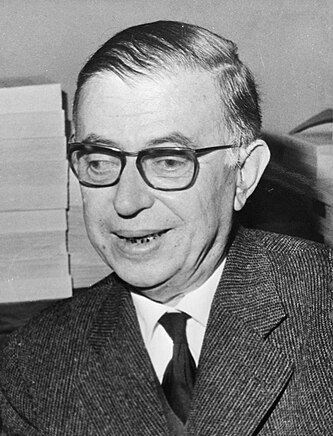








About Jean-Paul Sartre
Jean-Paul Charles Aymard Sartre (21 June 1905 – 15 April 1980), normally known simply as Jean-Paul Sartre, was a French existentialist philosopher, dramatist and screenwriter, novelist, and critic. He had an enduring personal relationship with fellow philosopher Simone de Beauvoir.
Best Jean-Paul Sartre Quotes
Shortest
Earliest
Explore our curated collection of the most famous and impactful Jean-Paul Sartre quotes.

“Eh bien, continuons...”
“such mad confidence within despair.”

“The past is the luxury of proprietors.”
“To eat is to appropriate by destruction.”

“Nothingness haunts being.”

“I hate victims who respect their executioners.”

“I exist, that is all, and I find it nauseating.”
“It was a constraint; he makes of it his mission”
“...the prisoner's dreams is the guard's spirituality”

“L'existence précède et commande l'essence.”

“If the Jew did not exist, the anti-Semite would invent him.”
“I have no need for good souls: an accomplice is what I wanted.”
“in order to make himself thoroughly undesirable, he will speak.”
“All-powerful god, who am I but the fear that I inspire in others?”

“...inversion...is an outlet that a child discovers when he is suffocating.”
“...in order to change poverty into wealth, one must start by displaying it.”

“...the reality of society involves the socialization of certain unrealities.”



“If literature isn't everything, it's not worth a single hour of someone's trouble.”

“Ah! How I hate the crimes of the new generation: they are dry and sterile as darnel.”

“The dreamer must contaminate the others by his dream, he must make them fall into it”
“esse est percipi, and he recognizes himself as being only insofar as he is perceived.”

“Politics is a science. You can demonstrate that you are right and that others are wrong.”

“Intellectuals cannot be good revolutionaries; they are just good enough to be assassins.”
“...the impossible must be supposed in order to explain the superdetermination of the event”
“Better to have beasts that let themselves be killed than men who run away.”
“She believed in nothing; only her skepticism kept her from being an atheist.”

“For an occurrence to become an adventure, it is necessary and sufficient for one to recount it.”
“Ah! yes, I know: those who see me rarely trust my word: I must look too intelligent to keep it.”

“If a victory is told in detail, one can no longer distinguish it from a defeat.”

“In doing Good, I lose myself in Being, I abandon my particularity, I become a universal subject.”

“Similarly, individual acts of aristocratic generosity do not eliminate pauperism; they perpetuate it.”
“It is freedom, it is particularity, it is solitude that we are aiming at, and not Evil for its own sake”

“All human activities are equivalent ... and ... all are on principle doomed to failure.”
“A man who is free is like a mangy sheep in a herd. He will contaminate my entire kingdom and ruin my work.”
“I respect orders but I respect myself too and I do not obey foolish rules made especially to humiliate me.”
“"Everything is both a trap and a display; the secret reality of the object is what the Other makes of it."”

“The worst of misfortunes is still a stroke of luck, since one feels oneself living when one experiences it/”
“I say a murder is abstract. You pull the trigger and after that you do not understand anything that happens.”

“Our responsibility is much greater than we might have supposed, because it involves all mankind.”

“Thus, Beauty is neither an appearance nor a being, but a relationship: the transformation of being into appearance”

“If we must absolutely mention this state of affairs, I suggest that we call ourselves "absent", that is more proper.”
“His business is here, it is here that he is despised and vilified, it is here that he must carry out his undertaking”


“I mistrust illuminations: what we take for a discovery is very often only a familiar thought that we have not recognized.”
“I do not understand! I understand nothing! I cannot understand nor do I want to understand! I want to believe! To Believe!”
“[W]e only become what we are by the radical and deep-seated refusal of that which others have made of us.”

“Man is condemned to be free; because once thrown into the world, he is responsible for everything he does.”
“...man first of all exists, encounters himself, surges up in the world – and defines himself afterwards.”

“Be quiet! Anyone can spit in my face, and call me a criminal and a prostitute. But no one has the right to judge my remorse.”


“Suppose that I wish to deserve the title of "robber of remorse" and that I place in myself all [the townspeople's] repentence?”
“The For-itself, in fact, is nothing but the pure nihilation of the In-itself; it is like a hole of being at the heart of Being.”

“The [Communist] Party has one objective: the creation of a socialist economy; and one means: the utilization of the class struggle.”
“Only a neutral, who is indifferent to the stake and perhaps to all stakes, can appreciate aesthetically the grandeur of a fine disaster”
“You take souls for vegetables.... The gardener can decide what will become of his carrots but no one can choose the good of others for them.”

“Monsieur ... I do not believe in God; his existence has been disproved by Science. But in the concentration camp, I learned to believe in men.”

“I think of death only with tranquility, as an end. I refuse to let death hamper life. Death must enter life only to define it.”

“He chooses the most feared, most hated man in order to worship him as a god, feeling sure that he is alone in perceiving the god's secret virtues.”

“Imagination is not an empirical or superadded power of consciousness, it is the whole of consciousness as it realizes its freedom.”

“As for me, I am mean: that means that I need the suffering of others to exist. A flame. A flame in their hearts. When I am all alone, I am extinguished.”

“"This is the contradiction of racism, colonialism, and all forms of tyranny: in order to treat a man like a dog, one must first recognize him as a man."”



“People who live in society have learned how to see themselves in mirrors as they appear to their friends. I have no friends. Is that why my flesh is so naked?”

“I think they do it to pass the time, nothing more. But time is too large, it can't be filled up. Everything you plunge into it is stretched and disintegrates.”
“For man holds his ground only by surpassing himself, in the same sense in which it is said that one ceases to love if one does not love increasingly everyday.”

“If you want to deserve Hell, you need only stay in bed. The world is iniquity; if you accept it, you are an accomplice, if you change it you are an executioner.”
“Jupiter: I am not your king, impudent larva? Who then has created you?
Orestes: You. But you should not have created me free.”
Orestes: You. But you should not have created me free.”
“Commoners are weightless. But he was a royal bon vivant who, no matter what, always weighed 125 kilos. I would be very surprised if he didn't have a few pounds left.”
“To believe is to know you believe, and to know you believe is not to believe.Quotation #32866 from Michael Moncur's (Cynical) Quotations:”

“Quand les riches se font la guerre, ce sont les pauvres qui meurent.
• Translation: When the rich make war, it's the poor that die.”
• Translation: When the rich make war, it's the poor that die.”

“This inner revolution is realistic because it maintains itself deliberately within the framework of existing institutions; the oppressed reckon with the real situation.”
“I wanted for the moments in my life to follow each other and order themselves like those of a life remembered. It would be just as well to try to catch time by the tail.”

“Genet is a man-failure: he wills the impossible in order to derive from the tragic grandeur of this defeat the assurance that there is something other than the possible.”

“I can be twenty women, one hundred, if that's what you want, all women. Ride with me behind you, I weigh nothing, your horse will not feel me. I want to be your whorehouse!”

“For Genet, reflective states of mind are the rule. And although they are of an unstable nature in everyone, in him...reflection is always contrary to the reflected feeling.”
“In a world, man must create his own essence: it is in throwing himself into the world, suffering there, struggling there, that he gradually defines himself.”

“The consciousness of being betrayed is to the collective consciousness of a sacred group what a certain form of schizophrenia is to the individual...it is a form of madness.”
“But when they have realized that it [society] rejects them forever, they themselves assume the ostracism of which they are victims so as not to leave the initiative to their oppressors”
“And when we speak of "abandonment" - a favorite word of Heidegger - we only mean to say that God does not exist and that it is necessary to draw the consequences of his absence to the end.”
“...and if you are common, you can dress up as a woman, show you behind or write poems: there's nothing offensive about a naked behind if it's everybody's; each person will be mirrored in it.”
“Yes, Lord, you are innocence itself: how could you conceive of Nothingness, you who are plenitude? Your gaze is light and transforms all into light: how could you know the half-light in my heart?”

“But since he has decided to have the impossibility of living, every misfortune is an opportunity which lays this importance of living before his eyes and obliges him to decide, once again, to die.”

“Lord, you have cursed Cain and Cain's children: thy will be done. You have allowed men's hearts to be corrupted, that their intentions be rotten, that their actions putrefy and stink: thy will be done.”


“Abjection is a methodological conversion, like Cartesian doubt and Husserlian epoche: it establishes the world as a closed system which consciousness regards from without, in the manner of divine understanding.”
“It is the good children, Madame, who make the most terrible revolutionaries. They say nothing, they do not hide under the table, they eat only one sweet at a time, but later on, they make Society pay dearly for it!”

“Generosity is nothing else than a craze to possess. All which I abandon, all which I give, I enjoy in a higher manner through the fact that I give it away.... To give is to enjoy possessively the object which one gives.”
“I maintain that inversion is the effect of neither a prenatal choice nor an endocrinal malformation nor even the passive and determined result of complexes. It is an outlet that a child discovers when he is suffocating.”

“If you die, I will lie down beside you and I will stay there until the end, without eating or drinking, you will rot in my arms and I will love you as carcass: for you love nothing if you do not love everything.”

“Either the USSR was not the country of socialism, in which case socialism didn't exist anywhere and doubtless, wasn't possible: or else, socialism was that, this abominable monster, this police state, the power of beasts of prey.”

“Virtue is the death of conscience because it is the habit of Good, and yet the ethic of the honest man infinitely prefers virtue to the noblest agonies of conscience. Thus, being poses nonbeing and eliminates it. There is only being”
“They made me take cod liver oil: that is the height of luxury: a medicine to make you hungry while the others, in the street, would have sold themselves for a beefsteak. I saw them passing my window with their signs: "Give me bread".”


“Catherine: Why commit Evil?
Goetz: Because Good has already been done.
Catherine: Who has done it?
Goetz: God the Father. I, on the other hand, am improvising.”
Goetz: Because Good has already been done.
Catherine: Who has done it?
Goetz: God the Father. I, on the other hand, am improvising.”
“We will not go to Heaven,Goetz, and even if we both entered it, we would not have eyes to see each other, nor hands to touch each other. Up there, God gets all the attention.... We can only love on this earth and against God.”
“Jupiter: I committed the first crime by creating men as mortals. After that, what more could you do, you the murderers?
Aegisteus: Come on; they already had death in them: at most you simply hastened things a little.”
Aegisteus: Come on; they already had death in them: at most you simply hastened things a little.”

“I was not the one to invent lies: they were created in a society divided by class and each of us inherited lies when we were born. It is not by refusing to lie that we will abolish lies: it is by eradicating class by any means necessary.”
“I wanted pure love: foolishness; to love one another is to hate a common enemy: I will thus espouse your hatred. I wanted Good: nonsense; on this earth and in these times, Good and Bad are inseparable: I accept to be evil in order to become good.”
“I will take it all: tongs, molten lead, prongs, garrotes, all that burns, all that tears, I want to truly suffer. Better one hundred bites, better the whip, vitriol, than this suffering in the head, this ghost of suffering which grazes and caresses and never hurts enough.”
“I, for my part, do not conceive an act as having causes, and I consider myself satisfied when I have found in it not its 'factors' but the general themes which it organizes: for our decisions gather into new syntheses and on new occasions the leitmotif that governs our life”
“Aegistheus, the kings have another secret.... Once liberty has exploded in the soul of a man, the Gods can do nothing against that man. It is a matter for men to handle amongst themselves, and it is up to other men — and to them alone — to let him flee or to destroy him.”
“I came to claim my kingdom and you refused me because I was not one of you. Now I am one of you, my subjects, we are bound by blood, and I deserve to be your king. Your sins and your remorse, your mighty anguish, I take all upon myself. Fear your dead no more, they are my dead.”
“When Descartes said, "Conquer yourself rather than the world," what he meant was, at bottom, - the same - that we should act without hope. Marxists, to whom I have said thus have answered: "Your action is limited, obviously, by your death: but you can rely upon the help of others.”

“When you live alone you no longer know what it is to tell a story: the plausible disappears at the same time as the friends. You let events flow by too: you suddenly see people appear who speak and then go away; you plunge into stories of which you can't make head or tail: you'd make a terrible witness.”
“Man cannot will unless he has first understood that he must count on no one but himself; that he is alone, abandoned on earth in the midst of his infinite responsibilities, without help, with no other aim than the one he sets himself, with no other destiny than the one he forges for himself on this earth.”

“You know how much I admire Che Guevara. In fact, I believe that the man was not only an intellectual but also the most complete human being of our age: as a fighter and as a man, as a theoretician who was able to further the cause of revolution by drawing his theories from his personal experience in battle.”
“Nicias, do you think you can erase with good deeds the wrongs you committed against your mother? What good deed will ever reach her? Her soul is a scorching noon time, without a single breath of a breeze, nothing moves, nothing changes, nothing lives there; a great emaciated sun, an immobile sun eternally consumes her.”

“The strangest mores of the most of-the-way societies will, in spite of everything, be relatively comprehensible to the person who has a flesh-and-blood knowledge of man's needs, anxieties, and hopes. If, on the other hand, this experience is lacking, he will not even be able to understand the customs of those about him.”
“Karsky: I met your father last week. Are you still interested in hearing how he is doing?
Hugo: No.
Karsky: It is very probable that you will be responsible for his death.
Hugo: It is virtually certain that he is responsible for my life. We are even.”
Hugo: No.
Karsky: It is very probable that you will be responsible for his death.
Hugo: It is virtually certain that he is responsible for my life. We are even.”
“I grasp at each second, trying to suck it dry: nothing happens which I do not seize, which I do not fix forever in myself, nothing, neither the fugitive tenderness of those lovely eyes, nor the noises of the street, nor the false dawn of early morning: and even so the minute passes and I do not hold it back, I like to see it pass.”
“He yawned. He had finished the day and he had also finished with his youth. Various well-bred moralities had already discreetly offered him their services: disillusioned epicureanism, smiling tolerance, resignation, common sense stoicism - all the aids whereby a man may savour, minute by minute, like a connoisseur, the failure of a life.”
“In some places the metropolis makes do with paying a clique of feudal overlords; in others, it has fabricated a fake bourgeoisie of colonized subjects in a system of divide and rule; elsewhere, it has killed two birds with one stone: the colony is both settlement and exploitation.”
“He was free, free in every way, free to behave like a fool or a machine, free to accept, free to refuse, free to equivocate; to marry, to give up the game, to drag this death weight about with him for years to come. He could do what he liked, no one had the right to advise him, there would be for him no Good or Evil unless he thought them into being.”

“That is precisely what we should have expected, since Genet wants to live simultaneously creation, destruction, the impossibility of destroying and the impossibility of creating, since he wants both to show his rejection of the divine creation and to manifest, in the absolute, human impotence as man's reproval of God and as the testimony of his grandeur.”

“Dostoevsky once wrote: "If God did not exist, everything would be permitted"; and that, for existentialism, is the starting point. Everything is indeed permitted if God does not exist, and man is in consequence forlorn, for he cannot find anything to depend upon either within or outside himself. He discovers forthwith, that he is without excuse.”
“Generally speaking there is no irreducible taste or inclination. They all represent a certain appropriative choice of being. It is up to existential psychoanalysis to compare and classify them. Ontology abandons us here; it has merely enabled us to determine the ultimate ends of human reality, its fundamental possibilities, and the value which haunts it.”

“I know. I know that I shall never again meet anything or anybody who will inspire me with passion. You know, it's quite a job starting to love somebody. You have to have energy, generosity, blindness. There is even a moment, in the very beginning, when you have to jump across a precipice: if you think about it you don't do it. I know I'll never jump again.”

“But [your crime] will be there, one hundred times denied, always there, dragging itself behind you. Then you will finally know that you have committed your life with one throw of the die, once and for all, and there is nothing you can do but tug our crime along until your death. Such is the law, just and unjust, of repentance. Then we will see what will become of your young pride.”

“And we feel that the hero has lived all the details of this night like annunciations, promises, or even that he lived only those that were promises, blind and deaf to all that did not herald adventure. We forget that the future was not yet there; the man was walking in the night without forethought, a night which offered him a choice of dull rich prizes, and he did not make his choice.”

“First, what do we mean by anguish? The existentialist frankly states that man is in anguish. His meaning is as follows-When a man commits himself to anything, fully realizing that he is not only choosing what he will be, but is thereby at the same time a legislator deciding for the whole of mankind-in such a moment a man cannot escape from the sense of complete and profound responsibility.”
“A man who belongs to some communist or revolutionary society wills certain concrete ends, which imply the will to freedom, and that freedom is willed in community. We will freedom for freedom's sake, and in and through the particular circumstances. And in thus willing freedom, we discover that it depends entirely upon the freedom of others and that the freedom of others depends upon our own.”

“The homosexual never thinks of himself when someone is branded in his presence with the name homosexual. ...His sexual tastes will doubtless lead him to enter into relationships with this suspect category, but he would like to make use of them without being likened to them. Here, too, the ban that is cast on certain men by society has destroyed all possibility of reciprocity among them. Shame isolates.”
“To shoot down a European is to kill two birds with one stone, to destroy an oppressor and the man he oppresses at the same time.The Doctor Prescribed Violence, Adam Shatz
Sept. 2, 2001, New York Times”
“You are a tiny little girl, Electra. Other little girls dreamed of being the richest or the most beautiful women of all. And you, fascinated by the horrid destiny of your people, you wished to become the most pained and the most criminal ... At your age, children still play with dolls and they play hopscotch. You, poor child, without toys or playmates, you played murder, because it is a game that one can play alone.”

“I was your luxury. For nineteen years I have been put in your man's world and was forbidden to touch anything and you made me think that all was going very well and that I did not have to worry about anything but putting flowers in vases. Why did you lie to me? Why did you keep me ignorant, if it was to admit to me one day that this world is cracking and that you are all powerless and to make me choose between a suicide and a murder?”
“As for the square at Meknes, where I used to go every day, it's even simpler: I do not see it at all anymore. All that remains is the vague feeling that it was charming, and these five words that are indivisibly bound together: a charming square at Meknes. ... I don't see anything any more: I can search the past in vain, I can only find these scraps of images and I am not sure what they represent, whether they are memories or just fiction.”
“I am responsible for everything ... except for my very responsibility, for I am not the foundation of my being. Therefore everything takes place as if I were compelled to be responsible. I am abandoned in the world ... in the sense that I find myself suddenly alone and without help, engaged in a world for which I bear the whole responsibility without being able, whatever I do, to tear myself away from this responsibility for an instant.”
“Understand me: I wish to be a man from somewhere, a man among men. You see, a slave, when he passes by, weary and surly, carrying a heavy load, limping along and looking down at his feet, only at his feet to avoid falling down; he is in his town, like a leaf in greenery, like a tree in a forest, argos surrounds him, heavy and warm, full of herself; I want to be that slave, Electra, I want to pull the city around me and to roll myself up in it like a blanket. I will not leave.”
“Quietism is the attitude of people who say, "let others do what I cannot do." The doctrine I am presenting before you is precisely the opposite of this, since it declares that there is no reality except in action. It goes further, indeed, and adds, "Man is nothing else but what he purposes, he exists only in so far as he realizes himself, he is therefore nothing else but the sum of his actions, nothing else but what his life is." Hence we can well understand why some people are horrified by our teaching.”
“For the moment, the jazz is playing; there is no melody, just notes, a myriad of tiny tremors. The notes know no rest, an inflexible order gives birth to them then destroys them, without ever leaving them the chance to recuperate and exist for themselves.... I would like to hold them back, but I know that, if I succeeded in stopping one, there would only remain in my hand a corrupt and languishing sound. I must accept their death; I must even want that death: I know of few more bitter or intense impressions.”
“We will freedom for freedom's sake, in and through particular circumstances. And in thus willing freedom, we discover that it depends entirely upon the freedom of others and that the freedom of others depends upon our own. Obviously, freedom as the definition of a man does not depend upon others, but as soon as there is a commitment, I am obliged to will the liberty of others at the same time as my own. I cannot make liberty my aim unless I make that of others equally my aim.”
“Absurd, irreducible; nothing — not even a profound and secret delirium of nature — could explain it. Obviously I did not know everything, I had not seen the seeds sprout, or the tree grow. But faced with this great wrinkled paw, neither ignorance nor knowledge was important: the world of explanations and reasons is not the world of existence. A circle is not absurd, it is clearly explained by the rotation of a straight segment around one of its extremities. But neither does a circle exist. This root, on the other hand, existed in such a way that I could not explain it.”
“You see, I divide men into three categories: those who have a lot of money, those who have none at all and those who have a little. The first want to keep what they have: their interest is to maintain order; the second want to take what they do not have: their interest is to destroy the existing order and to establish one which is profitable to them. They each are realist, people with whom one can agree. The third group want to overthrow the social order to take what they do not have, while still preserving it so that no one takes away what they have. Thus, they preserve in fact what they destroy in theory, or they destroy in fact what they seem to preserve. Those are the idealists.”
“Each human reality is at the same time a direct project to metamorphose its own For-itself into an In-itself-For-itself, a project of the appropriation of the world as a totality of being-in-itself, in the form of a fundamental quality. Every human reality is a passion in that it projects losing itself so as to found being and by the same stroke to constitute the In-itself which escapes contingency by being its own foundation, the Ens causa sui, which religions call God. Thus the passion of man is the reverse of that of Christ, for man loses himself as man in order that God may be born. But the idea of God is contradictory and we lose ourselves in vain. Man is a useless passion.”
“What do we mean by saying that existence precedes essence? We mean that man first of all exists, encounters himself, surges up in the world—and defines himself afterwards. If man as the existentialist see him is not definable, it is because to begin with he is nothing. He will not be anything until later, and then he will be what he makes of himself. Thus, there is no human nature, because there is no God to have a conception of it. Man simply is. Not that he is simply what he conceives himself to be, but he is what he wills, and as he conceives himself after already existing – as he wills to be after that leap towards existence. Man is nothing else but that which he makes of himself. That is the first principle of existentialism.”
“Zeus (Jupiter): Agistheus, you are a king, and it's to your sense of king-ship I appeal, for you enjoy wielding the scepter.
Aegistheus: Continue.
Zeus: You may hate me, but we are akin; I made you in my image. A king is a god on earth, glorious and terrifying as a god.
Aegistheus: You, terrifying?
Zeus: Look at me. [A long silence.] I told you you were made in my image. Each keeps order; you in Argos, I in heaven and on earth — and you and I harbor the same dark secret in our hearts.
Aegistheus: I have no secret.
Zeus: You have. The same as mine. The bane of gods and kings. The bitterness of knowing men are free. Yes, Aegistheus they are free. But your subjects do not know it, and you do.”
Aegistheus: Continue.
Zeus: You may hate me, but we are akin; I made you in my image. A king is a god on earth, glorious and terrifying as a god.
Aegistheus: You, terrifying?
Zeus: Look at me. [A long silence.] I told you you were made in my image. Each keeps order; you in Argos, I in heaven and on earth — and you and I harbor the same dark secret in our hearts.
Aegistheus: I have no secret.
Zeus: You have. The same as mine. The bane of gods and kings. The bitterness of knowing men are free. Yes, Aegistheus they are free. But your subjects do not know it, and you do.”

“Existentialism is nothing else but an attempt to draw the full conclusions from a consistently atheistic position. Its intention is not in the least that of plunging men into despair. And if by despair one means as the Christians do – any attitude of unbelief, the despair of the existentialists is something different. Existentialism is not atheist in the sense that it would exhaust itself in demonstrations of the non-existence of God. It declares, rather, that even if God existed that would make no difference from its point of view. Not that we believe God does exist, but we think that the real problem is not that of His existence; what man needs is to find himself again and to understand that nothing can save him from himself, not even a valid proof of the existence of God. In this sense existentialism is optimistic. It is a doctrine of action, and it is only by self-deception, by confining their own despair with ours that Christians can describe us as without hope.”
“Our aim is precisely to establish the human kingdom as a pattern of values in distinction from the material world. But the subjectivity which we thus postulate as the standard of truth is no narrowly individual subjectivism, for as we have demonstrated, it is not only one's own self that one discovers in the cogito, but those of others too. Contrary to the philosophy of Descartes, contrary to that of Kant, when we say "I think" we are attaining to ourselves in the presence of the other, and we are just as certain of the other as we are of ourselves. Thus the man who discovers himself directly in the cogito also discovers all the others, and discovers them as the condition of his own existence. He realizes that he can't be anything unless others recognize him as such. I cannot obtain any truth whatsoever about myself, except through the mediation of another. The other is indispensable to my existence, and equally so to any knowledge I can have of myself.”
“By turning my head slightly, I could see something out of the corner of my eye: it was a hand, the small white hand which slid along the table a little while ago. Now it was resting on its back, relaxed, soft and sensual, it had the indolent nudity of a woman sunning herself after bathing. A brown hairy object approached it, hesitant. It was a thick finger, yellowed by tobacco; inside this hand it had all the grossness of a male sex organ. It stopped for an instant, rigid, pointing at the fragile palm, then suddenly, it timidly began to stroke it. I was not surprised, I was only furious at the Self-Taught Man (L'Autodidacte); couldn't he hold himself back, the fool, didn't he realize the risk he was running?
The Self-Taught Man did not look surprised. He must have been expecting this for years. He must have imagined what would happen a hundred times, the day the Corsican would slip up behind him and a furious voice would resound suddenly in his ears. Yet he came back every evening, he feverishly pursued his reading and then, from time to time, like a thief, stroked a white hand or perhaps the leg of a small boy. It was resignation that I read on his face.”
The Self-Taught Man did not look surprised. He must have been expecting this for years. He must have imagined what would happen a hundred times, the day the Corsican would slip up behind him and a furious voice would resound suddenly in his ears. Yet he came back every evening, he feverishly pursued his reading and then, from time to time, like a thief, stroked a white hand or perhaps the leg of a small boy. It was resignation that I read on his face.”
“The anti‐Semite has chosen hate because hate is a faith; at the outset he has chosen to devaluate words and reasons. How entirely at ease he feels as a result. How futile and frivolous discussions about the rights of the Jew appear to him. He has placed himself on other ground from the beginning. If out of courtesy he consents for a moment to defend his point of view, he lends himself but does not give himself. He tries simply to project his intuitive certainty onto the plane of discourse. I mentioned awhile back some remarks by anti‐Semites, all of them absurd: "I hate Jews because they make servants insubordinate, because a Jewish furrier robbed me, etc." Never believe that anti‐ Semites are completely unaware of the absurdity of their replies. They know that their remarks are frivolous, open to challenge. But they are amusing themselves, for it is their adversary who is obliged to use words responsibly, since he believes in words. The anti‐Semites have the right to play. They even like to play with discourse for, by giving ridiculous reasons, they discredit the seriousness of their interlocutors. They delight in acting in bad faith, since they seek not to persuade by sound argument but to intimidate and disconcert. If you press them too closely, they will abruptly fall silent, loftily indicating by some phrase that the time for argument is past. It is not that they are afraid of being convinced. They fear only to appear ridiculous or to prejudice by their embarrassment their hope of winning over some third person to their side.”

“The anti‐Semite understands nothing about modern society. He would be incapable of conceiving of a constructive plan; his action cannot reach the level of the methodical; it remains on the ground of passion. To a long‐term enterprise he prefers an explosion of rage analogous to the running amuck of the Malays. His intellectual activity is confined to interpretation; he seeks in historical events the signs of the presence of an evil power. Out of this spring those childish and elaborate fabrications which give him his resemblance to the extreme paranoiacs. In addition, anti‐Semitism channels evolutionary drives toward the destruction of certain men, not of institutions. An anti‐Semitic mob will consider it has done enough when it has massacred some Jews and burned a few synagogues. It represents, therefore, a safety valve for the owning classes, who encourage it and thus substitute for a dangerous hate against their regime a beneficent hate against particular people. Above all this naive dualism is eminently reassuring to he anti‐Semite himself. If all he has to do is to remove Evil, that means that the Good is already given. He has no need to seek it in anguish, to invent it, to scrutinize it patiently when he has found it, to prove it in action, to verify it by its consequences, or, finally, to shoulder the responsibilities of the moral choice he has made. It is not by chance that the great outbursts of anti‐Semitic rage conceal a basic optimism. The anti‐Semite has cast his lot for Evil so as not to have to cast his lot for Good. The more one is absorbed in fighting Evil, the less one is tempted to place the Good in question. One does not need to talk about it, yet it is always understood in the discourse of the anti‐Semite and it remains understood in his thought. When he has fulfilled his mission as holy destroyer, the Lost Paradise will reconstitute itself. For the moment so many tasks confront the anti‐Semite that he does not have time to think about it. He is in the breach, fighting, and each of his outbursts of rage is a pretext to avoid the anguished search for the Good.”

“We are dealing here with a kind of worker aristocracy; around them would gravitate the people who were to be helped and raised up but who, for the moment, really were inferiors within the context of the working class itself. This translated into the choice of a particular form of unionization. When the time came to raise the issue of forming industrial unions, the skilled workers opted for craft-based organization, because that would exclude the unskilled. Objectively, this gave rise to a particular kind of union struggle that was real enough at the time, because in practice it was enough for the skilled workforce in a factory—the minority—to go on strike for operations to cease, even if the unskilled majority wanted to go on working. The union practice of the time, the kind of self-valuing, the type of struggle and form of organization, corresponded strictly to what those workers were, to what the machine was. We are not saying here that they were wrong or right: they were all that the universal lathe allowed them to be. It was in them, as their superiority; they interiorized it, and this interiorization, or subjectivation, produced the whole phenomenon of anarcho-syndicalism.
This was not, as Lukács claims, because they did not grasp the totality of what the working class was and what its struggle was. On the contrary, because they were at the centre of production, they did grasp it as it was at that time. It is true that at that time they were far better qualified than the rest, but it is also true that this led to the development of yellow unions, an aristocracy of labour and a host of fairly aberrant secondary elements reflecting that conception, that interiorization in the form of social superiority, which disappeared wherever work that required training was replaced by semi-automated, then automated machines. But in that epoch they could not have been expected to foresee the existence of such machines, practically and in their struggle. Of course Marx described them in Capital, but he was a theorist, a leader of the International, not a worker who struggles at every instance of his life, someone who is formed by the machine and at the same time internally transforms it. Which means that class consciousness itself has its limits, which are the limits of the situation as long as that situation has not been completely revealed.
Should this lead us to describe this type of 'class consciousness' as empty? Should we decide that the anarcho-syndicalists were not the men required? On the contrary, it is because they were aware of their strength, their courage and their worth, because they established unions and specific forms of struggle, that other forms of struggle could emerge in the era when specialized workers appeared. In the course of struggle, the subjective moment, as a way of being inside the objective moment, is absolutely indispensable to the dialectical development of social life and the historical process.”
This was not, as Lukács claims, because they did not grasp the totality of what the working class was and what its struggle was. On the contrary, because they were at the centre of production, they did grasp it as it was at that time. It is true that at that time they were far better qualified than the rest, but it is also true that this led to the development of yellow unions, an aristocracy of labour and a host of fairly aberrant secondary elements reflecting that conception, that interiorization in the form of social superiority, which disappeared wherever work that required training was replaced by semi-automated, then automated machines. But in that epoch they could not have been expected to foresee the existence of such machines, practically and in their struggle. Of course Marx described them in Capital, but he was a theorist, a leader of the International, not a worker who struggles at every instance of his life, someone who is formed by the machine and at the same time internally transforms it. Which means that class consciousness itself has its limits, which are the limits of the situation as long as that situation has not been completely revealed.
Should this lead us to describe this type of 'class consciousness' as empty? Should we decide that the anarcho-syndicalists were not the men required? On the contrary, it is because they were aware of their strength, their courage and their worth, because they established unions and specific forms of struggle, that other forms of struggle could emerge in the era when specialized workers appeared. In the course of struggle, the subjective moment, as a way of being inside the objective moment, is absolutely indispensable to the dialectical development of social life and the historical process.”
Jean-Paul Sartre Quotes by Topic
Find exactly what you are looking for by browsing this categorized list of Jean-Paul Sartre quotes by topic.
Jean-Paul Sartre on Love 5 quotes
“It is too early to love. We will buy the right to do so by shedding blood.”
Jean-Paul Sartre on Antisemitism 3 quotes
“Anti-Semitism, in a word, is fear of man’s fate. The anti-Semite is the man who wants to be a pitiless stone, a furious torrent, devastating lightning: in short, anything but a man.”

Jean-Paul Sartre on Existentialism 2 quotes
“The existentialist says the coward makes himself cowardly, the hero makes himself heroic; and that there is always a possibility for the coward to give up cowardice and for the hero to stop being a hero. What counts is the total commitment, and it is not by a particular case or particular action that you are committed altogether.”
Jean-Paul Sartre on Despair
Jean-Paul Sartre on Absurdity
“The more absurd life is, the more unsupportable death is.”
What Jean-Paul Sartre Said About Others
Discover personal opinions Jean-Paul Sartre shared regarding contemporaries.
Jean-Paul Sartre on Ferdinand Barbedienne 2 quotes
“Because beyond hell, it is in any salon, with bronze of Barbedienne or not, that the suffering is: as soon as other people see clearly in the game of the human being.”

Jean-Paul Sartre on Alberto Giacometti
Jean-Paul Sartre on Che Guevara
“You know how much I admire Che Guevara. In fact, I believe that the man was not only an intellectual but also the most complete human being of our age: as a fighter and as a man, as a theoretician who was able to further the cause of revolution by drawing his theories from his personal experience in battle.”

Jean-Paul Sartre on Victor Hugo
“Hugo, optimism incarnate, the vatic poet, recognised by God as the only worthy interlocutor, the courageous defender of the Communards...this cantor of the poor, the only one who was- and still is- read by the working classes,... this astonishing man: half priest and half anarchist, incontestable sovereign of the century.”

Jean-Paul Sartre on Fyodor Dostoyevsky
“Dostoevsky once wrote, "If God did not exist, everything would be permitted"; and that, for existentialism, is the starting point. Everything is indeed permitted, if God does not exist, and man is in consequence forlorn, for he cannot find anything to depend upon either within or outside himself. He discovers forthwith that he is without excuse. For if indeed existence precedes essence, one will never be able to explain one's action by reference to a given and specific human nature; in other words, there is no determinism-man is free, man is freedom.”

Quotes About Jean-Paul Sartre
Gain deeper perspective through quotes about Jean-Paul Sartre from others.
Louis Althusser on Jean-Paul Sartre
“He was a generous and courageous man. He always defended the cause of the unfortunate, of the exploited, and of the oppressed. He always struggled for freedom, most often with the communists and, if necessary, against them. He believed in the strength of reason and in the contagious power of the idea of freedom. But above all, for me and I have said it several times, he was our Jean-Jacques Rousseau.”

Lisa Appignanesi on Jean-Paul Sartre
“When I was growing up in the 60s, Simone de Beauvoir and Jean-Paul Sartre were a model couple, already legendary creatures, rebels with a great many causes, and leaders of what could be called the first postwar youth movement: existentialism — a philosophy that rejected all absolutes and talked of freedom, authenticity, and difficult choices. It had its own music and garb of sophisticated black which looked wonderful against a cafe backdrop. Sartre and De Beauvoir were its Bogart and Bacall, partners in a gloriously modern love affair lived out between jazz club, cafe and writing desk, with forays on to the platforms and streets of protest. Despite being indissolubly united and bound by ideas, they remained unmarried and free to engage openly in any number of relationships. This radical departure from convention seemed breathtaking at the time.”
Otto Friedrich Bollnow on Jean-Paul Sartre
“During the last months of the German Occupation in 1944, the young man who was to become France's most controversial contemporary philosopher and the woman who was to become its most controversial feminist met the professional criminal who was to become its most controversial playwright.”
Angela Davis on Jean-Paul Sartre
“I had gotten very much involved in the writings of the so-called Existentialists. Camus. Sartre. I retreated into myself and rejected practically everything outside. Only in the artificial surroundings of an isolated, virtually all-white college campus could I have allowed myself to cultivate this nihilistic attitude. It was as if in order to fight off the unreal quality of my environment, I leaped desperately into another equally unreal mode of living.”

Katharena Eiermann on Jean-Paul Sartre
“Jean Paul Sartre has said that all of French Existentialism is to be found in Ivan Karamazov's contention that if there is no God, everything is permitted.”






About Jean-Paul Sartre
Jean-Paul Charles Aymard Sartre (21 June 1905 – 15 April 1980), normally known simply as Jean-Paul Sartre, was a French existentialist philosopher, dramatist and screenwriter, novelist, and critic. He had an enduring personal relationship with fellow philosopher Simone de Beauvoir.