Link Copied!
James M. Buchanan Quotes (1919-2013)

About James M. Buchanan
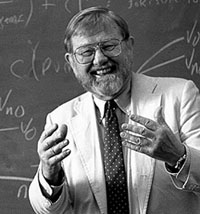
James McGill Buchanan, Jr. (3 October 1919 – 9 January 2013) was an American economist known for his work on public choice theory, who was awarded the 1986 Nobel Prize in Economics.
Best James M. Buchanan Quotes
Shortest
Earliest
Explore our curated collection of the most famous and impactful James M. Buchanan quotes.


“A version of the old fable about the king's nakedness may be helpful here. Public choice is like the small boy who said that the king really has no clothes. Once he said this, everyone recognized that the king's nakedness had been recognized, but that no-one had really called attention to this fact.”
“I did not call him "Fritz." To me he remained always "Professor Hayek," despite his own graciousness in treating me as a peer. I shall not attempt to evaluate Professor Hayek's monumental contribution to our understanding of the events of this turbulent century, to the influence of his ideas on these events themselves or even to the development of economic theory in a strictly scientific sense.”

“Individuals do not act so as to maximize utilities described in independently-existing functions. They confront genuine choices, and the sequence of decisions taken may be conceptualized, ex post (after the choices), in terms of “as if” functions that are maximized. But these “as if” functions are, themselves, generated in the choosing process, not separately from such process. If viewed in this perspective, there is no means by which even the most idealized omniscient designer could duplicate the results of voluntary interchange. The potential participants do not know until they enter the process what their own choices will be. From this it follows that it is logically impossible for an omniscient designer to know, unless, of course, we are to preclude individual freedom of will.”
“Well, we haven’t learnt yet to live together peacefully... But I don’t know what progress really means. Anyway, I think we need to have faith in the fact that there is more out there to be explained. Even the paradigms that we now have, including subjective value theory, for example, are only provisional. Some physicist might believe that ultimately, we will be able to explain everything. To me, that is utterly stupid, just like saying that an atheist is equally dogmatic as a Texas Baptist. It seems to me that, if you accept evolution, you can still not expect your dog to get up and start talking German. And that’s because your dog is not genetically programmed to do that. We are human animals, and we are equally bound. There are whole realms of discourse out there that we cannot reach, by definition. There are always going to be limits beyond which we cannot go. Knowing that they are there, you can always hope to move a little closer – but that’s all.”
James M. Buchanan Quotes by Topic
Find exactly what you are looking for by browsing this categorized list of James M. Buchanan quotes by topic.
James M. Buchanan on Public choice 2 quotes
“The key to Public Choice, as you said earlier, is common sense. And common sense tells you that a politician is very much like the rest of us. A politician who's seeking office or seeking to remain in office is responsible, as he should be, to constituents. He wants to go back to a constituency and tell them that he's either lowered their taxes, or he's brought them program benefits. You plug that into politics and you have a natural proclivity of a politician to create deficits.”
James M. Buchanan on Democracy in Deficit
“Then the question comes along: Why didn't we have deficits before? You see the Keynesian economic revolution gave the politicians an excuse for deficits. You give politicians half an excuse; they play out this natural proclivity. So from the '60s on we have the regime accelerating deficits. This ties into my support of the constitutional amendment as a corrective device. That's an easy example. You can also take these other aspects—regulatory policy or anything like that—and you can come at it from a Public Choice perspective.”
James M. Buchanan on Keynesian economics
“I have chosen my title, “Keynesian Follies,” carefully. Folly is defined as (1) lack of good sense or of normal prudence, (2) inability or refusal to accept existing reality or to foresee inevitable consequences. Both of these definitions convey something of the policy stance that I associate with the term Keynesian. I have put “follies” plurally in my title in order to suggest that several separate but related elements are involved, and, also, to hint that, to an extent, the whole historical episode has theatrical aspects of its own.”

James M. Buchanan on Friedrich Hayek and evolution
“My basic criticism of F. A. Hayek’s profound interpretation of modern history and his diagnoses for improvement is directed at his apparent belief or faith that social evolution will, in fact, insure the survival of efficient institutional forms. Hayek is so distrustful of man’s explicit attempts at reforming institutions that he accepts uncritically the evolutionary alternative. We may share much of Hayek’s skepticism about social and institutional reform, however, without elevating the evolutionary process to an ideal role. Reform may, indeed, be difficult, but this is no argument that its alternative is ideal.”
James M. Buchanan on The Calculus of Consent
“Tullock and I considered ourselves to be simply taking the tools of economics, looking at something like the structure of American politics in the way James Madison had envisioned it. That is, it was clearly not a majoritarian democracy, which would be the parliamentary model (which was the ideal, at that time especially, of all the political scientists), rather it was a sort of a constitutional structure. We were the first to start analyzing the Constitution from an economic point of view. There were other people who analyzed particular voting rules, like majority voting, but we put that in a constitutional structure and provided an argument for choices among voting rules. We concentrated on that. So, in a sense, I considered us to be simply writing out in modern economic terms more or less Madison's framework of what he wanted to do, as opposed to anything new and different. It turned out that nobody had looked at it in that way.”
James M. Buchanan on Mont Pelerin Society
“I was invited to become a member of the Mt. Pelerin Society in 1957, and I vividly recall my first participation in a general meeting, at the Suvretta House in St. Moritz, the most luxurious hotel I had ever seen. I recall the feet cushions in the lobby and the Spanish princess who got so many of us a bit excited by her mere presence. (No connection with the society.) I do not know who nominated me for membership, perhaps it was Frank Knight, but I do know that everyone acknowledged that the society was really Hayek's and that any new member must have been approved by Hayek himself. By 1957, the membership had grown somewhat from its small beginnings a decade earlier, but there was still a club-like aspect to the meeting and with an underlying tension between the central European and American members (the latter mostly with Chicago connections). To those of us who had libertarian-populist blood in our veins, there was too much deference accorded to Hayek, and especially to Ludwig von Mises, who seemed to demand sycophancy.”

James M. Buchanan on Marxism
“As I noted earlier, when we look back at the scientific and public climates of discussion 50 years ago, the prevailing mindset was socialist in its underlying presupposition that government offered the solution to social problems. But there was a confusing amalgam of Marxism and ideal political theory involved: Governments, as observed, were modeled and condemned by Marxists as furthering class interests, but governments which might be installed 'after the revolution', so to speak, would become both omniscient and benevolent. In some of their implicit modeling of political behavior aimed at furthering special group or class interests, the Marxists seemed to be closet associates of public choice, even as they rejected methodological individualism. But how was the basic Marxist critique of politics, as observed, to be transformed into the idealized politics of the benevolent and omniscient superstate? This question was simply left glaringly unanswered. And the debates of the 1930s were considered by confused economists of the time to have been won by the socialists rather than by their opponents, Ludwig von Mises and Friedrich Hayek. Both sides, to an extent, neglected the relevance of incentives in motivating human action, including political action.”

James M. Buchanan on The Constitution of Liberty
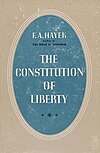
“Hayek gave a series of several lectures at the conference during which he sketched out most of the ideas that were later to appear in his treatise The Constitution of Liberty (1960). He must have already had a quasi-finished draft of this book in hand, since, as I recall, the arguments were well developed. Most of the ideas were, as expected, quite congenial to me, but I recall thinking that Hayek was analytically wrong in his discussion of equal pay for equal work, and that, normatively, I rejected his argument in support of proportional rather than progressive income taxation. On the latter point, the influence of Henry Simons was still too fresh for me to appreciate the political implications of progression, which Hayek may have sensed although they did not appear directly in his discussion. At the time, I was only beginning to escape from the orthodox mindset and to begin to look at politics realistically. In retrospect, what seems most interesting to me about the Wabash lectures is that we judged Professor Hayek as a senior scholar who was presenting to us the well-reasoned product of a life's work. Little did we dream that there were major new and quite different Hayek contributions ahead, and that Hayek would develop ideas that he surely did not sense at all at the time.”
What James M. Buchanan Said About Others
Discover personal opinions James M. Buchanan shared regarding contemporaries.
James M. Buchanan on Friedrich Hayek 3 quotes
“I did fully learn from Hayek the distinction between what I later called moral community and moral order and moral anarchy – this is about the sense that our genetic predisposition is all for the insider tribe.”

James M. Buchanan on John Maynard Keynes 3 quotes
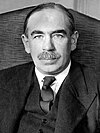
“Why does Camelot lie in ruins? Intellectual error of monumental proportion has been made, and not exclusively by the politicians. Error also lies squarely with the economists. The "academic scribbler" who must bear substantial responsibility is Lord Keynes...”
James M. Buchanan on Frank Knight 2 quotes
“[The Economic Organization by Frank Knight provided] the elements of theory that helped to establish for Chicago its eminence in neoclassical economics.”

James M. Buchanan on Knut Wicksell
“His work preceded by several decades the final construction of the Paretian "new" welfare economics, which is closely related although independently developed. The merit of Wicksell is that he states directly the implications of his analysis for the institutions of collective choice, a subject upon which the modern welfare economists have been rather strangely silent.”

James M. Buchanan on Kenneth Arrow
“Then during the early '50s Kenneth Arrow published his book Social Choice and Individual Values (1951). That stirred up a great deal of interest, both in political science and economics. My general reaction was that the people who criticized Arrow, and Arrow himself, really didn't quite get the message in the sense that the concentration was on the fact that majority rule would not give you a political equilibrium, that you get this political cycle and so forth. My criticism basically was, if that's the way the preferences are, that's what you want to have. A democracy should not mean one majority simply ruling. It ought to be a rotation, if that's the way the preferences are. I was kind of an anti-majoritarian then and now. So my critique of Arrow, which not many people paid much attention to, got me further into thinking about these things.”
James M. Buchanan on Mancur Olson
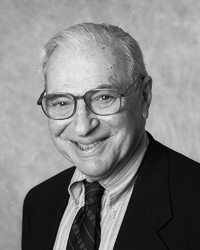
“If you take the story I've given you, if you recognize that the traditional way we looked at politics had a lot of romance in it, then Public Choice comes along and removes the romance. I think the natural outcome of that is you're going to be more skeptical about government than you would have been otherwise. Mancur Olson, a good friend of mine, has been influential in Public Choice and objects very strongly to this argument that there is this conservative bias. There is no bias in it as such. But Mancur himself has necessarily had to look at politics differently because of that, despite the fact that his natural proclivity would be more left than mine. There's nothing inherently biased about it. It's just that the fact that if you start looking at the political sector or politics from a non-romantic view, you come to a different view on what has been traditional.”
Quotes About James M. Buchanan
Gain deeper perspective through quotes about James M. Buchanan from others.
Dean Baker on James M. Buchanan
“In short, if Buchanan's argument was that liberal demands for an ever expanding welfare state would lead to chronic deficits, history has shown him to be wrong. If the argument is that the desire for tax cuts and increased military spending, coupled with macroeconomic mismanagement, could lead to large deficits, there is a strong case.”
Tyler Cowen on James M. Buchanan
“1. He developed the “theory of clubs,” which sets out the conditions under which private associations supply excludable public goods at optimum levels. 2. For his time he had the best and most rigorous analysis of the incidence of public debt. 3. With Gordon Tullock he pioneered the economic analysis of voting rules in terms of transactions costs and external costs imposed on others. Any current blogosphere discussion of say the filibuster will rely on this approach, though we now take it so for granted we don’t realize how impressive it was at the time. 4. He had pioneering economic analyses of bicameralism, logrolling, and other aspects of legislatures, again with Tullock. 5. Along with Harsanyi, he formulated aspects of the “original position” before Rawls did and he was a major influence on Rawls. By the way, I have seen Buchanan numerous times with top professional philosophers, and he has no problem holding his own or better. 6. He helped pin down, including on the technical side, the economic concept of externality. 7. He provided the most important revision to optimal tax theory since Ramsey, namely the point that supposedly efficient methods of taxation can be too easy to use. That was in The Power to Tax, with Brennan. His piece on static vs. dynamic versions of the Laffer curve, with Dwight Lee, is also significant. 8. He provided a public choice analysis of why Keynesian economics would not lead to the appropriate budget surpluses during good times and thus would contain dangerous ratchet effects toward excess deficits. 9. He thought through the conflict between subjective and objective notions of value in economics, and the importance of methodologically individualist postulates, more deeply than perhaps any other economist. Most economists hate this work, or refuse to understand it, either because it lowers their status or because it is genuinely difficult to follow or because it requires philosophy. Yet it stands among Buchanan’s greatest contributions even if a) I do not myself agree with his approach, and b) I do not think it is easily summarized or even well-explained. Buchanan took Knight and Shackle very seriously and he understood that the typical pragmatic dismissal of their caveats was not in fact well-founded. 10. His Hayekian work on “order defined only through the process of emergence” and “economics as a science of exchange and catallactics” is a very important take-down of the scientific pretensions of much of economics. It doubted whether the notion of efficiency could be independently conceptualized at all. Again, this work is disliked or ignored. Buchanan may be going too far, but it is a very important and neglected perspective. 11. He thought more consistently in terms of “rules of the games” than perhaps any other economist. This point remains underappreciated and underapplied. It makes technocracy out to be a fundamentally different endeavor. 12. He did important work in the history of economic thought, reviving interest in the Italian school of public finance and public choice. 13. His late papers with Yoon on the work ethic, increasing returns, and economic growth remain underappreciated. I also admire his work with Yoon on the anti-commons.”
J. Bradford DeLong on James M. Buchanan
“I see at least six James Buchanans: 1. The brilliant academic thinker behind the genius insights of Calculus of Consent. […] 2. The academic operator seeking to get money from ex-Governor and U.Va. President Darden for the great public choice research project by overpromising how useful his Thomas Jefferson Center for Political Economy would be in providing intellectual weapons to strengthen the political causes of Darden and his friends. 3. The academic operator going beyond what I, at least, regard as the permissible academic pale by imposing a political-ideological litmus test on who he invited into the public choice circle—i.e., not Mancur Olson, or any Olson students or potential Olson students (like me, in my younger days). […] 4. The grandson of Kentucky Governor John Buchanan, offended that Yankees would dare tell southern gentlemen how to deal with their "peculiar institutions". (And just what are these "Western traditions"? And how near to the core of these "Western traditions" is white supremacy anyway? That the language here is Aesopian is not to Buchanan's credit.) 5. The friend of plutocrats or would-be plutocrats buying into the Hayekian idea that political democracy was, fundamentally, a mistake because the plebes would vote themselves bread-and-circuses and so ultimately destroy civilization. 6. The right-wing activist seeking, in a von Misian or Rothbardian way, to harness and in fact mobilize racial evil to the service of what he regarded as the good of stomping the New Deal and Keynesian economics into oblivion.”

Karen Horn on James M. Buchanan
“Unlike Kenneth J. Arrow or Robert M. Solow, Buchanan is not a puzzle solver, but rather a system builder, someone who has come up with a whole new paradigm, an innovative way of looking at the world in general and at politics or collective choice in particular (see Horn, 2009, pp. 85–90.) As mentioned, the roots of this are to be found largely in his personal background and his experience and cultural inheritance as a Southerner. From the outset, what interested him more than anything else was how it is possible for people to live in society without infringing on each other’s rights.”
Steve Horwitz on James M. Buchanan
“Buchanan’s work changed political economy in fundamental ways. Thanks to him and his colleagues, three things are true: No one who wishes to talk responsibly about politics can be ignorant of public choice theory. No one should ever invoke the language of market failure (including externalities) without having digested his work on government failure. And people who run around talking about the constitution better be able to understand something of his contributions to constitutional political economy.”
Daniel Kuehn on James M. Buchanan
“The basic idea of Buchanan's constitutional economics was that public decision really comes in two stages, not one: the constitutional stage, and the political stage. People generate constitutions that create an institutional environment constrained in ways that they perceive to be beneficial. This has implications for how we think about the subsequent political stage. It rejects that Lysander Spooner take on things that says that unanimous consent is required for just policy decisions, because people will consent to a constitutional arrangement where legislation passes with less than unanimous consent because they think that the whole package of policy that such an institutional environment produces is preferable to policy produced in a unanimous consent environment. You can think about it as a sort of nested optimization.”
Alan T. Peacock on James M. Buchanan
“The basic concern of Buchanan (e.g. Buchanan, 1975) is to deny that a libertarian position requires the making of ethical judgments of the kind made by social philosophers who 'play God'. ... It follows that liberalism is about determination of the 'correct' contractual procedures which will allow individuals to consent to intervention by government. That procedure, if it is to be compatible with an individualist position, requires, so far as is practically possible, unanimous consent. Therefore, the common procedure used by economists to identify a social welfare function which is then to be 'maximized' implicitly rejects the individualistic decision-making process, which is the only mechanism through which individuals both express preferences and have them acted upon. To claim that preferences can be revealed and acted upon by governments, unencumbered by individuals' consent, is to presuppose that they and their officials will always act in an enlightened and wholly disinterested way. It is a curious paradox that, in the light of Buchanan's distaste for Keynesian elitism (see Buchanan, 1991), there are elements in Keynes's rather fragmentary thinking on political matters which express a sympathy with an individualistic stance.”
Robert D. Tollison on James M. Buchanan
“His great mind is now still, but he lives on in the ideas he passed on to his students, colleagues, and friends. It has been said that only poets and songwriters are immortal, but as an economist, Jim’s work surely approaches immortality because it will continue to be read and discussed throughout time to come. We still read Adam Smith (at least some of us), and it is a good bet that over 200 years from now, young scholars will pore over Jim’s articles and books in search of ideas, insights, and inspiration. This may not be an eternity, but it is a very long half-life. Better yet, maybe some future political generation will see fit to put our fiscal house in order and in so doing pay homage to our memory of Jim Buchanan. Rest in peace.”
About James M. Buchanan
James McGill Buchanan, Jr. (3 October 1919 – 9 January 2013) was an American economist known for his work on public choice theory, who was awarded the 1986 Nobel Prize in Economics.