Link Copied!
James Clerk Maxwell Quotes (1831-1879)
Physicist

















About James Clerk Maxwell
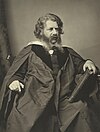
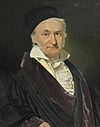
James Clerk Maxwell (13 June 1831 – 5 November 1879) was a Scottish mathematical physicist, who formulated the classical theory of electromagnetic radiation, bringing together for the first time electricity, magnetism, and light as manifestations of the same phenomenon.
Best James Clerk Maxwell Quotes
Shortest
Earliest
Explore our curated collection of the most famous and impactful James Clerk Maxwell quotes.
“I have also a paper afloat, with an electromagnetic theory of light, which, till I am convinced to the contrary, I hold to be great guns.”
“Colour as perceived by us is a function of three independent variables at least three are I think sufficient, but time will show if I thrive.”
“In every branch of knowledge the progress is proportional to the amount of facts on which to build, and therefore to the facility of obtaining data.”


“How the learned fool would wonder
Were he now to see his blunder,
When he put his reason under
The control of worldly Pride.”
Were he now to see his blunder,
When he put his reason under
The control of worldly Pride.”
“The equations at which we arrive must be such that a person of any nation, by substituting the numerical values of the quantities as measured by his own national units, would obtain a true result.”
“The 2nd law of thermodynamics has the same degree of truth as the statement that if you throw a tumblerful of water into the sea, you cannot get the same tumblerful of water out again.”

“It is of great advantage to the student of any subject to read the original memoirs on that subject, for science is always most completely assimilated when it is in the nascent state...”
“We may find illustrations of the highest doctrines of science in games and gymnastics, in travelling by land and by water, in storms of the air and of the sea, and wherever there is matter in motion.”
“I have also cleared the electromagnetic theory of light from all unwarrantable assumption, so that we may safely determine the velocity of light by measuring the attraction between bodies kept at a given difference of potential, the value of which is known in electromagnetic measure.”

“Ask no more, then, "what is best,
How shall those you love be blest,"
Ask at once eternal Rest,
Peace and assurance giving.
Rest of Life and not of death,
Rest in Love and Hope and Faith,
Til the God who gives their breath
Calls them to rest from living.”
How shall those you love be blest,"
Ask at once eternal Rest,
Peace and assurance giving.
Rest of Life and not of death,
Rest in Love and Hope and Faith,
Til the God who gives their breath
Calls them to rest from living.”

“By the hollow mauntain-side
Questions strange I shout for ever,
While echoes far and wide
Seem to mock my vain endeavour;
Still I shout, for though they never
Cast my borrowed voice aside,
Words from empty words they sever—
Words of Truth from words of Pride.”
Questions strange I shout for ever,
While echoes far and wide
Seem to mock my vain endeavour;
Still I shout, for though they never
Cast my borrowed voice aside,
Words from empty words they sever—
Words of Truth from words of Pride.”

“But listen, what harmony holy
Is mingling its notes with our own!
The discord is vanishing slowly,
And melts in that dominant tone.
And they that have heard it can never
Return to confusion again,
Their voices are music for ever,
And join in the mystical strain.”
Is mingling its notes with our own!
The discord is vanishing slowly,
And melts in that dominant tone.
And they that have heard it can never
Return to confusion again,
Their voices are music for ever,
And join in the mystical strain.”
“We shall see that the mathematical treatment of the subject [of electricity] has been greatly developed by writers who express themselves in terms of the 'Two Fluids' theory. Their results, however, have been deduced entirely from data which can be proved by experiment, and which must therefore be true, whether we adopt the theory of two fluids or not. The experimental verification of the mathematical results therefore is no evidence for or against the peculiar doctrines of this theory.”

“I think men of science as well as other men need to learn from Christ, and I think Christians whose minds are scientific are bound to study science that their view of the glory of God may be as extensive as their being is capable. But I think that the results which each man arrives at in his attempts to harmonize his science with his Christianity ought not to be regarded as having any significance except to the man himself, and to him only for a time, and should not receive the stamp of a society.”

“Mathematicians may flatter themselves that they possess new ideas which mere human language is yet unable to express. Let them make the effort to express these ideas in appropriate words without the aid of symbols, and if they succeed they will not only lay us laymen under a lasting obligation, but we venture to say, they will find themselves very much enlightened during the process, and will even be doubtful whether the ideas as expressed in symbols had ever quite found their way out of the equations of their minds.”

“And last of all we have the secondary forms of crystals bursting in upon us, and sparkling in the rigidity of mathematical necessity and telling us, neither of harmony of design, usefulness or moral significance, — nothing but spherical trigonometry and Napier's analogies. It is because we have blindly excluded the lessons of these angular bodies from the domain of human knowledge that we are still in doubt about the great doctrine that the only laws of matter are those which our minds must fabricate, and the only laws of mind are fabricated for it by matter.”

“The vast interplanetary and interstellar regions will no longer be regarded as waste places in the universe, which the Creator has not seen fit to fill with the symbols of the manifold order of His kingdom. We shall find them to be already full of this wonderful medium; so full, that no human power can remove it from the smallest portion of Space, or produce the slightest flaw in its infinite continuity.”
“Velocity of transverse undulations in our hypothetical medium, calculated from the electromagnetic experiments of 'MM'. Kohlrausch and Weber, agrees so exactly with the velocity of light calculated from the optical experiments of M. Fizeau, that we can scarcely avoid the conclusion that light consists in the transverse undulations of the same medium which is the cause of electric and magnetic phenomena.”
“I maintain that all the evil influences that I can trace have been internal and not external, you know what I mean—that I have the capacity of being more wicked than any example that man could set me, and that if I escape, it is only by God's grace helping me to get rid of myself, partially in science, more completely in society, — but not perfectly except by committing myself to God as the instrument of His will, not doubtfully, but in the certain hope that that Will will be plain enough at the proper time. Nevertheless, you see things from the outside directly, and I only by reflexion, so I hope that you will not tell me you have little fault to find with me, without finding that little and communicating it.”

“I believe, with the Westminster Divines and their predecessors ad Infinitum that "Man's chief end is to glorify God and to enjoy him for ever."
That for this end to every man has been given a progressively increasing power of communication with other creatures.
That with his powers his susceptibilities increase. That happiness is indissolubly connected with the full exercise of these powers in their intended direction. That Happiness and Misery must inevitably increase with increasing Power and Knowledge. That the translation from the one course to the other is essentially miraculous, while the progress is natural. But the subject is too high. I will not, however, stop short, but proceed to Intellectual Pursuits.”

“The general equations are next applied to the case of a magnetic disturbance propagated through a non-conductive field, and it is shown that the only disturbances which can be so propagated are those which are transverse to the direction of propagation, and that the velocity of propagation is the velocity v, found from experiments such as those of Weber, which expresses the number of electrostatic units of electricity which are contained in one electromagnetic unit. This velocity is so nearly that of light, that it seems we have strong reason to conclude that light itself (including radiant heat, and other radiations if any) is an electromagnetic disturbance in the form of waves propagated through the electromagnetic field according to electromagnetic laws.”
“He that would enjoy life and act with freedom must have the work of the day continually before his eyes. Not yesterday's work, lest he fall into despair; nor to-morrow's, lest he become a visionary—not that which ends with the day, which is a worldly work; nor yet that only which remains to eternity, for by it he cannot shape his actions.
Happy is the man who can recognise in the work of to-day a connected portion of the work of life and an embodiment of the work of Eternity. The foundations of his confidence are unchangeable, for he has been made a partaker of Infinity. He strenuously works out his daily enterprises because the present is given him for a possession.
Thus ought Man to be an impersonation of the divine process of nature, and to show forth the union of the infinite with the finite, not slighting his temporal existence, remembering that in it only is individual action possible; nor yet shutting out from his view that which is eternal, knowing that Time is a mystery which man cannot endure to contemplate until eternal Truth enlighten it.”

“The whole science of heat is founded Thermometry and Calorimetry, and when these operations are understood we may proceed to the third step, which is the investigation of those relations between the thermal and the mechanical properties of substances which form the subject of Thermodynamics. The whole of this part of the subject depends on the consideration of the Intrinsic Energy of a system of bodies, as depending on the temperature and physical state, as well as the form, motion, and relative position of these bodies. Of this energy, however, only a part is available for the purpose of producing mechanical work, and though the energy itself is indestructible, the available part is liable to diminution by the action of certain natural processes, such as conduction and radiation of heat, friction, and viscosity. These processes, by which energy is rendered unavailable as a source of work, are classed together under the name of the Dissipation of Energy.”

“I
My soul’s an amphicheiral knot
Upon a liquid vortex wrought
By Intellect in the Unseen residing,
While thou dost like a convict sit
With marlinspike untwisting it
Only to find my knottiness abiding;
Since all the tools for my untying
In four-dimensioned space are lying,
Where playful fancy intersperses
Whole avenues of universes;
Where Klein and Clifford fill the void
With one unbounded, finite homaloid,
Whereby the Infinite is hopelessly destroyed.
II
But when thy Science lifts her pinions
In Speculation’s wild dominions,
I treasure every dictum thou emittest;
While down the stream of Evolution
We drift, and look for no solution
But that of the survival of the fittest.
Till in that twilight of the gods
When earth and sun are frozen clods,
When, all its energy degraded,
Matter in æther shall have faded,
We, that is, all the work we’ve done,
As waves in æther, shall for ever run
In swift-expanding spheres, through heavens
beyond the sun.
III
Great Principle of all we see,
Thou endless Continuity!
By thee are all our angles gently rounded;
Our misfits are by thee adjusted,
And as I still in thee have trusted,
So let my methods never be confounded!
O never may direct Creation
Break in upon my contemplation,
Still may the causal chain, ascending,
Appear unbroken and unending,
And, where that chain is lost to sight
Let viewless fancies guide my darkling flight
Through Æon-haunted worlds, in order infinite.
∂p/∂t”

“This characteristic of modern experiments — that they consist principally of measurements — is so prominent, that the opinion seems to have got abroad, that in a few years all the great physical constants will have been approximately estimated, and that the only occupation which will then be left to men of science will be to carry on these measurements to another place of decimals. If this is really the state of things to which we are approaching, our Laboratory may perhaps become celebrated as a place of conscientious labour and consummate skill, but it will be out of place in the University, and ought rather to be classed with the other great workshops of our country, where equal ability is directed to more useful ends.
But we have no right to think thus of the unsearchable riches of creation, or of the untried fertility of those fresh minds into which these riches will continue to be poured. It may possibly be true that, in some of those fields of discovery which lie open to such rough observations as can be made without artificial methods, the great explorers of former times have appropriated most of what is valuable, and that the gleanings which remain are sought after, rather for their abstruseness, than for their intrinsic worth. But the history of science shews that even during the phase of her progress in which she devotes herself to improving the accuracy of the numerical measurement of quantities with which she has long been familiar, she is preparing the materials for the subjugation of the new regions, which would have remained unknown if she had been contented with the rough methods of her early pioneers. I might bring forward instances gathered from every branch of science, shewing how the labour of careful measurement has been rewarded by the discovery of new fields of research, and by the development of new scientific ideas. But the history of the science of terrestrial magnetism affords us a sufficient example of what may be done by experiments in concert, such as we hope some day to perform in our Laboratory.”
But we have no right to think thus of the unsearchable riches of creation, or of the untried fertility of those fresh minds into which these riches will continue to be poured. It may possibly be true that, in some of those fields of discovery which lie open to such rough observations as can be made without artificial methods, the great explorers of former times have appropriated most of what is valuable, and that the gleanings which remain are sought after, rather for their abstruseness, than for their intrinsic worth. But the history of science shews that even during the phase of her progress in which she devotes herself to improving the accuracy of the numerical measurement of quantities with which she has long been familiar, she is preparing the materials for the subjugation of the new regions, which would have remained unknown if she had been contented with the rough methods of her early pioneers. I might bring forward instances gathered from every branch of science, shewing how the labour of careful measurement has been rewarded by the discovery of new fields of research, and by the development of new scientific ideas. But the history of the science of terrestrial magnetism affords us a sufficient example of what may be done by experiments in concert, such as we hope some day to perform in our Laboratory.”
James Clerk Maxwell Quotes by Topic
Find exactly what you are looking for by browsing this categorized list of James Clerk Maxwell quotes by topic.
James Clerk Maxwell on Electromagnetism 4 quotes
“I have also cleared the electromagnetic theory of light from all unwarrantable assumption, so that we may safely determine the velocity of light by measuring the attraction between bodies kept at a given difference of potential, the value of which is known in electromagnetic measure.”

James Clerk Maxwell on Light 3 quotes
“I have also cleared the electromagnetic theory of light from all unwarrantable assumption, so that we may safely determine the velocity of light by measuring the attraction between bodies kept at a given difference of potential, the value of which is known in electromagnetic measure.”
James Clerk Maxwell on Atom 3 quotes
“As for the atoms, they have been in far worse rows before they became naturalised in my brain, but they forget the days before, etc. At any rate the atoms are a very tough lot, and can stand a great deal of knocking about, and it is strange to find a number of them combining to form a man of feeling.”
James Clerk Maxwell on Thermodynamics 2 quotes
“Heat may be generated and destroyed by certain processes, and this shows that heat is not a substance.”

James Clerk Maxwell on Substance 2 quotes
“This identification of extension with substance runs through the whole of Descartes's works, and it forms one of the ultimate foundations of the system of Spinoza.”

What James Clerk Maxwell Said About Others
Discover personal opinions James Clerk Maxwell shared regarding contemporaries.
James Clerk Maxwell on Isaac Newton 4 quotes
“We cannot... regard Newton's statement as an appeal to experience and observation, but rather as a deduction of the third law of motion from the first.”

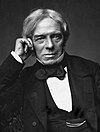
James Clerk Maxwell on Michael Faraday 3 quotes
“Faraday is, and must always remain, the father of that enlarged science of electro-magnetism.”
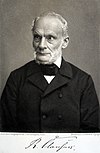
James Clerk Maxwell on Rudolf Clausius 3 quotes
“He opened up a new field of mathematical physics by shewing how to deal mathematically with moving systems of innumerable molecules.”
James Clerk Maxwell on René Descartes 3 quotes
“The primary property of matter was indeed distinctly announced by Descartes in what he calls the "First Law of Nature": "That every individual thing, so far as in it lies, perseveres in the same state, whether of motion or of rest."”

James Clerk Maxwell on Baruch Spinoza
“Descartes... fell back on his original confusion of matter with space—space being, according to him, the only form of substance, and all existing things but affections of space. This error... forms one of the ultimate foundations of the system of Spinoza.”

Quotes About James Clerk Maxwell
Gain deeper perspective through quotes about James Clerk Maxwell from others.
Anthea Callen on James Clerk Maxwell
“Pisarro explained the Neo-Impressionist theories to his dealer Durand-Ruel in a letter written towards the end of 1886. He stressed the importance of Seurat's role as inventor of the theory, and described the new function of colour, which replaced the mechanical mixtures of pigments with optical mixtures, where colours partially fused in the spectator's eye. The component parts of each optical colour mixture were to be painted in separate touches so that they retained their colour purity. When colours were mixed on the palette, they could only be combined with close neighbors on the colour circle, so as to avoid excessive dulling of the hues. Pissaro noted that the great colour theorists who had influenced Seurat's thinking were Chevreul, the Scott Maxwell, and the American Ogden Rood. Optical colour mixtures, they argued, were more luminous than mixed pigments.”
I. Bernard Cohen on James Clerk Maxwell
“The influence of Quetelet's ideas spread throughout the sciences, even to the physical sciences. The two primary founders of the modern kinetic theory of gases, based on considerations of probability, were James Clerk Maxwell and Ludwig Boltzmann. Both acknowledged their debt to Quetelet. ...historians generally consider the influence of the natural sciences on the social sciences, whereas in the case of Maxwell and Boltzmann, there is an influence of the social sciences on the natural sciences, as Theodore Porter has shown.”
A. D'Abro on James Clerk Maxwell 2 quotes
“In order to appreciate the nature of Maxwell's contributions , let us recall how matters stood in his day. ...Faraday's law of induction ...states that a variable magnetic field generates an electric field. Maxwell, however, considered that this law, standing alone, lacked symmetry; so he formulated the hypothesis that conversely a variable electric field should generate a magnetic one, and proceeded to construct his theory... no experimental results could be claimed to have justified any such assumption... His celebrated equations of electromagnetics represented, therefore, the results of experiment, supplemented by this additional hypothetical assumption. The advisability of making this hypothesis was accentuated when it was found to ensure the law of conservation of electricity. ...In the particular case of free space in which only fields but no charges or currents are present, Maxwell's equations of electromagnetics, termed field-equations (since they describe the state of the electromagnetic field), can be written:
where E represents electric field intensity, H magnetic field density, t denotes time, and c a most important constant... (2) represents Faraday's law of induction, while (4) constitutes the hypothetical law postulated by Maxwell... Prior to Maxwell's investigations the fourth equation would have been written "curl H = 0"...From his field equations, Maxwell... was able to deduce the two additional ones:
...these last two equations connote that varying electric and magnetic intensities will be propagated through the ether in wave form with a velocity c... This discovery removed all possibility of action at a distance, since the field perturbations now appeared to be propagated from place to place with a finite velocity. It was... of interest to determine the precise value of c. ...Physicists ...were unable, in Maxwell's day, to devise a means of performing such delicate experiments. ...Maxwell remarked that it would be given by the ratio of the magnitude of any electric charge, measured in terms of electrostatic units (based on electricity), and then of electromagnetic units (based on magnetism). If two magnetic poles of equal strength, situated in empty space... one centimetre apart, attract or repel each other with a force of one dyne, either pole is said to represent one unit of magnetic pole strength in the electromagnetic system of units. Owing to the interconnections between magnetism and electricity, we can deduce therefrom the unit of electric charge also in the electromagnetic system. Likewise, if two electric charges of equal strength... in empty space at a distance of one centimetre apart, attract or repel each other with a force of one dyne, either charge is said to represent one unit of electric charge in the electrostatic system of units. From this we can derive the unit of magnetic pole strength in the electrostatic system. Precise measurements... then proved that the value of this ratio was about 186,000 miles per second; whence it became necessary to assume that periodic perturbations in the strains and stresses of the field would be propagated in the form of waves moving through the ether with this particular speed. But this velocity was precisely that of light waves propagated through the luminiferous ether.”
Freeman Dyson on James Clerk Maxwell
“The first clear sign of a breakdown in communication between physics and mathematics was the extraordinary lack of interest among mathematicians in James Clerk Maxwell's discovery of the laws of electromagnetism. Maxwell discovered his equations, which describe the behavior of electric and magnetic fields under the most general conditions, in the year 1861, and published a clear and definitive statement of them in 1865. This was the great event of nineteenth century physics, achieving for electricity and magnetism what Newton had achieved for gravitation two hundred years earlier. Maxwell's equations contained, among other things, the explanation of light as an electromagnetic phenomenon, and the basic principles of electric power transmission and radio technology. ...But in addition to their physical applications, Maxwell's equations had abstract mathematical qualities which were profoundly new and important. Maxwell's theory was formulated in terms of a new style of mathematical concept, a tensor field extending throughout space and time and obeying coupled partial differential equations of peculiar symmetry. ...If they had taken Maxwell's equations to heart as Euler took Newton's, they would have discovered, among other things, Einstein's theory of special relativity, the theory of topological groups and their linear representations, and probably large pieces of the theory of hyperbolic differential equations and functional analysis. A great part of twentieth century physics and mathematics could have been created in the nineteenth century, simply by exploring to the end the mathematical concepts to which Maxwell's equations naturally lead.”

Albert Einstein on James Clerk Maxwell 3 quotes
“If the idea of physical reality had ceased to be purely atomic, it still remained for the time being purely mechanistic; people still tried to explain all events as the motion of inert masses; indeed no other way of looking at things seemed conceivable. Then came the great change, which will be associated for all time with the names of Faraday, Clerk Maxwell, and Hertz. The lion's share in this revolution fell to Clerk Maxwell. He showed that the whole of what was then known about light and electro-magnetic phenomena was expressed in his well known double system of differential equations, in which the electric and magnetic fields appear as the dependent variables. Maxwell did, indeed try to explain, or justify, these equations by intellectual constructions. But... the equations alone appeared as the essential thing and the strength of the fields as the ultimate entities, not to be reduced to anything else.”


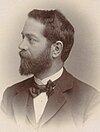


About James Clerk Maxwell
James Clerk Maxwell (13 June 1831 – 5 November 1879) was a Scottish mathematical physicist, who formulated the classical theory of electromagnetic radiation, bringing together for the first time electricity, magnetism, and light as manifestations of the same phenomenon.