Link Copied!
Irenaeus Quotes (200-20200)

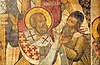
About Irenaeus
Irenaeus (early 2nd century – c. AD 202), also referred to as Saint Irenaeus, was Bishop of Lugdunum in Gaul, then a part of the Roman Empire (now Lyon, France). He was an early Church Father and apologist, and his writings were formative in the early development of Christian theology.
Best Irenaeus Quotes
Shortest
Earliest
Explore our curated collection of the most famous and impactful Irenaeus quotes.

“Wherefore also Luke, commencing the genealogy with the Lord, carried it back to Adam, indicating that it was He who regenerated them into the Gospel of life, and not they Him. And thus also it was that the knot of Eve’s disobedience was loosed by the obedience of Mary. For what the virgin Eve had bound fast through unbelief, this did the virgin Mary set free through faith.”

“The Lord has taught with very great fulness, that souls not only continue to exist, not by passing from body to body, but that they preserve the same form [in their separate state] as the body had to which they were adapted, and that they remember the deeds which they did in this state of existence, and from which they have now ceased, - in that narrative which is recorded respecting the rich man and that Lazarus who found repose in the bosom of Abraham [Luke 16:19ff].”
“Esaias says: “The wolf also shall feed with the lamb, and the leopard shall take his rest with the kid; the calf also, and the bull, and the lion shall eat together; and a little boy shall lead them. …” I am quite aware that some persons endeavour to refer these words to the case of savage men, both of different nations and various habits, who come to believe, and when they have believed, act in harmony with the righteous. But although this is [true] now with regard to some men coming from various nations to the harmony of the faith, nevertheless in the resurrection of the just [the words shall also apply] to those animals mentioned. For God is rich in all things. And it is right that when the creation is restored, all the animals should … revert to the food originally given by God … that is, the productions of the earth.”

“This expression [of our Lord], "How often would I have gathered thy children together, and thou wouldest not," [Matt 23:37] set forth the ancient law of human liberty, because God made man a free [agent] from the beginning, possessing his own power, even as he does his own soul, to obey the behests (ad utendum sententia) of God voluntarily, and not by compulsion of God.... And in man, as well as in angels, He has placed the power of choice (for angels are rational beings), so that those who had yielded obedience might justly possess what is good, given indeed by God, but preserved by themselves. On the other hand, they who have not obeyed shall, with justice, be not found in possession of the good, and shall receive condign punishment.... [4:37:5 p519f] And not merely in works, but also in faith, has God preserved the will of man free and under his own control, saying, "According to thy faith be it unto thee;" [Matt 9:29] thus showing that there is a faith specially belonging to man, since he has an opinion specially his own. And again, "All things are possible to him that believeth;" [Mark 9:23] and, "Go thy way; and as thou hast believed, so be it done unto thee." [Matt 8:13] Now all such expressions demonstrate that man is in his own power with respect to faith. And for this reason, "he that believeth in Him has eternal life while he who believeth not the Son hath not eternal life, but the wrath of God shall remain upon him." [John 3:36]”
Irenaeus Quotes by Topic
Find exactly what you are looking for by browsing this categorized list of Irenaeus quotes by topic.
Irenaeus on Truth 2 quotes
“It is not necessary to seek truth among others which it is easy to obtain from the Church.”

Irenaeus on Heresy
Irenaeus on Apostles
“Polycarp replied to Marcion, who met him on one occasion, and said, "Do you know me?" "I do know thee, first-born of Satan." Such was the horror of the apostles and their disciples had against holding even verbal communication with any corrupters of the truth.”
Irenaeus on Gospel of Judas
“[Some] declare that Cain derived his being from the Power above, and acknowledge that Esau, Korah, the Sodomites, and all such persons, are related to themselves. . .They declare that Judas the traitor was thoroughly acquainted with these things, and that he alone, knowing the truth as no others did, accomplished the mystery of the betrayal; by him all things, both earthly and heavenly, were thus thrown into confusion. They produce a fictional history of this kind, which they style the Gospel of Judas.”

Irenaeus on Christian vegetarianism
“Esaias says: “The wolf also shall feed with the lamb, and the leopard shall take his rest with the kid; the calf also, and the bull, and the lion shall eat together; and a little boy shall lead them. …” I am quite aware that some persons endeavour to refer these words to the case of savage men, both of different nations and various habits, who come to believe, and when they have believed, act in harmony with the righteous. But although this is [true] now with regard to some men coming from various nations to the harmony of the faith, nevertheless in the resurrection of the just [the words shall also apply] to those animals mentioned. For God is rich in all things. And it is right that when the creation is restored, all the animals should … revert to the food originally given by God … that is, the productions of the earth.”

Quotes About Irenaeus
Gain deeper perspective through quotes about Irenaeus from others.
Hans Jonas on Irenaeus
“[A] feature in the Valentinian account of creation is instructive regarding the much-debated question of the "Platonism" of the Gnostics. The world was created after the image of the invisible world of the Pleroma by a Demiurge carrying out unwittingly his mother's intention. His ignorance, however, was not complete, as is shown in the following...When the Demiurge further wanted to imitate the timeless nature of the upper Ogdoad (the original eight Aeons in the Pleroma), but could not express their immutable eternity, being as he was a fruit of defect, he embodied their eternity in the times, epochs, and great numbers of years, under the delusion that by the quantity of times he could represent their infinity. Thus truth escaped him and he followed the lie. Therefore his work shall pass away when the times are fulfilled. (Iren. I. 17. 2)This of course is a parody of the famous passage in the Timaeus (37 C ff.) where Plato describes the creation of time as "the moving image of eternity." The vast gulf that divides the spirit of this imitation will be evident to anyone who takes the trouble to compare the two passages.”
About Irenaeus
Irenaeus (early 2nd century – c. AD 202), also referred to as Saint Irenaeus, was Bishop of Lugdunum in Gaul, then a part of the Roman Empire (now Lyon, France). He was an early Church Father and apologist, and his writings were formative in the early development of Christian theology.