Link Copied!
Hyman G. Rickover Quotes (1900-1986)
Actor, Director

About Hyman G. Rickover
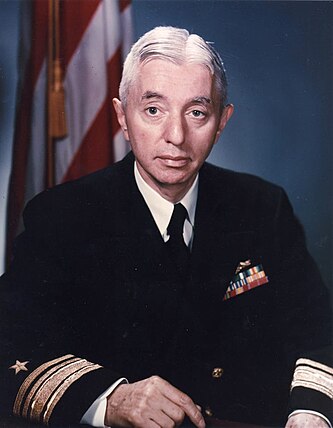
Hyman George Rickover, U.S. Navy (27 January 1900 – 8 July 1986) was a United States Navy admiral who directed the original development of naval nuclear propulsion and controlled its operations for three decades as director of Naval Reactors. Rickover built the world's first atomic power plant in only 4.5 years, starting as a Captain in 1950 and building a team that would beat other branches of the military and all private industry to the task by launching the world's first nuclear powered submarine in 1955. In addition, he oversaw the development of the Shippingport Atomic Power Station, the world's first commercial pressurized water reactor used for generating electricity. Rickover is known as the "Father of the Nuclear Navy".
Best Hyman G. Rickover Quotes
Shortest
Earliest
Explore our curated collection of the most famous and impactful Hyman G. Rickover quotes.


“Rickover management objectives:”

“Rickover management objectives:”


“Thoughts arising from practical experience may be a bridle or a spur.”

“If you are going to sin, sin against God, not the bureaucracy. God will forgive you but the bureaucracy won't.”

“Any one detail, followed through to its source, will usually reveal the general state of readiness of the whole organization.”

“Any one detail, followed through to its source, will usually reveal the general state of readiness of the whole organization.”
“Administration is, or ought to be, a necessary overhead to aid production, and should at all times be kept as low as possible.”



“Administration is, or ought to be, a necessary overhead to aid production, and should at all times be kept as low as possible.”

“Nothing so sharpens the thought process as writing down one's arguments. Weaknesses overlooked in oral discussion become painfully obvious on the written page.”
“Nothing so sharpens the thought process as writing down one's arguments. Weaknesses overlooked in oral discussion become painfully obvious on the written page.”
“To doubt one's own first principles is the mark of a civilized man. Don't defend past actions; what is right today may be wrong tomorrow. Don't be consistent; consistency is the refuge of fools.”

“Sit down before fact with an open mind. Be prepared to give up every preconceived notion. Follow humbly wherever and to whatever abyss Nature leads, or you learn nothing. Don't push out figures when facts are going in the opposite direction.”
“Yet it is incumbent on those in high places to make wise decisions and it is reasonable and important that the public be correctly informed. It is consequently incumbent on all of us to state the facts as forthrightly as possible.”
“They all have excellent resumes... So what I’m trying to find out is how they will behave under pressure. Will they lie, or bluff, or panic, or wilt? Or will they continue to function with some modicum of competence and integrity?”

Hyman G. Rickover Quotes by Topic
Find exactly what you are looking for by browsing this categorized list of Hyman G. Rickover quotes by topic.
Hyman G. Rickover on Manager 2 quotes
“It is a human inclination to hope things will work out, despite evidence or doubt to the contrary. A successful manager must resist this temptation.”

Hyman G. Rickover on Responsibility 2 quotes
“Responsibility is a unique concept... You may share it with others, but your portion is not diminished. You may delegate it, but it is still with you... If responsibility is rightfully yours, no evasion, or ignorance or passing the blame can shift the burden to someone else. Unless you can point your finger at the man who is responsible when something goes wrong, then you have never had anyone really responsible.”

Hyman G. Rickover on Optimism
Hyman G. Rickover on Bureaucracy
“If you are going to sin, sin against God, not the bureaucracy. God will forgive you but the bureaucracy won't.”
Hyman G. Rickover on Sin
“If you are going to sin, sin against God, not the bureaucracy. God will forgive you but the bureaucracy won't.”

Hyman G. Rickover on Organizational chart
“One must permit his people the freedom to seek added work and greater responsibility. In my organization, there are no formal job descriptions or organization charts. Responsibilities are defined in a general way, so that people are not circumscribed. All are permitted to do as they think best and to go to anyone and anywhere for help. Each person is then limited only by his own ability.”

Hyman G. Rickover on Quakers
“The Quakers have an excellent approach to thinking through difficult problems, where a number of intelligent and responsible people must work together. They meet as equals, and anyone who has an idea speaks up. There are no parliamentary procedures and no coercion from the Chair. They continue the discussion until unanimity is reached. I want you guys to do that. Get in a room with no phones and leave orders that you are not to be disturbed. And sit there until you can deal with each other as individuals, not as spokesmen for either organization.”

Hyman G. Rickover on Nuclear power
“A paper reactor [new reactor concept] has the following characteristics: it is simple; it is small; it is cheap; it is lightweight; it can be built very quickly; very little development is required and it will use off the shelf components; it is in the study phase and not being built now. By contrast a real reactor has the following characteristics: it is complicated; it is large; it is heavy; it is being built now; it is behind schedule; it requires an immense amount of development on apparently trivial items; it takes a long time to build because of its engineering development problems.”

Hyman G. Rickover on Engineering
“As a guide to engineering ethics, I should like to commend to you a liberal adaptation of the injunction contained in the oath of Hippocrates that the professional man do nothing that will harm his client. Since engineering is a profession which affects the material basis of everyone’s life, there is almost always an unconsulted third party involved in any contact between the engineer and those who employ him — and that is the country, the people as a whole. These, too, are the engineer’s clients, albeit involuntarily. Engineering ethics ought therefore to safeguard their interests most carefully. Knowing more about the public effects his work will have, the engineer ought to consider himself an “officer of the court” and keep the general interest always in mind.”
Hyman G. Rickover on Engineering ethics
“As a guide to engineering ethics, I should like to commend to you a liberal adaptation of the injunction contained in the oath of Hippocrates that the professional man do nothing that will harm his client. Since engineering is a profession which affects the material basis of everyone’s life, there is almost always an unconsulted third party involved in any contact between the engineer and those who employ him — and that is the country, the people as a whole. These, too, are the engineer’s clients, albeit involuntarily. Engineering ethics ought therefore to safeguard their interests most carefully. Knowing more about the public effects his work will have, the engineer ought to consider himself an “officer of the court” and keep the general interest always in mind.”

Hyman G. Rickover on Overpopulation
“Almost all of today’s low-energy countries have a population density so great that it perpetuates dependence on intensive manual agriculture which alone can yield barely enough food for their people. They do not have enough acreage, per capita, to justify using domestic animals or farm machinery, although better seeds, better soil management, and better hand tools could bring some improvement. A very large part of their working population must nevertheless remain on the land, and this limits the amount of surplus energy that can be produced. Most of these countries must choose between using this small energy surplus to raise their very low standard of living or [to] postpone present rewards for the sake of future gain by investing the surplus in new industries. The choice is difficult because there is no guarantee that today’s denial may not prove to have been in vain. This is so because of the rapidity with which public health measures have reduced mortality rates, resulting in population growth as high or even higher than that of the high-energy nations. Theirs is a bitter choice; it accounts for much of their anti-Western feeling and may well portend a prolonged period of world instability.”
Quotes About Hyman G. Rickover
Gain deeper perspective through quotes about Hyman G. Rickover from others.
This was the title of a book by Jimmy Carter sometimes misattributed as a quotation of Rickover on Hyman G. Rickover
Richard Nixon on Hyman G. Rickover
“I don't mean to suggest... that he is a man who is without controversy. He speaks his mind. Sometimes he has rivals who disagree with him; sometimes they are right, and he is the first to admit that sometimes he might be wrong. But the greatness of the American military service, and particularly the greatness of the Navy, is symbolized in this ceremony today, because this man, who is controversial, this man, who comes up with unorthodox ideas, did not become submerged by the bureaucracy, because once genius is submerged by bureaucracy, a nation is doomed to mediocrity.”

Misattributed Quotes
Quotes mistakenly credited to Hyman G. Rickover
About Hyman G. Rickover
Hyman George Rickover, U.S. Navy (27 January 1900 – 8 July 1986) was a United States Navy admiral who directed the original development of naval nuclear propulsion and controlled its operations for three decades as director of Naval Reactors. Rickover built the world's first atomic power plant in only 4.5 years, starting as a Captain in 1950 and building a team that would beat other branches of the military and all private industry to the task by launching the world's first nuclear powered submarine in 1955. In addition, he oversaw the development of the Shippingport Atomic Power Station, the world's first commercial pressurized water reactor used for generating electricity. Rickover is known as the "Father of the Nuclear Navy".