Link Copied!
Henry Clay Quotes (1777-1852)
Leader
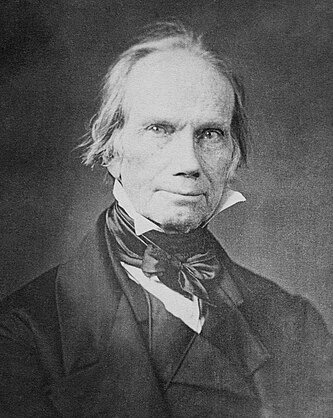













About Henry Clay
Henry Clay (12 April 1777 – 29 June 1852) was a leading American statesman and orator who served in both the House of Representatives and Senate. Known as "The Great Compromiser" and "The Great Pacifier" for his ability to bring others to agreement, he was the founder and leader of the Whig Party and a leading advocate of programs for modernizing the economy, especially tariffs to protect industry, a national bank and internal improvements to promote canals, ports and railroads.
Best Henry Clay Quotes
Shortest
Earliest
Explore our curated collection of the most famous and impactful Henry Clay quotes.

“If you wish to avoid foreign collision, you had better abandon the ocean.”

“An oppressed people are authorized, whenever they can, to rise and break their fetters.”
“I have no commiseration for princes. My sympathies are reserved for the great mass of mankind ….”
“All religions united with government are more or less inimical to liberty. All, separated from government, are compatible with liberty.”

“The gentleman cannot have forgotten his own sentiment, uttered even on the floor of this House, "Peaceably if we can, forcibly if we must."”
“Government is a trust, and the officers of the government are trustees; and both the trust and the trustees are created for the benefit of the people.”
“The Constitution of the United States was made not merely for the generation that then existed, but for posterity—unlimited, undefined, endless, perpetual posterity.”


“Whether we assert our rights by sea, or attempt their maintenance by land—whithersoever we turn ourselves, this phantom incessantly pursues us. Already has it had too much influence on the councils of the nation.”
“Precedents deliberately established by wise men are entitled to great weight. They are evidence of truth, but only evidence...But a solitary precedent...which has never been reexamined, cannot be conclusive.”
“I am not, sir, in favor of cherishing the passion of conquest. I am permitted … to indulge the hope of seeing, ere long, the new United States, (if you will allow me the expression,) embracing not only the old ….”
“We have had good and bad Presidents, and it is a consoling reflection that the American Nation possesses such elements of prosperity that the bad Presidents cannot destroy it, and have been able to do no more than slightly to retard the public's advancement.”
“Impart additional strength to our happy Union. Diversified as are the interests of its various parts, how admirably do they harmonize and blend together! We have only to make a proper use of the bounties spread before us, to render us prosperous and powerful.”
“In the little affairs of human life, whether social or national, I have found that courtesies, kindness, and small attentions are often received with more grateful feelings than those of a more substantial character. We often appreciate more the picayunes than the double eagles, in the currency of social and human life.”

“The great advantage of our system of government over all others, is, that we have a written constitution, defining its limits, and prescribing its authorities; and that, however, for a time, faction may convulse the nation, and passion and party prejudice sway its functionaries, the season of reflection will recur, when calmly retracing their deeds, all aberrations from fundamental principle will be corrected.”
“What is the nature of this government? It is emphatically federal, vested with an aggregate of special powers for general purposes, conceded by existing sovereignties, who have themselves retained what is not so conceded. It is said that there are cases in which it must act on implied powers. This is not controverted, but the implication must be necessary, and obviously flow from enumerated power with which it is allied.”
“My friends are not worth the powder and shot it would take to kill them!... If there were two Henry Clays, one of them would make the other President of the United States!... It is a diabolical intrigue, I know now, which has betrayed me. I am the most unfortunate man in the history of parties: always run by my friends when sure to be defeated, and now betrayed for a nomination when I, or any one, would be sure of an election.”
“In all cases where incidental powers are acted upon, the principal and incidental ought to be congenial with each other, and partake of a common nature. The incidental power ought to be strictly subordinate and limited to the end proposed to be obtained by the specified power. In other words, under the name of accomplishing one object which is specified, the power implied ought not to be made to embrace other objects, which are not specified in the constitution.”
“It consists in the genius of the nation, which is prone to peace; in that desire to arrange, by friendly negotiation, our disputes with all nations…. But a new state of things has arisen: negotiation has become hopeless. The power with whom it was to be conducted, if not annihilated, is in the situation that precludes it; and the subject-matter of it is in danger of being snatched forever from our power. Longer delay would be construed into a dereliction of our right, and would amount to a treachery to ourselves.”

“Sir, if you wish to avoid foreign commerce; give up all your prosperity. It is the thing protected, not the instrument of protection, that involves you in war. Commerce engenders collision, collision war, and war, the argument supposes, leads to despotism. Would the councils of that statesman be deemed who would recommend that the nation should be unarmed—that in the art of war, the material spirit, and martial exercises, should be prohibited—…—and that the great body of the people should be taught that the national happiness was to be found in perpetual peace alone? No, sir.”

“It is totally unnecessary for the gentleman to remind me of my coming from a slaveholding state. I know whence I came, and I know my duty, and I am ready to submit to any responsibility which belongs to me as a senator from a slaveholding state. I have heard something said on this and a former occasion about allegiance to the South. I know no South, no North, no East, no West, to which I owe any allegiance. I owe allegiance to two sovereignty, and only two: one is the sovereignty of this Union, and the other is the sovereignty of the state of Kentucky. My allegiance is to this Union and to my state; but if gentlemen suppose they can exact from me an acknowledgement of allegiance to any ideal or future contemplated confederacy of the South, I here declare that I owe no allegiance to it; nor will I, for one, come under any such allegiance if I can avoid it.”

Henry Clay Quotes by Topic
Find exactly what you are looking for by browsing this categorized list of Henry Clay quotes by topic.
Henry Clay on Revolution
“An oppressed people are authorized, whenever they can, to rise and break their fetters.”

Henry Clay on Character
Henry Clay on Criticism
Henry Clay on Prayer
Henry Clay on Patriotism
“I have heard something said about allegiance to the South: I know no South, no North, no East, no West, to which I owe any allegiance.”

Henry Clay on United States Constitution
“The Constitution was not made merely for the generation that then existed, but for posterity — unlimited, undefined, endless, perpetual posterity.”

Henry Clay on Public trust
“Government is a trust, and the officers of the government are trustees; and both the trust and the trustees are created for the benefit of the people.”

Henry Clay on Peace
“The gentleman [Josiah Quincy] cannot have forgotten his own sentiment, uttered even on the floor of this House, "Peaceably if we can, forcibly if we must."”

Henry Clay on Fidelity
Henry Clay on Freedom
What Henry Clay Said About Others
Discover personal opinions Henry Clay shared regarding contemporaries.
Henry Clay on William Tecumseh Sherman 3 quotes
“Hurrah! Hurrah! we bring the Jubilee! Hurrah! Hurrah! the flag that makes you free!" So we sang the chorus from Atlanta to the sea, While we were marching through Georgia.”

About Henry Clay
Henry Clay (12 April 1777 – 29 June 1852) was a leading American statesman and orator who served in both the House of Representatives and Senate. Known as "The Great Compromiser" and "The Great Pacifier" for his ability to bring others to agreement, he was the founder and leader of the Whig Party and a leading advocate of programs for modernizing the economy, especially tariffs to protect industry, a national bank and internal improvements to promote canals, ports and railroads.