Gustave de Molinari Quotes (1819-1912)

About Gustave de Molinari

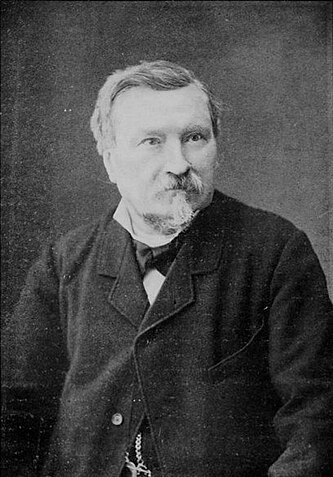
Gustave de Molinari (3 March 1819 – 28 January 1912) was a Belgian political economist and classical liberal theorist.

Best Gustave de Molinari Quotes

Shortest
Earliest

Explore our curated collection of the most famous and impactful Gustave de Molinari quotes.

“The interests of the consumer of any commodity whatsoever should always prevail over the interests of the producer.”
Gustave de Molinari
“The production of security should, in the interests of the consumers of this intangible commodity, remain subject to the law of free competition.”
Gustave de Molinari
“Whether communism is partial or complete, political economy is no more tolerant of it than it is of monopoly, of which it is merely an extension.”
Gustave de Molinari
“The moral foundation of authority is neither as solid nor as wide, under a regime of monopoly or of communism, as it could be under a regime of liberty.”
“No government should have the right to prevent another government from going into competition with it, or to require consumers of security to come exclusively to it for this commodity.”
Gustave de Molinari
“Everywhere, men resign themselves to the most extreme sacrifices rather than do without government and hence security, without realizing that in so doing, they misjudge their alternatives.”
“The moral authority of governors rests, in reality, on the self-interest of the governed.  The latter having a natural tendency to resist anything harmful to their self-interest, unacknowledged authority would continually require the help of physical force.”
Gustave de Molinari
“Either communistic production is superior to free production, or it is not.

If it is, then it must be for all things, not just for security.

If not, progress requires that it be replaced by free production.

Complete communism or complete liberty: that is the alternative!”

Gustave de Molinari
“But why should there be an exception relative to security?  What special reason is there that the production of security cannot be relegated to free competition?  Why should it be subjected to a different principle and organized according to a different system?”
Gustave de Molinari
“In all cases, for all commodities that serve to provide for the tangible or intangible needs of the consumer, it is in the consumer's best interest that labor and trade remain free, because the freedom of labor and of trade have as their necessary and permanent result the maximum reduction of price.”
Gustave de Molinari
“The production of security should, in the interests of the consumers of this intangible commodity, remain subject to the law of free competition.  …  [N]o government should have the right to prevent another government from going into competition with it, or to require consumers of security to come exclusively to it for this commodity.”
Gustave de Molinari
“In the entire world, there is not a single establishment of the security industry that is not based on monopoly or on communism.  […]  Political economy has disapproved equally of monopoly and communism in the various branches of human activity, wherever it has found them.  Is it not then strange and unreasonable that it accepts them in the security industry?”
Gustave de Molinari
“If one takes the thought into one's head that the leaders of the people do not receive their inspirations directly from providence itself, that they obey purely human impulses, the prestige that surrounds them will disappear.  One will irreverently resist their sovereign decisions, as one resists anything man-made whose utility has not been clearly demonstrated.”
“Suppose that a man found his person and his means of survival incessantly menaced […]

Even though this man might be asked to surrender a very considerable portion of his time and of his labor to someone who takes it upon himself to guarantee the peaceful possession of his person and his goods, wouldn't it be to his advantage to conclude this bargain?

Still, it would obviously be no less in his self-interest to procure his security at the lowest price possible.”

Gustave de Molinari
“Because one fine day they took it into their heads to question and to reason, and in questioning, in reasoning, they discovered that their governors governed them no better than they, simpl[e] mortals out of communication with Providence, could have done themselves.

It was free inquiry that demonetized the fiction of divine right, to the point where the subjects of monarchs or of aristocracies based on divine right obey them only insofar as they think it in their own self-interest to obey them.”

“It offends reason to believe that a well-established natural law can admit of exceptions.  A natural law must hold everywhere and always, or be invalid.  I cannot believe, for example, that the universal law of gravitation, which governs the physical world, is ever suspended in any instance or at any point of the universe.  Now I consider economic laws comparable to natural laws, and I have just as much faith in the principle of the division of labor as I have in the universal law of gravitation.  I believe that while these principles can be disturbed, they admit of no exceptions.”
Gustave de Molinari
“If there is one well-established truth in political economy, it is this:
That in all cases, for all commodities that serve to provide for the tangible or intangible needs of the consumer, it is in the consumer’s best interest that labor and trade remain free, because the freedom of labor and of trade have as their necessary and permanent result the maximum reduction of price.
... Whence it follows:
That no government should have the right to prevent another government from going into competition with it, or to require consumers of security to come exclusively to it for this commodity.”
Gustave de Molinari
“A careful examination of the facts will decide the problem of government more and more in favor of liberty, just as it does all other economic problems.  We are convinced, so far as we are concerned, that one day societies will be established to agitate for the freedom of government, as they have already been established on behalf of the freedom of commerce.

And we do not hesitate to add that after this reform has been achieved, and all artificial obstacles to the free action of the natural laws that govern the economic world have disappeared, the situation of the various members of society will become the best possible.”

Gustave de Molinari
“Under the rule of free competition, war between the producers of security entirely loses its justification.  Why would they make war?  To conquer consumers?  But the consumers would not allow themselves to be conquered.  They would be careful not to allow themselves to be protected by men who would unscrupulously attack the persons and property of their rivals.  If some audacious conqueror tried to become dictator, they would immediately call to their aid all the free consumers menaced by this aggression, and they would treat him as he deserved.  Just as war is the natural consequence of monopoly, peace is the natural consequence of liberty.”
“Everywhere, when societies originate, we see the strongest, most warlike races seizing the exclusive government of the society.  Everywhere we see these races seizing a monopoly on security within certain more or less extensive boundaries, depending on their number and strength.

And, this monopoly being, by its very nature, extraordinarily profitable, everywhere we see the races invested with the monopoly on security devoting themselves to bitter struggles, in order to add to the extent of their market, the number of their forced consumers, and hence the amount of their gains.

War has been the necessary and inevitable consequence of the establishment of a monopoly on security.

Another inevitable consequence has been that this monopoly has engendered all other monopolies.”

Gustave de Molinari
“Everywhere, when societies originate, we see the strongest, most warlike races seizing the exclusive government of the society.  Everywhere we see these races seizing a monopoly on security within certain more or less extensive boundaries, depending on their number and strength.

And, this monopoly being, by its very nature, extraordinarily profitable, everywhere we see the races invested with the monopoly on security devoting themselves to bitter struggles, in order to add to the extent of their market, the number of their forced consumers, and hence the amount of their gains.

War has been the necessary and inevitable consequence of the establishment of a monopoly on security.

Another inevitable consequence has been that this monopoly has engendered all other monopolies.”

Gustave de Molinari
“This option the consumer retains of being able to buy security wherever he pleases brings about a constant emulation among all the producers, each producer striving to maintain or augment his clientele with the attraction of cheapness or of faster, more complete and better justice.

If, on the contrary, the consumer is not free to buy security wherever he pleases, you forthwith see open up a large profession dedicated to arbitrariness and bad management.  Justice becomes slow and costly, the police vexatious, individual liberty is no longer respected, the price of security is abusively inflated and inequitably apportioned, according to the power and influence of this or that class of consumers.  The protectors engage in bitter struggles to wrest customers from one another.  In a word, all the abuses inherent in monopoly or in communism crop up.”

Gustave de Molinari
“There are two ways of considering society.  According to some, the development of human associations is not subject to providential, unchangeable laws.  Rather, these associations, having originally been organized in a purely artificial manner by primeval legislators, can later be modified or remade by other legislators, in step with the progress of social science.  In this system the government plays a preeminent role, because it is upon it, the custodian of the principle of authority, that the daily task of modifying and remaking society devolves.

According to others, on the contrary, society is a purely natural fact.  Like the earth on which it stands, society moves in accordance with general, preexisting laws.  In this system, there is no such thing, strictly speaking, as social science; there is only economic science, which studies the natural organism of society and shows how this organism functions.”

Gustave de Molinari
“Man experiences a multitude of needs, on whose satisfaction his happiness depends, and whose non-satisfaction entails suffering.  Alone and isolated, he could only provide in an incomplete, insufficient manner for these incessant needs.  The instinct of sociability brings him together with similar persons, and drives him into communication with them.  Therefore, impelled by the self-interest of the individuals thus brought together, a certain division of labor is established, necessarily followed by exchanges.  In brief, we see an organization emerge, by means of which man can more completely satisfy his needs than he could living in isolation.

This natural organization is called society.

The object of society is therefore the most complete satisfaction of man's needs.  The division of labor and exchange are the means by which this is accomplished.”

Gustave de Molinari

Gustave de Molinari Quotes by Topic

Find exactly what you are looking for by browsing this categorized list of Gustave de Molinari quotes by topic.

Gustave de Molinari on Security 6 quotes

“But why should there be an exception relative to security?  What special reason is there that the production of security cannot be relegated to free competition?  Why should it be subjected to a different principle and organized according to a different system?”
Gustave de Molinari
View all 6 quotes on Security →

Gustave de Molinari on Divine right of kings 2 quotes

“Le libre examen a démonétisé la fiction du droit divin, à ce point que les sujets des monarques ou des aristocraties de droit divin ne leur obéissent plus qu’autant qu’ils croient avoir intérêt à leur obéir.”
Gustave de Molinari
View all 2 quotes on Divine right of kings →

Gustave de Molinari on Society 2 quotes

“Man experiences a multitude of needs, on whose satisfaction his happiness depends, and whose non-satisfaction entails suffering.  Alone and isolated, he could only provide in an incomplete, insufficient manner for these incessant needs.  The instinct of sociability brings him together with similar persons, and drives him into communication with them.  Therefore, impelled by the self-interest of the individuals thus brought together, a certain division of labor is established, necessarily followed by exchanges.  In brief, we see an organization emerge, by means of which man can more completely satisfy his needs than he could living in isolation.This natural organization is called society.The object of society is therefore the most complete satisfaction of man's needs.  The division of labor and exchange are the means by which this is accomplished.”
Gustave de Molinari
View all 2 quotes on Society →

Gustave de Molinari on Price

“[I]n all cases, for all commodities that serve to provide for the tangible or intangible needs of the consumer, it is in the consumer's best interest that labor and trade remain free, because the freedom of labor and of trade have as their necessary and permanent result the maximum reduction of price.”
Gustave de Molinari

Gustave de Molinari on Competition

“The production of security should, in the interests of the consumers of this intangible commodity, remain subject to the law of free competition. ... No government should have the right to prevent another government from going into competition with it, or to require consumers of security to come exclusively to it for this commodity.”
Gustave de Molinari

Gustave de Molinari on Political economy
“If there is one well-established truth in political economy, it is this: That in all cases, for all commodities that serve to provide for the tangible or intangible needs of the consumer, it is in the consumer’s best interest that labor and trade remain free, because the freedom of labor and of trade have as their necessary and permanent result the maximum reduction of price. ... Whence it follows: That no government should have the right to prevent another government from going into competition with it, or to require consumers of security to come exclusively to it for this commodity.”
Gustave de Molinari

Gustave de Molinari on Natural law

“It offends reason to believe that a well-established natural law can admit of exceptions.  A natural law must hold everywhere and always, or be invalid.  I cannot believe, for example, that the universal law of gravitation, which governs the physical world, is ever suspended in any instance or at any point of the universe.  Now I consider economic laws comparable to natural laws, and I have just as much faith in the principle of the division of labor as I have in the universal law of gravitation.  I believe that while these principles can be disturbed, they admit of no exceptions.”
Gustave de Molinari

Gustave de Molinari on Gravity

“It offends reason to believe that a well-established natural law can admit of exceptions.  A natural law must hold everywhere and always, or be invalid.  I cannot believe, for example, that the universal law of gravitation, which governs the physical world, is ever suspended in any instance or at any point of the universe.  Now I consider economic laws comparable to natural laws, and I have just as much faith in the principle of the division of labor as I have in the universal law of gravitation.  I believe that while these principles can be disturbed, they admit of no exceptions.”
Gustave de Molinari

Gustave de Molinari on War and peace

“Sous le régime de la libre concurrence, la guerre entre les producteurs de sécurité cesse totalement d’avoir sa raison d’être.  Pourquoi se feraient-ils la guerre ?  Pour conquérir des consommateurs ?  Mais les consommateurs ne se laisseraient pas conquérir.  Ils se garderaient certainement de faire assurer leurs personnes et leurs propriétés par des hommes qui auraient attenté, sans scrupule, aux personnes et aux propriétés de leurs concurrents.  Si un audacieux vainqueur voulait leur imposer la loi, ils appelleraient immédiatement à leur aide tous les consommateurs libres que menacerait comme eux cette agression, et ils en feraient justice.  De même que la guerre est la conséquence naturelle du monopole, la paix est la conséquence naturelle de la liberté.”
Gustave de Molinari

Gustave de Molinari on War

“Partout, à l’origine des sociétés, on voit donc les races les plus fortes, les plus guerrières, s’attribuer le gouvernement exclusif des sociétés ; partout on voit ces races s’attribuer, dans certaines circonscriptions plus ou moins étendues, selon leur nombre et leur force, le monopole de la sécurité.Et, ce monopole étant excessivement profitable par sa nature même, partout on voit aussi les races investies du monopole de la sécurité se livrer à des luttes acharnées, afin d’augmenter l’étendue de leur marché, le nombre de leurs consommateurs forcés, partant la quotité de leurs bénéfices.La guerre était la conséquence nécessaire, inévitable de l’établissement du monopole de la sécurité.Comme une autre conséquence inévitable, ce monopole devait engendrer tous les autres monopoles.”
Gustave de Molinari

Gustave de Molinari on Division of labor
“Man experiences a multitude of needs, on whose satisfaction his happiness depends, and whose non-satisfaction entails suffering. Alone and isolated, he could only provide in an incomplete, insufficient manner for these incessant needs. The instinct of sociability brings him together with similar persons, and drives him into communication with them.& Therefore, impelled by the self-interest of the individuals thus brought together, a certain Division of labor is established, necessarily followed by exchanges. In brief, we see an organization emerge, by means of which man can more completely satisfy his needs than he could living in isolation.This natural organization is called society.The object of society is therefore the most complete satisfaction of man's needs.& The Division of labor and exchange are the means by which this is accomplished.”
Gustave de Molinari

Gustave de Molinari on Organization

“Man experiences a multitude of needs, on whose satisfaction his happiness depends, and whose non-satisfaction entails suffering.  Alone and isolated, he could only provide in an incomplete, insufficient manner for these incessant needs.  The instinct of sociability brings him together with similar persons, and drives him into communication with them.  Therefore, impelled by the self-interest of the individuals thus brought together, a certain division of labor is established, necessarily followed by exchanges.  In brief, we see an organization emerge, by means of which man can more completely satisfy his needs than he could living in isolation.This natural organization is called society. The object of society is therefore the most complete satisfaction of man's needs.  The division of labor and exchange are the means by which this is accomplished.”
Gustave de Molinari

Gustave de Molinari on Social science

“There are two ways of considering society.  According to some, the development of human associations is not subject to providential, unchangeable laws.  Rather, these associations, having originally been organized in a purely artificial manner by primeval legislators, can later be modified or remade by other legislators, in step with the progress of social science.  In this system the government plays a preeminent role, because it is upon it, the custodian of the principle of authority, that the daily task of modifying and remaking society devolves.According to others, on the contrary, society is a purely natural fact.  Like the earth on which it stands, society moves in accordance with general, preexisting laws.  In this system, there is no such thing, strictly speaking, as social science; there is only economic science, which studies the natural organism of society and shows how this organism functions.”
Gustave de Molinari

Gustave de Molinari on Communism

“If the roused and insurgent consumers secure the means of production of the salt industry, in all probability they will confiscate this industry for their own profit, and their first thought will be, not to relegate it to free competition, but rather to exploit it, in common, for their own account.  They will then name a director or a directive committee to operate the saltworks, to whom they will allocate the funds necessary to defray the costs of salt production.  Then, since the experience of the past will have made them suspicious and distrustful, since they will be afraid that the director named by them will seize production for his own benefit, and simply reconstitute by open or hidden means the old monopoly for his own profit, they will elect delegates, representatives entrusted with appropriating the funds necessary for production, with watching over their use, and with making sure that the salt produced is equally distributed to those entitled to it.  The production of salt will be organized in this manner.This form of the organization of production has been named communism.When this organization is applied to a single commodity, the communism is said to be partial.When it is applied to all commodities, the communism is said to be complete.But whether communism is partial or complete, political economy is no more tolerant of it than it is of monopoly, of which it is merely an extension.”
Gustave de Molinari

Quotes About Gustave de Molinari

Gain deeper perspective through quotes about Gustave de Molinari from others.

Yves Guyot on Gustave de Molinari

“M. de Molinari had a very true and penetrating perception of events. M. de Molinari believed that the writer's task is to spare the reader any effort, by giving him a task already completed. M. de Molinari belonged to what philanthropists and sentimental socialists call the "stern" school, as though science could have any other purpose than that of seeking after truth.  As a man he was tender-hearted. M. de Molinari had but one preoccupation: the pursuit of truth.  He never subordinated truth to considerations of success.  He never upheld an opinion for-the sake of pleasing such or such a person. M. de Molinari was, above all, an economist, and he made everything converge toward economic questions.  Liberty and property, he said, are related to the economic phenomena of value.  Value is the object of liberty and the substance of property.  […]  He knew how to find impressive and profound formulae which grafted themselves on one's memory, as, for instance, "An interest can only be vanquished by a stronger interest."”

Ludwig Von Mises on Gustave de Molinari

“Only his early death had prevented Frédéric Bastiat from writing a treatise on “social harmonies” — as a follow-up work on his Economic Harmonies (1850). But his follower Gustave de Molinari published a great number of monographs dealing with virtually all of the contemporary social and political problems of France, as well as with fundamental problems of social interpretation and with the sociology of religion. His writings had a decisive impact on one of the greatest champions of the new marginal-utility approach. The Italian economist Vilfredo Pareto was a disciple of Léon Walras and a great admirer of Gustave de Molinari. Right from his first systematic exposition of economic science in Cours d'Economie Politique (1896), Pareto applied Walrasian techniques of analysis to Molinarian themes. He applied marginal-utility theory and the theory of general equilibrium to explain spoliation, aristocracy and the circulation of elites, economic interests and class struggle, and the relationship between doctrines and social science.”
Gustave de Molinari

Murray Rothbard on Gustave de Molinari 2 quotes

“The most "extreme" and consistent, as well as the longest-lived and most prolific of the French laissez-faire economists was the Belgian-born Gustave de Molinari (1819–1912), who edited the Journal des Economistes for several decades.”
Gustave de Molinari
View all 2 quotes on Murray Rothbard →

Ralph Raico on Gustave de Molinari

“The dean of the laissez-faire French economists in the last decades of the nineteenth century and virtually until his death in 1911 was the Belgian-born Gustave de Molinari. Molinari is most famous for his doctrine of “competing governments” — he has been called “the first anarcho-capitalist” — and while he allegedly modified his position in later years, there is no doubt that he was always an unbending advocate of laissez-faire.”

About Gustave de Molinari

Gustave de Molinari (3 March 1819 – 28 January 1912) was a Belgian political economist and classical liberal theorist.