Gerald James Whitrow on Spacetime
← Back to Gerald James Whitrow Profile
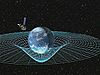
“Space-time is curved in the neighborhood of material masses, but it is not clear whether the presence of matter causes the curvature of space-time or whether this curvature is itself responsible for the existence of matter.”
“With regard to the Newtonian concept of absolute rotation, Eddington admitted that Einstein's plenum does in fact provide a world-wide inertial frame, with respect to which it can be measured. Nevertheless, Eddington believed that Einstein attributed to important a role to matter, for in his universe it appears that not only the metrical properties, as in General Relativity, but the very existence of space depends on the existence of matter. Eddington preferred to regard matter as a manifestation of the 'structure' of space-time.”
“In 1908 the famous mathematician Minkowski made a remarkable discovery concerning the Lorentz formulae. He showed that, although each observer had his own private space and private time, a public concept which is the same for all observers can be formed by combining space and time in a particular way. If we regard an inverval of time as a kind of 'distance' in the time dimension, we can convert it into a true distance by multiplying it by the velocity of light, c; in other words, with any time interval we can associate a definite spatial interval, namely the distance which light can travel in empty space in that period. If, according to a particular observer, the difference in time between any two events is T, this associated spatial interval is cT. Then, if R is the space-distance between these two events, Minkowski showed that the difference of the squares of cT and R has the same value for all observers in uniform relative motion. The square root of this quantity is called the space-time interval between the two events. Hence, although time and three-dimensional space depend on the observer, this new concept of space-time is the same for all observers.”
“Shortly after Einstein published his original memoir... de Sitter constructed an alternative static world-model... unlike Einstein's, space-time has an intrinsic structure of its own, independent of the presence of matter. ...there is, strictly speaking, no matter or radiation. ...whereas a test particle in Einstein's universe will remain at rest if it has no initial motion, a similar particle introduced in de Sitter's world will immediately acquire an ever-increasing velocity of recession from the observer. Moreover, in de Sitter's model, space-time is 'hyperbolic'. There is no absolute time, and each observer will perceive a horizon at which time will appear to him to stand still. ...This phenomenon. of course, is only apparent, like a rainbow. At any point on the (relative) horizon the time-flux experienced by an observer there will be the same as the original observer. Thus in de Sitter's world there will be an apparent slowing-down of distant atomic vibrations, if these keep standard time. Consequently the radiation from a distant nebula will appear to be shifted toward the red... This effect, of course, will be supplemented by the Doppler effect, due to the relative recession of the nebula regarded as a test particle.”