Link Copied!
George Lucas Quotes (1944-)
Writer, Director, Producer



-100px.jpg)


About George Lucas
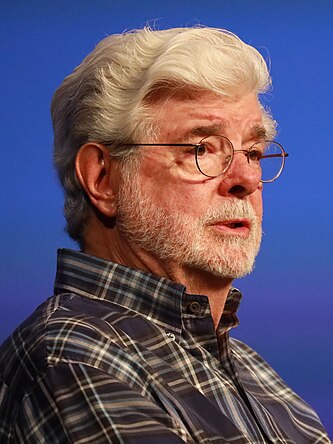
George Walton Lucas Jr. (born 14 May 1944) is an American film director, producer, screenwriter, and entrepreneur, most famous for the Star Wars and Indiana Jones trilogies.
Best George Lucas Quotes
Shortest
Earliest
Explore our curated collection of the most famous and impactful George Lucas quotes.
“It's Star Wars starring an eleven-year-old girl”
“Being in Washington is more fictional than being in Hollywood.”

“Anakin Skywalker has a Padawan.
Anakin has a Padawan.”
Anakin has a Padawan.”
“No, I like my own characters. I want to get Anakin and Obi-Wan in. I want to give Anakin a padawan
Let's take that girl there.”
Let's take that girl there.”
“The Johnson film wasn't terrible. I just didn't agree with the politics. I'm not a fan of big government and propaganda films are distasteful.”

“Sound is half the experience of seeing a film. That's why I have been bothered by the poor sound re-production in many theaters and most homes.”

“There is no Episode VII...Not about Luke Skywalker, not about, you know, that group of people and that struggle to bring democracy back to the galaxy.”

“One of the amazing things about 'Seven Samurai' is that there are a lot of characters. And considering you have so many, and they all have shaved heads, and you've got good guys and bad guys and peasants, you get to understand a lot of them without too much being said.”

“It was insane, I wish I had filmed it. It was like bringing an audience to the Mona Lisa and asking, 'Do you know why she is smiling?' 'Sorry Leonardo, you'll have to make some changes.' At least the audience understood that THX was not a love story set in the 25th-century, which was the way Warners had planned to advertise it. Instead, the company settled for 'Visit the future, where love is the ultimate crime.'”

“My primary concept in approaching the production of THX 1138 was to make a kind of theater verité film of the future — something that would look like a documentary crew had made a film about some character in a time yet to come.
No film ever ends up exactly as you would like it to, but with minor exceptions, THX came out pretty much as I had visualized it, thanks to some excellent assistance — and a whole lot of luck.”
No film ever ends up exactly as you would like it to, but with minor exceptions, THX came out pretty much as I had visualized it, thanks to some excellent assistance — and a whole lot of luck.”
“Everybody has the choice of being a hero or not being a hero every day of their lives … and you can either help somebody, you can be compassionate toward people, you can treat some people with dignity — or not. And … one way you become a hero, and the other way … you’re part of the problem. And … it’s not a grand thing, you know; you don’t have to get into a giant laser-sword fight and blow up three spaceships to become a hero. I mean — it’s a very small thing that happens every day of your life.”
“In the world we live in - and the system we've created for ourselves, in terms of it's a big industry - you cannot lose money. So the point is that you're forced to make a particular kind of movie. And I used to say this all the time, with people, you know, back when Russia was the Union of Soviet Socialist Republics, and they'd say: "Oh, but aren’t you so glad that you're in America?" And I'd say: "Well, I know a lot of Russian filmmakers and they have a lot more freedom than I have. All they have to do is be careful about criticizing the government. Otherwise, they can do anything they want".”
“Pleasure's fun. It's great, but you can't keep it going forever; just accept the fact that it's here and it's gone, and maybe then again, it will come back, and you'll get to do it again. Joy lasts forever. Pleasure is purely self-centered. It's all about your pleasure: it's about you. It's a selfish, self-centered emotion, that is created by a self-centered motive of greed. Joy is compassion. Joy is giving yourself to somebody else, or something'' else. And it's a kind of thing that is, in its subtlety and lowness, much more powerful than pleasure. You get hung up on pleasure; you're doomed. If you pursue joy; you will find everlasting happiness.”

“He could have known this little girl when she was just a kid. Had an affair with her when she was eleven. … He hasn’t seen her in twelve years. Now she’s twenty-two. It’s a really strange relationship. …This is a resource that you can either mine or not. It's not as blatant as we're talking about. You don't think about it that much. You don't immediately realize how old she was at the time. It would be subtle. She could talk about it. "I was jail bait the last time we were together." She can flaunt it at him, but at the same time she never says, "I was fifteen years old." Even if we don't mention it, when we go to cast the part we're going to end up with a woman who's about twenty-three and a hero who's about thirty- five.”
“We say, 'We think you are a talented, functioning person, and we are hiring you because of your abilities, and whatever you come up with, we're going to take.' If we make a mistake, it will be in picking the wrong person. What we're striving for is total freedom, where we can finance our pictures, make them our way, release them where we want them released and be completely free to express ourselves. That's very hard to do in the world of business. In this country, the only thing that speaks is money and you have to have the money to have the power to be free. So the danger is — in being as oppressive as the next guy to the people below you. We're going to do everything possible to avoid that pitfall. But if we fail, it's another saga in the history of man...”
“As you go through history, I didn't think it was going to get quite this close. So it's just one of those recurring things… I hope this doesn't come true in our country. Maybe the film will wake people to the situation. … When I wrote it [Star Wars Episode III: Revenge of the Sith], Iraq didn't exist… We were just funding Saddam Hussein and giving him weapons of mass destruction. We didn't think of him as an enemy at that time. We were going after Iran and using him as our surrogate, just as we were doing in Vietnam… The parallels between what we did in Vietnam and what we're doing in Iraq now are unbelievable…
[In ancient Rome,] why did the senate after killing Caesar turn around and give the government to his nephew? Why did France after they got rid of the king and that whole system turn around and give it to Napoleon? It's the same thing with Germany and Hitler. … You sort of see these recurring themes where a democracy turns itself into a dictatorship, and it always seems to happen kind of in the same way, with the same kinds of issues, and threats from the outside, needing more control. A democratic body, a senate, not being able to function properly because everybody's squabbling, there's corruption.”
[In ancient Rome,] why did the senate after killing Caesar turn around and give the government to his nephew? Why did France after they got rid of the king and that whole system turn around and give it to Napoleon? It's the same thing with Germany and Hitler. … You sort of see these recurring themes where a democracy turns itself into a dictatorship, and it always seems to happen kind of in the same way, with the same kinds of issues, and threats from the outside, needing more control. A democratic body, a senate, not being able to function properly because everybody's squabbling, there's corruption.”
“One of the fatal mistakes that almost every science-fiction film makes is that they spend so much time on the settings — you know, creating the environment — that they spend film time on it. And you don't have to spend too much film time to create an environment. What they're doing is showing off the amount of work that they generated, and it slows the pace of the film down. And the story is not the settings. The story is the stories, plot. You're always surprised with characters, I mean in film it's even more dramatic than it is in writing, because eventually you actually take a real person and stick them into that character. And that real person brings with him, or her, an enormous package of reality. I mean, Threepio is just a hunk of plastic, and without Tony Daniels in there it just isn't anything at all. In the first film we had maybe 20 colors to paint with, and this time we've had 40 colors to paint with. Well, that doesn't mean it's going to be a better painting. Visual effects are just a tool, a means of telling a story. People tend to confuse them as an end to themselves. A visual effect without a story is a pretty boring thing.”

George Lucas Quotes by Topic
Find exactly what you are looking for by browsing this categorized list of George Lucas quotes by topic.
George Lucas on Star Wars 8 quotes
“Without Ray Harryhausen, there would likely have been no Star Wars.”

George Lucas on Star Wars: Episode I – The Phantom Menace 4 quotes
View all 4 quotes on Star Wars: Episode I – The Phantom Menace →George Lucas on Star Wars: Episode III – Revenge of the Sith 3 quotes
“We knew that Padmé was going to be pregnant through the whole film, and nobody in the outside world could know that. Because she's pregnant, I wanted a soft quality to be apparent in the fabrics that were used.”
George Lucas on Star Wars (film) 3 quotes
“My main reason for making it was to give young people an honest, wholesome fantasy life, the kind my generation had. We had westerns, pirate movies, all kinds of great things. Now they have The Six Million Dollar Man and Kojak. Where are the romance, the adventure, and the fun that used to be in practically every movie made?”
-100px.jpg)
George Lucas on Star Wars: Episode II – Attack of the Clones 2 quotes
“When I wrote [the backstory/Clone Wars], Iraq didn't exist.”
What George Lucas Said About Others
Discover personal opinions George Lucas shared regarding contemporaries.
George Lucas on Indiana Jones
“Lucas: A bounty hunter of antiquities.
Spielberg: I like that. The doctor with the bullwhip.
Lucas: It has to be unique. It’s a character. Very Americana. Square. He was born in Indiana.
Kasdan: What does she call him, Indy?
Lucas: That’s what I was thinking. Or Jones.”

George Lucas on Saddam Hussein
“As you go through history, I didn't think it was going to get quite this close. So it's just one of those recurring things… I hope this doesn't come true in our country. Maybe the film will waken people to the situation. … When I wrote it [Star Wars Episode III: Revenge of the Sith], Iraq didn't exist… We were just funding Saddam Hussein and giving him weapons of mass destruction. We didn't think of him as an enemy at that time. We were going after Iran and using him as our surrogate, just as we were doing in Vietnam… The parallels between what we did in Vietnam and what we're doing in Iraq now are unbelievable…[In ancient Rome,] why did the senate after killing Caesar turn around and give the government to his nephew? Why did France after they got rid of the king and that whole system turn around and give it to Napoleon? It's the same thing with Germany and Hitler. … You sort of see these recurring themes where a democracy turns itself into a dictatorship, and it always seems to happen kind of in the same way, with the same kinds of issues, and threats from the outside, needing more control. A democratic body, a senate, not being able to function properly because everybody's squabbling, there's corruption.”

Quotes About George Lucas
Gain deeper perspective through quotes about George Lucas from others.
Carrie Fisher on George Lucas
“[P]eople are still asking me if I knew Star Wars was going to be that big of a hit. Yes, of course I knew. We all knew. The only one who didn’t know was George Lucas. We kept it from him, because we wanted to see what his face looked like when it changed expression—and he fooled us even then. He got Industrial Light and Magic to change his facial expression for him[,] and THX sound to make the noise of a face-changing expression. Not only was he virtually expressionless in those days, but he also hardly talked at all. His only two directions to the three of us in the first film were "faster" and "more intense."”

About George Lucas
George Walton Lucas Jr. (born 14 May 1944) is an American film director, producer, screenwriter, and entrepreneur, most famous for the Star Wars and Indiana Jones trilogies.