G. K. Chesterton on The Man Who Was Thursday
← Back to G. K. Chesterton Profile
“I would much rather quote a tribute from a totally different type of man, who was nevertheless one of the very few men who, for some reason or other, have ever made head or tail of this unfortunate romance of my youth. He was a distinguished psychoanalyst, of the most modern and scientific sort. He was not a priest; far from it; we might say, like the Frenchman asked if he had lunched on the boat, "au contraire". He did not believe in the Devil; God forbid, if there was any God to forbid. But he was a very keen and eager student of his own subject; and he made my hair stand on end by saying that he had found my very juvenile story useful as a corrective among his morbid patients; especially the process by which each of the diabolical anarchs turns out to be a good citizen in disguise. "I know a number of men who nearly went mad," he said quite gravely, "but were saved because they had really understood The Man Who Was Thursday." He must have been rather generously exaggerative; he may have been mad himself, of course; but then so was I. But I confess it flatters me to think that, in this my period of lunacy, I may have been a little useful to other lunatics.”
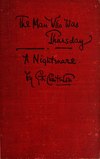
“I recur here to my personal point about the tendency to miss what the title means; or even what the title says. An article like this is called subjective because it has no subject. In a rambling column, whether because it is personal or impersonal, it is permissible to introduce personal trifles about oneself, as well as about other people, so long as it is made sufficiently obvious that they are trifling. And I may remark in this connexion, or disconnexion, that I happen to have a very strong objection to that trick of missing the point of a story, or sometimes even the obvious sense of the very name of a story. I have sometimes had occasion to murmur meekly that those who endure the heavy labour of reading a book might possibly endure that of reading the title-page of a book. For there are more examples than may be imagined, in which earnest critics might solve many of their problems about what a book is, merely by discovering what it professes to be. … It is odd that one example occurred in my own case... in a book called The Man Who was Thursday. It was a very melodramatic sort of moonshine, but it had a kind of notion in it; and the point is that it described, first a band of the last champions of order fighting against what appeared to be a world of anarchy, and then the discovery that the mysterious master both of the anarchy and the order was the same sort of elemental elf who had appeared to be rather too like a pantomime ogre. This line of logic, or lunacy, led many to infer that this equivocal being was meant for a serious description of the Deity; and my work even enjoyed a temporary respect among those who like the Deity to be so described. But this error was entirely due to the fact that they had read the book but had not read the title page. In my case, it is true, it was a question of a subtitle rather than a title. The book was called The Man Who Was Thursday: A Nightmare. It was not intended to describe the real world as it was, or as I thought it was, even when my thoughts were considerably less settled than they are now. It was intended to describe the world of wild doubt and despair which the pessimists were generally describing at that date; with just a gleam of hope in some double meaning of the doubt, which even the pessimists felt in some fitful fashion.”