Catharine Beecher on Frances Wright
← Back to Frances Wright Profile
“The appropriate character of a woman demands delicacy of appearance and manners, refinement of sentiment, gentleness of speech, modesty in feeling and action, a shrinking from notoriety and public gaze, a love of dependence, and protection, aversion to all that is coarse and rude, and an instinctive abhorrence of all that tends to indelicacy and impurity, either in principles or actions. These are what are admired and sought for in a woman, and your sex demand and appreciate these qualities, as much as my own. With this standard of feeling and of taste, who can look without disgust and abhorrence upon such an one as Fanny Wright, with her great masculine person, her loud voice, her untasteful attire, going about unprotected, and feeling no need of protection, mingling with men in stormy debate, and standing up with bare-faced impudence, to lecture to a public assembly. And what are the topics of her discourse, that in some cases may be a palliation for such indecorum? Nothing better than broad attacks on all those principles that protect the purity, the dignity, and the safety of her sex. There she stands, with brazen front and brawny arms, attacking the safeguards of all that is venerable and sacred in religion, all that is safe and wise in law, all that is pure and lovely in domestic virtue. Her talents only make her the more conspicuous and offensive, her amiable disposition and sincerity, only make her folly and want of common sense the more pitiable, her freedom from private vices, if she is free, only indicates, that without delicacy, and without principles, she has so thrown off all feminine attractions, that freedom from temptation is her only, and shameful palladium. I cannot conceive any thing in the shape of a woman, more intolerably offensive and disgusting; and I believe that in eulogizing her, you did violence to your judgment and your taste, from a natural desire to make a prominent member in your party appear respectable.”
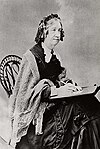
“There is a class of minds, of which I consider Robert Owen and Fanny Wright as specimens, who, while wanting in that fine mental balance called common sense, are supplied with a large amount of enthusiasm. Such a combination, if united with a contemplative turn of mind and lively imagination, often leads to that mysticism whose votaries reside in a world of imagination and feeling. But when united to an active and fearless temperament, and under certain influences, it tends to that practical Atheism, which is exhibited in the projects and visionary efforts of Owen and Fanny Wright.”