Link Copied!
Erwin Schrödinger Quotes (1887-1961)
Physicist




About Erwin Schrödinger
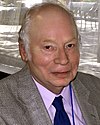
Erwin Rudolf Josef Alexander Schrödinger (12 August 1887 – 4 January 1961) was an Austrian physicist, one of the founders of quantum theory, and winner of the 1933 Nobel Prize in Physics. His ideas were heavily influenced by monist philosophy and he is particularly well known for original interpretations of the significance of the wave function and for devising the Schrödinger's cat thought experiment.
Best Erwin Schrödinger Quotes
Shortest
Earliest
Explore our curated collection of the most famous and impactful Erwin Schrödinger quotes.
“The laws of physics and chemistry are statistical throughout.”

“Multiplicity is only apparent, in truth, there is only one mind...”

“The sensation of colour cannot be accounted for by the physicist's objective picture of light-waves.”
“Some blood transfusion from the East to the West is a must to save Western science from spiritual anaemia.”

“We have just introduced the term gene for the hypothetical material carrier of a definite hereditary feature...”
“we never experiment with just one electron or atom or (small) molecule. In thought-experiments we sometimes assume that we do.”

“Vedanta teaches that consciousness is singular, all happenings are played out in one universal consciousness and there is no multiplicity of selves.”

“The material world has only been constructed at the price of taking the self, that is, mind, out of it, removing it; mind is not part of it... ”

“There is obviously only one alternative, namely the unification of minds or consciousnesses. Their multiplicity is only apparent, in truth there is only one mind.”
“The stages of human development are to strive for:
(1) Besitz [Possession]
(2) Wissen [Knowledge]
(3) Können [Ability]
(4) Sein [Being]”
(1) Besitz [Possession]
(2) Wissen [Knowledge]
(3) Können [Ability]
(4) Sein [Being]”

“I consider it extremely doubtful whether the happiness of the human race has been enhanced by the technical and industrial developments that followed in the wake of rapidly progressing natural science.”
“No self is of itself alone. It has a long chain of intellectual ancestors. The "I" is chained to ancestry by many factors … This is not mere allegory, but an eternal memory.”

“I would not call [entanglement] one but rather the characteristic trait of quantum mechanics, the one that enforces its entire departure from classical lines of thought. [italics in the original]”
“It is these chromosomes … that contain in some kind of code-script the entire pattern of the individual's future development and of its functioning in the mature state. Every complete set of chromosomes contains the full code...”
“The multiplicity is only apparent. This is the doctrine of the Upanishads. And not of the Upanishads only. The mystical experience of the union with God regularly leads to this view, unless strong prejudices stand in the way.”

“In particular, and most importantly, this is the reason why the scientific worldview contains of itself no ethical values, no esthetical values, not a word about our own ultimate scope or destination, and no God, if you please. Whence came I and whither go I?”
“'If finally we look back at that idea of [Ernst] Mach [1838-1916], we shall realize that it comes as near to the orthodox dogma of the Upanishads as it could possibly do without stating it expressis verbis . The external world and consciousness are one and the same thing.'”
“The world is given to me only once, not one existing and one perceived. Subject and object are only one. The barrier between them cannot be said to have broken down as a result of recent experience in the physical sciences, for this barrier does not exist.”

“Our mind, by virtue of a certain finite, limited capability, is by no means capable of putting a question to Nature that permits a continuous series of answers. The observations, the individual results of measurements, are the answers of Nature to our discontinuous questioning.”

Erwin Schrödinger Quotes by Topic
Find exactly what you are looking for by browsing this categorized list of Erwin Schrödinger quotes by topic.
Erwin Schrödinger on Open individualism 8 quotes
“Multiplicity is only apparent, in truth, there is only one mind.”
Erwin Schrödinger on Matter 2 quotes
“Matter and energy seem granular in structure, and so does "life", but not so mind.”

Erwin Schrödinger on Vedanta 2 quotes
“Vedanta teaches that consciousness is singular, all happenings are played out in one universal consciousness and there is no multiplicity of selves.”

Erwin Schrödinger on Monism 2 quotes
“No self is of itself alone. It has a long chain of intellectual ancestors. The "I" is chained to ancestry by many factors … This is not mere allegory, but an eternal memory.”

Erwin Schrödinger on Upanishads 2 quotes
“The multiplicity is only apparent. This is the doctrine of the Upanishads. And not of the Upanishads only. The mystical experience of the union with God regularly leads to this view, unless strong prejudices stand in the West.”
Erwin Schrödinger on Unification in science and mathematics
“There is obviously only one alternative, namely the unification of minds or consciousnesses. Their multiplicity is only apparent, in truth there is only one mind.”
Erwin Schrödinger on The All
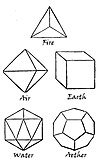
“Inconceiveable as it seems to ordinary reason, you — and all other conscious beings as such — are all in all. Hence, this life of yours... is, in a certain sense, the whole.”

Erwin Schrödinger on Karma
“Indeed in a certain sense two "I"s are identical namely when one disregards all special contents-their Karma. The goal of man is to preserve his karma and to develop it further when man dies his Karma lives and creates for itself another carrier.”

Erwin Schrödinger on Reincarnation
“Nirvana is a state of pure blissful knowledge.. It has nothing to do with individual. The ego or its separation is an illusion. The goal of man is to preserve his Karma and to develop it further – when man dies his karma lives and creates for itself another carrier.”

Erwin Schrödinger on Tea leaf paradox
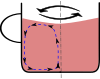
“I very much enjoyed your delightful explanation of the formation of meanders. It just happens that my wife had asked me about the “teacup phenomenon” a few days earlier, but I did not know a rational explanation. She says that she will never stir her tea again without thinking of you.”
Erwin Schrödinger on World view
“In 1925, the world view of physics was a model of a great machine composed of separable interacting material particles. During the next few years, Schrodinger and Heisenberg and their followers created a universe based on super imposed inseparable waves of probability amplitudes. This new view would be entirely consistent with the Vedantic concept of All in One.”

Erwin Schrödinger on Illusion
“Nirvana is a state of pure bliss and knowledge... It has nothing to do with the individual. The ego or its separation is an illusion. Indeed in a certain sense two "I"'s are identical namely when one disregards all special contents — their Karma. The goal of man is to preserve his Karma and to develop it further... when man dies his Karma lives and creates for itself another carrier.”

What Erwin Schrödinger Said About Others
Discover personal opinions Erwin Schrödinger shared regarding contemporaries.
Erwin Schrödinger on Immanuel Kant
“Einstein has not — as you sometimes hear — given the lie to Kant’s deep thoughts on the idealization of space and time; he has, on the contrary, made a large step towards its accomplishment.”

Quotes About Erwin Schrödinger
Gain deeper perspective through quotes about Erwin Schrödinger from others.
Jeremy Bernstein on Erwin Schrödinger
“Schrödinger, who was born in Vienna in 1887, was a fascinating man. I met him a few months before he died in 1961. All the inventors of the quantum theory, as it happened, were men of very broad culture, perhaps attributable in part to their European gymnasium educations, but even in this group Schrödinger stood out. He read very widely in a variety of languages, ancient and modern. He was a scientific polymath with a deep interest in Eastern religions. He was also a rather romantic figure who wrote poetry. I was told by Philipp Frank that when Schrödinger appeared in 1939 at the Institute for Advanced Study in Dublin, where he had been offered sanctuary during the war, he did so with what Professor Frank referred to as two ‘‘wives.’’ (This was the least of it. Schrödinger had several mistresses, with whom he fathered at least two daughters.)”
Paul Davies on Erwin Schrödinger 2 quotes
“Seventy-five years ago Erwin Schrödinger published... What Is Life?... based on a series of lectures he gave in Dublin in 1943 during the height of World War II... [S]chrödinger was the... co-architect of one of the most difficult scientific theories that we know, quantum mechanics, but he was unable to wrap his head around the nature of life. He was baffled. He made some progress, but the key point he wanted to address was whether life can be explained by physics. ...[I]t's really important... to distinguish between known physics, what you find in the textbooks, and new physics.”

Paul Dirac on Erwin Schrödinger
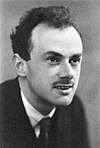
“I met him frequently in later life, and, of all the physicists that I met, I think Schrodinger was the one that I felt to be most closely similar to myself. I found myself getting into agreement with Schrodinger more readily than with anyone else. I believe the reason for this is that Schrodinger and I both had a very strong appreciation of mathematical beauty, and this appreciation of mathematical beauty dominated all our work. It was a sort of act of faith with us that any equations which describe fundamental laws of Nature must have great mathematical beauty in them. It was like a religion with us. It was a very profitable religion to hold, and can be considered as the basis of much of our success.”
Albert Einstein on Erwin Schrödinger
“You are the only contemporary physicist, besides Laue, who sees that one cannot get around the assumption of reality — if only one is honest. Most of them simply do not see what sort of risky game they are playing with reality — reality as something independent of what is experimentally established. Their interpretation is, however, refuted most elegantly by your system of radioactive atom + amplifier + charge of gun powder + cat in a box, in which the psi-function of the system contains both the cat alive and blown to bits. Nobody really doubts that the presence or absence of the cat is something independent of the act of observation.”

Brian Greene on Erwin Schrödinger
“Just a few months after de Broglie's suggestion, Schrödinger took the decisive step... by determining an equation that governs the shape and the evolution of probability waves, or as they became known, wave functions. It was not long before Schrödinger's equation and the probabilistic interpretation were being used to make wonderfully accurate predictions. By 1927, therefore, classical innocence had been lost. Gone were the days of a clockwork universe whose individual constituents were set in motion at some moment in the past and obediently fulfilled their inescapable, uniquely determined destiny. According to quantum mechanics, the universe evolves according to a rigorous and precise mathematical formalism, but this framework determines only the probability that any particular function will happen—not which future actually ensues.”
Nick Lane on Erwin Schrödinger
“So if we're going to ask... What is life? ...Erwin Schrödinger wrote a famous book on that theme ...Two famous ideas ...emerged ...one ...was ...that genes are a code-script, and that was the first time anybody had used the word "code-script" or really thought in terms of information, in biology. ...This was before DNA was discovered. He was a direct inspiration to Watson and Crick and many others. The second theme... was how life maintains its organization over time, and why don't we just fall to pieces as entropy would tend to suggest... He talked about life feeding on negative entropy, or "negentropy"... [H]e talked about continually sucking order... from its environment. ...[I]t's a wonderful book. ...[H]e said, "If I had been catering for physicists alone I should have let the discussion turn on free energy instead." ...In more modern terms he's saying something like life is the harnessing of chemical energy in such a way that the energy-harnessing device makes a copy of itself. ...[H]e's linking the two key themes of biology ...information and energy together.”

Walter J. Moore on Erwin Schrödinger 3 quotes
“The unity and continuity of Vedanta are reflected in the unity and continuity of wave mechanics. In 1925, the world view of physics was a model of a great machine composed of separable interacting material particles. During the next few years, Schrodinger and Heisenberg and their followers created a universe based on super imposed inseparable waves of probability amplitudes. This new view would be entirely consistent with the Vedantic concept of All in One.”
Rajiv Malhotra on Erwin Schrödinger
“The unity and continuity of Vedanta are reflected in the unity and continuity of wave mechanics. In 1925, the world view of physics was a model of a great machine composed of separable interacting material particles. During the next few years, Schrödinger and Heisenberg and their followers created a universe based on superimposed inseparable waves of probability amplitudes. This new view would be entirely consistent with the Vedantic concept of All in One.”

Steven Weinberg on Erwin Schrödinger
“As everyone knows, wave mechanics was revived by Erwin Schrödinger. In his 1926 series of papers, ... the familiar non-relativistic wave equation is suggested first, and then used to reserve the results of matrix mechanics. Only later, in the sixth edition of the fourth paper, is a relativistic wave equation offered. According to Dirac, ... the history is actually quite different: Schrödinger first derived the relativistic equation, then became discouraged because it gave the wrong fine structure for hydrogen, and then some months later realized that the non-relativistic approximation to his relativistic equation was of value even if the relativistic equation was incorrect! By the time Schrödinger came to publish his relativistic wave equation, it had already been independently rediscovered by Oskar Klein ... and Walter Gordon, ... and for this reason it is usually called the 'Klein-Gordon equation.'”
About Erwin Schrödinger
Erwin Rudolf Josef Alexander Schrödinger (12 August 1887 – 4 January 1961) was an Austrian physicist, one of the founders of quantum theory, and winner of the 1933 Nobel Prize in Physics. His ideas were heavily influenced by monist philosophy and he is particularly well known for original interpretations of the significance of the wave function and for devising the Schrödinger's cat thought experiment.