Enoch Powell Quotes (1912-1998)






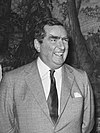


About Enoch Powell
Best Enoch Powell Quotes
Explore our curated collection of the most famous and impactful Enoch Powell quotes.







And swifts are overhead,
To lie and watch the clouds, and weep
For friends already dead.”














In a garden in the south,
I met a youth who carried
A rose-bud in his mouth.
I gave him chase and caught him,
And would not set him free,
But held him and besought him
To give the flower to me.
He smiled, and broke a petal
And laid it in my hand—
It seared like molten metal,
And here is yet the brand.”


And cross your right leg on your left, and fold
Your hands around your knee, I felt a flow
Of white-hot lava seething up the old
Volcano-shaft. That selfsame attitude,
Though not of yours, it was which long ago
Fired me, an innocent, unknowing boy,
And led me on to sin and on to learn
And onwards to the very fount of woe.”














A: The Chancellor of the Exchequer.
Q: How did he cause it?
A: By putting a flood of new money into circulation.
Q: Why did he do that?
A: To prevent the exchange rate of the pound rising last year.
Q: Why did he want to stop it rising?
A: To keep level with the Deutschmark.
Q: What for?
A: To make it easier to join the EMS.”
Marghanita Laski: Were we wise to do so? Didn't they add to us in the end? Wasn't there much more suffering and misery because we fought them?
Enoch Powell: Only because we fought them, and eventually subjugated them and Christianised them. (applause)”





Ross: I'm not sure that I understand that. Surely many black people regard themselves as genuinely British.
Powell: People fight for power, people fight for domination.
Ross: And this will be a battle for domination?
Powell: And they try to resist it.
Ross: What do you think the outcome will be?
Powell: Appalling.”









Enoch Powell: Yes, for – in peace as in war, it is the great, the ultimate, question for any nation. If we still are a nation. So really I am inviting the British people and have been these many years, to say whether or not they intend still to be a nation.”












Enoch Powell: Oh no, oh no! On the contrary, I have often said that if we saw the prospect of five million Germans in this country at the end of the century, the risks of disruption and violence would probably be greater, and the antagonism which would be aroused would be more severe. The reason why the whole debate in this country on immigration is related to coloured immigration, is because there has been no net immigration of white Commonwealth citizens, and there could be no migration of aliens. This is merely an automatic consequence of the facts of the case; it is not because there is anything different, because there is anything necessarily more dangerous, about the alienness of a community from Asia, than about the alienness of a community from Turkey or from Germany, that we discuss this inevitably in terms of colour. It is because it is that problem.”



I am one of what must be an increasing number who find the portentous moralisings of A. Solzhenitsyn a bore and an irritation. Scarcely any aspect of life in the countries where he passes his voluntary exile has failed to incur his pessimistic censure. Coming from Russia, where freedom of the press has been not so much unknown as uncomprehended since long before the Revolution, he is shocked to discover that a free press disseminated all kinds of false, partial and invented information and that journalists contradict themselves from one day to the next without shame and without apology. Only a Russian would find all that surprising, or fail to understand that freedom which is not misused is not freedom at all.
Like all travellers he misunderstands what he observes. It simply is not true that ‘within the Western countries the press has become more powerful than the legislative power, the executive and the judiciary’. The British electorate regularly disprove this by electing governments in the teeth of the hostility and misrepresentation of virtually the whole of the press. Our modern Munchhausen has, however, found a more remarkable mare’s nest still: he has discovered the ‘false slogan, characteristic of a false era, that everyone is entitled to know everything’. Excited by this discovery he announces a novel and profound moral principle, a new addendum to the catalogue of human rights. ‘People,’ he says, ‘have a right not to know, and it is a more valuable one.’ Not merely morality but theology illuminates the theme: people have, say Solzhenitsyn, ‘the right not to have their divine souls’ burdened with ‘the excessive flow of information’.
Just so. Whatever may be the case in Russia, we in the degenerate West can switch off the radio or television, or not buy a newspaper, or not read such parts of it as we do not wish to. I can assure Solzhenitsyn that the method works admirably, ‘right’ or ‘no right’. I know, because I have applied it with complete success to his own speeches and writings.
”

One of the most dangerous words is 'extremist'. A person who commits acts of violence is not an 'extremist'; he is a criminal. If he commits those acts of violence with the object of detaching part of the territory of the United Kingdom and attaching it to a foreign country, he is an enemy under arms. There is the world of difference between a citizen who commits a crime, in the belief, however mistaken, that he is thereby helping to preserve the integrity of his country and his right to remain a subject of his sovereign, and a person, be he citizen or alien, who commits a crime with the intention of destroying that integrity and rendering impossible that allegiance. The former breaches the peace; the latter is executing an act of war. The use of the word 'extremist' of either or both conveys a dangerous untruth: it implies that both hold acceptable opinions and seek permissible ends, only that they carry them to 'extremes'. Not so: the one is a lawbreaker; the other is an enemy.
The same purpose, that of rendering friend and foe indistinguishable, is achieved by references to the 'impartiality' of the British troops and to their function as 'keeping the peace'. The British forces are in Northern Ireland because an avowed enemy is using force of arms to break down lawful authority in the province and thereby seize control. The army cannot be 'impartial' towards an enemy, nor between the aggressor and the aggressed: they are not glorified policemen, restraining two sets of citizens who might otherwise do one another harm, and duty bound to show no 'partiality' towards one lawbreaker rather than another. They are engaged in defeating an armed attack upon the state. Once again, the terminology is designed to obliterate the vital difference between friend and enemy, loyal and disloyal.
Then there are the 'no-go' areas which have existed for the past eighteen months. It would be incredible, if it had not actually happened, that for a year and a half there should be areas in the United Kingdom where the Queen's writ does not run and where the citizen is protected, if protected at all, by persons and powers unknown to the law. If these areas were described as what they are—namely, pockets of territory occupied by the enemy, as surely as if they had been captured and held by parachute troops—then perhaps it would be realised how preposterous is the situation. In fact the policy of refraining from the re-establishment of civil government in these areas is as wise as it would be to leave enemy posts undisturbed behind one's lines.
”
For of course a logically irresistible conclusion followed from the creed that our safety depended upon the nuclear capability of the United States and its willingness to commit that capability in certain events. If that was so—and we assured ourselves for 40 years that it was—the guiding principle of the foreign policy of the United Kingdom had to be that, in no circumstances, must it depart from the basic insights of the United States and that any demand placed in the name of defence upon the United Kingdom by the United States was a demand that could not be resisted. Such was the rigorous logic of the nuclear deterrent...
It was in obedience to it...that the Prime Minister said, in the context of the use of American bases in Britain to launch an aggressive attack on Libya, that it was "inconceivable" that we could have refused a demand placed upon this country by the United States. The Prime Minister supplied the reason why: she said it was because we depend for our liberty and freedom upon the United States. Once let the nuclear hypothesis be questioned or destroyed, once allow it to break down, and from that moment the American imperative in this country's policies disappears with it.
A few days ago I was reminded, when reading a new biography of Richard Cobden, that he once addressed a terrible sentence of four words to this House of Commons. He said to hon. Members: "You have been Englishmen." The strength of those words lies in the perfect tense, with the implication that they were so no longer but had within themselves the power to be so again. I believe that we now have the opportunity, with the dissolution of the nightmare of the nuclear theory, for this country once again to have a defence policy that accords with the needs of this country as an island nation, and to have a foreign policy which rests upon a true, undistorted view of the outside world. Above all, we have the opportunity to have a foreign policy that is not dictated from outside to this country, but willed by its people. That day is coming. It may be delayed, but it will come.”
Have you ever wondered, perhaps, why opinions which the majority of people quite naturally hold are, if anyone dares express them publicly, denounced as 'controversial, 'extremist', 'explosive', 'disgraceful', and overwhelmed with a violence and venom quite unknown to debate on mere political issues? It is because the whole power of the aggressor depends upon preventing people from seeing what is happening and from saying what they see.
The most perfect, and the most dangerous, example of this process is the subject miscalled, and deliberately miscalled, 'race'. The people of this country are told that they must feel neither alarm nor objection to a West Indian, African and Asian population which will rise to several millions being introduced into this country. If they do, they are 'prejudiced', 'racialist'... A current situation, and a future prospect, which only a few years ago would have appeared to everyone not merely intolerable but frankly incredible, has to be represented as if welcomed by all rational and right-thinking people. The public are literally made to say that black is white. Newspapers like the Sunday Times denounce it as 'spouting the fantasies of racial purity' to say that a child born of English parents in Peking is not Chinese but English, or that a child born of Indian parents in Birmingham is not English but Indian. It is even heresy to assert the plain fact that the English are a white nation. Whether those who take part know it or not, this process of brainwashing by repetition of manifest absurdities is a sinister and deadly weapon. In the end, it renders the majority, who are marked down to be the victims of violence or revolution or tyranny, incapable of self-defence by depriving them of their wits and convincing them that what they thought was right is wrong. The process has already gone perilously far, when political parties at a general election dare not discuss a subject which results from and depends on political action and which for millions of electors transcends all others in importance; or when party leaders can be mesmerised into accepting from the enemy the slogans of 'racialist' and 'unChristian' and applying them to lifelong political colleagues...
In the universities, we are told that education and the discipline ought to be determined by the students, and that the representatives of the students ought effectively to manage the institutions. This is nonsense—manifest, arrant nonsense; but it is nonsense which it is already obligatory for academics and journalists, politicians and parties, to accept and mouth upon pain of verbal denunciation and physical duress.
We are told that the economic achievement of the Western countries has been at the expense of the rest of the world and has impoverished them, so that what are called the 'developed' countries owe a duty to hand over tax-produced 'aid' to the governments of the undeveloped countries. It is nonsense—manifest, arrant nonsense; but it is nonsense with which the people of the Western countries, clergy and laity, but clergy especially—have been so deluged and saturated that in the end they feel ashamed of what the brains and energy of Western mankind have done, and sink on their knees to apologise for being civilised and ask to be insulted and humiliated.
Then there is the 'civil rights' nonsense. In Ulster we are told that the deliberate destruction by fire and riot of areas of ordinary property is due to the dissatisfaction over allocation of council houses and opportunities for employment. It is nonsense—manifest, arrant nonsense; but that has not prevented the Parliament and government of the United Kingdom from undermining the morale of civil government in Northern Ireland by imputing to it the blame for anarchy and violence.
Most cynically of all, we are told, and told by bishops forsooth, that communist countries are the upholders of human rights and guardians of individual liberty, but that large numbers of people in this country would be outraged by the spectacle of cricket matches being played here against South Africans. It is nonsense—manifest, arrant nonsense; but that did not prevent a British Prime Minister and a British Home Secretary from adopting it as acknowledged fact.
”
Enoch Powell Quotes by Topic
Find exactly what you are looking for by browsing this categorized list of Enoch Powell quotes by topic.
Enoch Powell on Book of Common Prayer 2 quotes

Enoch Powell on Monarchy of the United Kingdom 2 quotes

Enoch Powell on Racism in the United Kingdom
Enoch Powell on Value (ethics)

What Enoch Powell Said About Others
Discover personal opinions Enoch Powell shared regarding contemporaries.
Enoch Powell on Margaret Thatcher 3 quotes

Enoch Powell on A. E. Housman 2 quotes

Enoch Powell on Michael Foot 2 quotes

Enoch Powell on Aneurin Bevan 2 quotes

Enoch Powell on Benjamin Disraeli 2 quotes

Quotes About Enoch Powell
Gain deeper perspective through quotes about Enoch Powell from others.
Tariq Ali on Enoch Powell
Idi Amin on Enoch Powell

Noel Annan on Enoch Powell
Mary Beard on Enoch Powell 2 quotes
Tony Benn on Enoch Powell