Link Copied!
Emmy Noether Quotes (1882-1935)
Mathematician
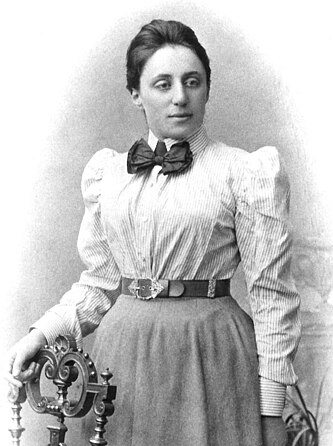
About Emmy Noether
Amalie Emmy Noether (March 23, 1882 – April 14, 1935) was a German mathematician known for her landmark contributions to abstract algebra and theoretical physics.
Best Emmy Noether Quotes
Shortest
Earliest
Explore our curated collection of the most famous and impactful Emmy Noether quotes.
“Es steht alles schon bei Dedekind.
[It is already all in Dedekind.]”
[It is already all in Dedekind.]”
“My methods are really methods of working and thinking; this is why they have crept in everywhere anonymously.”
“Ich habe das symbolische Rechnen mit Stumpf und Stil verlernt.
I have completely forgotten the symbolic calculus.”
I have completely forgotten the symbolic calculus.”
“If one proves the equality of two numbers and by showing first that and then that , it is unfair; one should instead show that they are really equal by disclosing the inner ground for their equality.”

“Wissenschaftliche Anregung verdanke ich wesentlich dem persönlichen mathematischen Verkehr in Erlangen und in Göttingen. Vor allem bin ich Herrn E. Fischer zu Dank verpflichtet, der mir den entscheidenden Anstoẞ zu der Beschäftigung mit abstrakter Algebra in arithmetischer Auffassung gab, was für all meine späteren Arbeiten bestimmend blieb.
I obtained scientific guidance and stimulation mainly through personal mathematical contacts in Erlangen and in Göttingen. Above all I am indebted to Mr. E. Fischer from whom I received the decisive impulse to study abstract algebra from an arithmetical viewpoint, and this remained the governing idea for all my later work.”
I obtained scientific guidance and stimulation mainly through personal mathematical contacts in Erlangen and in Göttingen. Above all I am indebted to Mr. E. Fischer from whom I received the decisive impulse to study abstract algebra from an arithmetical viewpoint, and this remained the governing idea for all my later work.”
Quotes About Emmy Noether
Gain deeper perspective through quotes about Emmy Noether from others.
Pavel Alexandrov on Emmy Noether
“[Noether] taught us to think in terms of simple and general algebraic concepts—homomorphic mappings, groups and rings with operators, ideals—and not in cumbersome algebraic computations; and she thereby opened up the path to finding algebraic principles in places where such principles had been obscured by some complicated special situation.”
Emil Artin on Emmy Noether
“Emmy Noether introduced the notion of a representation space— a vector space upon which the elements of the algebra operate as linear transformations, the composition of the linear transformations reflecting the multiplication in the algebra. By doing so she enables us to use our geometric intuition. Her point of view stresses the essential fact about a simple algebra, namely, that it has only one type of irreducible space and that it is faithfully represented by its operation on this space. Wedderburn's statement that the simple algebra is a total matrix algebra over a quasifield is now more understandable. It simply means that all transformations of this space which are linear with respect to a certain quasifield are produced by the algebra. This treatment of algebras may be found in van der Waerden's Moderne Algebra. Recently it has been discovered that this last described treatment of simple algebras is capable of generalization to a far wider class of rings.”

Eric Temple Bell on Emmy Noether 3 quotes
“The third great epoch in the extension of arithmetic is that of the twentieth century after 1910. To anticipate, the introduction of general methods into linear algebra, beginning in the first decade of the twentieth century, prepared that vast field of mathematics, first opened up by Hamilton and Grassman in the 1840s, for partial arithmetization in the second and third decades of the century. In 1910, E. Steinitz... proceeding from, and partly generalizing, Kronecker's theory (1881) of "algebraic magnitudes," made a fundamental contribution to the modern theory of (commutative) fields. His work was one of the strongest impulses to the abstract algebra of the 1920s and 1930s, with its accompanying generalized arithmetic. The outstanding figure in the later phase of this development is usually considered to be Emmy Noether... who, with her numerous pupils, laid down the broad foundations of the modern abstract theory of ideals, also a great deal more in the domain of modern algebra. The application of this work to the 'integers' of linear associative algebras affords the ultimate extension up to 1940 of common arithmetic.”
Carl B. Boyer on Emmy Noether 3 quotes
“Dedekind's concern with algebra goes back to the 1850s, when he attended Dirichlet's lectures on number theory... and pursued intensive studies of Galois theory. ...[H]e developed an abstract treatment of elementary group theory at that time. After Dirichlet's death, Dedekind was charged with publishing Dirichlet's lectures on number theory. In appendices he presented... his ideal theory... The most axiomatic approach [1894]... was the one that especially influenced Emmy Noether and her school of algebraists in the 1920s.”
Leo Corry on Emmy Noether
“She continually advised her students to read and re-read Dedekind's works, in which she saw an inexhaustible source of inspiration. When praised for her own innovations, she used to repeat: "Es steht alles schon bei Dedekind."”



About Emmy Noether
Amalie Emmy Noether (March 23, 1882 – April 14, 1935) was a German mathematician known for her landmark contributions to abstract algebra and theoretical physics.