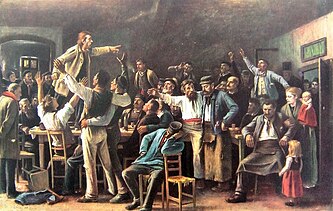
At the end of my second year at Hampton, by the help of some money sent me by my mother and brother John, supplemented by a small gift from one of the teachers at Hampton, I was enabled to return to my home in Malden, West Virginia, to spend my vacation. When I reached home I found that the salt-furnaces were not running, and that the coal-mine was not being operated on account of the miners being out on a “strike.” This was something which, it seemed, usually occurred whenever the men got two or three months ahead in their savings. During the strike, of course, they spent all that they had saved, and would often return to work in debt at the same wages, or would move to another mine at considerable expense. In either case, my observations convinced me that the miners were worse off at the end of a strike. Before the days of strikes in that section of the country, I knew miners who had considerable money in the bank, but as soon as the professional labor agitators got control, the savings of even the more thrifty ones began disappearing.
What It Means
This is a placeholder explanation generated by the low-overhead model. It interprets "At the end of my second year at Hampton, by the help of some money sent me by my mother and brother John, supplemented by a small gift from one of the teachers at Hampton, I was enabled to return to my home in Malden, West Virginia, to spend my vacation. When I reached home I found that the salt-furnaces were not running, and that the coal-mine was not being operated on account of the miners being out on a “strike.” This was something which, it seemed, usually occurred whenever the men got two or three months ahead in their savings. During the strike, of course, they spent all that they had saved, and would often return to work in debt at the same wages, or would move to another mine at considerable expense. In either case, my observations convinced me that the miners were worse off at the end of a strike. Before the days of strikes in that section of the country, I knew miners who had considerable money in the bank, but as soon as the professional labor agitators got control, the savings of even the more thrifty ones began disappearing." in the context of "Booker T. Washington, Up From Slavery (1901), Chapter 4: Helping Others" to mean that wisdom is timeless.
Tags

About Booker T. Washington