Link Copied!
Bernard Montgomery, 1st Viscount Montgomery of Alamein Quotes (1887-1976)
King
About Bernard Montgomery, 1st Viscount Montgomery of Alamein
Field Marshal Bernard Law Montgomery (17 November 1887 – 24 March 1976) was a senior British Army officer who served in the First World War, the Irish War of Independence and the Second World War.
Best Bernard Montgomery, 1st Viscount Montgomery of Alamein Quotes
Shortest
Earliest
Explore our curated collection of the most famous and impactful Bernard Montgomery, 1st Viscount Montgomery of Alamein quotes.
“Leadership is the capacity and will to rally men and women to a common purpose and the character which inspires confidence.”

“The frightful casualties appalled me. The so-called "good fighting generals" of the war appeared to me to be those who had a complete disregard for human life. There were of course exceptions and I suppose one was Plumer; I had only once seen him and I had never spoken to him.”
“Rule 1, on page 1 of the book of war, is: "Do not march on Moscow". Various people have tried it, Napoleon and Hitler, and it is no good. That is the first rule. I do not know whether your Lordships will know Rule 2 of war. It is: "Do not go fighting with your land armies in China". It is a vast country, with no clearly defined objectives.”

“The British soldier is second to none in the communities of fighting men. Some may possess more élan, others may be better disciplined; but none excels him in all-round character. We require no training in bravery in Britain; we can trust to our own native manliness to see us through. So it is with the soldier. It is his natural pride which gives him his fighting qualities. How often he has stood firm before tyranny and oppression, the last hope of the free world! In the midst of the noise and confusion of the battlefield, the simple homely figure of the British soldier stands out calm and resolute—dominating all around him with his quiet courage, his humour and his cheerfulness, his unflinching acceptance of the situation. May the ideals for which he has struggled never vanish from the world! May he never be forgotten by the nation for which he has fought so nobly! I know better than most to what heights the British soldier can aspire. His greatness is a measure of the greatness of the British character, and I have seen the quality of our race proved again and again on the battlefield.”

“The time has come to deal the enemy a terrific blow in Western Europe.
The blow will be struck by the combined sea, land and air forces of the Allies together constituting one great Allied team, under the supreme command of General Eisenhower.
On the eve of this great adventure I send my best wishes to every soldier in the Allied team.
To us is given the honour of striking a blow for freedom which will live in history; and in the better days that lie ahead men will speak with pride of our doings. We have a great and a righteous cause.
Let us pray that " The Lord Mighty in Battle " will go forth with our armies, and that His special providence will aid us in the struggle.
I want every soldier to know that I have complete confidence in the successful outcome of the operations that we are now about to begin.
With stout hearts, and with enthusiasm for the contest, let us go forward to victory.
And, as we enter the battle, let us recall the words of a famous soldier spoken many years ago :
"He either fears his fate too much,
Or his deserts are small,
Who dare not put it to the touch,
To win or lose it all. "
Good luck to each one of you. And good hunting on the main land of Europe.”
“There were many reasons why we did not gain complete success at Arnhem. The following in my view were the main ones. First. The operation was not regarded at Supreme Headquarters as the spearhead of a major Allied movement on the northern flank designed to isolate, and finally to occupy, the Ruhr - the one objective in the West which the Germans could not afford to lose. There is no doubt in my mind that Eisenhower always wanted to give priority to the northern thrust and to scale down the southern one. He ordered this to be done, and he thought that it was being done. It was not being done. Second. The airborne forces at Arnhem were dropped too far away from the vital objective - the bridge. It was some hours before they reached it. I take the blame for this mistake. I should have ordered Second Army and 1st Airborne Corps to arrange that at least one complete Parachute Brigade was dropped quite close to the bridge, so that it could have been captured in a matter of minutes and its defence soundly organised with time to spare. I did not do so. Third. The weather. This turned against us after the first day and we could not carry out much of the later airborne programme. But weather is always an uncertain factor, in war and in peace. This uncertainty we all accepted. It could only have been offset, and the operation made a certainty, by allotting additional resources to the project, so that it became an Allied and not merely a British project. Fourth. The 2nd S.S. Panzer Corps was refitting in the Arnhem area, having limped up there after its mauling in Normandy. We knew it was there. But we were wrong in supposing that it could not fight effectively; its battle state was far beyond our expectation. It was quickly brought into action against the 1st Airborne Division.”
Bernard Montgomery, 1st Viscount Montgomery of Alamein Quotes by Topic
Find exactly what you are looking for by browsing this categorized list of Bernard Montgomery, 1st Viscount Montgomery of Alamein quotes by topic.
Bernard Montgomery, 1st Viscount Montgomery of Alamein on Moscow
“Rule 1, on page 1 of the book of war, is: "Do not march on Moscow". Various people have tried it, Napoleon and Hitler, and it is no good. That is the first rule. I do not know whether your Lordships will know Rule 2 of war. It is: "Do not go fighting with your land armies in China". It is a vast country, with no clearly defined objectives.”

Quotes About Bernard Montgomery, 1st Viscount Montgomery of Alamein
Gain deeper perspective through quotes about Bernard Montgomery, 1st Viscount Montgomery of Alamein from others.
Stephen E. Ambrose on Bernard Montgomery, 1st Viscount Montgomery of Alamein
“On January 7, the senior British officer on the Continent, the commander of 21st Army Group, which included the U.S. Ninth Army but no longer the First, held a press conference. Montgomery told the press that on the very first day of the Bulge, "as soon as I saw what was happening I took certain steps myself to ensure that if the Germans got to the Meuse they would certainly not get over the river. And I carried out certain movements so as to provide balanced dispositions to meet the threatened danger... i.e., I was thinking ahead." Soon Eisenhower put him in command of the northern flank, and he then brought the British into the fight, and thus saved the Americans. "You have thus the picture of British troops fighting on both sides of American forces who have suffered a hard blow. This is a fine Allied picture." It had been an "interesting" battle, Montgomery said, rather like El Alamein; indeed, "I think possibly one of the most interesting and tricky battles I have ever handled." He added that GIs made great fighting men, when given proper leadership. Every American in Europe was outraged. As the GIs and their officers saw the battle, they had stopped the Germans before Montgomery came onto the scene. Almost no British forces were even engaged in the Bulge. Far from directing the victory, Montgomery had gotten in everyone's way and botched the counterattack. But what was especially galling about Montgomery's version of the Bulge was his immense satisfaction with the progress of the counterattack. Although the linkup of First and Third Armies was still a week away, and although the Germans were pulling out in good order, saving much of their equipment and men, Monty was claiming complete victory. Patton ranted and raved to every reporter who would listen, telling them publicly what he had already written privately in his diary- that had it not been for Montgomery, "we could have bagged the whole German army. I wish Ike were more of a gambler, but he is certainly a lion compared to Montgomery, and Bradley is better than Ike as far as nerve is concerned. Monty is a tired little fart. War requires the taking of risks and he won't take them."”
Lieutenant-Colonel C P Dawney on Bernard Montgomery, 1st Viscount Montgomery of Alamein
“One always had the curious feeling of being taught by a great master. In this connection it is interesting to note that he was privately and affectionately known by those who worked for him at TAC HQ as 'Master'.”
Arthur "Bomber" Harris on Bernard Montgomery, 1st Viscount Montgomery of Alamein
“I had the greatest admiration for his precision of statement and lucidity as a lecturer and also for what I, as an airman, considered his ability and breadth of view as a soldier. But he appeared to me to be regarded with grave suspicion for holding what I understood were heretical, though they seemed to me very reasonable, views about the conduct of future war. As a stranger in a strange land I kept my own counsel, but I left the course with a very definite impression that in Monty we certainly had a soldier who knew his onions, no matter what the "high-ups" in the army might officially think of the smell.”
Brian Horrocks on Bernard Montgomery, 1st Viscount Montgomery of Alamein 2 quotes
“I knew him well by reputation. He was probably the most discussed general in the British Army before the war, and-except with those who had served under him - not a popular figure. Regular armies in all countries tend to produce a standard type of officer, but Monty, somehow or other, didn't fit into the British pattern. His methods of training and command were unorthodox, always a deadly crime in military circles. He was known to be ruthlessly efficient, but somewhat of a showman. I had been told sympathetically that I wouldn't last long under his command, and, to be honest, I would rather have served under any other divisional commander.”
Dwight D. Eisenhower on Bernard Montgomery, 1st Viscount Montgomery of Alamein 5 quotes
“General Montgomery is a very able, dynamic type of army commander. I personally think that the only thing he needs is a strong immediate commander. He loves the limelight but in seeking it, it is possible that he does so only because of the effect upon his own soldiers, who are certainly devoted to him. I have great confidence in him as a combat commander. He is intelligent, a good talker, and has a flair for showmanship. Like all other senior British officers, he has been most loyal - personally and officially - and has shown no disposition whatsoever to overstep the bounds imposed by allied unity of command.”

Denis Falvey on Bernard Montgomery, 1st Viscount Montgomery of Alamein
“Much has been written about the remarkable effect Montgomery had on the troops, his appearance in peculiar hats, and so on. This was superficial. We judged him on results and his manner of achievement. Many of the troops never saw him: our first encounter was months later at Tripoli. Yet the signs of a new grip on affairs was palpable, as Churchill noticed. There was the first of those special messages to the troops. These were printed on sheets, some 11 inches by 8 inches, and were widely circulated. The first gave the gist of the famous address to the staff. We were going to fight where we stood. There would be no withdrawal, no surrender. We had to do our duty so long as we had breath in our bodies.”
Wilhelm von Thoma who fought against Montgomery on Bernard Montgomery, 1st Viscount Montgomery of Alamein
“I thought he (Montgomery) was very cautious, considering his immensely superior strength, but he is the only Field-Marshal in this war who won all his battles. In modern mobile warfare the tactics are not the main thing. The decisive factor is the organization of one's resources to maintain the momentum.”
General Harold Alexander on Bernard Montgomery, 1st Viscount Montgomery of Alamein
“Montgomery is a first-class trainer and leader of troops on the battlefield, with a fine tactical sense. He knows how to win the loyalty of his men and has a great flair for raising morale. He rightly boasted that, after the battle of Alamein, he never suffered a defeat; and the truth is that he never intended to run the risk of a defeat; that is one reason why he was cautious and reluctant to take chances. There is, however, much to be said for his attitude when we consider that, up to October 1942, we had not won a single major battle since the start of the war - except Archie Wavell's operations against the Italians and some local victories against the Axis forces in the Western Desert. Yet I can't disguise that he was not an easy man to deal with; for example, administrative orders issued by my staff were sometimes objected to - in other words Monty wanted to have complete independence of command and to do what he liked. Still, no serious difficulties arose over these very minor disturbances, he was always reasonable when tackled.”
Winston Churchill on Bernard Montgomery, 1st Viscount Montgomery of Alamein 2 quotes
“I cannot, of course, commit myself to any particular details. Reports are coming in in rapid succession. So far the Commanders who are engaged report that everything is proceeding according to plan. And what a plan! This vast operation is undoubtedly the most complicated and difficult that has ever taken place. It involves tides, wind, waves, visibility, both from the air and the sea standpoint, and the combined employment of land, air and sea forces in the highest degree of intimacy and in contact with conditions which could not and cannot be fully foreseen. There are already hopes that actual tactical surprise has been attained, and we hope to furnish the enemy with a succession of surprises during the course of the fighting. The battle that has now begun will grow constantly in scale and in intensity for many weeks to come, and I shall not attempt to speculate upon its course. This I may say, however. Complete unity prevails throughout the Allied Armies. There is a brotherhood in arms between us and our friends of the United States. There is complete confidence in the supreme commander, General Eisenhower, and his lieutenants, and also in the commander of the Expeditionary Force, General Montgomery. The ardour and spirit of the troops, as I saw myself, embarking in these last few days was splendid to witness. Nothing that equipment, science or forethought could do has been neglected, and the whole process of opening this great new front will be pursued with the utmost resolution both by the commanders and by the United States and British Governments whom they serve.”

George M. Hall on Bernard Montgomery, 1st Viscount Montgomery of Alamein
“Montgomery's problem was twofold. First, he had an inflated opinion of himself (even more than Patton's). Churchill later said that in defeat, Montgomery was unbeatable, but in victory, he became unbearable. Second, his verbal daring was not matched by his methods. As at El Alamein, he seldom commenced an offensive unless he had overwhelming superiority and could not fail. Marketgarden was the exception, and the failure stung him badly. Moreover, the Chief of the Imperial General Staff, Field Marshal Alan Brooke, had minimum admiration for Eisenhower and kept feeding his angst privately to Montgomery. Warren Harding once said that his enemies were no problem, he could take care of them: "It's my goddamn friends that keep me awake at nights."”
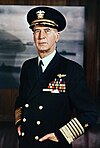
Ernest King on Bernard Montgomery, 1st Viscount Montgomery of Alamein
“King greatly enjoyed a luncheon with Mr. Churchill, who had invited him to meet Field Marshal Montgomery, whom he had not previously known. King felt that what Montgomery said made very good sense, and noted that he was not only very firm in all matters of military business, but equally firm in his personal disinclination to either smoke or drink. It is true that his beret was somewhat dramatic, but hardly more so than MacArthur's gold embroidered cap and corncob pipe or Patton's two pearl-handled pistols. Within the United States Navy, Halsey and King's old friend Jonas Ingram could hardly have been considered restrained in their style. Although King's own taste did not run to such personal exuberance, he was not necessarily surprised to find it in military commanders whose chiefs were as colorful as President Roosevelt and Mr. Churchill.”
Richard Overy on Bernard Montgomery, 1st Viscount Montgomery of Alamein
“'Monty' was the victor of the Alamein campaign which turned the tide in North Africa; he was enormously popular with the troops under his command and with the British public. Three years older than Eisenhower, his military career was fuller. The son of a clergyman, he followed a conventional path from public school to the British army academy at Sandhurst. In 1914 he was a lieutenant in the Royal Warwickshire Regiment. He saw fierce fighting on the Western front, was severely wounded, returned to the front and ended the war as a divisional chief-of-staff with the rank of major; two years later he saw combat again, against Sinn Fein in the struggle for Irish independence. Between the wars he was a successful staff officer; when war broke out again he was a major-general. As with Eisenhower, real responsibility came only in 1942 when Churchill chose him to take over the 8th Army in Egypt and turn back the Axis armies advancing on Suez. He was a good organizer and a careful strategist. His bloody baptism of fire in 1914 taught him not to gamble with the lives of his men. He suffered fools not at all, and had little respect for rank and distinction. He believed that officers should get close to their men, but with fellow commanders he could be prickly and arrogant. He possessed a strong self-belief which he communicated to those below him, but it was a quality that made him intolerant of allies and colleagues where Eisenhower was a model of appeasement. The eventual success of their awkward partnership owed more to Eisenhower's self-restraint than it did to any diffidence on the part of Montgomery.”
Chester Wilmot on Bernard Montgomery, 1st Viscount Montgomery of Alamein 5 quotes
“It is not surprising, however, that American generals found the British system irksome, especially as applied by Montgomery. To them his methods were the more objectionable because he was so clearly born to command and, even in his most tactful moments, he exercised his authority almost as a matter of right. Moreover, he was not as other men. He shunned the company of women; he did not smoke or drink or play poker with 'the boys.' He could never be 'slapped on the back.' Because he lived in a small tactical H.Q. with a few aides and liaison officers, he was looked upon as setting himself apart from (and therefore above) his fellow soldiers. This impression seemed to be confirmed by his practice, resented as much by other British services as it was by the Americans, of sending his Chief of Staff, de Guingand, to represent him at conferences.”
Georgy Zhukov on Bernard Montgomery, 1st Viscount Montgomery of Alamein
“At the ceremony of signing the decoration I met Field-Marshal Montgomery for the first time. During the war I had closely followed the actions of British troops under his command. In 1940 the British Expeditionary Corps had sustained a disastrous setback at Dunkirk. Later, British troops under Montgomery's command had smashed the German corps under General Rommel at El Alamein. During the Normandy landing Montgomery had ably commanded the Allied forces and their advance to the banks of the Seine. Montgomery was above medium height, very agile, soldierly, trim and created an impression of a lively and intelligent man. He began to talk about the operations at El Alamein and at Stalingrad. In his view the two operations were of equal significance. I did not want to belittle the merits of the British troops, but still I had to explain to him that the El Alamein operation was carried out on an army scale, while at Stalingrad the operation engaged a group of fronts and it had a vast strategic importance- it resulted in the rout of a major enemy force in the area of the Volga and Don rivers and later, in the North Caucasus. It was an operation that actually marked a radical turning-point in the war and ensured the retreat of the German forces from our country.”

About Bernard Montgomery, 1st Viscount Montgomery of Alamein
Field Marshal Bernard Law Montgomery (17 November 1887 – 24 March 1976) was a senior British Army officer who served in the First World War, the Irish War of Independence and the Second World War.