Link Copied!
Benito Mussolini Quotes (1883-1945)
Politician












About Benito Mussolini
Benito Amilcare Andrea Mussolini (29 July 1883 – 28 April 1945) was an Italian politician and journalist who founded and led the National Fascist Party. He was Prime Minister of Italy from the March on Rome in 1922 until his deposition in 1943, and "Duce" of Italian Fascism from the establishment of the Italian Fasces of Combat in 1919 until his execution in 1945 by Italian partisans. As dictator of Italy and principal founder of fascism, Mussolini inspired and supported the international spread of fascist movements during the inter-war period.
Best Benito Mussolini Quotes
Shortest
Earliest
Explore our curated collection of the most famous and impactful Benito Mussolini quotes.
“A revolutionist is born, not made.”
- Benito Mussolini, 1930s)


“Speeches made to the people are essential to the arousing of enthusiasm for a war.”
- Benito Mussolini, 1930s)
“[Marx was] the magnificent philosopher of working class violence.”
- Benito Mussolini, Undated)
Before embracing fascism, Mussolini, writing for a socialist newspaper, foreshadowed his future disregard for human life and rejection of utopian ideals.
“Socialism is not Arcadian and peaceful. We do not believe in the sacredness of human life.”
- Benito Mussolini, 1910s)

Speaking to the Italian Chamber of Deputies in 1921, Mussolini, despite his fascist leanings, acknowledged a familial connection to communism, stating "I know the Communists...".
“I know the Communists. I know them because some of them are my children…”
- Benito Mussolini, 1920s)

“The Socialists ask what is our program? Our program is to smash the heads of the Socialists.”
- Benito Mussolini, Undated)
In a 1904 speech, the future dictator Benito Mussolini denounced religion as a "mental disease," a sentiment documented decades later by James A. Haught.
“Religion is a species of mental disease. It has always had a pathological reaction on mankind.”
- Benito Mussolini, 1900s)


“Italy is not a capitalist country according to the meaning now conventionally assigned to that term.”
- Benito Mussolini, 1930s)
“It is no longer economy aiming at individual profit, but economy concerned with collective interest.”
- Benito Mussolini, 1930s)
“I want to make my own life a masterpiece.
• Variant: I shall make my own life a masterpiece.”
• Variant: I shall make my own life a masterpiece.”
- Benito Mussolini, 1930s)

In his 1904 essay, Mussolini, later a fascist dictator, celebrated science's perceived demolition of religious dogma, specifically dismissing divine creation as absurd.
“Science is now in the process of destroying religious dogma. The dogma of the divine creation is recognized as absurd.”
- Benito Mussolini, 1900s)

“Science is now in the process of destroying religious dogma. The dogma of the divine creation is recognized as absurd.”
- Benito Mussolini, 1900s, God Does Not Exist
“Silence is the only answer you should give to the fools. Where ignorance speaks, intelligence should not give advices.”
- Benito Mussolini, 1930s)

Before seizing control of the Italian Socialist Party's newspaper, Mussolini reveals his ambition to wield socialism as a powerful and intimidating force against adversaries.
“Socialism has to remain a terrifying and a majestic thing. If we follow this line, we shall be able to face our enemies.”
- Benito Mussolini, 1910s)

“God does not exist—religion in science is an absurdity, in practice an immorality and in men a disease.”
- Benito Mussolini, 1920s)
This jarring admission, attributed to Mussolini, reveals a surprising ideological alignment between early Italian Fascism and the nascent Bolshevik regime in Russia.
“In the whole negative part, we are alike. We and the Russians are against liberals, against democrats, against parliament.”
- Benito Mussolini, Undated)

“I am making superhuman efforts to educate this people. When they have learnt to obey, they will believe what I tell them.”
- Benito Mussolini, Undated)
“No nation can become greater in which there are enormous masses condemned to the conditions of life of prehistoric humanity.”
- Benito Mussolini, 1920s, Mussolini as Revealed in his Political Speeches
“War is to man what motherhood is to a woman. From a philosophical and doctrinal viewpoint, I do not believe in perpetual peace.”
- Benito Mussolini, 1930s)
In a 1928 statement promising equality between workers and owners, Mussolini ironically reveals the Fascist regime's intent to control both groups within a single, state-controlled system.
“I declare that henceforth capital and labor shall have equal rights and duties as brothers in the fascist family.”
- Benito Mussolini, 1930s)
“This is the epitaph I want on my tomb: "Here lies one of the most intelligent animals who ever appeared on the face of the Earth."”
- Benito Mussolini, 1930s)
- Benito Mussolini, 1900s, God Does Not Exist
“Religious morality shows the original stigmata of authoritarianism precisely because it pretends to be the revelation of divine authority.”
- Benito Mussolini, 1900s, God Does Not Exist
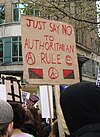
“"Religious man" is an abnormality and "religion" is the certain cause of epidemic diseases of the mind which require the care of alienists.”
- Benito Mussolini, 1900s, God Does Not Exist
In a 1923 speech, President Harding shared a message ostensibly from an Italian leader, praising America's strength and simplicity as a model for Italy.
“Tell America that I like her, like her because she is strong, simple, and direct. I wish Italy to be the same and shall try to make her so.”
- Benito Mussolini, 1920s)
“There is a great deal of Prussianism in German Socialism. My impression has been that that explains why German Socialists are so disciplined.”
- Benito Mussolini, 1930s)
“The citizen in the Fascist State is no longer a selfish individual who has the anti-social right of rebelling against any law of the Collectivity.”
- Benito Mussolini, 1920s)
“I bequeath the republic to the republicans and not to the monarchists, and the work of social reform to the socialist and not to the middle class.”
- Benito Mussolini, Undated)
“National pride has no need of the delirium of race. Anti-Semitism does not exist in Italy… Whenever things go awry in Germany, the Jews are blamed for it.”
- Benito Mussolini, 1930s)

“Fascism conceives of the State as an absolute, in comparison with which all individuals or groups are relative, only to be conceived in their relation to the State.”
- Benito Mussolini, 1930s)

“I shall defend this pact with all my strength, and if Fascism does not follow me in collaboration with the Socialists, at least no one can force me to follow Fascism.”
- Benito Mussolini, 1920s)

“Our position is different as regards the Socialist Party. In the first place we are careful to make a distinction between party Socialism and the Socialism of Labour.”
- Benito Mussolini, 1920s, Mussolini as Revealed in his Political Speeches
English Translation: "Fortunately, the Italian people have not yet become accustomed to eating many times a day, and possessing a modest standard of living, they feel deficiency and suffering less."
Original (Italian): "Fortunately the Italian people has not yet accustomed itself to eat many times a day, and possessing a modest level of living, it feels deficiency and suffering less."
“Fortunately the Italian people has not yet accustomed itself to eat many times a day, and possessing a modest level of living, it feels deficiency and suffering less.”
Original (Italian): "Fortunately the Italian people has not yet accustomed itself to eat many times a day, and possessing a modest level of living, it feels deficiency and suffering less."
- Benito Mussolini, Undated)
“If the 19th was the century of the individual (liberalism means individualism), you may consider that this is the "collective" century, and therefore the century of the state.”
- Benito Mussolini, 1930s)

“The history of many saints, beatified by the church, is repugnant. It shows nothing more than a profound aberration of the human spirit in search of ultra-terrestrial chimeras.”
- Benito Mussolini, 1900s, God Does Not Exist
In 1932, Mussolini, while expressing his pragmatic approach to power, warned that Hitler's antisemitism was politically unwise despite his own lack of affection for Jews.
“I have no love for the Jews, but they have great influence everywhere. It is better to leave them alone. Hitler's antisemitism has already brought him more enemies than is necessary.”
- Benito Mussolini, 1930s)
Speaking to Italian farmers in 1928, Mussolini linked agricultural land reclamation to the fascist revolution, envisioning enduring glory through territorial transformation.
“The integral reclamation of our national territory is an enterprise the achievement of which would alone suffice to make the revolution of the Blackshirts glorious down the centuries.”
- Benito Mussolini, 1920s)

Threatening landowners with expropriation or a veteran-led uprising, Mussolini's 1919 statement reveals early Fascist strategy to leverage popular discontent and intimidate the establishment.
“This is what we propose now to the Treasury: either the property owners expropriate themselves, or we summon the masses of war veterans to march against these obstacles and overthrow them.”
- Benito Mussolini, 1910s)
“I owe most to Georges Sorel. This master of syndicalism by his rough theories of revolutionary tactics has contributed most to form the discipline, energy and power of the fascist cohorts.”
- Benito Mussolini, Undated)
Speaking in 1922, as Fascism gained momentum, Benito Mussolini dismissed policy details in favor of decisive leadership and a promise to seize control of Italy.
“Our program is simple: we wish to govern Italy. They ask us for programs but there are already too many. It is not programs that are wanting for the salvation of Italy but men and will power.”
- Benito Mussolini, 1920s)

“We are syndicalists, because we think that by means of the mass it may be possible to determine an economic readjustment…”
- Benito Mussolini, 1920s, Mussolini as Revealed in his Political Speeches
Attributed to an unknown speaker and widely cited, this scathing assessment of provincial Fascism's devolution highlights its betrayal of original ideals into oppressive self-interest.
“[Provincial Fascism is] “no longer liberation, but tyranny; no longer protector of the nation, but defense of private interests and of the dullest, deafest, most miserable cast that exists in Italy."”
- Benito Mussolini, 1920s)
In a late, desperate attempt to frame his war efforts, Mussolini claimed to be fighting for social justice against plutocratic privilege during an interview on Trimelone Island in March 1945.
“We are fighting to impose a higher social justice. The others are fighting to maintain the privileges of caste and class. We are proletarian nations that rise up against the plutocrats.”
- Benito Mussolini, 1940s)

Mussolini, anticipating a global class war fueled by bourgeois conflict, invoked Marx to characterize the inevitable socialist revolution emerging from societal upheaval.
“With the unleashing of a mighty clash of peoples, the bourgeoisie is playing its last card and calls forth on the world scene that which Karl Marx called the sixth great power: the socialist revolution.”
- Benito Mussolini, Undated)

Anticipating global socialist revolution, historian Jacob Talmon argued that a single successful uprising would either inspire imitation abroad or deter capitalist intervention.
“The outbreak of a socialist revolution in one country will cause the others to imitate it or so to strengthen the proletariat as to prevent its national bourgeoisie from attempting any armed intervention.”
- Benito Mussolini, Undated)
“The dangerous persons for the socialist movement are not the intellectuals, but those who are not convinced of socialism. And all those who call themselves socialists without knowing why they are socialists.”
- Benito Mussolini, 1910s)
“At a given moment the worker, the tiller of the soil, must be able to say to himself and to his family: "If I am really better off today it is due to the institutions that the Fascist Revolution has created."”
- Benito Mussolini, 1930s)
Speaking at the 1934 Levantine Fair, this scathing remark derides German Nordicism and alludes to Italy's long and historically rich heritage, contrasting it with Germany's perceived cultural infancy.
“Thirty centuries of history allow us to look with supreme pity on certain doctrines which are preached beyond the Alps by the descendants of those who were illiterate when Rome had Caesar, Virgil and Augustus.”
- Benito Mussolini, 1930s)
“World Jewry has been, for sixteen years, despite our policy, an irreconcilable enemy of Fascism. In Italy our policy has led, in the Semitic elements, to what can today be called a true rush to board the ship.”
- Benito Mussolini, 1930s)

“I admire Lassalle. He was a man of first-class intelligence and endowed with far more imagination than Marx. That was why his vision of the days to come was far less catastrophic than that of Marx.”
- Benito Mussolini, 1930s)
Expelled from the Italian Socialist Party in 1914 for advocating intervention in WWI, this defiant statement reveals the speaker's continued commitment to socialist ideals despite the party's censure.
“Do not believe, even for a moment, that by stripping me of my membership card you do the same to my Socialist beliefs, nor that you would restrain me of continuing to work in favor of Socialism and of the Revolution.”
- Benito Mussolini, 1910s)
Writing in 1933, Mussolini saw echoes of Fascist mobilization tactics in Roosevelt's New Deal rhetoric, particularly its call for decisive action from the nation's youth.
“The appeal to the decisiveness and masculine sobriety of the nation’s youth, with which Roosevelt here calls his readers to battle, is reminiscent of the ways and means by which Fascism awakened the Italian people.”
- Benito Mussolini, 1930s)
“These men are not made of the same stuff as the Francis Drakes and the other magnificent adventurers who created the empire. These, after all, are the tired sons of a long line of rich men, and they will lose their empire.”
- Benito Mussolini, 1930s)

“Some still ask of us: what do you want? We answer with three words that summon up our entire program. Here they are…Italy, Republic, Socialization. . .Socialization is no other than the implantation of Italian Socialism…”
- Benito Mussolini, 1940s)

“Fascism recognizes the real needs which gave rise to socialism and trade unionism, giving them due weight in the guild or corporative system in which divergent interests are coordinated and harmonized in the unity of the State.”
- Benito Mussolini, 1930s)
“With each new discovery of chemistry, physics, biology, the anthropological sciences, of the practical application of sound principles, dogma collapses. It is a part of that old edifice of religion which crumbles and falls in ruins.”
- Benito Mussolini, 1900s, God Does Not Exist


“It is humiliating to remain with our hands folded while others write history. It matters little who wins. To make a people great it is necessary to send them to battle even if you have to kick them in the pants. That is what I shall do.”
- Benito Mussolini, 1940s)

“How can the idea of a creator be reconciled with the existence of dwarfed and atrophied organs, with anomalies and monstrosities, with the existence of pain, perpetual and universal, with the struggle and the inequalities among human beings?”
- Benito Mussolini, 1900s, God Does Not Exist
Articulating the fascist economic model, this excerpt from Mussolini's Labor Charter rationalizes state intervention as a necessary corrective to private sector shortcomings and a tool for political advancement.
“State intervention in economic production arises only when private initiative is lacking or insufficient, or when the political interests of the State are involved. This intervention may take the form of control, assistance or direct management.”
- Benito Mussolini, 1920s)
“We assert—and on the basis of the most recent socialist literature that you cannot deny—that the real history of capitalism is only now beginning, because capitalism is not just a system of oppression; it also represents a choice of value,…”
- Benito Mussolini, 1920s)

“We play upon every cord of the lyre, from violence to religion, from art to politics. We are politicians and we are warriors. We are syndicalists and we also fight battles in the streets and the squares. That is Fascismo as it was conceived at Milan…”
- Benito Mussolini, 1920s, Mussolini as Revealed in his Political Speeches

“For us the national flag is a rag to be planted on a dunghill. There are only two fatherlands in the world: that of the exploited and that of the exploiters.
• Variant translation: The national flag is a rag that should be placed in a dunghill.”
• Variant translation: The national flag is a rag that should be placed in a dunghill.”
- Benito Mussolini, 1910s)
Written in 1914, this quote reveals Mussolini's rationale for abandoning socialism, citing the International's failure to address national concerns as a critical weakness.
“The root of our psychological weakness was this: We socialists have never examined the problems of nations. The International was never concerned with it. The International is dead, paralyzed by events. Ten million proletarians are today on the battlefield.”
- Benito Mussolini, 1910s)

“Comrade Tassinari was right in stating that for a revolution to be great, for it to make a deep impression on the life of the people and on history, it must be a social revolution.”
- Benito Mussolini, 1930s)
“The socialist revolution was a pure and simple question of ‘force.’… Between the [bourgeoisie and the proletariat] no accord is possible. One must disappear. The weaker will be ‘eliminated.’ The class struggle is therefore a question of ‘force.’”
- Benito Mussolini, Undated)

Prior to leading the Italian Socialist Party, Mussolini's harsh 1912 declaration reveals an aggressive, almost militaristic vision of socialism rooted in conflict and retribution.
“The law of socialism is that of the desert: a tooth for a tooth, an eye for an eye. Socialism is a rude and bitter truth, which was born in the conflict of opposing forces and in violence. Socialism is war, and woe to those who are cowardly in war. They will be defeated.”
- Benito Mussolini, 1910s)
“Standing by me and helping my work as newspaper man were the Fascisti. They were composed of revolutionary spirits who believed in intervention. They were youths—the students of the universities, the socialist syndicalists—destroying faith in Karl Marx by their ideals.”
- Benito Mussolini, 1920s)
“If today the Middle Ages are retiring into the thick shadows of convents, it is due to triumphant skepticism; and if the epidemic disease of religion no longer appears with the terrible intensity of former times, it is due to the diminution of the political power of the Church.”
- Benito Mussolini, 1900s, God Does Not Exist

“The struggle between the two worlds [Fascism and Democracy] can permit no compromises. The new cycle which begins with the ninth year of the Fascist regime places the alternative in even greater relief — either we or they, either their ideas or ours, either our State or theirs!”
- Benito Mussolini, Undated)
“The Socialists, and I am still one, although an exasperated one, never brought forward the question of irredentism, but left it to the Republicans. We are in favour of a national war. But there are also reasons, purely socialist in character, which spur us on towards intervention.”
- Benito Mussolini, 1920s, Mussolini as Revealed in his Political Speeches
“Foolish and reactionary and Conservative contraband practices must not be carried on under the Fascista flag… We are the first to recognize that a State law should grant the eight-hour day, and that there should be social legislation corresponding to the exigencies of the new times.”
- Benito Mussolini, 1920s, Mussolini as Revealed in his Political Speeches

In a 1932 interview, Benito Mussolini expressed skepticism about the biological reality of race, viewing it instead as a largely fabricated sentiment.
“Race! It is a feeling, not a reality: ninety-five percent, at least, is a feeling. Nothing will ever make me believe that biologically pure races can be shown to exist today. Amusingly enough, not one of those who have proclaimed the "nobility" of the Teutonic race was himself a Teuton.”
- Benito Mussolini, 1930s)
“I had the courage to transform the eight-hours day into a law of the State. Do not despise this victory; do not undervalue it. I have approved all the social and pacifist Conventions of Washington… No exceptional laws were pasted, and the regulation of the Press is not an exceptional law.”
- Benito Mussolini, 1920s, Mussolini as Revealed in his Political Speeches

“Fascism denies that numbers, as such, can direct human society. It denies that numbers can govern by means of periodical consultations: It asserts the unavoidable fruitful and beneficent inequality of men who cannot be leveled by any such mechanical and extrinsic device as universal suffrage.”
- Benito Mussolini, 1930s)
“To-day we can affirm that the capitalistic method of production is out of date. So is the doctrine of laissez-faire, the theoretical basis of capitalism… To-day we are taking a new and decisive step in the path of revolution. A revolution, in order to be great, must be a social revolution.”
- Benito Mussolini, 1930s)
In his 1919 announcement of the Fascist League, Mussolini criticizes the Italian Socialist Party as reactionary and conservative, despite differing definitions of socialism.
“Although we can discuss the question of what socialism is, what is its program and what are its tactics, one thing is obvious: the official Italian Socialist Party has been reactionary and absolutely conservative.”
- Benito Mussolini, 1910s)
In a 1932 interview, future Fascist dictator Benito Mussolini revealed his youthful admiration for Karl Marx, even carrying a Marx medallion as a "talisman".
“It was inevitable that I should become a Socialist ultra, a Blanquist, indeed a communist. I carried about a medallion with Marx’s head on it in my pocket. I think I regarded it as a sort of talisman… [Marx] had a profound critical intelligence and was in some sense even a prophet.”
- Benito Mussolini, 1930s)
“Here in Italy Socialism was a unifying factor. All Italian historians have recognized this. The Socialists of Italy were advocates of one idea and of one nation. From 1892, when they cut adrift from the anarchists at the Congress of Genoa, down till 1911, they battled for on behalf of a united Italy.””
- Benito Mussolini, 1930s)
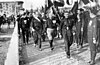
“To make a revolution it is not necessary to play the great drama of the area. We have left many dead on the roads to Rome and naturally anybody who deludes himself is a fool. We have the power and we shall hold it. We shall defend it against anybody! The revolution lies in this firm determination to hold power!”
- Benito Mussolini, 1920s, Mussolini as Revealed in his Political Speeches
“As Italy discovered America, so America and the rest of the New World must discover Italy, not only in the great towns, pulsating with life and humming with industry, but also in the country, where the humble labourers wait with quiet resignation for the dawn of a victorious and just peace to appear on the horizon.”
- Benito Mussolini, 1920s, Mussolini as Revealed in his Political Speeches
“When we claim that "God does not exist," we mean to deny by this declaration the personal God of theology, the God worshiped in various ways and divers modes by believers the world over, that God who from nothing created the universe, from chaos matter, that God of absurd attributes who is an affront to human reason.”
- Benito Mussolini, 1900s, God Does Not Exist
“When, in the now distant March of 1919, I summoned a meeting at Milan through the columns of the Popolo d'Italia of the surviving members of the Interventionist Party who had themselves been in action, and who had followed me since the creation of the Fascist Revolutionary Party (which took place in January of 1915).”
- Benito Mussolini, 1930s)

“We are one with the United States. This is Internationalism, the real, true and lasting Internationalism, even if it has not got the formulas, dogmas and chrism of Socialism made official. It is in the trenches, where soldiers of different nationalities have crossed six thousand leagues of ocean to come and die in Europe.”
- Benito Mussolini, 1920s, Mussolini as Revealed in his Political Speeches
“The watchword is only one, categorical and challenging for everyone. It already flies across and lights the hearts from the Alps to the Indian Ocean: Winning! And we will win, in order to finally give a long period of peace with justice to Italy, to Europe, to the world. **From the declaration of war's announce, 10 June 1940”
- Benito Mussolini, 1940s)
“The Fascist accepts life and loves it, knowing nothing of and despising suicide; he rather conceives of life as duty and struggle and conquest, life which should be high and full, lived for oneself, but above all for others — those who are at hand and those who are far distant, contemporaries, and those who will come after.”
- Benito Mussolini, 1930s)
“When the war is over, in the world's social revolution that will be followed by a more equitable distribution of the earth's riches, due account must be kept of the sacrifices and of the discipline maintained by the Italian workers. The Fascist revolution will make another decisive step to shorten social distances.”
- Benito Mussolini, 1940s)
In a 1920 speech, an Italian speaker advocated for aggressive expansionism at the expense of Slavic populations, revealing a deeply prejudiced perspective.
“When dealing with such a race as Slavic - inferior and barbarian - we must not pursue the carrot, but the stick policy [...] We should not be afraid of new victims [...] The Italian border should run across the Brenner Pass, Monte Nevoso and the Dinaric Alps: I would say we can easily sacrifice 500,000 barbaric Slavs for 50,000 Italians.”
- Benito Mussolini, 1920s)
Written in 1911, this fiery denouncement of American capitalism reveals Mussolini's early socialist leanings before his later embrace of fascism.
“The rapacious property-owning American bourgeoisie admits no limits, possesses no scruples and does not share the fears and the cowardice of our bourgeoisie. [They are] violent, absolute criminal. When they feel the need, they simply stain their hands with proletarian blood. They lack any human sense. They are only interested in exploitation.”
- Benito Mussolini, 1910s)
“What does it matter to the proletarian to understand socialism as one understands a theorem? And is socialism perhaps reducible to a theorem? We want to believe in it; we must believe in it. Humanity needs a credo. It is faith that moves mountains because it gives the illusion that mountains move. Illusion is perhaps the only reality of life.”
- Benito Mussolini, 1910s)
“How does it come about that we are said to be sold to the middle class, capitalism and the Government? But already our enemies dare no longer continue this accusation, so false and ridiculous it is.”
- Benito Mussolini, 1920s, Mussolini as Revealed in his Political Speeches
“Against individualism, the Fascist conception is for the State; and it is for the individual in so far as he coincides with the State . . . . It is opposed to classical Liberalism . . . . Liberalism denied the State in the interests of the particular individual; Fascism reaffirms the State as the true reality of the individual.”
- Benito Mussolini, 1930s)
“The Revolutionary War. To say that we are causing a revolution in order to obtain war, is to say something which we cannot maintain. We do have not the strength. We find ourselves face to face with formidable coalitions, but the fasci of action have this object, to create that state of mind which will impose war upon the country.”
- Benito Mussolini, 1920s, Mussolini as Revealed in his Political Speeches

“Yet the Fascist State is unique, and an original creation. It is not reactionary, but revolutionary, in that it anticipates the solution of the universal political problems which elsewhere have to be settled in the political field by the rivalry of parties, the excessive power of the Parliamentary regime and the irresponsibility of political assemblies.”
- Benito Mussolini, 1930s)
“Fascism entirely agrees with Mr. Maynard Keynes, despite the latter's prominent position as a Liberal. In fact, Mr. Keynes' excellent little book, The End of Laissez-Faire (1926) might, so far as it goes, serve as a useful introduction to fascist economics. There is scarcely anything to object to in it and there is much to applaud.”
- Benito Mussolini, 1920s)
“We go to battle against the plutocratic and reactionary democracies of the west… This gigantic struggle is nothing other than a phase in the logical development of our revolution; it is the struggle of peoples that are poor but rich in workers against the exploiters who hold on ferociously to the monopoly off all the riches and all the gold of the earth…”
- Benito Mussolini, 1940s)
“But you have not seen the last of me! Twelve years of my party life are, or ought to be, a sufficient guarantee of my faith in Socialism. Socialism is something which takes root in the heart… Do not think that in taking away my membership card you will be taking away my faith in the cause, or that you will prevent my still working for Socialism and revolution.”
- Benito Mussolini, 1920s, Mussolini as Revealed in his Political Speeches
“I think that within five or six months’ time there will be quite a few Socialists who will recognize that I am the only Socialist that there has been in Italy for the last five years; and I am not being paradoxical, even if I add that the Socialist Party on the whole is detestable.”
- Benito Mussolini, 1920s, Mussolini as Revealed in his Political Speeches
“The faculty by which man is differentiated from the lower animals is his reasoning power. But the devout believer renounces reason, refuses to explain the things which surround him, the innumerable natural phenomena, because his religious faith is enough for him. The brain loses the habit of thinking; and this religious sottishness hurls mankind back into animalism.”
- Benito Mussolini, 1900s, God Does Not Exist
In a 1919 Milan speech, Mussolini outlined his rejection of socialism for its anti-nationalist stance and warned the middle class against seeing Fascism as solely their defense.
“We declare war against socialism, not because it is socialism, but because it has opposed nationalism.... We intend to be an active minority, attract the proletariat away from the official Socialist party. But if the middle class thinks that we are going to be their lightning rods, they are mistaken.”
- Benito Mussolini, 1910s)
“ Social Democracy seems to have a very ambiguous position. First of all one wonders why it is called Social Democracy. A democracy is already necessarily social; we think, however that this Social Democracy is a kind of Trojan horse which holds within it an army against whom we shall always be at war.”
- Benito Mussolini, 1920s, Mussolini as Revealed in his Political Speeches

“The Electoral Reform will pass. The scrutiny of lists and proportional representation will pass. That will determine, for obvious reasons, the great coalitions—the Socialist-Leninist, the Clerical-Popular, and, lastly ours, which might be called the ‘Alliance for the Constituent,’ the Republican Alliance or the group of the ‘interveners’ of the Left.”
- Benito Mussolini, 1920s, Mussolini as Revealed in his Political Speeches
“The Truth Apparent, apparent to everyone's eyes who are not blinded by dogmatism, is that men are perhaps weary of liberty. They have a surfeit of it. Liberty is no longer the virgin, chaste and severe, to be fought for … we have buried the putrid corpse of liberty … the Italian people are a race of sheep.
• Variant translation: The truth is that men are tired of liberty.”
• Variant translation: The truth is that men are tired of liberty.”
- Benito Mussolini, 1930s)

“The Fascist State has never tried to create its own God, as at one moment Robespierre and the wildest extremists of the Convention tried to do; nor does it vainly seek to obliterate religion from the hearts of men as does Bolshevism: Fascism respects the God of the ascetics, of the saints, of the heroes, and also God as seen and prayed to by the simple and primitive heart of the people.”
- Benito Mussolini, 1930s)
Writing in 1933, Mussolini identifies the fragmentation of socialist theory after 1905 as a key factor leading to both revisionism and the radical Bolshevik movement.
“A unanimous, universally-accepted theory of Socialism did not exist after 1905, when the revisionist movement began in Germany under the leadership of Bernstein, which under pressure of the tendencies of the time, a Left Revolutionary movement also appeared, which though never getting further than talk in Italy, in Russian Socialistic circles laid the foundations of Bolshevism.”
- Benito Mussolini, 1930s)
“The country is young, but its institutions are old; and when — If I may be allowed to quote once more from Karl Marx, the old Pangermanist — a conflict between new forces and old institutions begins to shape itself, that means that the new wine cannot any longer be kept in the old skins, or the inevitable will occur. The old forces of the political and social life of Italy will fall into fragments.”
- Benito Mussolini, 1920s, Mussolini as Revealed in his Political Speeches
“As long as 1911, when I was still a member of the Socialist Party, I wrote that the Gordian knot of Trent could be cut only by the sword. At the same date I declared that war is usually the prelude to revolution. It was therefore easy for me, when the Great War broke out, to predict the Russian and the German revolutions.”
- Benito Mussolini, 1930s)
“The measures adopted to restore public order are: First of all, the elimination of the so-called subversive elements. ...They were elements of disorder and subversion. On the morrow of each conflict I gave the categorical order to confiscate the largest possible number of weapons of every sort and kind. This confiscation, which continues with the utmost energy, has given satisfactory results.”
- Benito Mussolini, 1920s)

“...It was therefore not sufficient to create—as some have said superficially—an anti-altar to the altar of socialism. It was necessary to imagine a wholly new political conception, adequate to the living reality of the twentieth century, overcoming at the same time the ideological worship of liberalism, the limited horizons of various spent and exhausted democracies, and finally the violently Utopian spirit of Bolshevism.”
- Benito Mussolini, 1920s)
Published shortly after WWI, Mussolini's early Fascist agenda, outlined in his newspaper, advocated for radical wealth redistribution and nationalization of religious assets.
“We want an extraordinary heavy taxation, with a progressive character, on capital, that will represent an authentic partial expropriation of all wealth; seizures of all assets of religious congregations and suppression of all the ecclesiastic Episcopal revenues, in what constitutes an enormous deficit of the nation and a privilege for a minority; revisions of all contracts made by the war ministers and seizure of 85% of all war profits.”
- Benito Mussolini, 1910s)
Framing rural housing as vital to racial and societal health, this 1934 Italian census report highlights the Fascist regime's desire to reverse urbanization and strengthen agrarian life.
“The order of the day is this: Within a few decades all peasants and farm workers must possess large, healthful houses, in which the rural generations can live through the centuries, in which the race will find a secure foundation. Only thus is it possible to combat the poisons of urbanism, only thus is it possible to bring back to the villages and fields the deluded peasants who have followed the urban mirage of money wages and easy diversions.”
- Benito Mussolini, 1930s)
Mussolini's 1931 address, as documented by Schmidt, reveals the Fascist regime's strategic prioritization of rural populations and agriculture as cornerstones of national strength and economic revival.
“I am proud to be your friend, your brother, your leader. ... The Government looks on the peasants, in war and in peace, as the fundamental forces on which the country relies for its success. ... As between the city and the village, I am for the village. ... The time for a prevalently urban policy has passed. ... The people who abandon the land are condemned to decadence. ... I have willed that agriculture take first place in the Italian economy.”
- Benito Mussolini, 1930s)
In a 1934 address, Mussolini boasted of Italy's state control over its economy, hinting at a potential shift towards outright state capitalism or state socialism.
“Three-fourths of the Italian economy, industrial and agricultural, is in the hands of the state. And if I dare to introduce to Italy state capitalism or state socialism, which is the reverse side of the medal, I will have the necessary subjective and objective conditions to do it.”
- Benito Mussolini, 1930s)
Writing in 1933, Mussolini observed parallels between Roosevelt's New Deal and Fascist ideology, specifically noting the state's intervention in the economy for national welfare.
“The question is often asked in America and in Europe just how much ‘Fascism’ the American President’s program contains. Reminiscent of Fascism is the principle that the state no longer leaves the economy to its own devices, having recognized that the welfare of the economy is identical with the welfare of the people. Without question, the mood accompanying this sea change resembles that of Fascism. More than that cannot be said at the moment.”
- Benito Mussolini, 1930s)
“The Socialist Intervention. We Socialists who were in favour of intervention advocated war, because we divined that it contained within it the seeds of revolution. It is not the first instance of revolutionary war. There were the Napoleonic wars, the war of 1870, the enterprises of Garibaldi, in which, had we lived in those days, we should have joined in the same spirit and same faith.”
- Benito Mussolini, 1920s, Mussolini as Revealed in his Political Speeches
In late 1921, Mussolini acknowledged surprising intellectual common ground between Fascists and communists, particularly regarding a centralized, disciplined state, despite ideological differences.
“To-morrow, Fascists and communists, both persecuted by the police, may arrive at an agreement, sinking their differences until the time comes to share the spoils. I realise that though there are no political affinities between us, there are plenty of intellectual affinities. Like them, we believe in the necessity for a centralised and unitary state, imposing an iron discipline on everyone, but with the difference that they reach this conclusion through the idea of class, we through the idea of the nation.”
- Benito Mussolini, 1920s)
In one of his final interviews, Mussolini defended his socialist roots and rationalized his evolving ideology as a pragmatic adaptation of Marxism into corporatism.
“For this I have been and am a socialist. The accusation of inconsistency has no foundation. My conduct has always been straight in the sense of looking at the substance of things and not to the form. I adapted socialisticamente to reality. As the evolution of society belied many of the prophecies of Marx, the true socialism folded from possible to probable. The only feasible socialism socialisticamente is corporatism, confluence, balance and justice interests compared to the collective interest.”
- Benito Mussolini, 1940s)
“Militarism! Here is the monstrous leech that is incessantly sucking the blood of the people and its best energy! Here is the target for our attacks! We must put an end to barbarism, proclaim that the army is now a highly organized school of crime and that it exists solely to protect bourgeois capital and profits. We must not be deterred from proclaiming ourselves international socialists. We recognize no borders and no flags, we hate all steel, every institution that exist to kill men, waste energy, strangle the advance of the workers.”
- Benito Mussolini, 1900s)

“The Fascist State directs and controls the entrepreneurs, whether it be in our fisheries or in our heavy industry in the Val d'Aosta. There the State actually owns the mines and carries on transport, for the railways are state property. So are many of the factories… We term it state intervention… If anything fails to work properly, the State intervenes. The capitalists will go on doing what they are told, down to the very end. They have no option and cannot put up any fight. Capital is not God; it is only a means to an end.”
- Benito Mussolini, 1930s)
“Everything I have said and done in these last years is relativism by intuition. If relativism signifies contempt for fixed categories and those who claim to be the bearers of objective immortal truth … then there is nothing more relativistic than Fascist attitudes and activity... From the fact that all ideologies are of equal value, that all ideologies are mere fictions, the modern relativist infers that everybody has the right to create for himself his own ideology and to attempt to enforce it with all the energy of which he is capable.”
- Benito Mussolini, 1920s)

“I could understand a strike which had as its object the setting up of the Soviet in Italy, but I do not understand or admit this one, which is without aim, object or justification. It must and will fail, because the leaders themselves are in the cul de sac of this dilemma: either tragedy, because the State at this moment has its repressive machinery in full working order; or comedy, in the event of a revolt on the part of the workmen already outlined, and due to their being tired of serving a Socialist Party mostly composed of middle-class elements.”
- Benito Mussolini, 1920s, Mussolini as Revealed in his Political Speeches
“I must tell you that the government over which I have the honour of presiding never has had, never can and never will have the intentions of following a so-called anti-labour policy. On the contrary, I want to praise the working classes, who do not put obstacles in the way of the Government, who work, and who have practically abolished strikes. They have redeemed themselves, because they no longer believe in the Asiatic Utopia which came from Russia; they believe in themselves, in their work; they believe in the possibility, which for me is a certainty, of a prosperous Italian nation.”
- Benito Mussolini, 1920s, Mussolini as Revealed in his Political Speeches
“We do not intend to oppose the movement of the working classes, only to unmask the work of mystification which is carried on by a horde of middle-class, lower-middle-class and pseudo-middle-class men, who think that they have become the saviours of humanity by the mere fact of being possessed of a card of membership. ‘We are not against the proletariat, but against the Socialist Party in as far as it continues to be anti-Italian.’ The Socialist Party continued, after the victory, to abuse the war, to fight against those who had been in favour of intervention, threatening reprisals and excommunication.”
- Benito Mussolini, 1920s, Mussolini as Revealed in his Political Speeches
Ghostwritten by Giovanni Gentile, this excerpt from "The Doctrine of Fascism" reveals the ideology's core tenet: the rejection of pacifism and the glorification of war as a noble pursuit.
“Above all, Fascism, in so far as it considers and observes the future and the development of humanity quite apart from political considerations of the moment, believes neither in the possibility nor the utility of perpetual peace. It thus repudiates the doctrine of Pacifism — born of a renunciation of struggle and an act of cowardice in the face of sacrifice. War alone brings up to its highest tension all human energy and puts the stamp of nobility upon the people who have the courage to meet it. All other trials are substitutes, which never really put a man in front of himself in the alternative of life and death.”
- Benito Mussolini, 1930s)
“We deny the existence of two classes, because there are many more than two classes. We deny that human history can be explained in terms of economics. We deny your internationalism. That is a luxury article which only the elevated can practise, because peoples are passionately bound to their native soil.
We affirm that the true story of capitalism is now beginning, because capitalism is not a system of oppression only, but is also a selection of values, a coordination of hierarchies, a more amply developed sense of individual responsibility.”
We affirm that the true story of capitalism is now beginning, because capitalism is not a system of oppression only, but is also a selection of values, a coordination of hierarchies, a more amply developed sense of individual responsibility.”
- Benito Mussolini, 1920s)
In "The Doctrine of Fascism," Mussolini articulates that imperial expansion is a vital sign of a nation's strength and resurgence, particularly for Italy.
“For Fascism, the growth of Empire, that is to say the expansion of the nation, is an essential manifestation of vitality, and its opposite a sign of decadence. Peoples which are rising, or rising again after a period of decadence, are always imperialist; any renunciation is a sign of decay and of death. Fascism is the doctrine best adapted to represent the tendencies and the aspirations of a people, like the people of Italy, who are rising again after many centuries of abasement and foreign servitude. But Empire demands discipline, the coordination of all forces and a deeply felt sense of duty and sacrifice.”
- Benito Mussolini, 1930s)

“I am a revolutionary and a reactionary. Really, life is always like this. I am afraid of the revolution which destroys and does not create. I fear going to extremes, the policy of madness, at the bottom of which may lie the destruction of this our fragile mechanical civilization, robbed of its solid moral basis, and the coming of a terrible race of dominators who would reintroduce discipline into the world and re-establish the necessary hierarchies with the cracking of whips and machine-guns.”
- Benito Mussolini, 1920s, Mussolini as Revealed in his Political Speeches

“The shout of your legitimate exultation merges with the shout rising from all the cities of Spain now wholly free from the Reds’ infamy, and with the shout of the anti-Bolsheviks from all over the world. The bright victory of Barcelona is another chapter in the history of the new Europe we are creating. Franco’s magnificent troops and our intrepid legionnaires did not defeat only Negrín’s government. Many others among our enemies are biting the dust right now. The Reds’ watchword was ‘No pasarán’, but we passed and, I am telling you, we will pass.”
- Benito Mussolini, 1930s)
Speaking to Milanese workers in 1935, Mussolini outlined Fascism's promise of economic justice, contrasting it with the perceived failures of capitalism and envisioning a "century of labor."
“Fascism establishes the real equality of individuals before the nation… the object of the regime in the economic field is to ensure higher social justice for the whole of the Italian people… What does social justice mean? It means work guaranteed, fair wages, decent homes, it means the possibility of continuous evolution and improvement. Nor is this enough. It means that the workers must enter more and more intimately into the productive process and share its necessary discipline… As the past century was the century of capitalist power, the twentieth century is the century of power and glory of labour.”
- Benito Mussolini, 1930s)
“All other parties and associations argue on a basis of dogma and from the standpoint of definite preconceptions and infallible ideals. We, being an anti-party, have no preconceptions. We are not like the Socialists, who always think that the working masses are in the right, and we are not like the Conservatives, who think that they are always in the wrong… First, we have kept in mind the general interests of the nation, particularly as regards the recent strikes. Secondly, we have considered the subject of production, because if we kill production, if to-day we render sterile the fount of economic activity, to-morrow there will be universal poverty.”
- Benito Mussolini, 1920s, Mussolini as Revealed in his Political Speeches

“The new society cannot get out of the involucrum of the old society, except by smashing it to pieces; two conceptions, two classes, two worlds will contend for primacy, and only force will compel the weaker to disappear. For this reason, we socialists of the first school, Marxist and catastrophic, if you wish, explain to ourselves the partial violence of to-day and the violence of to-morrow… Do not call us prophets of massacre if we present the possibility that the socialist revolution will have insurrectional episodes. It is puerile to think that such a radical displacement of interests, such a profound transformation of habits can be accomplished without violent conflicts.”
- Benito Mussolini, 1910s)
“Karl Marx, too, was a jingoist. In 1855 he wrote that Germany would have been obligated to declare war against Russia; and in 1870 he said of the French: ‘They must be defeated! They will never be sufficiently beaten.’ And when in 1871 the Socialists of France, with Latin ingenuousness, after declaring the Republic, sent a passionate appeal to the Germans for peace, Karl Marx said: ‘These imbeciles of Frenchmen claim that for their rag of a republic we should renounce all the advantages of this war.’ One does not deny one’s country. It is possible to remain a Socialist and be in favour of certain wars.”
- Benito Mussolini, 1920s, Mussolini as Revealed in his Political Speeches

“I recognize the fact that the sacrifices made by the Italian Jews during the war were considerable and generous, but now it is a question of examining certain political positions and of indicating what line the government might eventually adopt… This is in the interest of the Jews, who, having fled from the pogroms of Ukraine and Poland, must not meet Arab pogroms in Palestine; moreover, it is advisable that the Western nations should refrain from creating a painful legal position for the Jews, since to-morrow those same Jews, becoming citizen-subjects of those States, might immediately form foreign colonies within them.”
- Benito Mussolini, 1920s, Mussolini as Revealed in his Political Speeches
“With regard to domestic policy, the current burning issue is the racial question. Also in this field we will adopt the necessary solutions. Those who believe that we have obediently imitated anyone, or worse, acted on suggestions, are poor fools toward whom we do not know if we should direct our contempt or our pity. The racial problem did not suddenly burst out of nowhere, as those who are accustomed to brusque awakenings think — since they are used to long armchair naps. It is in relation to imperial conquest; because history teaches us that empires are conquered by arms but are held by prestige. And for prestige it is necessary to have a clear, severe racial consciousness, that establishes not only the differences, but also very clear superiorities.”
- Benito Mussolini, 1930s)

“Not only this, but we affirm, and on the strength of recent Socialist literature, which you ought not to repudiate, that the real history of capitalism is beginning now, because capitalism is not only a system of oppression, but a selection of that which is of most worth, a co-ordination of hierarchies, a more strongly developed sense of individual responsibility. So true is this that Lenin, after having instituted the building councils, abolished them and put in dictators; so true is it that, after having nationalised commerce, he reintroduced the regime of liberty; and as you who have been in Russia well know, after having suppressed—even physically—the bourgeoisie, to-day he summons it back, because without capitalism and its technical system of production, Russia could never rise again.”
- Benito Mussolini, 1920s, Mussolini as Revealed in his Political Speeches
“But after all, my dear friends, does Bolshevism exist in Russia? It does not any longer. There are no longer councils of the factories, but dictators of the factories; no longer eight hours of work, but twelve; no longer equal salaries, but thirty-five different categories, not according to need, but according to merit. There is not in Russia even that liberty which there is in Italy. Is there a dictatorship of the proletariat? No! Is there a dictatorship of the Socialists? No! There is a dictatorship of a few intelligent men, not workmen, who belong to a section of the Socialist Party, and their dictatorship is opposed by all other sections. This dictatorship of a few men is what is called Bolshevism. Now we do not want this in Italy.”
- Benito Mussolini, 1920s, Mussolini as Revealed in his Political Speeches
“My labor had not been easy nor light; our Masonry had spun a most intricate net of anti-religious activity; it dominated the currents of thought; it exercised its influence over publishing houses, over teaching, over the administration of justice and even over certain dominant sections of the armed forces. To give an idea of how far things had gone, this significant example is sufficient. When, in parliament, I delivered my first speech of November 16, 1922, after the Fascist revolution, I concluded by invoking the assistance of God in my difficult task. Well, this sentence of mine seemed to be out of place! In the Italian parliament, a field of action for Italian Masonry, the name of God had been banned for a long time. Not even the Popular party — the so-called Catholic party — had ever thought of speaking of God. In Italy, a political man did not even turn his thoughts to the Divinity. And, even if he had ever thought of doing so, political opportunism and cowardice would have deterred him, particularly in a legislative assembly. It remained for me to make this bold innovation! And in an intense period of revolution! What is the truth! It is that a faith openly professed is a sign of strength. I have seen the religious spirit bloom again; churches once more are crowded, the ministers of God are themselves invested with new respect. Fascism has done and is doing its duty.”
- Benito Mussolini, 1920s)
“No one knows better than I with forty years' political experience that policy--particularly a revolutionary policy--has its tactical requirements. I recognised the Soviets in 1924. In 1934, I signed with them a treaty of commerce and friendship. I, therefore, understood that, especially as Ribbentrop's forecast about the non-intervention of Britain and France has not come off, you are obliged to avoid the second front [with Russia]. You have had to pay for this in that Russia has, without striking a blow, been the great profiteer of the war in Poland and the Baltic. But I, who was born a revolutionary and have not modified my revolutionary mentality, tell you that you cannot permanently sacrifice the principles of your revolution to the tactical requirements of a given moment... I have also the definite duty to add that a further step in the relations with Moscow would have catastrophic repercussions in Italy, where the unanimity of anti-Bolshevik feeling is absolute, granite-hard, and unbreakable. Permit me to think that this will not happen. The solution of your Lebensraum is in Russia, and nowhere else... The day when we shall have demolished Bolshevism we shall have kept faith with both our revolutions. Then it will be the turn of the great democracies, who will not be able to survive the cancer which gnaws them...”
- Benito Mussolini, 1930s)

Benito Mussolini Quotes by Topic
Find exactly what you are looking for by browsing this categorized list of Benito Mussolini quotes by topic.
Benito Mussolini on Fascism 19 quotes
View all 19 quotes on Fascism →Benito Mussolini on Fascism's relationship with other political and economic ideologies 5 quotes
“When brought within the orbit of the State, Fascism recognizes the real needs which gave rise to socialism and trade unionism, giving them due weight in the guild or corporative system in which divergent interests are coordinated and harmonized in the unity of the State.”
Benito Mussolini on Socialism 3 quotes
In 1919, Mussolini, writing in *Il Popolo d'Italia*, attacked socialism not on ideological grounds, but for its perceived opposition to Italian nationalism, highlighting early Fascist priorities.
“Unquestionably, Bolshevism has ruined the economic life of Russia... For our part, we declare war on socialism, not because it is socialism, but because it has opposed nationalism.”
Benito Mussolini on Religion 2 quotes
View all 2 quotes on Religion →Benito Mussolini on Antireligion 2 quotes
Before his rise to fascist dictatorship, a young Benito Mussolini denounced religion as a "mental disease" in a 1904 speech, foreshadowing his later complex relationship with the Catholic Church.
“Religion is a species of mental disease. It has always had a pathological reaction on mankind.”
What Benito Mussolini Said About Others
Discover personal opinions Benito Mussolini shared regarding contemporaries.
Benito Mussolini on Adolf Hitler 2 quotes
View all 2 quotes on Adolf Hitler →Benito Mussolini on Arturo Toscanini 2 quotes
Benito Mussolini, despite his dictatorial rule, lauded Arturo Toscanini, a staunch anti-fascist and the renowned conductor of Teatro alla Scala, as "the greatest conductor in the world."
“[Arturo Toscanini is] the greatest conductor in the world.”
Benito Mussolini on Giovanni Gentile
Benito Mussolini on Georges Sorel
“I owe most to Georges Sorel. This master of syndicalism by his rough theories of revolutionary tactics has contributed most to form the discipline, energy and power of the fascist cohorts.”
Quotes About Benito Mussolini
Gain deeper perspective through quotes about Benito Mussolini from others.
Silvio Berlusconi on Benito Mussolini 2 quotes
View all 2 quotes on Silvio Berlusconi →
Nicola Bombacci on Benito Mussolini 2 quotes
View all 2 quotes on Nicola Bombacci →
Mussolini è stato il figlio del fabbro on Benito Mussolini
“Mussolini was the son of a blacksmith, Hitler was the son of a house painter and I am the son of a miller.”
R.J.B. Bosworth on Benito Mussolini 2 quotes
“Which European politician of the first half of the twentieth century could be relied on to read the philosophical and literary works of his co-nationals and send their authors notes of criticism and congratulation? Who, at the time of profound crisis and despite his evident ill health, kept on his desk a copy of the works of Socrates and Plato, annotated in his own hand? Who declared publicly that he loved trees and anxiously quizzed his bureaucracy about storm damage to the environment? Who, in his table talk while he was entrenched in power, was fascinated by the task of tracing his intellectual antecedents?... Who seemed almost always ready to grant an interview and, having done so, was especially pleased by the prospect of talking about contemporary political and philosophical ideas? Who left more than 44 volumes of his collected works? Who claimed with an element of truth that money never dirtied his hands? Who could conduct a conversation in three languages apart from his own?... The somewhat surprising answer to all these questions is Benito Mussolini, Duce of Italian Fascism and dictator of Italy from 1922 (or 1925) to 1945 (or 1943).”

The Hitlers on Benito Mussolini
English Translation: "The Hitlers, the Mussolinis.../Bullets! Bullets! Bullets! Bullets!/The two vipers of Europe/who make pacts with death."
Original (Spanish): "Los Hitler, los Mussolini.../¡Balas! ¡Balas! ¡Balas! ¡Balas!/Las dos víboras de Europa/que con la muerte se pactan."
“Los Hitler, los Mussolini.../¡Balas! ¡Balas! ¡Balas! ¡Balas!/Las dos víboras de Europa/que con la muerte se pactan.”
Original (Spanish): "Los Hitler, los Mussolini.../¡Balas! ¡Balas! ¡Balas! ¡Balas!/Las dos víboras de Europa/que con la muerte se pactan."














Disputed Quotes
Quotes attributed to Benito Mussolini that are questionable.
Misattributed Quotes
Quotes mistakenly credited to Benito Mussolini
“Fascism should more properly be called corporatism, since it is the merger of state and corporate power.”
About Benito Mussolini
Benito Amilcare Andrea Mussolini (29 July 1883 – 28 April 1945) was an Italian politician and journalist who founded and led the National Fascist Party. He was Prime Minister of Italy from the March on Rome in 1922 until his deposition in 1943, and "Duce" of Italian Fascism from the establishment of the Italian Fasces of Combat in 1919 until his execution in 1945 by Italian partisans. As dictator of Italy and principal founder of fascism, Mussolini inspired and supported the international spread of fascist movements during the inter-war period.