Link Copied!
Augustus Quotes (-63--14)
Emperor












About Augustus
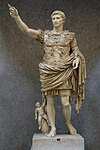
Imperator Gaius Julius Caesar Octavianus Augustus (23 September 63 BC – 19 August 14), born Gaius Octavius, was the adopted son of Julius Caesar and the first Roman Emperor. He also became a pontiff and later Pontifex Maximus.
Best Augustus Quotes
Shortest
Earliest
Explore our curated collection of the most famous and impactful Augustus quotes.
“Marmoream relinquo, quam latericiam accepi.”
“To seek to keep the established constitution unchanged argues a good citizen and a good man.”
“Those who slew my father I drove into exile, punishing their deed by due process of law, and afterwards when they waged war upon the republic I twice defeated them in battle.”

“Wars, both civil and foreign, I undertook throughout the world, on sea and land, and when victorious I spared all citizens who sued for pardon. The foreign nations which could with safety be pardoned I preferred to save rather than to destroy.”

“Livia, nostri coniugii memor vive, ac vale!
• Said to his wife Livia on his deathbed; in Suetonius, Divus Augustus, paragraph 99. Translation: Robert Graves, 1957.”
• Said to his wife Livia on his deathbed; in Suetonius, Divus Augustus, paragraph 99. Translation: Robert Graves, 1957.”

“Aetati tuae, mi Tiberi, noli in hac re indulgere et nimium indignari quemquam esse, qui de me male loquatur; satis est enim, si hoc habemus ne quis nobis male facere possit.
• Suetonius, Divus Augustus, paragraph 51. Translation: Robert Graves, 1957.”
• Suetonius, Divus Augustus, paragraph 51. Translation: Robert Graves, 1957.”
“At the age of nineteen, on my own initiative and at my own expense, I raised an army by means of which I restored liberty to the republic, which had been oppressed by the tyranny of a faction. For which service the senate, with complimentary resolutions, enrolled me in its order...”
“En Romanos, rerum dominos, gentemque togatam!
• Said disparagingly of a group of men in cloaks, quoting Virgil's The Aeneid. Augustus allowed only those wearing a toga and no cloak to enter the Forum; in Suetonius, Divus Augustus, paragraph 40. Translation: Robert Graves, 1957.”
• Said disparagingly of a group of men in cloaks, quoting Virgil's The Aeneid. Augustus allowed only those wearing a toga and no cloak to enter the Forum; in Suetonius, Divus Augustus, paragraph 40. Translation: Robert Graves, 1957.”
“May it be my privilege to have the happiness of establishing the commonwealth on a firm and secure basis and thus enjoy the reward which I desire, but only if I may be called the author of the best possible government; and bear with me the hope when I die that the foundations which I have laid for its future government, will stand firm and stable.”

“I came to see a king, not a row of corpses.
• After having visited the mausoleum of Alexander the Great in Alexandria, Augustus was asked if he also wanted to visit the mausoleum of the Ptolemies; in Suetonius, Divus Augustus, paragraph 16. Translation: Robert Graves, 1957.”
• After having visited the mausoleum of Alexander the Great in Alexandria, Augustus was asked if he also wanted to visit the mausoleum of the Ptolemies; in Suetonius, Divus Augustus, paragraph 16. Translation: Robert Graves, 1957.”
“Αἴθ᾽ ὄφελον ἄγαμός τ᾽ ἔμεναι ἄγονός τ᾽ ἀπολέσθαι.
• Ah, never to have married, and childless to have died!
• Quoting Homer's Iliad. Augustus was frequently disappointed in the conduct of his daughter Julia; in Suetonius, Divus Augustus, paragraph 65. Translation: Robert Graves, 1957.”
• Ah, never to have married, and childless to have died!
• Quoting Homer's Iliad. Augustus was frequently disappointed in the conduct of his daughter Julia; in Suetonius, Divus Augustus, paragraph 65. Translation: Robert Graves, 1957.”
“Quintili Vare, legiones redde!
• Said of Publius Quinctilius Varus, who commanded the three legions lost at the Battle of the Teutoburg Forest; in Suetonius, Divus Augustus, paragraph 23. Translation: Robert Graves, 1957.”
• Said of Publius Quinctilius Varus, who commanded the three legions lost at the Battle of the Teutoburg Forest; in Suetonius, Divus Augustus, paragraph 23. Translation: Robert Graves, 1957.”
“I declined to be made Pontifex Maximus in succession to a colleague still living, when the people tendered me that priesthood which my father had held. Several years later I accepted that sacred office when he at last was dead who, taking advantage of a time of civil disturbance, had seized it for himself, such a multitude from all Italy assembling for my election, in the consulship of Publius Sulpicius and Gaius Valgius, as is never recorded to have been in Rome before.”
“I had a good mind to discontinue permanently the supply of grain to the city, reliance on which had discouraged Italian agriculture, but refrained because some politician would be bound one day to revive the dole as a means of ingratiating himself with the people.
• The grain supply to the city of Rome was a contentious political issue; in Suetonius, Divus Augustus, paragraph 42. Translation: Robert Graves, 1957.”
• The grain supply to the city of Rome was a contentious political issue; in Suetonius, Divus Augustus, paragraph 42. Translation: Robert Graves, 1957.”

Augustus Quotes by Topic
Find exactly what you are looking for by browsing this categorized list of Augustus quotes by topic.
Augustus on Euclid’s Elements 5 quotes
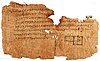
“The sacred writings excepted, no Greek has been so much read and so variously translated as Euclid.”
Augustus on History of calculus 3 quotes
“I have throughout introduced the Integral Calculus in connexion with the Differential Calculus. ...Is it always proper to learn every branch of a direct subject before anything connected with the inverse relation is considered? If so why are not multiplication and involution in arithmetic made to follow addition and precede subtraction? The portion of the Integral Calculus, which properly belongs to any given portion of the Differential Calculus increases its power a hundred-fold...”

Augustus on Rome 2 quotes
View all 2 quotes on Rome →Augustus on Mathematics 2 quotes
“We know that mathematicians care no more for logic than logicians for mathematics. The two eyes of exact science are mathematics and logic: the mathematical sect puts out the logical eye, the logical sect puts out the mathematical eye; each believing that it can see better with one eye than with two.”
Augustus on Deductive reasoning 2 quotes
“I cannot see why it is necessary that every deduction from algebra should be bound to certain conventions incident to an earlier stage of mathematical learning, even supposing them to have been consistently used up to the point in question. I should not care if any one thought this treatise unalgebraical, but should only ask whether the premises were admissible and the conclusions logical.”
Augustus on History of algebra 2 quotes
“The following Treatise... has been endeavoured to make the theory of limits, or ultimate ratios... the sole foundation of the science, without any aid whatsoever from the theory of series, or algebraical expansions. I am not aware that any work exists in which this has been avowedly attempted, and I have been the more encouraged to make the trial from observing that the objections to the theory of limits have usually been founded either upon the difficulty of the notion itself, or its unalgebraical character, and seldom or never upon anything not to be defined or not to be received in the conception of a limit...”

Augustus on Mathematics education 2 quotes
“Although there is no study which presents so simple a beginning as that of geometry, there is none in which difficulties grow more rapidly as we proceed, and what may appear at first rather paradoxical, the more acute the student the more serious will the impediments in the way of his progress appear. This necessarily follows in a science which consists of reasoning from the very commencement, for it is evident that every student will feel a claim to have his objections answered, not by authority, but by argument, and that the intelligent student will perceive more readily than another the force of an objection and the obscurity arising from an unexplained difficulty, as the greater is the ordinary light the more will occasional darkness be felt. To remove some of these difficulties is the principal object of this Treatise.”

Augustus on History of mathematics 2 quotes
“The late Professor Leslie... [i]n his Philosophy of Arithmetic... entered... into much of its history. ...[O]ne principal, thing to be cautious of is, his almost monomaniac antipathy to every thing Hindoo—a most unfortunate turn... Leslie... generalises... fearfully every now and then. He informs us that it was the practice throughout Europe to reduce the rules of arithmetic to memorial verses, and that [William] Buckley's Arithmetica Memorativa appears at one period to have gained possession of the schools and colleges of England. Now the truth... the verses attributed to Sacrobosco had never... been printed when Leslie wrote; and Buckley... was printed only once... and two or three times as an appendix to a work on logic. Dr. Peacock expresses the truth in saying... before the invention of printing, the practice of writing memorial verses was common, as appears by manuscript libraries. ...[H]ad the practice of using them been common, the presses of the fifteenth and sixteenth centuries would have given them forth in great numbers. But I cannot learn that any metrical work was printed in the fifteenth century, except the Compotus of [Magister] Anianus, and that only once.”

Augustus on The Bible
Augustus on Due process
“Those who slew my father I drove into exile, punishing their deed by due process of law, and afterwards when they waged war upon the republic I twice defeated them in battle.”

Augustus on Literature
“It is to Rome and Roman literature that we must turn to find the earliest examples of affectionate and confidential letters passing between members of the same family, and between friends of the same tastes and sympathies.”

Augustus on Integration
“Common integration is only the memory of differentiation... The artifices by which it [integration] is effected, are changes, not from the unknown to the known, but from the forms in which memory will not serve to those in which it will”
Augustus on Fleas
Augustus on Infinity
Augustus on Insect suffering
Augustus on Logic
“We know that mathematicians care no more for logic than logicians for mathematics. The two eyes of exact science are mathematics and logic: the mathematical sect puts out the logical eye, the logical sect puts out the mathematical eye; each believing that it can see better with one eye than with two.”

Augustus on Science
“We know that mathematicians care no more for logic than logicians for mathematics. The two eyes of exact science are mathematics and logic: the mathematical sect puts out the logical eye, the logical sect puts out the mathematical eye; each believing that it can see better with one eye than with two.”

Augustus on Negative number
“The imaginary expression sqrt{-a} and the negative expression -b have this resemblence, that either of them occurring as the solution of a problem indicates some inconsistency or absurdity. As far as real meaning is concerned, both are equally imaginary, since 0 - a is as inconceivable as sqrt{-a}. What then is the difference of signification? The following problems will elucidate this.”

Augustus on Paradox
“A great many individuals ever since the rise of the mathematical method, have, each for himself, attacked its direct and indirect consequences. ...I shall call each of these persons a paradoxer, and his system a paradox. I use the word in the old sense: ...something which is apart from general opinion, either in subject-matter, method, or conclusion. ...Thus in the sixteenth century many spoke of the earth's motion as the paradox of Copernicus, who held the ingenuity of that theory in very high esteem, and some, I think, who even inclined towards it. In the seventeenth century, the depravation of meaning took place... Phillips says paradox is "a thing which seemeth strange"—here is the old meaning...—"and absurd, and is contrary to common opinion," which is an addition due to his own time.”

Augustus on Geometry
“Although there is no study which presents so simple a beginning as that of geometry, there is none in which difficulties grow more rapidly as we proceed, and what may appear at first rather paradoxical, the more acute the student the more serious will the impediments in the way of his progress appear. This necessarily follows in a science which consists of reasoning from the very commencement, for it is evident that every student will feel a claim to have his objections answered, not by authority, but by argument, and that the intelligent student will perceive more readily than another the force of an objection and the obscurity arising from an unexplained difficulty, as the greater is the ordinary light the more will occasional darkness be felt. To remove some of these difficulties is the principal object of this Treatise.”

Augustus on Civilization (series)
“The blessings of the gods be upon you, Caesar Augustus, emperor of Rome and all her holdings. Your empire was the greatest and longest lived of all in Western civilization. And your people single handedly shaped its culture, law, art, and warfare like none other, before or since. Through years of glorious conquest, Rome came to dominate all the lands of the Mediterranean from Spain in the west to Syria in the east. And her dominion would eventually expand to cover much of England and northern Germany. Roman art and architecture still awe and inspire the world. And she remains the envy of all lesser civilizations who have followed. O mighty emperor, your people turn to you to once more reclaim the glory of Rome! Will you see to it that your empire rises again, bringing peace and order to all? Will you make Rome once again center of the world? Can you build a civilization that will stand the test of time?”

What Augustus Said About Others
Discover personal opinions Augustus shared regarding contemporaries.
Augustus on David Hare (dramatist) 14 quotes
View all 14 quotes on David Hare (dramatist) →Augustus on John Green 2 quotes
“"That's the thing about pain," Augustus said, and then glanced back at me. "It demands to be felt."”

Augustus on Horace Walpole
“He was born a writer of letters, and if he had been shut up in a desert island like Robinson Crusoe he would have written letters all the same, and kept them till some ship arrived which should carry them to their destination.”

Augustus on Euclid
“There never has been, and till we see it we never shall believe that there can be, a system of geometry worthy of the name, which has any material departures (we do not speak of corrections or extensions or developments) from the plan laid down by Euclid.”

Augustus on Gregory St. Vincent
“Gregory St. Vincent is the greatest of circle-squarers, and his investigations led him into many truths: he found the property of the arc of the hyperbola which led to Napier's logarithms being called hyperbolic. Montucla says of him, with sly truth, that no one ever squared the circle with so much genius, or, excepting his principal object, with so much success.”

Augustus on Joseph Louis Lagrange
“Lagrange, in one of the later years of his life, imagined that he had overcome the difficulty [of the parallel axiom]. He went so far as to write a paper, which he took with him to the Institute, and began to read it. But in the first paragraph something struck him which he had not observed : he muttered II faut que fy songe encore, and put the paper in his pocket.”

Augustus on Jean-Étienne Montucla
“Montucla says, speaking of France, that he finds three notions prevalent among cyclometers: 1. That there is a large reward offered for success; 2. That the longitude problem depends on that success; 3. That the solution is the great end and object of geometry. The same three notions are equally prevalent among the same class in England. No reward has ever been offered by the government of either country. The longitude problem hi no way depends upon perfect solution; existing approximations are sufficient to a point of accuracy far beyond what can be wanted. And geometry, content with what exists, has long passed on to other matters. Sometimes a cyclometer persuades a skipper who has made land in the wrong place that the astronomers are at fault, for using a wrong measure of the circle; and the skipper thinks it a very comfortable solution! And this is the utmost that the problem has to do with longitude.”

Quotes About Augustus
Gain deeper perspective through quotes about Augustus from others.
Suetonius on Augustus

The younger men had been born after the victory of on Augustus
“Juniores post Actiacam victoriam, etiam senes plerique inter bella civium nati: quotus quisque reliquus qui rem publicam vidisset? Igitur verso civitatis statu nihil usquam prisci et integri moris: omnes exuta aequalitate iussa principis aspectare, nulla in praesens formidine, dum Augustus aetate validus seque et domum et pacem sustentavit. Postquam provecta jam senectus aegro et corpore fatigabatur aderatque finis et spes novae, pauci bona libertatis in cassum disserere, plures bellum pavescere, alii cupere. Pars multo maxima inminentis dominos variis rumoribus differebant.”
Margaret MacMillan on Augustus
“History can be helpful in making sense of the world we live in. It can also be fascinating, even fun. How can even the best novelist or playwright invent someone like Augustus Caesar or Catherine the Great, Galileo or Florence Nightingale? How can screenwriters create better action stories or human dramas than exist, thousand upon thousand, throughout the many centuries of recorded history? There is a thirst out there both for knowledge and to be entertained, and the market has responded with enthusiasm.”

Source on Augustus
He took a beating twice at sea on Augustus
Anthony Everitt on Augustus
“The story of his career shows that Augustus was indeed ruthless, cruel, and ambitious for himself. This was only in part a personal trait, for upper-class Romans were educated to compete with one another and to excel. However, he combined an overriding concern for his personal interests with a deep-seated patriotism, based on a nostalgia of Rome's antique virtues. In his capacity as princeps, selfishness and selflessness coexisted in his mind. While fighting for dominance, he paid little attention to legality or to the normal civilities of political life. He was devious, untrustworthy, and bloodthirsty. But once he had established his authority, he governed efficiently and justly, generally allowed freedom of speech, and promoted the rule of law. He was immensely hardworking and tried as hard as any democratic parliamentarian to treat his senatorial colleagues with respect and sensitivity. He suffered from no delusions of grandeur.”
Dan Jones on Augustus
“Fame was Caesar’s destiny, but true greatness was Octavian’s. Imperium was almost written on Octavian’s face: his bright eyes and magnetically handsome features were somehow accentuated by a tousled, slightly dishevelled experience, which would have suggested an utter lack of vanity were it not for the fact that he wore steel-heeled shoes to raise him above his natural height of 5’7”. Octavian succeeded were Caesar had not, avenging his father’s death and defeating his enemies in battle, eventually emerging as Rome’s sole, uncontested ruler. As Augustus he accrued himself all the carefully separated political powers of the Republic, effectively playing senator, consul and tribune, pontifex maximus (high priest) and supreme military commander all at once. Augustus’ character divided Roman opinion – was he a high-minded visionary and peerless soldier-politician, or a corrupt, bloodthirsty, treacherous tyrant, wondered the historian Tacitus (c. AD 58-116), without committing to either judgment. But his achievements as emperor – or as he preferred it, First Citizen (Princeps civitatis) – were impossible to gainsay. On taking power he stamped out the embers of the late Republic’s debilitating civil war. He transformed the city of Rome with grandiose building projects – some of them already begun under Caesar and others of his own design. The 500-acre Field of Mars (Campus Martius), littered with temples and monuments, was radically rebuilt. New theatres, aqueducts, and roads were commissioned. Only the finest building materials passed muster: on his deathbed Augustus bragged that he had found Rome a city of brick, but left it a city of marble. He carried out sweeping reforms to government, concentrating power in his own hands at the expense of the Senate, and encouraging a personal cult of imperial magnificence, which evolved under his successors until some emperors were venerated as demi-gods. ”
Adrian Goldsworthy on Augustus
“Augustus pursued power relentlessly and then clung to it, whatever he might pretend in public. Such ambition is surely the hallmark of any successful political leader – and no doubt plenty of less successful ones. Yet in his case he made use of that power for the common good. He worked hard to make the res publica function again, and we cannot deny that he succeeded, since the peace and stability he imposed brought ever greater levels of prosperity. At a basic level more people were better-off under his principate than they had been for several generations. The concerns he dealt with were traditional ones, even if some of his methods were innovative. Julius Caesar had tried to address several of these issues, as had others, but none had the chance to deal with them as thoroughly as Augustus. In the process he made sure that it was well known that he was working for the common good, but once again such advertising was what any Roman politician would have done. By doing favours for individuals and whole communities he placed them in his debt, and so, as so often, personal advantage was intertwined with the wider good. That does not alter the fact that he did rule well, whatever his motivation.”
About Augustus
Imperator Gaius Julius Caesar Octavianus Augustus (23 September 63 BC – 19 August 14), born Gaius Octavius, was the adopted son of Julius Caesar and the first Roman Emperor. He also became a pontiff and later Pontifex Maximus.