Link Copied!
Andrew Jackson Quotes (1767-1845)
President

-100px.jpg)











About Andrew Jackson
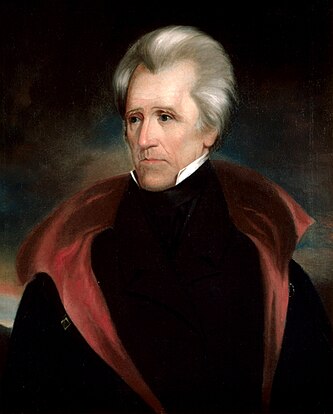
Andrew Jackson (15 March 1767 – 8 June 1845) was the seventh president of the United States of America (1829-1837), regarded as a hero for his actions in the Battle of New Orleans (1815), a founder of the Democratic Party, and the eponym of the era of Jacksonian democracy. He was the first American president to have been a Democrat.
Best Andrew Jackson Quotes
Shortest
Earliest
Explore our curated collection of the most famous and impactful Andrew Jackson quotes.

“Take time to deliberate; but when the time for action arrives, stop thinking and go in.”
“The people are the government, administering it by their agents; they are the Government, the sovereign power.”


“The brave man inattentive to his duty, is worth little more to his country, than the coward who deserts her in the hour of danger.”

“Internal improvement and the diffusion of knowledge, so far as they can be promoted by the constitutional acts of the Federal Government, are of high importance.”

“It was settled by the Constitution, the laws, and the whole practice of the government that the entire executive power is vested in the President of the United States.”
“But you must remember, my fellow-citizens, that eternal vigilance by the people is the price of liberty, and that you must pay the price if you wish to secure the blessing.”

“The individual who refuses to defend his rights when called by his Government, deserves to be a slave, and must be punished as an enemy of his country and friend to her foe.”
“Every good citizen makes his country's honor his own, and cherishes it not only as precious but as sacred. He is willing to risk his life in its defense and is conscious that he gains protection while he gives it.”


“As long as our government is administered for the good of the people, and is regulated by their will; as long as it secures to us the rights of person and of property, liberty of conscience, and of the press, it will be worth defending.”
“In the performance of a task thus generally delineated I shall endeavor to select men whose diligence and talents will insure in their respective stations able and faithful cooperation, depending for the advancement of the public service more on the integrity and zeal of the public officers than on their numbers.”

“Hemans gallows ought to be the fate of all such ambitious men who would involve their country in civil wars, and all the evils in its train that they might reign & ride on its whirlwinds & direct the Storm — The free people of these United States have spoken, and consigned these wicked demagogues to their proper doom.”
“As sons of freedom you are now called upon to defend your most inestimable blessing. As Americans, your country looks with confidence on her adopted children, for a valorous support, as a faithful return for the advantages enjoyed under her mild and equitable government.”

“Was this to be permitted the Government would loose [sic] the confidence of its citizens & it would induce disunion every where[.] No my friend, the crisis must be now met with firmness, our citizens protected, & the modern doctrine of nullification & secession put down forever—for we have yet to learn, whether some of the eastern states may not secede or nullify, if the tariff is reduced. I have to look at both ends of the union to preserve it.”
“Gentleman, I have had men watching you for a long time, and I am convinced that you have used the funds of the bank to speculate in the bread-stuffs of the country. When you won, you divided the profits amongst you, and when you lost, you charged it to the bank. You tell me that if I take the deposits from the bank and annul its charter, I shall ruin ten thousand families. That may be true, gentlemen, but that is your sin! Should I let you go on, you will ruin fifty thousand, and that would be my sin! You are a den of vipers and thieves. I intend to route you out!”
“While I concur with the Synod in the efficacy of prayer, and in the hope that our country may be preserved from the attacks of pestilence "and that the judgments now abroad in the earth may be sanctified to the nations," I am constrained to decline the designation of any period or mode as proper for the public manifestation of this reliance. I could not do otherwise without transcending the limits prescribed by the Constitution for the President and without feeling that I might in some degree disturb the security which religion nowadays enjoys in this country in its complete separation from the political concerns of the General Government.”
“To say that any State may at pleasure secede from the Union, is to say that the United States are not a nation because it would be a solecism to contend that any part of a nation might dissolve its connection with the other parts, to their injury or ruin, without committing any offense. Secession, like any other revolutionary act, may be morally justified by the extremity of oppression; but to call it a constitutional right, is confounding the meaning of terms, and can only be done through gross error, or to deceive those who are willing to assert a right, but would pause before they made a revolution, or incur the penalties consequent upon a failure.”

“It is a damn poor mind indeed which can't think of at least two ways to spell any word.
• Sometimes reported as having been a retort to statements of his political rival, John Quincy Adams, who had boycotted Harvard University's awarding of a Doctorate of Laws degree to Jackson in 1833, declaring "I would not be present to witness her [Harvard's] disgrace in conferring her highest literary honors on a barbarian who could not write a sentence of grammar and could hardly spell his own name." Quoted in News Reporting and Writing 4th edition (1987) by M. Mencher.
Unsourced variant: Never trust a man who has only one way to spell a word.”
• Sometimes reported as having been a retort to statements of his political rival, John Quincy Adams, who had boycotted Harvard University's awarding of a Doctorate of Laws degree to Jackson in 1833, declaring "I would not be present to witness her [Harvard's] disgrace in conferring her highest literary honors on a barbarian who could not write a sentence of grammar and could hardly spell his own name." Quoted in News Reporting and Writing 4th edition (1987) by M. Mencher.
Unsourced variant: Never trust a man who has only one way to spell a word.”
“It is maintained by some that the bank is a means of executing the constitutional power "to coin money and regulate the value thereof." Congress have established a mint to coin money and passed laws to regulate the value thereof. The money so coined, with its value so regulated, and such foreign coins as Congress may adopt are the only currency known to the Constitution. But if they have other power to regulate the currency, it was conferred to be exercised by themselves, and not to be transferred to a corporation. If the bank be established for that purpose, with a charter unalterable without its consent, Congress have parted with their power for a term of years, during which the Constitution is a dead letter. It is neither necessary nor proper to transfer its legislative power to such a bank, and therefore unconstitutional.”

“It is to be regretted that the rich and powerful too often bend the acts of government to their selfish purposes. Distinctions in society will always exist under every just government. Equality of talents, of education, or of wealth can not be produced by human institutions. In the full enjoyment of the gifts of Heaven and the fruits of superior industry, economy, and virtue, every man is equally entitled to protection by law; but when the laws undertake to add to these natural and just advantages artificial distinctions, to grant titles, gratuities, and exclusive privileges, to make the rich richer and the potent more powerful, the humble members of society — the farmers, mechanics, and laborers — who have neither the time nor the means of securing like favors to themselves, have a right to complain of the injustice of their government. There are no necessary evils in government. Its evils exist only in its abuses. If it would confine itself to equal protection, and, as Heaven does its rains, shower its favors alike on the high and the low, the rich and the poor, it would be an unqualified blessing.”
Andrew Jackson Quotes by Topic
Find exactly what you are looking for by browsing this categorized list of Andrew Jackson quotes by topic.
Andrew Jackson on Nullification crisis 6 quotes
“[T]he tariff was only the pretext and disunion & a southern confederacy the real object—the next pretext will be the negro, or slavery question.”
Andrew Jackson on United States 3 quotes
View all 3 quotes on United States →Andrew Jackson on Union (United States) 2 quotes
View all 2 quotes on Union (United States) →Andrew Jackson on Debt 2 quotes
“Live within your means, never be in debt, and by husbanding your money you can always lay it out well. But when you get in debt you become a slave. Therefore I say to you never involve yourself in debt, and become no man's surety. If your friend is in distress, aid him if you have the means to spare. If he fails to be able to return it, it is only so much lost.”

What Andrew Jackson Said About Others
Discover personal opinions Andrew Jackson shared regarding contemporaries.
Andrew Jackson on Native Americans in the United States 8 quotes
“It will separate the Indians from immediate contact with settlements of whites; free them from the power of the States; enable them to pursue happiness in their own way and under their own rude institutions; will retard the progress of decay, which is lessening their numbers, and perhaps cause them gradually, under the protection of the Government and through the influence of good counsels, to cast off their savage habits and become an interesting, civilized, and Christian community.”
Andrew Jackson on Martin Van Buren
“I... believe him not only deserving of my confidence but the confidence of the Nation... He... is not only well qualified, but desires to fill the highest office in the gift of the people, who in him, will find a true friend and safe repository of their rights and liberty.”

Andrew Jackson on Thomas Jefferson
“I have long believed, that it was only by preserving the identity of the Republican party as embodied and characterized by the principles introduced by Mr. Jefferson that the original rights of the states and the people could be maintained as contemplated by the Constitution.”

Quotes About Andrew Jackson
Gain deeper perspective through quotes about Andrew Jackson from others.
Augustus Ceaser Buell on Andrew Jackson
“He told his friends that he purposed washing his hands utterly of public life and political affairs; that he had now been to all intents and purposes a public servant from the age of thirteen to that of threescore and ten ... that he had lived his whole life in plain sight of the public and the people, hiding nothing, simulating nothing, confessing nothing, extenuating nothing and regretting nothing — except that he could never get a chance to shoot Clay or hang Calhoun.”
Winston Churchill on Andrew Jackson 4 quotes
“The West grouped itself around the figure of the frontier General Andrew Jackson, who claimed to represent the true Jeffersonian principles of democracy against the corrupt moneyed interests of the East. Adams received the support of those classes who feared majority rule and viewed with alarm the growing power of the farmers and settlers of the frontier. The issue between the two factions was joined in 1828, when Jackson stood as rival candidate against Adams’s re-election. In the welter of this election two new parties were born, the Democrats and the National Republicans, later called the Whigs. It was the fiercest campaign since Jefferson had driven the elder Adams from office in 1800. As the results came in it was seen that Adams had won practically nothing outside New England, and that in the person of Andrew Jackson the West had reached controlling power. Here at last was an American President who had no spiritual contacts whatever with the Old World or its projection on the Atlantic shore, who represented at the White House the spirit of the American frontier. To many it seemed that democracy had triumphed indeed.”

William A. DeGregorio on Andrew Jackson
“A charismatic figure, Jackson was combative, quick-tempered, and thin-skinned. To his friends he was generous, considerate, and above all loyal; to his enemies, mean-spirited and spiteful. "When Andrew Jackson hated," Robert V. Remini, a modern Jacksonian scholar, has written, "it often became grand passion. He could hate with a Biblical fury and would resort to petty and vindictive acts to nurture his hatred and keep it bright and strong and ferocious." He at time exploded with anger, but it is believed that he never really lost his temper. Rather, he launched into tirades quite purposefully either to intimidate his opposition or to end debate on a matter that was dragging on too long. Martin Van Buren, his closest adviser, marveled at Jackson's ability to turn his anger on and off at will. One minute he could be shrieking at the cabinet in the high register his voice invariably had whenever he was agitated; the next moment, alone with Van Buren after the others had left, he was relaxed and in good humor. At social occasions Jackson surprised many with his grace, poise, and charm. Around women he shed his backwoods manner and earthly language to engage comfortably in social discourse. He delighted in disappointing those who, he said, "were prepared to see me with a tomahawk in one hand and a scalping knife in the other."”
Frederick Douglass on Andrew Jackson
“There is something too mean in looking upon the Negro, when you are in trouble, as a citizen, and when you are free from trouble, as an alien. When this nation was in trouble, in its early struggles, it looked upon the Negro as a citizen. In 1776 he was a citizen. At the time of the formation of the Constitution the Negro had the right to vote in eleven States out of the old thirteen. In your trouble you have made us citizens. In 1812 General Jackson addressed us as citizens; 'fellow-citizens'. He wanted us to fight. We were citizens then! And now, when you come to frame a conscription bill, the Negro is a citizen again. He has been a citizen just three times in the history of this government, and it has always been in time of trouble. In time of trouble we are citizens. Shall we be citizens in war, and aliens in peace? Would that be just?”

Roxanne Dunbar-Ortiz on Andrew Jackson 2 quotes
“It's not that Jackson had a "dark side," as his apologists rationalize and which all human beings have, but rather that Jackson was the Dark Knight in the formation of the United States as a colonialist, imperialist democracy, a dynamic formation that continues to constitute the core of US patriotism. The most revered presidents-Jefferson, Jackson, Lincoln, Wilson, both Roosevelts, Truman, Kennedy, Reagan, Clinton, Obama-have each advanced populist imperialism while gradually increasing inclusion of other groups beyond the core of descendants of old settlers into the ruling mythology. All the presidents after Jackson march in his footsteps. Consciously or not, they refer back to him on what is acceptable, how to reconcile democracy and genocide and characterize it as freedom for the people.”





Disputed Quotes
Quotes attributed to Andrew Jackson that are questionable.
“Corporations have neither bodies to kick nor souls to damn.”
“Gentlemen! I too have been a close observer of the doings of the Bank of the United States. I have had men watching you for a long time, and am convinced that you have used the funds of the bank to speculate in the breadstuffs of the country. When you won, you divided the profits amongst you, and when you lost, you charged it to the bank. You tell me that if I take the deposits from the bank and annul its charter I shall ruin ten thousand families. That may be true, gentlemen, but that is your sin! Should I let you go on, you will ruin fifty thousand families, and that would be my sin! You are a den of vipers and thieves. I have determined to rout you out, and by the Eternal, (bringing his fist down on the table) I will rout you out!”
Misattributed Quotes
Quotes mistakenly credited to Andrew Jackson
“Any man worth his salt will stick up for what he believes right, but it takes a slightly better man to acknowledge instantly and without reservation that he is in error.”
About Andrew Jackson
Andrew Jackson (15 March 1767 – 8 June 1845) was the seventh president of the United States of America (1829-1837), regarded as a hero for his actions in the Battle of New Orleans (1815), a founder of the Democratic Party, and the eponym of the era of Jacksonian democracy. He was the first American president to have been a Democrat.