Andrew Jackson on Nullification crisis
← Back to Andrew Jackson Profile
“[T]he tariff was only the pretext and disunion & a southern confederacy the real object—the next pretext will be the negro, or slavery question.”
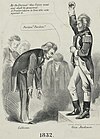
“Was this to be permitted the Government would loose [sic] the confidence of its citizens & it would induce disunion every where[.] No my friend, the crisis must be now met with firmness, our citizens protected, & the modern doctrine of nullification & secession put down forever—for we have yet to learn, whether some of the eastern states may not secede or nullify, if the tariff is reduced. I have to look at both ends of the union to preserve it.”
“The parties in So. C. [South Carolina] are arming on both sides, & drilling in the night, & I expect soon to hear that a civil war of extermination has commenced. I will meet all things with deliberate firmness & forbearence, but wo, to those nullifiers who shed the first blood. The moment I am prepared with proof I will direct prosecutions for treason to be instituted against the leaders, and if they are surrounded with 12,000 bayonets our marshall shall be aided by 24,000 & arrest them in the midst thereof—nothing must be permitted to weaken our government at home or abroad.”
“To say that any State may at pleasure secede from the Union, is to say that the United States are not a nation because it would be a solecism to contend that any part of a nation might dissolve its connection with the other parts, to their injury or ruin, without committing any offense. Secession, like any other revolutionary act, may be morally justified by the extremity of oppression; but to call it a constitutional right, is confounding the meaning of terms, and can only be done through gross error, or to deceive those who are willing to assert a right, but would pause before they made a revolution, or incur the penalties consequent upon a failure.”
“Were we mistaken, my countrymen, in attaching this importance to the Constitution of our country? Was our devotion paid to the wretched, inefficient, clumsy contrivance, which this new doctrine would make it? Did we pledge ourselves to the support of an airy nothing—a bubble that must be blown away by the first breath of disaffection? Was this self-destroying, visionary theory the work of the profound statesmen, the exalted patriots, to whom the task of constitutional reform was intrusted? Did the name of Washington sanction, did the States deliberately ratify, such an anomaly in the history of fundamental legislation? No. We were not mistaken. The letter of this great instrument is free from this radical fault; its language directly contradicts the imputation; its spirit, its evident intent, contradicts it. No, we did not err. Our Constitution does not contain the absurdity of giving power to make laws, and another power to resist them. The sages, whose memory will always be reverenced, have given us a practical, and, as they hoped, a permanent constitutional compact.”
“The rich inheritance bequeathed by our fathers has devolved upon us the sacred obligation of preserving it by the same virtues which conducted them through the eventful scenes of the Revolution and ultimately crowned their struggle with the noblest model of civil institutions. They bequeathed to us a Government of laws and a Federal Union founded upon the great principle of popular representation. After a successful experiment of forty-four years, at a moment when the Government and the Union are the objects of the hopes of the friends of civil liberty throughout the world, and in the midst of public and individual prosperity unexampled in history, we are called to decide whether these laws possess any force and that Union the means of self-preservation. The decision of this question by an enlightened and patriotic people can not be doubtful. For myself, fellow-citizens, devoutly relying upon that kind Providence which has hitherto watched over our destinies, and actuated by a profound reverence for those institutions I have so much cause to love, and for the American people, whose partiality honored me with their highest trust, I have determined to spare no effort to discharge the duty which in this conjuncture is devolved upon me.”