Ali on Mental process
← Back to Ali Profile
“A mass of information is now available to those who have the ability to read and write—and the number of these is growing every day—whilst the means of transmission and of communication have practically annihilated time and brought the whole world together as a functioning unit... Much of it is ill-digested and unusable, yet it tends to the general elevation of the mental process.”
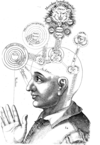
“If perception and sensuous apprehension, with their consequent rationalizings and the institution of a subsequent mental process, have their source in the brain, then Dr. Sellars is right in his book, Evolutionary Naturalism (1922), when he says that mind can be regarded as a "physical category" and that "we should mean by it the nervous processes which find expression in intelligent conduct."”
“Dr. McDougall points out in Psychology, the Science of Behavior (1912) that our mental activity (which is usually unconscious) can be either subnormal, normal or supernormal. [lxix3] In the first case, you will have the idiot or the feeble-minded; in the second, you will have the intelligent average citizen whose mind is a theatre or rather a cinematograph, registering anything that happens to come along; and, finally, we shall discover those rare souls whose consciousness is illuminated and whose minds record that which is hidden to the majority.”
“This idea fails to satisfy the majority of thinkers and most of them — belonging to other schools than the purely materialistic — posit something more than matter, and regard the mind as distinct from the brain; they hold the hypothesis that it is a subjective substantial reality, which can use the brain as its terminal of expression and which it can impress in order to express those concepts and intuitions which a man can consciously utilize. What we are considering is in no wise a supernormal faculty, or the possession of a specialized instrument by a gifted few; the mind should be used by all educated people, and at the close of the educational process (carried on in the formative years) a man should be in possession of a faculty that he understands and uses at will.”
“It is difficult for us in these days to appreciate or to comprehend the Atlantean state of consciousness. There was no mental process whatsoever except among the leaders of the race; there was only rampant, ruthless, insatiable desire. This... forced two issues and confronted the race with two hitherto unrealised problems. The first was that psychological attitudes and states of consciousness can and do bring about physiological conditions, these being both good and bad. Secondly, for the first time the people faced with recognition the phenomenon of death—death which they themselves brought about in a new way and not just by physical means. This had to be dramatised for them in some definitely objective manner, for as yet the masses did not respond to verbal teaching but only to visual events. When, therefore, they saw a particularly predatory and rapacious person begin to suffer from a dire disease which seemed to arise from within himself and—whilst suffering—hold on to his love of life (as tubercular people do today), they were faced with another aspect or form of the original law (imposed in Lemurian times) which said: "The soul that sinneth, it shall die." Death had hitherto been accepted without questioning as the fate of all living things, but now, for the first time, mental relationship between individual action and death was recognised—as yet in a dim and feeble way—and a great step forward was made in the human consciousness.”