Alexei Panshin on A. E. van Vogt
← Back to Alexei Panshin Profile
“The truth of the matter seems to be that van Vogt's withdrawal into himself took place over a considerable period of time. The beginning of it may lie in the fact that young Alfred was a highly idealistic small town boy with a number of wide-eyed notions about right and truth and justice in his head. When the world failed to conform to his expectations, he found that a substantial shock. Beyond this, it was also true that Alfred was a boy who had something a little strange and left-footed about him. He didn't think or talk exactly like everyone else, and reaction to this may have had its effect on his developing personality.”
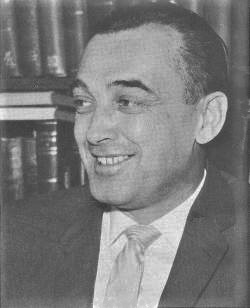
“Because he was a reader, a writer, and a thinker, van Vogt regarded himself as an intellectual. But if he was an intellectual, it was not of the usual sort. He wasn't silver-tongued or swift-witted. He had very little ability to remember a precise fact or an exact niggle, and no talent at all for linear thought and logical analysis. He was not a conventional man of reason. Rather, van Vogt's usual method was to fix on some question or subject in a highly single-minded way — to surround it and dwell upon it and absorb it. He might get nowhere with a problem for the longest time, but then at last the penny would drop and some insight would pop into his mind. When van Vogt had enough insights accumulated on a topic, they would assemble themselves into what he would come to think of as a system — a methodology or mode of approach that had its own consistency, if only in the manner in which it was applied by him. In later days, van Vogt would even take pride in describing himself as "Mr. System."”